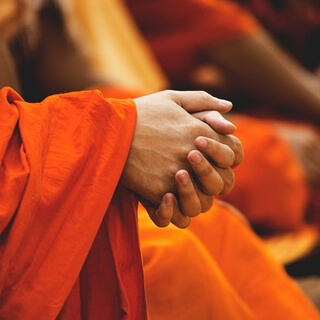
Contemplation.
Chapter 6.
By Plotinus.
Translation by Elmer O'Brien.
The point of action is contemplation,
And the having an object of contemplation.
Contemplation therefore is the end of action.
Action seeks to achieve indirectly what it cannot achieve directly.
When one has achieved the object of one's desires,
It is evident that one's real desire was not the ignorant possession of the desired object,
But to know it as possessed,
As actually contemplated,
As within one.
Action has always some good or other in view.
A good for oneself to be possessed.
Possessed where?
In the soul.
When the circuit is complete,
Through action the soul comes back to contemplation.
And what is there then in the soul?
Itself essential reasonableness,
But an inexpressible reasonableness.
And it is there the more,
The more reasonable it is.
Then the soul rests.
It seeks no further.
It is satiated.
Its vision remains all within.
It is sure of its object.
The greater this assurance,
The more tranquil is the contemplation,
And the more unified the soul.
The knower and the known are one.
I mean this seriously.
Were they two,
They would be different.
They would lie,
As it were,
Side by side,
In their duality,
Unassimilable by the soul.
Much as certain notions exist within the soul without producing effect.
To learn,
We must not allow ideas to remain exterior to us,
But fuse with them until they become part of our existence.
When this is done and our dispositions correspond,
The soul is able to formulate and make use of them.
It comprehends now what it merely contained before.
Using them,
The soul becomes,
As it were,
Different.
Only upon this reflection does it find them to be alien.
Nevertheless,
The soul itself is rational and a kind of intelligence,
But an intelligence that sees an object different from itself.
It does not possess fullness and is deficient compared with its prior.
Yet it beholds in silence what it expresses in words,
Because verbal formulation is only of what it has already seen.
If it speaks,
It is because it is deficient and needs to inquire in order to know what it contains.
The soul is richer in content than nature is,
And so it is more at rest and more contemplative.
But as its possessions are not complete,
It wants to increase the knowledge of its object and the contemplation that comes from inquiry.
Even while withdrawn from its own higher part and involved in a variety of things,
Only to return to itself later,
The soul contemplates with its remaining higher part.
But the soul that abides within itself does this less.
Thus it is that the wise man is penetrated by reason and is wholly within himself what he manifests to others.
He contemplates himself.
She contemplates herself.
They contemplate their self.
They achieve unity and steadiness not only in regard to external objects,
But also in regard to the things within themselves.
They find all things within themselves.
So everything derives from contemplation.
And everything is contemplation.