Greetings,
My friends.
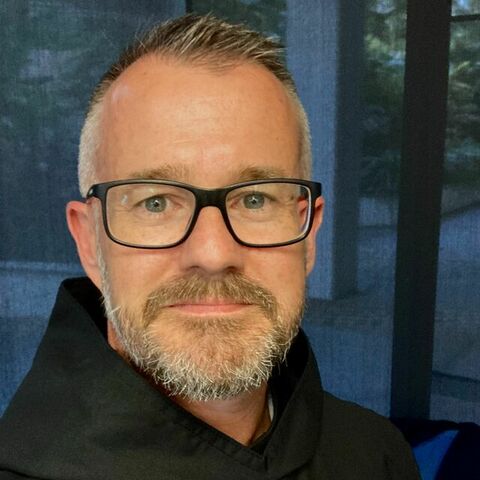
This is Mark Gladman,
Also known as Brother Frederick James,
And I welcome you to this short introductory teaching about the act and art of Lectio Divina,
Or Lectio as it's often called for short.
Lectio is a practice of prayer and meditation that uses a written text,
Usually scripture or some other spiritual text,
As the foundation of the time in contemplation.
In Lectio one waits on the text,
Seeking for the word or phrase that the spirit draws us to,
And then spends time in active reflection on the text to allow its words to sink deeply into our being.
This is not an academic exercise whatsoever though and many of us,
Myself included when I started in Lectio Divina,
Who were academically inclined may find Lectio difficult for a period of time.
We don't go to the text for a study of its contextual,
Grammatical,
Historical meaning,
Although these things might be pondered,
But instead Lectio is prayer.
Prayer in which we pray upon the text,
And we literally pray the text and allow it to read us.
We prayerfully ponder what the text would have us change or become or do.
We allow these things time to sink into our hearts and we rise to begin placing into action those things the spirit spoke or revealed to us during our time of prayer.
Now Lectio traditionally has four movements,
Although in this lesson I will also share with you a fifth that some have suggested as a good addition.
These movements by the way should be understood as a very loose structure or scaffold.
There are no rules to Lectio Divina,
But having a scaffold that you might use as a helpful guide as you start,
Which you can then grow a strong foundation of your practice and you can choose to use it in any way you please,
Is often helpful.
Now the four traditional movements are Lectio,
Meditatio,
Contemplatio and Oratio and I'll try and as simply as I can define each one as I talk you through the process of what a time in Lectio Divina might look like.
Now we always begin with a simple prayer asking that in the time of Lectio Divina our metaphorical ears,
The ears of our hearts and minds would be open and that we would be led to the word or phrase in the text we read that we're going to reflect on.
Now what should I read you might ask?
Well that's entirely up to you.
In my practice I follow the daily Gospel readings in electionary and at other times I have chosen to read a whole book stopping at the point where I feel I'm led to stop and reflect and then picking up from that spot the next time I come to my time of Lectio Divina and yes it can take a long time to read a book all the way through even a short biblical text in this way but boy it can be so worth it.
And perhaps your circumstances might cause you to want to ponder a passage or text that speaks directly to your situation.
Now in my Insight Time a teacher page I create Lectio recordings that are specific to certain situations.
Now these might help as a start point or as a regular tool you use in your practice of Lectio but I'm sure you'll find a reading situation that will work best for you.
Now after the prayer and stilling and settling myself the first movement is what we move into and this one's called Lectio.
Now this is the actual reading of the text although I also like to think of it as the listening to the text and while you can listen to the text reading silently you may choose to read the text aloud or use a recording like those I mentioned a moment ago and literally listen to it as well.
Now in Lectio we read the text slowly and sometimes I'll read achingly slowly even for myself and as we read we savour the words we allow the images we read to form in our imagination we feel what we're reading in our senses and we allow the words to move from our head to our heart it's like slowly chewing a piece of food and separating the flavours and experiencing them as best you can and when we come to approach the text we try and do so as if it is brand new we try to place preconceived ideas of what the text might mean aside and open ourselves to a new understanding and experience with the text.
Remember this is not academic don't fear being wrong about what begins to stir in you and also note that what the spirit might draw you to might not be in the text itself but comes via something you see somewhere around or deeper in the scene or the words of the passage that you're reading.
The ancient rabbis spoke about black fire on white fire the black fire they spoke of was the ink on the page the letters of the text of scripture but the white fire was the space between the words and the letters and the rabbis believed that God could speak to us through the white fire as well so know that you might discover things that aren't necessarily written as you prayerfully read the text.
Now how long you stay in this phase of your time in Lectio Divina is up to you.
If spirit draws you to a word or phrase immediately you could in effect transition to the next phase straight away.
In some cases you may find you have been in Lectio for the entire time that you have and you feel led to nothing in which case say a prayer of gratitude for the time that you have been able to spend but perhaps ask that the words might stay with you and that perhaps you'll be illuminated at some point later in the day as you carry the text with you in your mind and heart.
But generally speaking you'll read the text through probably three times or so even if a word or a phrase has popped out for you straight away giving it time to have its context known within the passage that you've chosen to read.
Now the second movement is called meditatio.
After listening we settle with the word phrase or idea and let it begin to seep deep into our spirits.
In effect we encounter the text and let that meeting we have with it draw out understanding,
Revelations,
Even questions and doubts.
In meditatio we make a deep connection with the text and begin to let it move with us and within us.
In this movement it's good to see how the word or phrase you've been drawn to makes you feel.
Does it buoy you and inspire you or perhaps does it scare you or cause conflict within you?
Hold on to these things as they emerge as they all begin to form the basis for the next movement.
And once again the question comes well how long do I stay in meditatio?
For me meditatio tends to overlap with the next movement or ratio which I'll explain next and it overlaps in a way that sees a movement that flows back and forth between the two.
In meditatio a question or idea comes and then I'll move into oratio and pray a little bit about that but then move back to meditatio,
Discover something else,
Move back to oratio and so on.
And note that often in all of this I'll continue to look at the text as I meditate on it although this may be because I'm a word person and looking at the word or phrase helps me to reflect.
But I'll stay here until I have something that I believe the spirit would want me to carry from this time of reflection.
And again there's no rule about how long to stay here just trust and allow the flow between the movements to happen naturally remembering that there are no hard and fast rules.
The third movement as I mentioned a moment ago is called oratio.
This is where we have a prayerful conversation about the word idea or phrase with God.
Prayer is very much about listening in fact I personally believe most prayer is listening both God and I listening most of the time at the same time.
But often we can be stirred to a verbal response either in mind or audibly of gratitude,
Thanksgiving,
Repentance or perhaps even asking for strength to carry out what you believe needs to happen now from this time of prayer and reflection on this part of the text.
You may find the words you pray carry sentiment from the text that you've reflected on.
Whatever the case just let it be a natural and heartfelt response to what you've encountered.
And remember you may like me flow back to meditatio and come back to oratio and flow back and forth between the two until you feel you're ready to move to the final movement.
The final movement is contemplatio.
This is a time of ceasing words and simply sitting in God's presence allowing the words you've been reflecting upon to take root in your heart.
As you become more apt at lectio you may find that your time of oratio just naturally ceases to be necessary and you simply transition to contemplatio in a natural flow.
If sitting in silence is too difficult or you find your mind drifting you may like to take a word or phrase or image from the text and use it as a type of mantra to maintain your awareness and keep your mind still and on God.
Now what happens in this phase is up to God not you.
It's up to spirit not your effort.
This is your time to be transformed as God's spirit works deeply within yours.
This movement is definitely not about intellectual ascent at all but about intimacy with God.
We let go and we just be in God's presence allowing love to surround us and hold us in an embrace.
This movement lasts as long as you need or can.
If you've only a set time remember you can carry the word or phrase with you through the day and you can always come back to a time of contemplation later and using the word or phrase as a mantra spend more time in contemplatio with the text and God.
Always remember though that this is not about production.
It's not about producing something.
You're not expected to have something at the end of your lectio divina prayer time.
It's simply about being intimately with God enjoying God's presence in through and around you.
And then I always end my time of lectio divina with a short prayer of gratitude of the time spent and courage to live out the transformation that God has begun in me as I go into the day and beyond.
Now I'll stop here for a moment as these are the traditional four movements of lectio divina.
Lectio,
Meditatio,
Oratio and contemplatio.
It's very difficult to explain how lectio divina works so I offer you the following reflection which I wrote some time ago which is more of a prose like explanation of what lectio divina feels like for me and perhaps from that you can start to feel and see what it might look like for you.
I close my eyes in prayer acknowledging the presence of God and being mindful of my need for guidance.
Ask the spirit to open my eyes,
Ears and heart to see,
Listen and know the word that God has for me today.
In my lap are the scriptures.
I long to know the word or words therein today that God wants as my focus of attention.
I give this time and space over to God,
Open my eyes and begin to read.
But this is not just any reading.
Lectio does not allow the words to be received as information,
Entertainment,
Knowledge or education but calls me to consume the words,
To allow them to be absorbed into my very spirit and have them planted deep so that an inside out transformation can be enacted that commences with the growth of the seed of the word and concludes as good fruit becoming apparent in my life.
Only then can I be sure that I have understood it in the truest sense.
In time the spirit speaks to me of a phrase,
A word and draws all of my attention to rest upon it.
There is no rush to move forward.
This is why I am here.
Not to read but to be read.
Not to gain knowledge but to be known.
Not to finish but to be finished.
Not to move on but to be moved.
In this space of meditatio I begin to dwell and ponder.
In doing so I start the process of turning,
Cleaning,
Digging a hole into the soil of my heart,
Ready to receive the word to be planted.
After all,
The sowing of the seed produces fruit in proportion to the receptivity of the soil.
In this state of mindfulness I seek for the word within the words that will be carried deep into my heart when I leave my time in the scripture today.
At this point the oratio begins,
A conversation with the text,
Asking it questions,
Hearing back from it.
In doing so God takes me deeper into relationship with the words I read.
They begin to form and take shape,
A shape that needs to find its space in my life.
This is why the text has been presented to me,
Because God has ordained this time for this word in my formation.
This questioning and conversation and turning over of thoughts and ideas in the wash of the spirit moves to a point where the soil in which the seed needs to be placed finds the shape it needs to fit the seed into the hole in my heart soil.
Note that the soil changes to fit the shape of the seed,
Not the other way around.
The seed will always fit the hole perfectly,
Even if the hole feels uncomfortable with the word.
One cannot reject the seed of the word stating simply that it doesn't fit.
The seed is always the right shape and the right size and the right kind.
And as the seed finds its place in the soil of my heart,
The oratio turns from conversing with the word to conversing with the word within the word,
The one who has brought this word to the forefront of this moment.
The conversation,
Which started perhaps as an almost one-sided conversation,
Progresses to become one-sided.
But this time the conversation comes from the other side,
Because now I simply listen as my questions and thoughts begin to synthesise as I allow God to speak clearly in response to this.
Taking then what the Spirit has revealed in giving thanks,
I sit and enter contemplatio of that which has been given to me.
What is given is simply accepted.
It may be heavy or difficult or light or easy.
It may mean little change or much change.
It may mean repentance or it may mean continuing in the direction I'm heading.
In any case,
That which is given is simply held.
And in that holding comes an acceptance and the initial response to that acceptance is to receive it as it is with gratefulness and thanksgiving.
To be with that word and to allow that word to seep into my very being.
This requires no conscious thought,
Just wilful presence with the word.
Well,
I hope that gives you a bit of a word picture of what Lectio Divina looks like,
At least for me.
Of course,
Walking away from contemplatio sees me carrying that word and making space for that word in every part of my life it wishes to possess.
And this is where the act of Lectio becomes active and actionable.
This is where the possession I have just accepted becomes incarnational.
The word must now become flesh and find its dwelling in the realm of the living.
This is formation and the purpose of Lectio being transformed into the person God desires us to be or even more so being formed into the image of God.
Stephen J.
Binns even suggests we understand this as a fifth movement in Lectio Divina and he calls it operational.
The act and art of Lectio is about a change of heart and therefore a change of life.
The efficacy of which will be evident in the transformation that will no doubt make a difference in the way we live.
He defines it like this and I quote,
Operatio is the words lived out in generous service,
In concrete witness,
In faithful commitment and in works of mercy.
These actions become vehicles of God's presence to others.
We become doers of the word and not merely hearers as James writes.
We become channels of God's compassion.
Cistercian monk and former abbot of Tarawara Abbey,
Father Michael Casey,
Has written a beautiful book about Lectio called Sacred Reading,
The Ancient Art of Lectio Divina.
I highly recommend it.
A long time practitioner of Lectio by the time I read it during my novitiate studies,
This beautiful book only agitated my already great love for Lectio Divina.
While Sacred Reading as a whole has done great things for me,
There were three paragraphs towards the end of the book which have almost single-handedly revolutionized my practice of Lectio.
Those paragraphs gave language to that deep yearning I have for the contemplative life in the Scriptures towards which I am drawn.
I realize that my love of Lectio and my daily urge to practice this discipline comes down to an internal thirst in which my heartfelt desire is for God.
I'll share a couple of quotes from them because perhaps they'll do the same for you.
I share them here in closing.
The first comes from a paragraph on page 123.
One particular sentence that drew me was this,
And I quote,
Intelligent beings aware of their nature and destiny understand that without participation in the life of God their existence is incomplete.
It is this deprivation that drives me to Lectio,
The thirst for the word and the desire for it to satisfy my thirsty soul.
Casey goes on to say in that paragraph that since the human being is both capable of and created for union with God,
Then the result of that potential being denied is frustration.
That said,
It's no surprise then that the potential of this divine union and the formation that takes place in the life of the Christian as they journey this path form the essence of the vows of baptism.
We turn to the essence of the Christ as revealed in the Word.
We reject selfish living and renounce evil by allowing the Word to take root in our lives and grow further into the core of vocation which is loving God with our whole heart,
Mind,
Soul and strength and our neighbour as ourselves.
As you can see it outlines the three baptismal vows perfectly.
In Casey's words in the next paragraph I'll refer to 124 he says this and I quote,
The measure of such contemplation is the degree of conformity between us and God.
The experience becomes stronger as our will is more fully and firmly conjoined to God's will.
In other words contemplation is the ultimate fruit of obedience of faith.
End quote.
And where does that faith come from?
Well as Paul wrote in Romans,
Faith comes by hearing and hearing by the Word of God,
Christ himself.
The last paragraph that struck me was on page 125 where Casey writes and I quote,
The Christian life is not about being good but becoming God.
End quote.
And in Lectio Divina we find a tool for the written Word to sink deep,
Take root,
Grow,
Bring about transformation and ultimately make this formation and transformation an evolving reality.
In participation in the contemplation of scripture and other spiritual texts via Lectio Divina we give space and time for that soaking in the words we read in ways that our pace of life and the busyness of the world around us too often deny.
And so I leave you this loose scaffold in which to begin your practice of Lectio Divina.
It may not work for you or suit your personality or temperament and that's just fine.
But perhaps it could be the way in which you find a practice that gives you space to be still,
Encounter the living God of love and be transformed by the words of the text you read as you make space for them to sink deeply into the soil of your heart and produce fruit that will last.
A change in you that will affect change in the world around you both for God and for good.
So thank you for joining me.
I hope that this little teaching has helped you get your head around what we do in Lectio and perhaps even helped you engage with the resources that I've been putting here a little better.
Please avail yourselves of any of the resources in my teacher page to help you grow in your practice of Lectio.
You're welcome to contact me here at Insights Hymer and I'd be very happy to help and support you where I can as you seek to enter into the act and art of this beautiful ancient and sacred practice of Lectio Divina.
May God's grace,
Peace and love go with you my friends,
Now and always.
Amen.