Hello and welcome to another edition of Quick Buddhist Lectures,
Where we take a quick look at a figure,
A text,
Or a school of Buddhist thought and give you an introductory understanding of who or what they are.
Today we will be taking a look at the Laughing Buddha,
Or Poteh,
Also called Poteh,
Who started out as a Taoist figure but then moved into being a Buddhist figure.
Poteh,
Known as Budai or Potai,
Is a semi-historical Chinese monk who maybe lived in the 10th century and is often identified with the figure of Maitreya,
Which is the concept of the future Buddha.
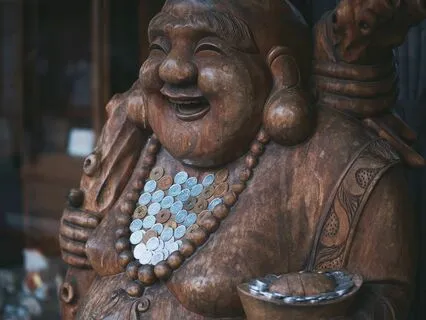
He is typically depicted as cheerful,
Rotund,
With a large belly,
Carrying a cloth sack filled with treasures which he distributes to those in need.
His jovial demeanor and abundant generosity have made him a popular figure in East Asian Buddhism as well as in Chinese and Japanese folklore.
The origins of Poteh can be traced back to Taoism and then to Zin Buddhism in China,
Where he was regarded as an eccentric monk who wandered from place to place,
Spreading joy and happiness wherever he went.
He started as a Taoist immortal but transformed into a Buddhist wandering monk.
His large cloth sack,
Which never seemed to empty,
Symbolizes the inexhaustible spiritual wealth that he shared with others.
One of the central concepts associated with Poteh is the cultivation of spiritual contentment,
Which involves the development of an inner sense of joy and satisfaction regardless of our external circumstances.
This sense of contentment arises from a deep understanding of the impermanent and unsatisfactory nature of worldly pleasures,
Leading to a greater appreciation of the true happiness that can be found through spiritual practice.
Poteh's significance extends beyond the Buddhist tradition,
As he has become a popular symbol of good fortune,
Abundance,
And happiness in East Asian culture.
His image is often found in homes,
Businesses,
And temples,
Where he serves as a reminder of the importance of maintaining a joyful and generous spirit in the face of life's challenges.
In conclusion,
The figure of Poteh and the teachings associated with him offer us a powerful reminder of the spiritual contentment and the transformative potential of joy and generosity in our spiritual journey.
I also think that Poteh is the one figure in all of Buddhism that,
No matter whether you know anything about Buddhism whatsoever,
You've probably seen the fat laughing Buddha.
His name is Poteh.
That's a fun fact you can share with people next time you're out getting some Chinese food.
Thank you so much for joining me in this exploration of Poteh and the joy of spiritual contentment.
I'm Silas Day,
And I hope that you are enjoying this series of short Buddhist lectures.
Thank you so much.