Welcome to the Mindfulness Meditation podcast.
I'm your host,
Dawn Eshelman.
Every Wednesday at the Rubin Museum of Art in Chelsea,
We present a meditation session led by a prominent meditation teacher from the New York area.
This podcast is a recording of our weekly practice.
If you would like to join us in person,
Please visit our website at rubinmuseum.
Org slash meditation.
We are proud to be partnering with Sharon Salzberg and teachers from the Interdependence Project.
The series is supported in part by the Hemera Foundation.
In the description for each episode,
You will find information about the theme for that week's session,
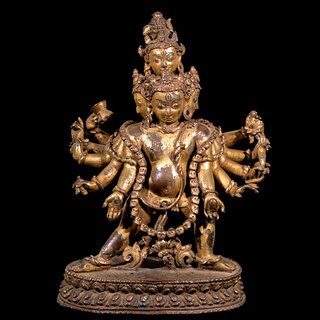
Including an image of a related artwork chosen from the Rubin Museum's permanent collection.
And now,
Please enjoy your practice.
Good afternoon,
Everybody.
Welcome to the Rubin Museum and to our weekly mindfulness meditation practice.
My name is Dawn Eshelman.
I'm head of programs here.
So we have been talking this month about the theme of impermanence,
Which is an idea that is really central in Tibetan Buddhist practice and is also very central to an exhibition we have going on upstairs on the sixth floor and really throughout the entire museum.
It's called The World is Sound.
And it is all about sound as matter and understanding sound as a tool for transformation from that lens of Tibetan Buddhism but also contemporary art as well.
And so today,
We have kind of a more whimsical view into this subject through the work of Christine Sun Kim.
She is a Korean American artist who was born deaf.
And her work explores different ways of thinking about auditory experiences.
And you can see her work right outside the theater doors,
Actually.
There are several pieces there.
And if you have come here a few times,
You might have stopped to take a look and be familiar with some of this already.
But here we have two pieces for you today that we thought gave a kind of experiential aspect to this topic of impermanence and also might be something that we as meditators might know a thing or two about.
So this first one here is The Sound of Obsessing.
And what Christine does in this series of works is she takes notations from traditional Western classical music and uses those notations kind of in a different way to explore experience or emotion.
So the letter P as a notation in Western music represents quiet or piano,
Right?
Quiet.
And here she has the letter P repeated over and over and over and over and over and over and over and over and over and over again,
Really giving us that kind of buildup.
And you can even see a little bit in here,
Perhaps,
With the spaces that are left blank,
Sort of this attempt to regulate and struggle with that.
The mind,
The monkey mind as we all know it to be.
And then,
Of course,
The obsession winning over at the end.
The other piece that we have here for you of hers is The Sound of Passing Time.
And in this work,
She uses the letter F.
So in musical notation,
This is forte or loud,
Right?
It is a very kind of a constant repetition here and the sort of variances and the spaces or the points at which the letters are close together really stand out because of that regularity.
And we can really see where time speeds up and slows down in her mind here.
So this is all to just really illustrate the ephemeral nature of experience and that impermanence is present in many of our experiences in both deep and profound ways and some kind of whimsical ways too.
So Kate Johnson is our teacher today.
It's great to have her back.
And I will bring her up here and introduce her to you in just a moment.
But I also want to introduce someone else to you.
This is Mark right over here.
Can you give a wave?
There he is.
So Mark is going to take our picture for the paper today.
He's a photographer from the New York Times and he's going to take our photograph.
And he's also,
This is exciting news for all of us,
I'm sure he's also a meditator.
He meditates every day except he missed his practice today.
So lucky him.
He's going to take a couple of pictures as we first begin our practice and then he will sit down and meditate with us.
Okay.
So let's do it.
Kate Johnson teaches mindful yoga in New York City public schools and Buddhist meditation at the Interdependence Project.
She holds a BFA in dance from the Alvin Ailey School at Fordham University and a master's in performance studies from NYU.
She's trained at Spirit Rock Meditation Center,
The Interdependence Project,
Laughing Lotus Yoga and the Presencing Institute.
And she's working on a book about waking up to power and oppression as a spiritual practice.
Please welcome her back,
Kate Johnson.
Hi there.
How are you doing today?
Good.
Nice to be here with you.
And I'm so in love with these pieces.
And just I was telling Don that the opportunity to learn more about this artist who is born deaf and became a sound artist,
I was just like,
Wow,
I love rule breakers,
You know.
Very dear to my heart.
And what an opportunity to talk about the theme of impermanence,
More simply known as just the truth of change.
And what a good season to talk about change.
I feel like in the middle of summer,
In the middle of winter,
It just seems like the days are the same,
The same,
The same.
But then in the fall and in the spring,
There's this real sense of you can feel it changing.
I remember the first morning where I noticed my skin was a little dry in the morning and I was like,
Oh,
It's fall,
It's going to be fall.
And so this is obviously a very mundane and worldly truth.
We can see that all things that are conditioned can be born and also can pass away.
And it's a,
That observation is really an entryway into a spiritual truth,
Which is not different than the mundane truth that all things that arise pass away.
And this is,
In some traditions,
In some ways of practicing a preparation for death,
For the little deaths that happen in life,
The death of an idea or the passing away of a friend or a movement,
Disintegration of a material thing that we love.
So it's a way of being able to notice the way that things change so that we don't get really freaked out or think that something's wrong when something starts to disintegrate and pass away.
So that's one reason why it's nice to practice impermanence,
Just so that we kind of get used to,
Oh,
This is the way things are.
But I also really like to think about the contemplation of impermanence as a training for life,
That there's this way in which when we think that we and the people that we love and this world as we know it will always be as it is,
We start to kind of take it for granted.
We think,
Oh,
I'll call that person tomorrow.
I'll start meditating next week.
And even objects that we love.
There's a story from a meditation teacher in the tradition that I practice in.
My teacher's teacher,
Really,
His name was Ajahn Chah.
He was a Thai forest master,
And he was said to have once held up this cup that he really loved to his students and said,
You know,
You see this cup?
Do you see how beautiful it is?
I love it.
I love how it glints in the light.
I love how it feels in my hand.
I love the way that it feels when I sip from it.
But this cup,
I know that it's already broken and that rather than reject this cup because it's already broken,
It's so precious to me.
Every moment I hold it,
Every moment I sip from it,
I just pay attention.
So in this way,
Paying attention to impermanence cultivates this really exquisite kind of sensitivity to what's arising and what's passing away.
And it's a sensitivity that we can then cultivate in the meditation practice and bring into the rest of our lives and to all our relationships.
So the way that we'll practice today is using sound.
And I was also joking with Don.
This is a little bit of a kind of maybe kindergarten version of what you might experience on the sixth floor should you choose to explore the sound exhibit here.
But sometimes it's helpful to train in just a simple way and then be able to open up to more and more complex phenomena.
So what we'll do is we'll,
And many of you have done this before I'm sure,
The same kind of meditation where we'll guide our awareness back to an object.
But whereas often,
At least when I'm here,
We use the object of a bodily sensation like the breath or the hands resting,
Or we might even use a phrase,
For today,
I'll invite us to use sound as our object.
So we'll allow our awareness to hover at the sense gate of the ear and to notice the contact of vibration at that sense gate.
And I brought something to assist me in creating more vibration for you throughout this meditation.
I'm hopefully not dropping my pen.
And so I'll give you a little overview and then we can practice together.
And then if you have any comments about your experience,
I'd love to hear them.
So basically,
We'll set up with our comfortable meditation seat.
And before we move into a real kind of formal meditation,
I kind of like to,
At my own practice,
Ease in a little bit.
So you know,
Soft landing,
Just if you'd like to stretch the neck or,
You know,
Open and close the eyes or move the hands,
Just anything that you might need to do to feel as comfortable as you can in the body at this moment.
And you can let your eyes be closed or just focus lightly the space in front of you.
For sound meditation,
I actually really like to close the eye because it helps me to become more sensitive to the what's being received through the ear,
But up to you.
And now that we've set up the posture,
Just taking a moment to check in with how you are right now.
How is it for you in your body at this moment?
So receiving the sensations that are there in a general way.
Allowing your awareness to run over the landscape of your body as if you are running your hand along a textured surface.
Now what's this like?
Little density here.
Little pinching there.
Little softness here.
Little bit of lightness there.
Listening to in a gentle way how it is for you in your mind and your heart.
Perhaps there are sensations to be known in the heart space or threads of thought that would like to announce themselves.
It's kind of opening up and letting the heart and the mind speak if there's something that they have to say right now.
And so without feeling like you need to push away any of the emotional content or mind stream or bodily sensation,
You know,
Really allowing them to be here,
But drawing your experience of hearing into the foreground and knowing sound as sound.
So the sounds that I'm making now have meaning certainly,
But seeing if you can also notice the experience of vibration.
So thinking of the sense gate of the ear as a field,
A blank page,
And then noticing the arising and passing away of sounds within that field and all the sounds count.
Some sounds are very short.
Some are longer,
Like an attenuated buzz.
You might experience some sounds as being pleasant and some as unpleasant.
Seeing the awareness hover at the sense gate of the ear and notice the arising and passing away of sound.
So I won't talk for the rest of the practice,
But I'll ring some bells at different intervals just assist you in noticing not only the sound,
But the space between the sound,
The field of awareness.
Okay,
Indian stat itself.
Person to the phone that can reach the associations with Grab.
Essential Peopleocked the Barry?
.
Ding.
Animation Number Climb up.
Oh the and no Thank you for your practice today.
That concludes this week's practice.
If you'd like to attend in person,
Please check out our website,
Rubinmuseum.
Org slash meditation to learn more.
Sessions are now available.
If you'd like to attend in person,
Please check out our website,
Rubinmuseum.
Org slash meditation to learn more.
Sessions are now available.
Sessions are now available.
If you'd like to attend in person,
Please check out our website,
Rubinmuseum.
Org slash meditation to learn more.
Sessions are now available.
Sessions are free to Rubin Museum members,
Just one of the many benefits of membership.
.