Welcome to the Mindfulness Meditation podcast.
I'm your host,
Dawn Eshelman.
Every Wednesday at the Rubin Museum of Art in Chelsea,
We present a meditation session led by a prominent meditation teacher from the New York area.
This podcast is a recording of our weekly practice.
If you would like to join us in person,
Please visit our website at rubinmuseum.
Org slash meditation.
We are proud to be partnering with Sharon Salzberg and teachers from the New York Insight Meditation Center.
The series is supported in part by the Hemera Foundation.
In the description for each episode,
You will find information about the theme for that week's session,
Including an image of a related artwork chosen from the Rubin Museum's permanent collection.
And now,
Please enjoy your practice.
Good afternoon,
Everybody.
Hi.
Welcome to the Rubin Museum of Art.
My name is Dawn Eshelman.
I'm head of programs here,
And it's great to have you at our weekly Mindfulness Meditation practice.
And today is quite a special practice that we get to do together because we have an incredible teacher here with us.
Kabgun Pakchak Rinpoche is here,
And he's a teacher with an amazing lineage and a deep connection to a figure that we have been talking about all year long,
And that is Padmasambhava.
There he is.
And I'll tell you a little bit more about our teacher in just a moment.
But I just wanted to mention that I really appreciate his willingness to do this here with us today because it's quite an unusual thing to ask a Rinpoche to speak briefly and lead a brief meditation.
Often they are speaking with their students for hours or days or weeks.
And today we're going to have this rare opportunity to just get a little taste.
And I just want to express my deep appreciation to Rinpoche for his willingness to do that.
And if you would like to hear more,
Hopefully we'll see some of you tonight.
You've already purchased your tickets,
But Rinpoche will be here tonight as well at 7 p.
M.
Giving a talk.
And this will be on the stories of Padmasambhava.
And he will not only tell some of those stories,
And we'll get to hear them,
But he'll talk a little bit about why this tradition of storytelling is so important in Tibetan Buddhism.
So I hope you can join us.
We may be on the brink of sold out there.
So if you're interested in joining,
I hope that you'll grab your ticket right away.
And also be sure to take the pre-programmed gallery tour with the curator of the exhibition up on the sixth floor,
Which is called the Second Buddha,
Master of Time,
And that is with Elena Paketova.
So that's a really special opportunity as well.
So each month in this program we select a different theme to explore.
And then based on that theme,
We select with our teachers some art objects from our exhibitions and collection that speak to that theme.
And this month we're talking about intention and intentionality.
And often in meditation,
Especially in a secular practice,
The students are invited to set an intention for their practice and also think about the intentions that they set throughout their days.
So unless you stumbled in here accidentally,
You had an intention to be here today and just want to honor that.
And I think that it brings us to think about how small intentions lead up to these larger intentions,
And indeed Padmasambhava was known for an incredible effect that he had when in the eighth century he brought Buddhism to Tibet,
And that is what he is most known for.
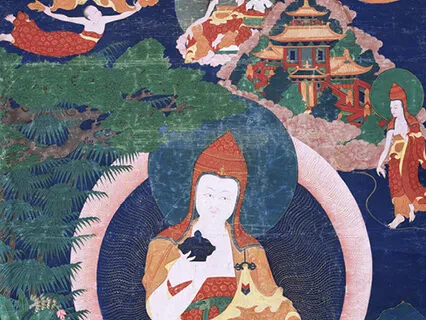
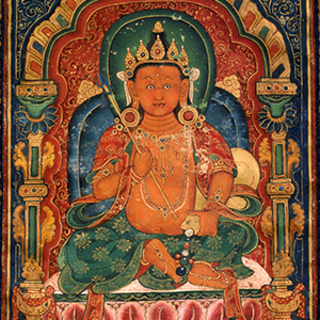
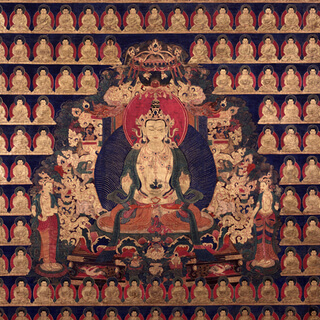
So let's take a look at this beautiful tanka,
This scroll painting.
This is Padmasambhava painted in the 1700s Bhutan.
And we are seeing him in a form that we don't always see him in.
He has an interesting hat on,
If you noticed,
And it is a kind of peak shape at the top.
And if you can take a look at the detail,
Either when you were walking in,
If you saw a detail,
Or you can head to the galleries after the program and take a look,
You will see that there is some beautiful gold kind of detail embroidered into this hat.
And this hat represents his role as a scholar,
As a learner.
And in fact he is wearing the robes of a monk here as well.
And the gold detailing in his hat represents the top level of knowledge that he has been able to acquire.
In his right hand he holds a small blue container which represents terma.
And if you have been here with us throughout the year,
You know that the terma were these treasures,
These teachings that Padmasambhava was able to plant for future treasure revealers to uncover,
Even hundreds and hundreds of years after he had gone.
And this made it possible for his teachings to live on.
And it is really incredible to think about also when you think of the landscape that all of these treasures were buried in,
In the sky,
In the earth,
In the rocks.
You can also look back at the painting and remember that this painting was painted with mineral paint that was created from the rocks.
And also think about the intentionality of the artist,
The hand that created this work,
And the very clear intention,
Very clear vision that this artist had in mind.
Kudgun Pakchak Rinpoche is a lineage holder of the profound treasures of Chökyölingpa from the Nyingma school of the early translations.
He is one of the throne holders of the Ryruche Talcung Kagyu lineage,
Which is a lineage of great masters.
And his primary root gurus are his grandfather,
The late Kabje Tökü Ergen Rinpoche,
And the late Kabje Nöshöl Ken Rinpoche.
He received a traditional education from the Zonsa Kedra in India and has been really instrumental in helping Nepali villages rebuild after the 2015 earthquake.
As a yogi practitioner with a family and the responsibility of monastic institutions,
Indeed he travels all around the world to do his work,
Rinpoche is deeply familiar with both ways of life and practice.
And we're so excited to have him here with us today.
Please welcome Pakchak Rinpoche.
So how are you?
Welcome.
I'm already here two times,
Many,
Many years back.
And today I have 10 minutes to talk.
So I'm going to make a very,
Very short,
Easy.
I think many of you already doing meditation can be some of you not doing much meditation,
But do time to time.
And some of you completely new.
So for that reason,
What I did is I put a pamphlet.
So after you go back,
You can actually carry back what I actually talked about.
So because of today,
This month is focused towards intention.
For me,
Intention is the light,
The beacon.
For me,
Meditation is sometimes blind.
Without intention,
Meditation is blind.
In the traditional Buddhism meditation,
They always teach you two things to guide you.
One is intention,
One is the view.
So today,
I'm not going to talk about the view,
Because that is not my topic.
My topic is attention.
So when I'm waiting for you,
My name is going to be called,
I'm sitting there.
Actually I tried to put my intention that I'm doing the intention build called Tonglen practice.
So today I want to talk a little bit simple one.
When you breathe out,
Exhale,
You think,
I wish everybody to be happy.
That's it.
No need to do any extra.
When you inhale,
When you breathe in,
You say,
I wish everybody free from suffering.
That's it.
No extra.
When you do that,
You actually build intention.
And the intention actually is human nature.
It's not actually religious.
That is actually not philosophical.
That is actually human nature.
But we forgot our busy life,
We forgot of our intention.
Why are we working so hard?
Why we do so many things?
To actually be happy,
To see somebody happy.
We're doing this for.
But on the way we're doing so busy,
That whole intention forgot.
That's why in meditation,
Traditional,
This is the always intention go first,
Because that creates your beacon light.
So what kind of intention you want to build?
It's very simple.
When you exhale,
I wish everybody be happy.
You inhale,
I wish everybody free from suffering.
That's it.
Exhale,
I wish everybody to be happy.
Inhale,
I wish everybody free from suffering.
Exhale,
I wish everybody happy.
Inhale,
I wish everybody.
For us,
Breath is a life.
Without breath,
We call it death.
So without intention,
Meditation actually is death.
It's not life.
So that's why I want to bring back the topic of this month,
Is intention.
The intention is actually that.
So I like to give some tips of meditation.
Of course,
I put here quality of mindfulness because you all heard about mindfulness so much.
And they have many unimaginable teachers in America who put so much effort to bring mindfulness into your life and a secular life.
I think it's very terrific thing they did.
Because meditation actually to benefit the people.
The whole intention to do with the meditation is to benefit,
There's nothing else like that.
So that's why I just give a few tips there.
First in meditation is two things.
Please do meditation every day,
Very short.
Don't do completely stop.
Just do two minutes,
You cannot make it.
And you're really so busy,
You cannot do it in the office and whatever,
You feel difficult.
Go in the toilet and meditate for three minutes.
That is number one.
Don't stop.
Second,
Don't attach to the result,
The results.
When I saw a Time magazine,
Mindfulness or meditation makes your stress release,
Look younger,
Wrinkles go away,
All that.
It's very nice.
I think so.
I agree a little bit.
But I don't think meditate to people who have no wrinkles.
I've never seen that.
I'm being very truthful.
But when I saw that,
It's very nice because it's encouraging the people to meditate in mindfulness,
But when you don't tell them,
Don't attach to the result,
What happened is they go into the similar emotion issue that goes up,
Excitement,
Doing every day and falls down,
Not doing nothing.
And you forgot about it completely.
And traditional meditation masters,
They're really concerned about that sharp edge,
Up going up and falling down.
That's what they always teach is don't attach to the result.
So I have one word for that.
I say great master attitude.
This is how I go,
Great master attitude.
What does it mean?
You meditate.
You see great experiences.
You just bow.
That's it.
Then you meditate next day.
Bad experiences.
Again bow.
The key is you don't react with the experiences.
You just keep doing,
Keep going on.
That is my tip for you.
The first tip,
Don't stop.
Second tip,
Great master attitude.
Don't attach to experience.
Don't stop,
Don't attach.
That's it.
That is my tip.
So now I have four minutes.
Mindfulness.
And my mindfulness teacher is here.
She told me stop 20 minutes,
1.
20.
Meditate until 40.
Two questions,
Finish.
So now I have 30 minutes.
I put here something that you can carry back.
I put here something that you can carry back that is mindfulness,
Keeping the key points in the mind through the gentle reminding.
So mindfulness in Tibetan word I did not put here because it's going to be confusing for you.
But basically reminding.
Mindfulness actually means reminding.
Don't forget.
Then take all seeing clearly without being over emotional.
Meaning you see things,
You do things,
You behave,
But don't react too much,
Too fast.
Preparing yourself to be more stable.
So you know that you're not going to be stable in that situations.
You remind yourself,
Okay,
That lousy man or lousy situation going to come,
I should prepare.
Imagine you need to go to see a doctor.
Then like me,
I go to see doctor and I have blood pressure.
See you do,
Do you really believe that?
Because I'm fat.
Now I lose weight.
I don't eat food much.
So put down weight.
So I prepare whenever I go see doctor.
Now,
Yeah,
I know what he going to say.
He going to threat me.
You have blood pressure,
You going to have stroke soon and you're going to have attack soon,
You're going to die right now.
So I prepare myself.
So when I see doctor,
I don't feel shocked.
Preparing is the key to be strength,
Not preparing.
That is the weakness.
That's why I put it down there.
Mindfulness can use for happiness,
We all want happiness.
What does mean happiness?
Meaning not comparing.
Don't compare too much.
Oh,
Yesterday is good time,
Not today.
Don't do comparing,
You happy.
Compassion meaning not judging others.
You really want to have compassion,
Don't judge others,
Just have compassion.
Don't count too many things.
Dignity.
Now for the dignity is very important for me.
So now when you look at Guru Rinpoche,
Guru Padmasambhava,
What he really brought to Tibet.
You tell me,
You ask me the question,
I'm going to say dignity.
The Vajrayana actually means dignity.
Okay,
That's why I say dignity.
What is the meaning?
Meaning not judging yourself.
So this is the something that you can carry back.
This one.
So one of my tips is very simple.
Don't stop.
Don't attach to your experience.
What is meditation today?
Exhale,
I wish everybody happy.
Inhale,
I wish everybody free from suffering.
That is the meditation for today.
We do this for 10 minutes.
So my time is up.
Anybody like to hear from me more than you can do.
So I'm going to bang.
I'm not going to talk much.
I'm going to talk three times.
Exhale,
Inhale.
Then we could do for 10 minutes and I'm going to bang again.
Then I talk something else a little bit,
Not so much.
Exhale,
Thinking I wish everybody happy.
Inhale,
I wish everybody free from suffering.
Exhale,
Wish happiness.
Inhale free from suffering.
Exhale wishing happiness.
Inhale free from suffering.
Exhale,
I wish everybody happy.
Inhale,
I wish everybody free from suffering.
Exhale,
I wish everybody happy.
Inhale,
I wish everybody happy.
Exhale,
I wish everybody happy.
Exhale,
I wish everybody happy.
Exhale,
I wish everybody happy.
Exhale,
I wish everybody happy.
Exhale,
I wish everybody happy.
Exhale,
I wish everybody happy.
Exhale,
I wish everybody happy.
Exhale,
I wish everybody happy.
Exhale,
I wish everybody happy.
Exhale,
I wish everybody happy.
Exhale,
I wish everybody happy.
Exhale,
I wish everybody happy.
Exhale,
I wish everybody happy.
Exhale,
I wish everybody happy.
Exhale,
I wish everybody happy.
Inhale,
I wish everybody free from suffering.
Exhale,
I wish everybody happy.
Inhale,
I wish everybody free from suffering.
Exhale,
I wish everybody happy.
Inhale,
I wish everybody free from suffering.
Exhale,
I wish everybody happy.
Exhale,
I wish everybody happy.
Exhale,
I wish everybody happy.
Exhale,
I wish everybody happy.
Exhale,
I wish everybody happy.
Exhale,
I wish everybody happy.
Exhale,
I wish everybody happy.
Exhale,
I wish everybody happy.
Exhale,
I wish everybody happy.
Exhale,
I wish everybody happy.
Exhale,
I wish everybody happy.
Exhale,
I wish everybody happy.
Exhale,
I wish everybody happy.
Exhale,
I wish everybody happy.
Exhale,
I wish everybody happy.
Exhale,
I wish everybody happy.
Exhale,
I wish everybody happy.
Exhale,
I wish everybody happy.
Thank you.
Bye-bye.
See you.
Take care.
Wish you happiness.
That concludes this week's practice.
If you'd like to attend in person,
Please check out our website,
Rubinmuseum.
Org slash meditation to learn more.
Sessions are free to Rubin museum members,
Just one of the many benefits of membership.
Thank you for listening.
Have a mindful day.