Welcome to the mindfulness meditation podcast.
I'm your host,
Dawn Eshelman.
Every Wednesday at the Rubin Museum of Art in Chelsea,
We present a meditation session led by a prominent meditation teacher from the New York area.
This podcast is a recording of our weekly practice.
If you would like to join us in person,
Please visit our website at rubinmuseum.
Org slash meditation.
We are proud to be partnering with Sharon Salzberg and teachers from the New York Insight Meditation Center.
The series is supported in part by the Hemera Foundation.
In the description for each episode,
You will find information about the theme for that week's session,
Including an image of a related artwork chosen from the Rubin Museum's permanent collection.
And now,
Please enjoy your practice.
Wasn't last night incredible?
I'm talking about the moon,
Of course.
We are in the midst of a lunar trifecta,
People.
Last night and tonight,
We have this beautiful,
Let's see if I can do it,
Super blue blood moon,
Right?
Yes.
So super,
Because it's very close in its orbit to the earth and it appears very large and bright and blue,
Because it is the second full moon of the month.
And then the blood moon part refers to this eclipse and the fact that it then gives the moon this kind of reddish hue.
So it is a very auspicious day for us to be gathered here together.
And if you think I'm making that up,
You should come to our program later tonight.
This is Tibetan Astrology and Divination.
And we will be speaking with Dr.
Tenzing Dacpa,
Who is a medical doctor in the Tibetan tradition.
And as part of his training and part of the tools of his practice,
He is trained in the Tibetan Astrology and Divination.
So come check it out.
So welcome again to the Rubin Museum of Art.
We are a museum of Himalayan art here in Chelsea,
New York City.
And we talk about what it means to be human.
And we are here Wednesday at one o'clock for our mindfulness meditation practice.
And we are rounding out this month of meditations focused on the theme of beginning again.
We're talking about that because,
Of course,
It is January.
So it is the new year in the Gregorian calendar.
We're approaching the new year in the lunar calendar as well.
And it's a time to reflect and to think about kind of starting over in whatever way works for us.
And as meditators,
We also know that beginning again is something that we do many,
Many times,
Not just once a year,
Not just even once a month or once a week,
But many times within one sitting.
We will give focus to our object during a meditation,
Which often is our breath here in this practice that we do together.
And when our focus drifts,
We will compassionately begin again,
Redirect that focus back.
And as our teacher today,
Sharon Salzberg,
Likes to say that that is the practice,
That compassionate act of coming back,
Beginning again.
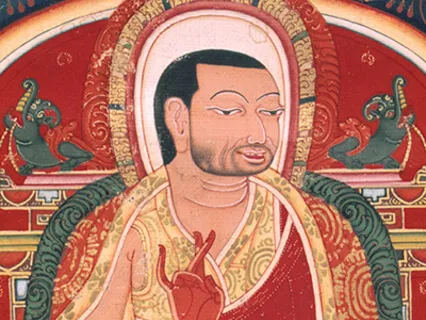
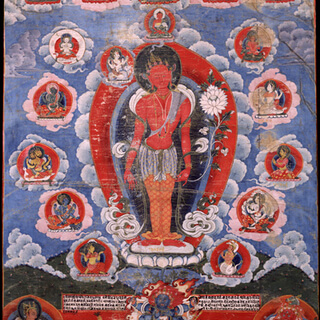
So we are looking today at a beautiful Tibetan tanka from the 13th century.
And this is a great Tibetan Buddhist master from the Kagyu tradition.
His name is Pakmodrukpa.
And he sits here amongst the scenes of his previous lives.
So he began again many times.
He was born into poverty and experienced a very difficult childhood and overcame many obstacles to become a very powerful teacher in the Kagyu tradition.
But it took him a long time.
And he studied with a number of different teachers.
And it was really later in his life that he studied with Gampopa and became enlightened and became an important teacher in the Kagyu tradition.
He was so beloved for the power and intensity of his teachings that the monks would line the ground,
The path from his hut to his teaching chair with their clothing,
Their hats,
And their katak,
Their scarves.
And in fact,
He inspired a generation of teachers in the Kagyu tradition that were very,
Very important.
And so this act of teaching is what I'm asking you to consider today,
That not only as teachers,
That teachers certainly have this particular wisdom and connection to their experience and the content of what they're teaching,
But that they have to begin again with every new student.
And that that is considered to be a great skill,
That beginner's mind,
To be able to employ that act of beginning again.
And so you can think today about your teachers and the people that you teach,
Including yourself.
Speaking of amazing teachers,
Let's bring up our teacher.
Sharon Salzberg is an amazing and renowned teacher that we have the great privilege of working with here and who's been here all month with us talking about beginning again.
So that's been great.
And we appreciate her ability to revisit this topic again and again with us and really bring that beginner's mind to our experience.
She is the co-founder of the Insight Meditation Society in Barre,
Massachusetts,
And the author of many fabulous books,
Including Real Love,
Which I think they just reordered up in the shop.
A couple of people told me it was out,
So I think it's back.
Please welcome her,
Sharon Salzberg.
Hello.
They're a lot of you here in online maybe.
108,
The magic number.
Did you know 108 is like the sacred number in Hinduism and Buddhism?
It's exactly that.
So how great to see you all for one more talk and not beginning again,
Which is so funny.
Usually there's a little more space between ones repeating oneself as a teacher,
But here there's not.
So,
But I was wondering,
Just looking at the really beautiful piece of art,
How many of you would say you have had in your life a very inspiring or important mentor,
Teacher,
Some figure like that?
I would.
Because there was something timeless I felt in looking at that.
And for those who've not maybe had that personal experience,
There's something about the archetype of offering,
Of generosity,
Of giving over.
They say in Zen that the goal of every good Zen master is to have a student who surpasses them.
And there's something very beautiful in that depiction,
Where even though if we're talking about beginning again,
We're talking about change,
We're talking about time.
In looking at the photo of the painting,
I actually thought about the timeless,
Which doesn't mean something static or stagnant or unchanging,
But something renewing,
Something that perpetuates through its very reappearance,
That's not in itself solid and stuck.
And so that's really a picture of the layers that we experience,
The different levels that we experience in our day-to-day reality,
That which is dissolving and moving and changing,
And at the same time,
That which is supportive and ongoing and can be counted on.
And that is actually one of the translations of the word dharma in Sanskrit,
D-H-A-R-M-A,
Which usually is translated as the Buddha's teaching or the truth.
It actually means that which supports us,
That which sustains us.
So there are some truths of life,
Which whether we like it or not,
That's how things happen.
And coming into harmony with that gives us that sense of being sustained.
And so even as we begin again,
It doesn't mean something kind of panicked,
You know,
With no structure,
No clarity,
Or no kind of logic almost to the unfolding of our lives.
But it does very much have that flavor of renewal.
And so I think also of the Buddha's images where he talked about life and he said,
Life is like a rainbow,
Like an echo,
Like a dream,
Like a flash of lightning in a summer sky,
Like a drop of dew in a blade of grass.
It all happens,
It all appears,
The joy and the sorrow and being included and being left out and being noticed and being rejected and all of it is happening and it's all so insubstantial.
It's so fleeting,
Like a drop of dew in a blade of grass and so is this very life.
The Buddha also talked about the eight vicissitudes of life.
And this is the wisdom base of knowing how to begin again.
It's knowing that life is this continual unfolding of changing states.
And these are pleasure and pain,
Gain and loss,
Praise and blame,
Fame and disrepute.
It's pleasure and pain,
Gain and loss,
Praise and blame,
Fame and disrepute,
Constantly moving,
Shifting,
Changing outside of our control.
And so if you have a really big picture of life,
Then any endeavor,
Any project,
Anything you're trying to get done can be held in this framework.
And so if you feel a dip,
Something's more difficult,
It's more challenging,
Or you've made a mistake,
You've blown it.
It feels like it's a part of the natural order of things instead of like,
Ooh,
It's over.
In some ways it is in itself a call to begin again,
To see what's real now,
What's realistic now,
What's important now.
So beginning again doesn't also mean that you go back to the same exact old thing.
Sometimes that's not very smart.
But it is a sense of connection and participation,
Even if your course alters or your path alters.
We begin again.
We like praise,
We like pleasure,
We like gain,
We like fame,
When it's the right kind of fame,
Of course.
We like everyone to love us.
I mean,
Why not?
That would be good.
But it doesn't seem to be the case that you create something or you mention something to a friend or you give someone a gift.
And there is universal acclaim like,
Wow,
Can you believe it?
Finally,
Perfection.
Like we're 100% of the people all the time,
Everywhere,
Will say that's the best thing ever.
That would be nice.
But it doesn't seem to be that way.
And so we find inspiration,
We find heartfulness,
We find encouragement,
Not from disregarding that.
Because I mean,
Really,
We're human beings.
That is really nice.
You like to give someone a gift and be thanked,
Right?
Or be acknowledged.
That seems normal.
But the question is,
How much are we counting on that for our definition of who we are?
And do we disregard the,
You know,
Maybe the whole process we went through in getting ready to offer that gift and the relinquishing and the putting someone else's happiness first and the ways in which we grew and changed.
Does that all disappear?
Because somebody doesn't thank us by jumping up and down and yelling.
Well,
Unfortunately,
It often does,
But it doesn't have to.
Right?
So we have overarching aspirations in our lives and visions of what will give our life meaning and how we will be happy.
And within that,
We're always sort of moving on,
Falling down,
Picking ourselves up,
Starting over,
Making a course correction in some way,
But not losing that really big vision.
And so here we are.
You know,
We're about to sit,
But apart from the sitting,
I would really encourage you.
It's like a game I play with myself very often is to try to look at the ways I myself use language.
How often do I say always?
Thereby shutting the door.
You know,
I'm a really angry person and I always will be.
Thereby shutting the door on change.
Somebody suggested to me that an experiment of saying I feel anger rather than I am angry.
Right?
Every way that we use language to solidify,
Hold on,
Reify,
Substantiate that which is always changing,
It's sort of an interesting challenge.
It doesn't mean you have to say nothing.
And you don't have to get weird either,
You know,
Like this ever-changing psychosocial mass of particles and electromagnetic impulses is going upstairs now,
You know?
It's like,
You don't have to go to that extent.
But just,
I think it's quite fun to pay attention.
People ask all the time,
Say at the end of a retreat,
How can I maintain the level of mindfulness I got in this retreat?
How can I keep awareness all day long at work?
And my response is usually,
Is not going to happen.
But you can keep starting over,
You can renew it,
You can find that you're gone,
You can remember this is natural,
This is a part of life,
It's part of the nature of things that we go up and down,
That we have all kinds of things happen,
And we can keep going in a very vibrant and alive way.
Okay,
So let's sit together.
See if you can sit comfortably with your back straight without being strained or over-arched.
You can close your eyes or not,
However you feel most at ease.
If you like,
You can start by listening to sound,
The sound of my voice or other sounds,
Whatever may be arising.
It's a way to relax deep inside,
Allowing your experience to come and go.
The sounds just wash through you.
And bring your attention to the feeling of your body sitting,
Whatever sensations you discover.
Bring your attention to the feeling of your breath.
In this system,
It's just the normal,
Natural breath.
You don't have to try to make it deeper or different,
Just however the breath is appearing.
And see if you can find the place where the breath is strongest for you or clearest for you.
Maybe that's the nostrils or the chest or the abdomen.
You can find that place,
Bring your attention there and just rest.
See if you can feel one breath.
If you like,
You can use a quiet mental notation of in,
Out or rising,
Falling to help support the awareness of the breath,
But very quiet.
See your attention is really going to feeling the breath,
One breath at a time.
See what's happening to you.
.
.
And if you find your attention has drifted off,
Gotten lost in thought,
Spun out in a fantasy,
Or you fall asleep,
Really that's okay.
That's inevitable.
The most important moment is the next moment.
When you realize you've been gone,
You've been disconnected,
We have the chance to let go gently and begin again.
Just shepherd your attention back to the feeling of the breath.
You don't have to feel discouraged or that you've failed.
You haven't.
The practice,
The training is in letting go and beginning again.
.
.
.
.
.
.
.
.
.
.
.
.
.
.
.
.
.
.
.
.
.
.
.
.
.
.
.
.
.
.
.
.
.
.
.
.
.
.
.
.
.
.
.
.