Welcome to the mindfulness meditation podcast.
I'm your host,
Dawn Eshelman.
Every Wednesday at the Rubin Museum of Art in Chelsea,
We present a meditation session led by a prominent meditation teacher from the New York area.
This podcast is a recording of our weekly practice.
If you would like to join us in person,
Please visit our website at rubinmuseum.
Org slash meditation.
We are proud to be partnering with Sharon Salzberg and teachers from the New York Insight Meditation Center.
In the description for each episode,
You will find information about the theme for that week's session,
Including an image of a related artwork chosen from the Rubin Museum's permanent collection.
And now,
Please enjoy your practice.
My name is Dawn Eshelman.
Great to be here with all of you.
Anybody here for the first time?
Welcome.
Great.
And who comes every week,
If they can?
Welcome back.
In between.
Anybody in between?
Welcome.
Great.
We are talking about ritual this month,
And ritual as a means to personal power,
To collective power,
And to the power within,
Right?
Then we have the power of singing bowls.
Thank you.
We are talking about this concept of ritual as a means to power because we are really having this year-long conversation all about power,
The power within us,
The power between us,
And we have been discussing through the course of the month what ritual means to us through a few different lenses,
Through the lens of our practice,
Because for some of us this is a ritual,
Or we like to ritualize it,
Right?
Some people really,
That helps them build their practice.
And we are talking about it through the lens of Tibetan Buddhism,
And as ritual being a form of passing on of power,
Of learning,
Of receiving,
Right?
Teachings and other types of empowerments.
And today is exciting because we really get to look through both of those lenses together.
I got a text from Kate Johnson today saying Amtrak is giving me lemons.
And so we are making lemonade with that today.
So it is some pretty gourmet lemonade.
I just want you to know.
And I am actually really excited to be able to introduce my colleague,
Tashi Chodron.
She runs Himalayan Heritage,
A regular program.
She is an amazing educator and partnership builder here at the museum,
And she also teaches meditation.
I will tell you a little bit more about her when I bring her up here.
But thank you,
Tashi.
Thank you for being just,
You know,
Saying yes right away and jumping in here so we can all practice together.
In fact,
When I texted Tashi to ask her if she could do this,
She,
And I said,
Tashi,
The theme is a ritual,
And we are using the ewer today.
She said,
I am in the shrine room looking at the ewer.
So pretty cool there.
So speaking of the ewer,
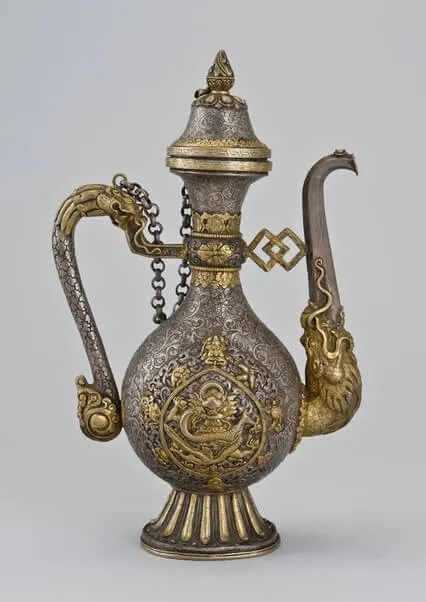
This is our object for today.
And this is a ritual object.
It is used for pouring liquid offerings during daily offerings,
Initiation ceremonies,
And other rituals.
And there is a central decorative motif there that you see on the belly of the vessel,
Which is a gilt dragon surrounded by Buddhism's eight auspicious symbols highlighted in gold.
And the mouth emerges from the mouth of a water monster,
Or Makara.
So while this is a very ornate object and quite beautiful,
It is just a reminder to us that these objects in our daily life,
Whether they are simple or ornate,
Can be very powerful in their ritual power.
So today,
Tashi is going to give us a taste of that awakening practice as the program.
And as I mentioned,
Tashi is my colleague here.
She runs Himalayan culture programs and partnerships and is the founder and current director of Voices of Tibet,
An organization dedicated to conducting interviews with Tibetan elders to preserve their stories for future generations.
And Tashi is a lifelong practitioner and meditator in the Nyingma tradition of Tibetan Buddhism and has studied quite a bit under that tradition and received teachings from a number of incredible teachers including the teacher who leads the Palayal Retreat Center upstate where I know Tashi is a practitioner as well and that teacher is Pimad Sagchin.
And Tashi also has studied with Insight Meditation Society,
Insight Meditation,
And Mindfulness as well.
So really just so grateful,
Tashi,
And excited to enjoy this.
Please welcome Tashi Chodron.
So it's so wonderful to see you all.
Thank you.
And as Dawn mentioned,
That when she texted me and said,
Kids having trouble with the train and our theme is ritual and this is the object,
And I texted her back and I said,
I'm standing right in front of it.
I happened to be wandering around on the galleries and sitting in the shrine room for a little bit and I was just looking at it right there on the screen.
Those of you who have attended awakening practice in the shrine room,
You probably remember this.
I often say that when we come together like this,
It's not a coincidence.
It's often our karmic connection ripening from many past lifetime.
And so the fact that we are all here together,
It's our karmic connection ripening.
And I guess instead of ritual,
We should talk about change because there's so much change.
But I was just sharing with my colleague earlier just a few seconds ago,
Change comes.
The essence of the teaching in Buddhism,
Especially in Tibetan Buddhism,
Is impermanence.
And so I think it's very important to hope for the best.
Change comes,
Let's hope for the best.
And then just face it.
Talking about ritual,
I have this ritual where I like to start the session with the eight auspicious noble auspicious prayer.
And again,
Some of you who attend awakening practice,
You're familiar.
It's feels long,
But it's only a little more than a minute.
And it's a very important prayer for us all to invoke the goodness that is in us.
So I'm going to recite the prayer.
Aste Boomer So this is a prayer that's written by Jim Mipham,
And the verses of auspicious invokes the power of goodness exemplified by the Buddhas and Bodhisattvas so that any harm or obstacles may be overcome.
So this is the prayer that I've seen our great masters reciting,
Beginning of any program and any major event and decisions in order to bring us all blessings.
Now,
Talk about ritual,
As Dawn was mentioning about the object having eight auspicious symbols.
So again,
Having the eight auspicious symbols helps to purify negativity,
Bring forth blessings and good fortune,
Things like that.
So again,
To touch on the ritual with my personal,
I often hear our friends saying,
I didn't get a cup of coffee this morning,
So I'm not myself kind of,
Those are saying right.
And for me,
My ritual every morning,
I do my shrine in my apartment.
That's filling up the seven bowls and making tea offering and lighting candle.
And so that's my cup of coffee every morning.
If I don't get to do that,
I don't feel fully myself,
So I thought I'll just share that with you.
But in the Buddhism,
As you all know,
There is Theravada Buddhism,
Which is practiced in Southeast Asia.
Then there is the Mahayana,
Which means creative vehicle in Sanskrit,
Which is practiced in China and Japan and other places.
Then there is Vajrayana,
Esoteric tantric Buddhism,
Which is practiced all over the Himalayas,
Which came to Tibet in the eighth century by Padmasambhava,
Guru Rinpoche in Tibetan.
Some of you probably are familiar with the future exhibition that we explored last year,
Which was exhibition on the Padmasambhava.
And in the esoteric Vajrayana form of Buddhism,
Which is often referred to as many methods,
It is categorized by the extensive use of ritual activities,
Among them the initiation of the practitioners by an authorized master,
The visualization of oneself as a deity,
The recitation of mantras,
And the making of offerings.
So when I make offerings in the morning,
Whether it's seven bowls or flower offerings on my shrine,
Candles,
I dedicate for the benefit of all sentient beings,
Which is one of the core,
Main important thing to benefit for all sentient beings,
Especially where there's darkness,
Where there is starvation,
Where there is hunger,
Things like that.
And so all of these rituals of offerings that we make,
I have heard some great masters saying,
It's like a fertilizer.
When you're growing something,
It needs all the five elements,
Right?
Proper space,
Proper air,
Light,
And all of that in order for that,
The seed or whatever that you're trying to grow.
And so this ritual is designed to remove obstacles for practitioners or for anybody to reach the path to enlightenment.
And reaching the path to enlightenment is for the benefit of all sentient beings.
And so again,
The core,
Or one of the first teachings by Buddha is the Four Noble Truth,
Right?
Which connects to the suffering,
Where the suffering causes of suffering,
Succession of suffering,
And path that leads to getting rid of the suffering.
And so nobody in the world wants suffering,
Right?
And so when we know where the sufferings come from,
Then of course then we can avoid that.
And what's the total opposite of suffering?
Is happiness.
And who doesn't want happiness?
Everybody wants happiness.
Whatever we're doing,
Whether we're working eight to five jobs or not doing that hours or with whatever kind of profession,
We are all ultimately doing it to find some kind of happiness.
And so that happiness,
Again,
It's like the fertilizer.
You plant the seed of happiness,
Then happiness comes.
For example,
If you want a mango tree to grow and if you plant banana,
You're not going to get mango,
Right?
So likewise,
There's those simple examples of how you want happiness,
You plant the seed of happiness.
And so in order to plant the seed of happiness,
I think one of the Buddha's core teaching is,
And now even science agree,
Right?
That mindfulness meditation,
Or now the experts say,
If we sit quietly,
Just for a moment,
The experts say if we sit quietly,
Just observing on our breath for even a few minutes,
But of course,
If you can stay up to 20 minutes each session,
Then you can actually see more result.
And so basically what that is is,
In the teaching,
It says every single human being or the beings are born with that wisdom.
And what is that wisdom?
It's the seed of,
Whether it's Jesus' wisdom or Allah's wisdom or Buddha's wisdom,
Any of the divine,
That seed.
But because of the afflicted emotions,
The anger,
Hatred,
Jealousy,
All these attachment,
They bring so much suffering.
So sitting quietly helps reduce these afflicted emotions and give rise to the wisdom that each of us are born with.
So let us sit together.
I think in the meditation,
It says in the teaching that sitting together,
Collective karma.
There is such thing as collective karma.
So coming together like this and sitting together also is considered actually very beneficial.
So let's sit comfortable.
I'm very happy to lead this short guided meditation.
First,
Keep your spine straight.
And then in this session,
I'd like to request everyone to close your eyes.
But if you're used to it,
Keeping your eyes semi-close,
Semi-open,
Then of course you can,
You know,
Just choose what makes you comfortable.
Relax your muscles in your body.
Starting from your head,
Relax your muscles in your head.
Relax your muscles in your cheeks.
Relax your muscles in your jaws,
Your shoulders,
Your shoulders,
Upper body,
Lower body,
Tip of your toes.
Again,
Since everyone is sitting on the chair,
Your feet firmly on the floor.
And just relax your whole body and observe on your breath.
Just be aware of your breath.
Breathing in,
Breathing out.
If your mind is wandering around,
Just try not to analyze or chase after it.
Just let it be.
And be aware of your breath.
Now let's take your awareness outside of your physical body to the sound.
Just be aware of the sounds of your neighbor's breathing or someone walking.
Just simply be aware of the sound around you.
And just be aware of the sound around you.
In this awareness,
Let's take it into the space.
Just be aware of the space around you,
Above you,
Beyond this hall.
And be aware of the space beyond this city,
The vastness of the space.
Again,
If your mind is wandering around,
Just simply let it be.
Just like the waves in the ocean,
It just goes away by itself.
Just don't chase after it.
Don't try to analyze.
And let it be.
Now from this experience,
I'd like to bring you to a different level of meditation,
Which is visualizing on a light above your head,
A blissful,
Illuminating divine light above your head,
Scanning one's body,
Starting from your head,
Down to your shoulders,
Your arms.
And as you visualize the light scanning one's body,
Visualize getting rid of all the negativity,
Sickness.
Visualize the whole upper body,
Lit with this blissful,
Divine light,
To your lower body,
And to the tip of your toes.
And visualize that all of your body,
Speech,
Mind,
Negative karmas,
For many past lifetimes,
Is purified by this divine,
Blissful light.
If you feel like there are some dark spots left in your body,
You can send the light back.
If you feel lightness in your body,
Just let it be.
Don't be attached.
Now,
From your heart chakra,
Let us send the light to all directions in front of you,
On your sides,
Below you,
Behind and above.
Let's fill the space with this blissful,
Divine light,
To all sentient beings' benefit,
Especially where there is so much suffering going around.
With genuine love and compassion,
With so much joy,
Let us send the light to all sentient beings' benefit.
Now,
Let's,
With so much joy and happiness,
Dissolve the lights back in your heart chakra.
And let's sit together for a few more minutes.
Breathe in and breathe out.
Breathe out.
Breathe in and breathe out.
Breathe out.
Breathe out.
Breathe in and breathe out.
Breathe out.
Breathe out.
Breathe in and breathe out.
Breathe out.
Breathe out.
Now,
I'm going to ring the phone.
You can open your eyes when you're ready.
May all sentient beings be free from the causes of suffering.
May all be happy.
Gewa magen dodo kun la,
May I dedicate this merit to all sentient beings.
Thank you.
Thank you,
Tashi.
That concludes this week's practice.
If you'd like to attend in person,
Please check out our website,
Rubinmuseum.
Org slash meditation to learn more.
Sessions are free to Rubin Museum members,
Just one of the many benefits of membership.
Thank you for listening.
Have a mindful day.