Welcome to the Mindfulness Meditation Podcast presented by the Rubin Museum of Art.
We are a museum in Chelsea,
New York City that connects visitors to the art and ideas of the Himalayas and serves as a space for reflection and personal transformation.
I'm your host,
Tashi Chodron.
Every Thursday,
We present a meditation session inspired by a different artwork from the Rubin Museum's collection and led by a prominent meditation teacher from the New York area.
This podcast is a recording of our weekly in-person practice.
In the description for each episode,
You will find information about the theme for that week's session,
Including an image of the related artwork.
Our Mindfulness Meditation Podcast is presented in partnership with Sharon Salzberg and teachers from the New York Insight Meditation Center,
The Interdependence Project and Parabola magazine and supported by the Frederick P.
Lenz Foundation for American Buddhism.
And now,
Please enjoy your practice.
Welcome everyone to Mindfulness Meditation at the Rubin Museum of Art.
I'm Jacqueline Smith,
Manager of School and Family Programs,
And I'm delighted to be your host today.
We are a global hub for Himalayan art with a home base here in New York City,
And we are so glad to have all of you join us for our weekly program where we combine art and meditation.
Inspired by our collection,
We will first take a look at a work of art.
We will then hear a brief talk from our teacher,
Lama Arya Drolma,
And then we will have a short sit,
15 to 20 minutes,
For the meditation guided by her.
Now let's take a look at today's theme and artwork.
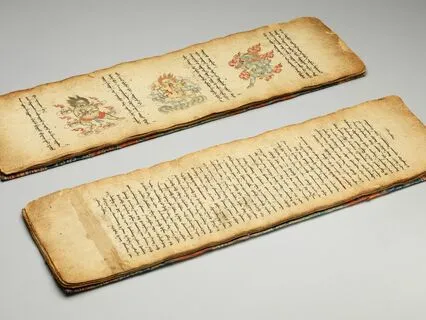
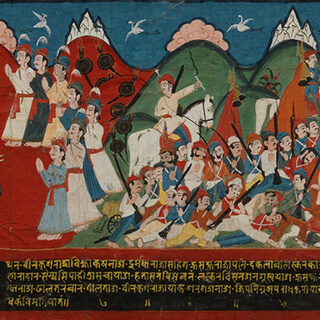
So our artwork for today is this illustrated manuscript of the liberation through hearing in the intermediate state,
The Bardo Todrol.
And our theme for the month of December is ritual.
This manuscript is on view on the fifth floor of the museum.
The Bardo Todrol is meant to guide practitioners through the intermediate state between death and rebirth,
Which is known as the Bardo.
There are many rituals associated with this text,
Including visualizing both peaceful and wrathful forms as a means of preparation for death.
The Bardo Todrol is often referred to in the West as the Tibetan Book of the Dead.
It is a treasure that was hidden by Padmasambhava,
Who brought the wisdom of Buddhism to Tibet in the 8th century,
And this was later revealed by treasure revealer Karma Lingpa in the 14th century.
This remarkable manuscript version of the text was made in Mongolia in the 19th century.
Although many sacred Tibetan Buddhist books are printed using traditional woodblock printing techniques,
Handwritten books became popular in the 19th century in Mongolia.
This illuminated manuscript features a vertical Uyghur-based Mongolian script that was instituted by the founder of the Mongol Empire,
Genghis Khan,
In the early 13th century.
And we can see here some beautiful examples of some of the illustrated pages of the text.
Many associate the Bardo as the state in between life and death,
However,
The Bardo also refers to any liminal state,
Including the midpoint of dreaming and waking.
Bardos are junctures at which the possibility for awakening or liberation is amplified.
As we behold this beautifully illustrated manuscript,
Let's reflect on how we can navigate Bardo periods in our own lives and come to terms with change.
And here we see just another example of an illustration within the text,
And then here we have the cover,
Which is also very richly illustrated,
And then we have the outer wrapping of the Bardo todril.
So with that,
Let's bring on our teacher for today,
Lama Arya Drolma.
Lama Arya Drolma is an ordained Buddhist teacher in the Tibetan Buddhist tradition who has completed a three-and-a-half-year meditation training and over a decade of monastic study.
She emphasizes Vajrayana Buddhism and Buddhist principles,
Making them relevant to our everyday lives,
Helping us to cultivate loving-kindness and compassion,
And bringing about a transformation of contentment and a genuine sense of well-being.
Lama Arya,
Thank you so much for being here.
We are honored to have you with us today.
Good afternoon,
Everyone,
And welcome.
Thank you all for coming in.
It's wonderful to see all of you all,
And thank you,
Jacqueline,
For the introduction.
This manuscript is such an important transcript for most Buddhist monastics and a lot of Tibetans because this is one of the texts that is read over and over when someone passes away,
And it's a direction to say,
Now,
Go to that light,
As we would say in the Western tradition.
So this month,
The theme is ritual,
And today,
The artwork I chose was this manuscript because I think it's very important that all of us reflect on death.
I know it's not a comfortable topic.
It's a scary topic.
That is what we do in the monastery.
What is our practice in the monastery?
The practice in our monastery is that reflection.
When we pass away in this bardo state,
We don't have any say where we are going to be born again because we do believe in rebirth.
So if you practice in this lifetime,
You practice meditation,
You are aware of your thoughts,
So in the bardo,
You will have a much more pleasant situation.
Some of these masters who pass away and who have mastered their mind,
Mastered meditation,
In that state,
They can direct where they can be born.
You know,
There are certain,
Today,
We are all blessed to be born in America.
Look at the abundance we have,
You know,
You can go into a grocery store,
I don't even know what to choose,
The amount of cereals there are,
There's like so many,
Right?
But then not every country has that.
So this is still in America,
There's a lot of abundance,
You know,
We have rites,
All these human rites,
There are so many things,
Advantages to us,
But not all our different countries have that.
So many masters who die,
They can direct their consciousness to be born in certain areas where they can continue their practice.
So this manuscript,
I do wish that all of you all one day have a chance to be in a space,
In a monastery or somewhere where you can hear the chant.
So this manuscript of the Tibetan Book of the Dead is a guide to navigate the state of consciousness between death and rebirth,
As Jacqueline mentioned.
This practice is also done by us,
You know,
Some days we read these transcripts,
And in the transcripts,
There are many,
Many thoughts that are shared to say,
This is to prepare us that when we die,
We lose consciousness,
And you know,
Whatever I am saying is from the Buddhist tradition.
So we lose consciousness,
And as we wake up,
And hear the text,
The text specifies,
Now this is the path to take,
It gives us direction,
It's like a GPS.
And it's a very,
Very profound text.
So even merely by looking at this very old scripture,
There is a seed in your heart that's planted.
And the seed could be,
I wish one day I do get to hear someone read the transcripts when you are alive.
And this is one of the practices we do.
And this is where the theme ritual is,
You know,
There are various rituals,
Very rich rituals in the Buddhist tradition.
For example,
In our monastery,
One of the rituals we have is every week,
We light 1000 butter lamps from real butter,
We prepare the lights,
And we light it on Saturdays.
And we recite prayers for one and a half hour,
We chant from the text.
And they're all aspirational prayers saying,
You know,
May we see the light,
May we become enlightened.
So what is the reason we light 1000 butter lamps,
It's the whole universe for them to wake up and,
You know,
Remove all the obstacles,
Remove all the negativity,
And may they be enlightened.
And this is one of the rituals that we do in the monastery.
And right now,
Tomorrow,
That's the 29th,
30th and 31st,
Three days,
We will have another ritual.
And here we are praying to the protector deities.
And if you have come to the Rubin Museum often,
You would see some of the deities,
They are they're known as Mahakalas.
And they in the Buddhist tradition,
They're known as the protectors.
For instance,
I'm a monastic,
And I'm in the path,
And I pray to this deities,
Please protect me,
So that I am steadfast,
And I stay in this as a monastic.
So I can,
You know,
Because it's very challenging to be,
You know,
In the monastery and a monastic.
So we pray to the deities to protect us and to be in the path.
And these are really heavy duty protectors.
So,
For instance,
Tomorrow,
The prayers will start at nine o'clock,
And then it'll end at four or five and three days of that.
So if anyone wants to listen to the prayers,
You're welcome to come to the monastery.
It's upstate in New Hamburg.
Yes,
So there are so many rituals and talking about rituals during our prayers tomorrow,
You will see so many rituals.
We will offer the mandala practice.
Last time when I had the session,
The artwork was mandala,
And mandalas are so beautiful.
We offer the whole universe to the deities.
And this is one of the hand gestures we do as a ritual,
You know,
Offering the whole world,
The whole universe,
We visualize as the universe,
Beautiful lakes and birds and everything.
So we pray to the deities in a form of generosity.
You know,
As a monastic,
If I'm walking on Fifth Avenue,
And if I see some wonderful,
Beautiful dresses and clothes and shoes and handbags and whatever,
You know,
I will offer that as well and say,
So this is a form of generosity that we practice even mentally.
So there are mandala practice.
There's another amazing practice called Chod,
Which is C-H-O-D.
And this practice is all about very similar to the Book of Death.
This practice is all about letting go.
A lot of us are so connected to our body.
And so in this practice,
All the parts of the body,
We sort of offer it to the deities,
You know,
Letting go of that deep connection to this body.
So these are all rituals that we have,
Very,
Very rich rituals,
Amazing.
And today,
For the meditation session,
I really wanted to give you a mantra practice,
A mantra with your breath practice and the mantra,
And don't worry if,
You know,
If you don't get it fully.
Do your best and,
You know,
Be very gentle,
Be very kind to yourself,
Be very compassionate.
If you can't do the mantra,
Then just focus on your breath,
Okay?
So this is how this meditation goes.
So the mantra is OM,
Which is O-M,
And then the other word is A-H-R,
And then the third word is HUM,
H-U-M,
Okay?
So this is a traditional Tibetan Buddhist mantra that represents the enlightened body,
Speech,
And mind.
When combined with the breath and meditation,
It can be a very powerful tool for focusing your mind and cultivating a sense of inner peace.
This mantra,
OM-A-HUM,
Combined with your breath,
It's a very powerful meditation technique because,
You know,
Right now you're coming into the holidays,
A lot of things are going on,
And for you to be steadfast in your meditation,
This is a very good way to meditate,
Okay?
So here are the steps you can follow for this meditation.
So let's all now sit comfortably and be as comfortable as you can.
You can sit upright,
It's always good to sit upright,
And keep your legs parallel because it grounds you then,
And I'll give you a guided meditation.
So breathe in,
Inhale and exhale,
And just relax your whole body,
Relax your shoulders,
And come into the present moment,
Be in the present moment,
And let's inhale and exhale,
And as you exhale,
Just let go of all your worries and your stress,
Any anxiety,
And just be in the present moment.
Focus your mind's attention on your breath,
Inhale and exhale.
Now let's incorporate the mantra,
As you inhale just say OM,
And you can say OM mentally,
You don't have to sound it,
And there's a little pause when you take your next breath,
So there you say AH mentally,
And then you say HUM when you breathe out.
So it'll be something like this,
But you'll say it mentally,
Okay?
As you breathe in,
OM,
And a small pause,
AH,
And then as you breathe out,
HUM.
So you'll do this mentally,
And it's not like OM,
AH,
HUM,
No?
It would be more like breathe in,
OM,
AH,
HUM,
Very gentle.
So it'll be OM,
AH,
HUM,
So mentally just as you breathe in,
Say OM,
And there's a little pause before you exhale,
And that'll be AH,
And then as you exhale,
It'll be HUM.
Let's sit for a few moments,
Inhale with the OM,
And there's a small pause which will be AH,
And then as you exhale,
It'll be a HUM,
OM,
AH,
HUM.
And somewhere around now,
Your mind has already wandered off to some thought process,
And that's okay,
That's what your mind does.
Gently bring your mind back to your breath,
Putting full attention on your breath,
And again,
The mantra,
As you breathe in,
OM,
There's a small pause,
AH,
And then HUM,
OM,
AH,
HUM.
Breathe in,
OM,
AH,
HUM,
It's a continuous repetition of the mantra,
Very gently,
At your own pace,
Don't alter your breath,
Breathe normally,
Again,
Inhale with the OM,
AH,
And exhale to HUM,
It'll be something like OM,
AH,
HUM,
OM,
AH,
HUM,
And rest your mind in the present moment.
And if your mind is lost in some thoughts,
Just say thinking,
And bring your mind back to your breath,
Let go of the story,
Just say thinking,
And bring your mind back,
Mind's attention on your breath,
Inhale and exhale,
And again add the mantra to your breath,
OM,
AH,
HUM,
OM,
AH,
HUM.
And as you say OM,
Visualize white light on your head,
Forehead,
AH would be the red light on your throat,
And the blue light when you say HUM in your heart,
OM will be white light on your forehead,
AH is the red light in your throat chakra,
And then HUM is the blue light in your heart center.
These are the enlightened qualities that we all have,
So breathe in and breathe out,
Breathe at your own pace,
OM as you breathe in,
AH in that pause,
And HUM as you breathe out.
And visualize the white light on your forehead,
Red in your throat center,
And blue light in the heart center.
And it's okay if your mind has wandered off,
That's what the mind does,
The minute you catch your mind,
Your thoughts,
Just say thinking,
And bring your mind's attention again back to your breath,
Inhale and exhale,
And again,
OM,
AH,
HUM as you breathe out.
And you can visualize this white light in the forehead,
In the center of your forehead,
And red light in your throat center,
And the blue light in your heart center.
So along with the mantra,
And the visualization,
It's a very powerful and profound technique of meditation,
Okay,
Gently open your eyes,
And then just relax your shoulders,
And come to the present moment,
And so we've done a good 10 minutes of this meditation,
Congratulations everyone,
That was wonderful.
Thank you,
Lama Arya,
So much for leading us in that meaningful meditation with the chanting.
To support the Rubin and this meditation series,
We invite you to become a member at rubinmuseum.
Org slash membership.
And to stay up to date with the Rubin Museum's virtual and in-person offerings,
Sign up for a monthly newsletter at rubinmuseum.
Org slash enews.
I am Tashi Chodron,
Thank you so much for listening,
Have a mindful day.