Welcome to the Mindfulness Meditation Podcast presented by the Rubin Museum of Art.
We are a museum in Chelsea,
New York City that connects visitors to the art and ideas of the Himalayas and serves as a space for reflection and personal transformation.
I'm your host,
Tashi Chodron.
Every Thursday,
We present a meditation session inspired by a different artwork from the Rubin Museum's collection and led by a prominent meditation teacher from the New York area.
This podcast is a recording of our weekly in-person practice.
In the description for each episode,
You will find information about the theme for that week's session,
Including an image of the related artwork.
Our Mindfulness Meditation Podcast is presented in partnership with Sharon Salzberg and teachers from the New York Insight Meditation Center,
The Interdependence Project and Parabola magazine and supported by the Frederic P.
Lenz Foundation for American Buddhism.
And now,
Please enjoy your practice.
Good afternoon,
Everybody.
Tashi Delek.
Welcome.
Welcome to the Mindfulness Meditation here at the Rubin Museum of Art.
I'm Tashi Chodron,
Himalayan Programs and Communities Ambassador,
And I'm so happy to be your host today.
So those of you who are first time,
We are a global hub for Himalayan art with a home base in New York City,
And we're so glad to have all of you join us for this weekly program where we combine art and meditation.
Inspired by our collection,
We will first take a look at work of art.
We will then hear a brief talk from our teacher,
Lavina Shyamdasani.
We'll have a short sit,
About 15 to 20 minutes for the meditation guided by her.
So let's take a look at today's theme and artwork.
This month,
Our theme is self-discovery.
And I'm assuming all of us are here trying to do that on this weekly mindfulness sessions.
And the art connection for today's session is handpicked by our teacher from a selection of art that we sent,
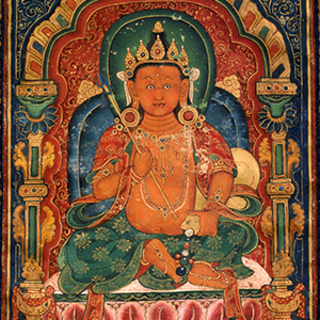
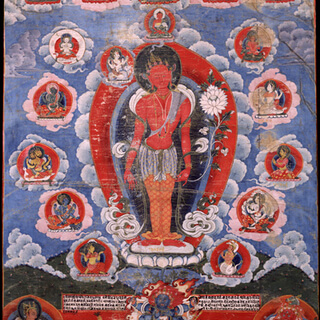
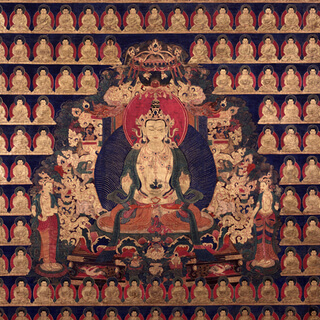
And that's this beautiful thangka mineral pigment on cloth of the central figure here is Dipamkara Buddha,
Origin from Nepal,
And it's dated 1853.
The medium is mineral pigment on cloth,
About 44 and a half into,
About 35 into 21 inches.
And this is a beautiful thangka painting.
And the connection to the theme,
Our theme for the month of self-discovery,
Dipamkara means lamp bearer in Sanskrit,
And Dipamkara lights the path towards greater awareness for all of us,
Helping us to discover our true identity,
Which is the root of awakening,
The wisdom,
The basic goodness,
The compassion,
The loving kindness.
This thangka,
Dipamkara,
Is known as the Buddha of the previous age.
He's associated with the age prior to the time of the historical Buddha Shakyamuni.
And Dipamkara is also in Tibetan known as Marme Ze,
Which means the one that lights up or the light.
You see here in this beautiful Nepalese style,
Which has a very red-on-red kind of painting.
And now here's a close-up look of the beautiful Dipamkara standing on a lotus pedestal.
The hand gesture of supreme generosity with the left hand in giving and the right hand sort of in the teaching and gesture.
Now,
If we look back here,
You will also see beautiful stories going around in this.
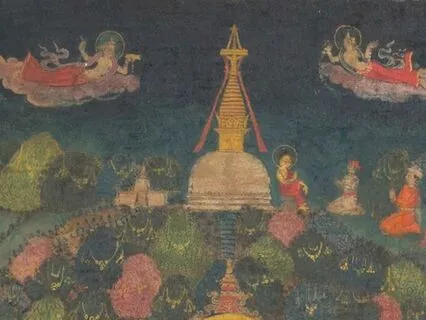
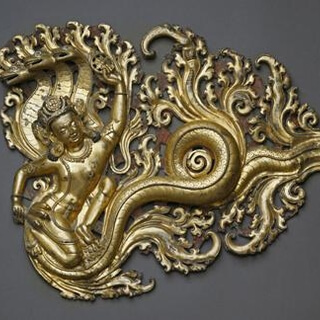
You also see the very popular figure of Garuda in the Nepalese art and a very playful figure of the lions underneath the standing Dipamkara.
And this stupa that you see here is the Swayambhu stupa,
One of the oldest stupa that dates back in the 5th century,
But it's restored.
If you have been to Nepal,
The Swayambhu stupa is something that is restored from the 14th or 15th century.
In Tibetan,
It's known as Papashinko.
So this painting was made in Nepal and depicts the Swayambhu stupa above the central figure.
We are able to precisely identify this painting by date because there's an inscription that reveals that it was commissioned in 1853.
The painting was most likely intended to be displayed in honor of a special almsgiving festival because Dipamkara is also revered in Nepal,
You know,
For almsgiving.
There's a special day.
And he's also revered by all schools of Buddhism,
The Theravada,
The Mahayana,
And the Vajrayana.
So let's bring on our teacher for today.
Our teacher is Lavina Shyamdasani.
Lavina Shyamdasani is a certified compassion teacher through the Compassion Institute and Stanford University.
She has taught programs focused on mindfulness,
Compassion,
Joy,
And gratitude,
And led book club discussions and meditations for over five years.
Lavina studied positive psychology coaching at the Holbein Institute and helps clients transform their lives and meet their personal and professional goals.
You can find Lavina at souljoybylavina.
Com.
Lavina,
Thank you so much for being here and please help me in welcoming Lavina Shyamdasani.
Hello,
Everyone,
And thank you,
Tashi,
For that warm welcome.
Thank you to the Rubin Museum for having me today.
And thank you to all of you for being here and taking time off to practice mindfulness meditation together.
It's an honor to be here with all of you.
And as Tashi pointed out,
The theme for the month is self-discovery.
And along that vein,
I thought,
What better conversation to have than about meditation,
Breath awareness meditation?
And so just a show of hands,
Who has a fairly regular mindfulness practice?
And I'm not surprised,
Not at all surprised.
And I realize I'm about to take the great risk of telling a lot of you what you probably already know.
And also,
There are so many revered teachers on the subject of meditation that I thought,
Why not share my own experience,
Sort of my own interpretation of breath awareness meditation and how it has helped me along my journey?
And so along the theme,
Again,
Of self-discovery,
To me,
Breath awareness meditation is all about beginning to really get to know yourself better,
To become your own best friend,
If you will,
And to show up for yourself in unconditional love and kindness.
And so how do we do this?
How do we get to know ourselves?
Well,
We have to really look deep within at our hearts,
At our minds,
And our thought patterns.
And if you will indulge me,
Just think of our minds as a butterfly,
Fluttering from one flower to the next,
From one thought to the next.
And as we all know,
To really catch a good glimpse of a butterfly,
We need silence and stillness,
Minimized distractions.
And as we really take in this butterfly,
Remembering to see clearly,
To look with honesty at the patterns of the wings,
The beautiful symmetry,
The vibrant colors,
And the blemishes,
Yes,
Even butterflies are not perfect.
And as we really get to know our thought patterns,
We start to understand what brings us joy and what doesn't.
We realize that that beautiful red petaled flower is not really fulfilling in terms of its nectar.
And perhaps we try another flower,
But sometimes we forget.
And we get trapped by the enigma of this red,
Beautiful flower,
Right,
FOMO for some of us in modern day technology.
But slowly we learn and catch ourselves in time to perhaps try another flower that brings us true joy.
There's some analogies here,
And I'm hoping everyone's following with me.
And so we get to know our strengths.
We get to know our weaknesses.
And we can magnify our strengths to live out our best lives and overcome,
Maybe compensate for our weaknesses,
Maybe even change our weaknesses.
Yes,
I truly feel like mindfulness,
Breath awareness practice can help us change.
And we really get to know ourselves.
We know exactly who we are,
The bright,
Beautiful wings,
The blemishes.
And if someone comes up to us and says,
You're the sun in all its splendor,
Or you're a dark snake,
We say,
No,
No,
No,
Who me?
We laugh.
You have the wrong person.
I'm simply a butterfly.
We learn that we're not invincible.
We're not eternal.
And we take in each day with gratitude and awareness,
Remembering that it takes a village to build this beautiful garden at all times.
And even with this strength and solidarity we might develop with a breath awareness practice,
There are moments when we feel diminished.
There are moments when we feel vulnerable.
Breath awareness practice helps us minimize those moments.
We learn how not to focus our energies on things that aren't very relevant,
And instead really follow the pursuit of our own happiness and passions.
But despite that,
There are days when we feel vulnerable,
When we feel stressed,
Let down.
And so here I want to introduce you to another type of meditation called analytical meditation.
And I would love a show of hands if anyone's heard of analytical meditation.
Okay,
So we have one person in the room.
And it's an ancient Buddhist practice of self-discovery.
And you don't need to have the breath awareness practice to do the analytical meditation.
But here we're really searching,
Probing,
And pondering what we know.
We're using facts and evidence to get to the truth of what really is.
We're applying logic and wisdom to uncover any exaggerations of the mind,
Right?
Because that's what the mind does.
The mind can blow up molehills into mountains.
And so why does the mind do this?
It's our instinctive way of self-protection,
Right?
It's our instinctive way to anticipate the worst in situations.
And to avert blame from ourselves,
Oh no,
I couldn't possibly have anything to do with this situation.
And so analytical meditation is about really diving deeper.
And so with your permission,
I thought we would try a few minutes of breath awareness meditation just to help us relax,
And then explore analytical meditation together.
I'm not going to tell you much more than actually we'll practice together.
But I invite you to ask questions afterwards,
Or possibly maybe even share how that went for you.
Remembering that when we're having these moments of vulnerability,
We say to ourselves,
Remember we're now our BFFs,
Right?
Our own BFFs.
And we say to ourselves,
Hey you,
What's going on?
Let's get on the cushion together.
Doesn't have to be a literal cushion,
But let's sit down and figure out what's really going on.
Now we will begin.
And I'm going to ask you to get into a comfortable position,
One that still supports sitting up straight and the natural flow of breath in and out of our bodies.
And you can either lower your gaze or close your eyes,
Whatever feels most comfortable to you,
Placing your hands in your lap,
Your feet firmly rooted on the ground,
And bringing your attention to your breath.
Really indulging in this gift that you've given yourself today,
30 minutes stillness and silence.
Noticing the sensations of the breath,
The rising and dropping of your chest,
The flow of air in and out of your nostrils.
And our mind as a butterfly,
If it wanders and rests on a flower,
Simply notice what's coming up for you today.
And paying homage to the thought,
Gently release the thought,
Never forcing the mind to stop thinking,
Simply acknowledging the thought and releasing.
And see if you can experience a little stretch of thoughtlessness from one flower to another,
From one thought to another,
Some quiet,
Really tuning into this quiet,
Experiencing the simplicity of your consciousness,
Awareness,
Really getting to know that inner voice.
You maybe have to get a million things done before the course of the day is over.
And trusting yourself,
Yes,
I see what I'm worried about,
And I'll get to it.
But for now,
Gently releasing.
And now releasing the focus on your breath,
Bring to mind something,
An event that is causing you some distress.
And see if you can place this event into a little spherical bubble,
Separating it from yourself,
Remembering that this is just another day and not a reflection of who you are.
You are very much whole and very much loved.
And now really notice the essence of this situation.
How does it show up for you?
Where do you feel it the most?
And if you find yourself feeling it very much in your heart center,
Maybe placing a hand on your heart center,
Noticing how it shows up for you in the mind.
And now ask yourself,
Do you really know all the details of this situation?
Are there any knowledge gaps that you need to verify?
Are you certain that your thoughts and conclusions are supported by facts?
Or are they mental exaggerations,
Making a mental note of any further investigations you might want to explore?
Can you think of a time when you overcame a similar situation and,
In fact,
Are better off for it?
How did you do that?
Now ask yourself,
What can you learn from this situation?
What is it teaching you about yourself?
Ponder the fact that many others have experienced or might be currently experiencing what you are going through now.
You are not alone.
And now really ponder,
How significant is this event in your life today?
Will it really matter a few years from now?
And following that,
Ask yourself,
What might you want to do about this situation?
How might you respond in a way that is helpful to you and others?
Noticing what has come up for you as you've asked yourself these questions,
Making any mental notes for new insights or plans of action,
Sometimes thinking about just one small step to help yourself.
And sometimes the answer is to do nothing,
And releasing the visualization and thoughts around the event,
And just enjoying the breath,
Remembering that you are complete just as you are,
Filled with infinite strength to overcome.
And when you're ready,
Gently open your eyes.
Thank you so much for that,
Loving man.
That concludes this week's practice.
To support The Rubin and this meditation series,
We invite you to become a member at rubinmuseum.
Org slash membership.
And to stay up to date with The Rubin Museum's virtual and in-person offerings,
Sign up for a monthly newsletter at rubinmuseum.
Org slash enews.
I am Tashi Chodron.
Thank you so much for listening.
Have a mindful day.