Welcome to the Mindfulness Meditation Podcast presented by the Rubin Museum of Art.
We are a museum in Chelsea,
New York City that connects visitors to the art and ideas of the Himalayas and serves as a space for reflection and personal transformation.
I'm your host,
Tashi Chodron.
Every Thursday we present a meditation session inspired by a different artwork from the Rubin Museum's collection and led by a prominent meditation teacher from the New York area.
This podcast is a recording of our weekly in-person practice.
In the description for each episode,
You will find information about the theme for that week's session,
Including an image of the related artwork.
Our Mindfulness Meditation Podcast is presented in partnership with Sharon Salzberg and teachers from the New York Inside Meditation Center,
The Interdependence Project and Parabola magazine and supported by the Frederic P.
Lenz Foundation for American Buddhism.
And now,
Please enjoy your practice.
Good afternoon,
Everyone,
And Tashi Delek,
And welcome.
Welcome to the return of in-person mindfulness meditation with Rubin Museum of Art.
I'm Tashi Chodron,
Himalayan Programs and Communities Ambassador.
So welcome,
And we are a museum of Himalayan art and ideas in New York City,
And we're so glad to have all of you join us for this weekly program where we combine art and meditation.
Inspired from our collection,
We will first take a look at work of art from our collection.
We will then hear a brief talk from our teacher,
And we're so happy to have our teacher,
Tracy Cochran,
Back.
And then we will have a short sit,
15 to 20 minutes,
For the meditation guided by her.
So let's look at today's art and the theme.
This month,
It's the first Thursday of this month,
So we will be exploring on the theme of compassion.
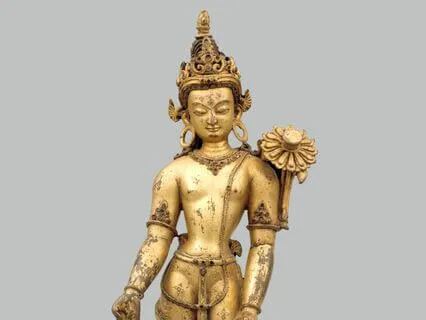
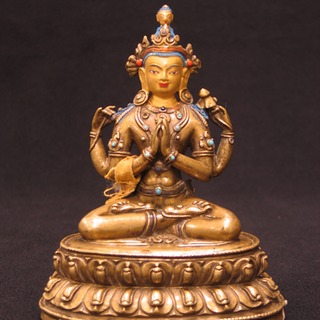
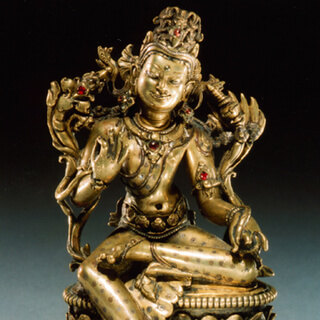
And the art connection for today is the Bodhisattva Avalokiteshvara.
And so,
As I've mentioned in the past,
The art is handpicked by our teacher,
And today is one of those very special day where the art is so beautifully connected to this auspicious day because Avalokiteshvara is Buddha of compassion,
Where the connection to Dalai Lama.
Dalai Lama is known to be the emanation of Avalokiteshvara.
And then Avalokiteshvara is also the patron deity of Tibet.
So it's such a beautiful,
Whether you call it coincidence or meant to be,
And it's so special.
And I was telling Tracy earlier that she has omniscient mind where,
You know,
She picked this not knowing today actually falls on this very auspicious special day of Dalai Lama's birthday.
And so this is origin from Nepal.
It's about 13th to 14th century.
Medium is gilt copper alloy with semi-precious stones inlay,
About 16 and a half into 6 and a half into about three inches.
And the connection to the theme is Avalokiteshvara is the Bodhisattva of compassion,
And he's known to be the most popular of all Bodhisattvas,
Beloved for his infinite compassion.
Avalokiteshvara,
As I mentioned,
Is the patron deity of Tibet,
And Avalokiteshvara in Nepalese language is known as Padma Pani,
Means lotus holder.
And in terms of iconography,
How you can identify that he is also the Bodhisattva is you look at how all the jewels like armlets,
Anklets,
Bracelets,
Necklaces,
Belt,
Crown,
So all this very visual,
And that's how you can identify that it's a Bodhisattva figure.
And it's a beautiful,
You know,
Aesthetic from Nepalese art where some of the signature look of Nepalese art are these hoop-like earrings,
Which are still in fashion,
Isn't it?
You know,
These are hundreds of years old,
And hoop-like earrings,
And then if you look from the sideways,
It's often in a beautiful way they refer it as hawk or beak-like nose.
Very interesting.
And those are some of the signature look of how you can identify that it's Nehwari or Nepalese art.
And then the crowns and the stone inlays and the translucent,
You know,
Drapery.
So these are some of the Nepalese art aesthetic.
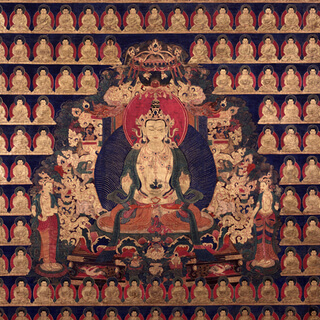
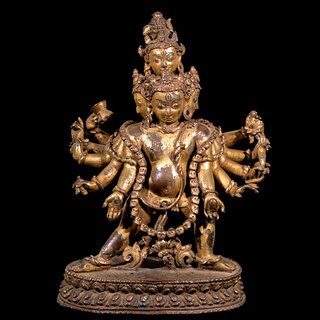
And Avalokiteshvara manifests in many different forms.
Some of you may have heard he appears in four arms,
Six arms,
And 1,
000 arms,
And 1,
000 eyes,
11-headed.
And so today's art,
As you saw earlier,
Is a simple standing in two arms.
And let's bring on our teacher for today.
And our teacher is Tracy Cochran.
Tracy has taught mindfulness meditation and mindful writing at the Rubin Museum of Art and the New York Insight Meditation Center,
As well as in schools,
Corporations,
And other venues worldwide.
She's also a writer and editorial director of Parabola,
An acclaimed quarterly magazine that seeks to bring timeless spiritual wisdom to the burning questions of the day.
Her writing and podcast and other details can be found on her website and on parabola.
Org.
Tracy,
Thank you so much for being here.
Please help me in welcoming Tracy.
I'm delighted to be here.
And I was so excited when Tashi told me it's his,
You know,
It's the Dalai Lama's birthday because I didn't know this when I picked this beautiful image,
But it's always good to know that you have a deeper mind under your mind.
Under my mind that was worried about train times and heat,
There's this deeper mind that we share.
And I picked the image because it's so beautiful and I feel that we all need a friend right now.
We all need a friend.
And we have these great ideas,
Wonderful,
Exalted ideas about emptiness and so forth,
But there's something about compassion and this embodied compassion that we really need to meet us on the way.
And Tashi has met the Dalai Lama,
So have I,
As a journalist.
I didn't expect to share this today,
But I met him in a small group of international different journalists from different countries.
And I could see that he has a quality that the bodhisattva of compassion is supposed to have,
Which is that he could meet everyone where they were,
Exactly where they were.
So there were people approaching him with great reverence,
Tibetan,
Other Asian people,
And he met them with great,
You know,
In kind.
And on the other hand,
There were some Americans there,
Not me,
I'm not pointing the finger at me,
But who were really coming from a different place,
Shall we say.
And he met them in a very direct,
Very matter-of-fact way,
You know,
Like,
Go sit down.
But then he saw my husband,
Who was with me,
Also a journalist,
He was being led away.
We got to take hands with him,
Not my husband.
He was being led away,
And he looked back and he saw that my husband was hurt,
Disappointed,
And he shook off his handlers,
And he came back,
And he took his hand in both hands,
And looked at him for a long time,
Giving him what he needed.
And it so beautifully embodied what this image,
In a way,
Embodied to me,
That this figure doesn't look warlike,
He's not armed,
He's holding out a lotus,
He's holding out this reminder that even on your worst day,
There's something beautiful inside you,
Waiting to be born,
Waiting to be remembered.
Under the small mind that's freaking out,
There's a larger mind that remembers a greater presence,
A greater connection.
And it struck me,
It strikes me more and more,
The older I get and the more I practice,
That there's something inside all of us.
Well,
There was a story in the news a few weeks ago,
This is really an illuminating contrast,
A business owner in California,
He owned a taco restaurant,
Was a wrongdoer,
And he decided to hire a fake priest to come in and take confession from his employees,
Most of whom were immigrants from Mexico or Central or South America,
So they're from a Catholic background.
And this pretend priest would say,
Have you been late to work?
Have you stolen money from this taco restaurant?
Are you thinking about it?
Have you ever thought about it?
And it seems like such a jarring thing to share,
After the beauty of the Dalai Lama and this figure,
But it reminded me that the way we often practice,
Or I'll use I statements,
I do,
There's a tendency to think that we are being judged or that we are seeking approval from outside,
From some higher authority or even from our friends.
How do I come across?
When something painful comes up,
Anger,
Sadness,
Disappointment,
Some greed or grasping,
We fear that it will be discovered or we want to get rid of it as soon as possible.
And this is what our practice is for,
Right?
To get rid of these things that cause us pain.
And it strikes me as I go how different it feels to imagine and finally to know that there is this force of compassion,
This great force of compassion that sees me and accepts me exactly as I am.
Exactly as I am.
And that's not to say,
You know,
Always taking my side,
Not like that,
But walking beside me,
Walking with me.
I see you.
You're acceptable.
It's like this now,
But there's more to you.
There's something beyond your ignorance and your grasping,
Your fear and your hatred.
I see you.
So the Dalai Lama certainly embodies that for me.
I saw him meeting people.
And I have found in this practice that we're about to do,
There's that quality too.
There's something in this presence that we're about to share that accepts us in a loving way exactly as we are.
So let's sit together and experience for ourselves and taking a comfortable seat,
Which I've come to know is actually a serious instruction to allow yourself to feel at home here,
In this place,
In this body,
On this day.
And letting your eyes close,
Just notice what's here.
Noticing that there's an awareness here,
That you don't have to search for or seek.
It's here.
That can take in an impression of how it is to be here without thinking about it.
Noticing how it feels to be seen by an awareness that doesn't comment or judge,
Just receives.
Just let yourself rest in stillness,
Which doesn't mean perfect silence inside,
But softness,
Not resisting,
Letting things be exactly as they are.
And notice that there's an aliveness here inside you and outside that's very gentle,
Open,
Awake.
When you find yourself drifting into thinking and picturing and planning and dreaming,
Notice that this is natural and also an opportunity to come back to the body,
To the sensation of sitting here,
Breathing,
Present.
Just let yourself sink into sensation,
Noticing that there's an awareness here that touches sensation,
That's open like the sky.
Notice how it feels to let go of striving,
To let yourself be just like this,
Acceptable,
Worthy of interest and compassion.
Just rest in this compassionate awareness.
You can begin again with the next breath.
Come home to the body,
To the sensation of being here.
And notice that you are completely welcome,
Acceptable,
Lovable.
Notice how it feels to let everything be accepted,
The going away and the coming back,
Every feeling,
Every impulse and thought accepted,
Human,
Understandable,
Not in words but in this field of compassionate awareness.
Notice that this simple movement of return,
Coming back to the body,
To the feet on the floor,
The rhythm of the breath,
Also opens us to this greater attention,
This compassionate awareness.
Notice that the stillness that surrounds us,
That's deep inside us,
Isn't an absence but very alive,
Seeing,
Sensing,
Listening.
Notice that you can come back to this compassionate awareness,
This presence at any moment.
Just let yourself be just like this.
Come back to sensation,
To being present.
And notice that you're being received,
Seen,
Held in awareness.
And notice how it feels to not feel so alone but with a presence,
An awareness that doesn't stop with your skin,
Something we share.
It's how it feels to let yourself soften and be still,
To treat yourself with great gentleness and acceptance and compassion.
Know that you belong.
You're welcome here.
Thank you so much for that beautiful sitting,
Tracy.
That concludes this week's practice.
To support the Rubin and this meditation series,
We invite you to become a member at rubinmuseum.
Org membership.
If you are looking for more inspiring content,
Please check out our other podcast,
Awaken,
Which uses art to explore the dynamic paths to enlightenment and what it means to wake up.
Season two,
Hosted by Raveena Arora,
Is out now and explores the transformative power of emotions using a mandala as a guide,
Available wherever you listen to podcasts.
And to stay up to date with the Rubin Museum's virtual and in-person offerings,
Sign up for a monthly newsletter at rubinmuseum.
Org slash e-news.
I am Tashi Chodron.
Thank you so much for listening.
Have a mindful day.