Welcome to the Mindfulness Meditation Podcast presented by the Rubin Museum of Art.
We are a museum in Chelsea,
New York City that connects visitors to the art and ideas of the Himalayas and serves as a space for reflection and personal transformation.
I'm your host,
Tashi Chodron.
Every Thursday we present a meditation session inspired by a different artwork from the Rubin Museum's collection and led by a prominent meditation teacher from the New York area.
This podcast is a recording of our weekly in-person practice.
In the description for each episode,
You will find information about the theme for that week's session,
Including an image of the related artwork.
Our Mindfulness Meditation Podcast is presented in partnership with Sharon Salzberg and teachers from the New York Inside Meditation Center,
The Interdependence Project and Parabola magazine and supported by the Frederic P.
Lenz Foundation for American Buddhism.
And now,
Please enjoy your practice.
Hello everybody,
Tashi Delek and welcome to the return of in-person mindfulness meditation with the Rubin Museum of Art.
I am Tashi Chodron,
Himalayan Programs and Communities Ambassador.
I'm so happy to be your host today.
Wow,
It's June already and in June we celebrate pride and in the Himalayas and the Himalayan communities here in New York and New Jersey,
We've been celebrating Sakadawa,
Which is one of the very important spiritual significant month in the Tibetan Buddhist calendar and that falls actually in the fourth month of Tibetan calendar.
The significance of the holy month is this is the month,
The fourth month is where the Buddha was born as well as reached enlightenment and Mahaparinirvana,
He passed away on the same month,
Of course,
After many,
Many years each occasion.
So for those of you who are first time,
We are a museum of Himalayan art and ideas in New York City and we're so glad to have all of you join us for this weekly program where we combine art and meditation.
Inspired from a collection,
We will first take a look at a work of art from a collection.
We will then hear a brief talk from our teacher,
From a spirituality week teacher,
Victoria Davis and then we will have a short set,
15 to 20 minutes for the meditation guided by her.
Now,
Let's take a look at today's theme and artwork.
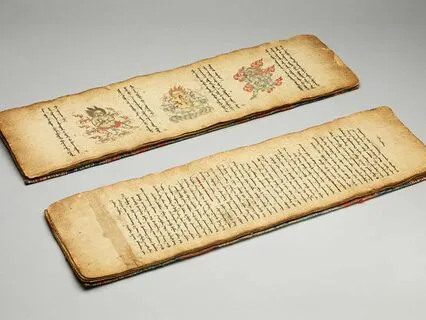
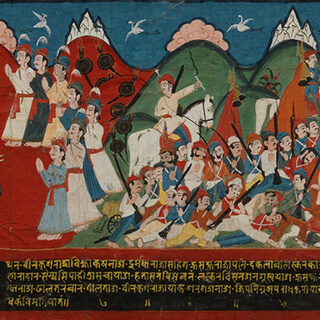
We have been following the most newest exhibition called Death is Not the End and as part of that we select the monthly theme and so for this month the theme is impermanence and the art connection for today's theme is this beautiful illustrated manuscript of the liberation through hearing in the intermediate state which is called Pardo or in fact Pardo Tödril,
Liberation upon hearing and this is origin from Mongolia.
It's 19th century mineral pigments and ink on paper and is about 7 3 by 8 into 24 1 by 4 into 1 1 8 inches.
This is a beautiful manuscript with mineral pigment and ink.
The Pardo Tödril,
Commonly known in the West as the Tibetan book of the dead,
Is a Therma text discovered by Tertön Kamalingpa in the 14th century.
Padmasambhava hid many treasures called Therma and then along with Lady Yeshe Tsogya and treasure revealers were born to reveal the treasures to benefit future generations and they are known as Tertön.
In 1927 the text was one of the first examples of both Tibetan and Vajrayana literature to be translated into a European language and arguably continues to this day to be the best known.
This manuscript,
Origin Mongolia manuscript of the Tibetan book of the dead,
A guide to navigating the intermediate state of consciousness between death and rebirth,
Features a vertical Uyghur-based Mongolian script that was instituted by order of Genghis Khan in the early 13th century.
Painted illustrations translate the written word into easily recognized and memorable forms and shapes,
Both peaceful and fierce-wrathful,
That are meant to be visualized during the practice in preparation for one's own death or as part of the ritual at someone else's death performed by a ritual specialist.
In the bottom folio,
Various female forms are depicted in active postures,
Each with a different animal head and body color.
The colors relate to elements such as fire,
Air,
And earth and the animal heads are derived from the Central Asian species of wild game along with iconic Indian animals such as the elephant and boar.
The text describes and is intended to guide one through the experiences that the consciousness has after death in the Pardho,
The interval between death and the next rebirth.
The text also includes chapters on the signs of death and rituals to undertake when death is closing in or has taken place.
The text can be used as either an advanced practice for trained meditators or to support the uninitiated during the death experience.
And now let's bring on our Spirituality Week teacher today.
Our teacher is Victoria Davis.
Victoria Davis is the founder of Wellspring Mind,
A New York-based company offering in-office meditation and genuine happiness training.
Victoria is an avid meditator,
Yogi,
And mental health advocate with a mind labeled obsessive,
Compulsive,
And disordered.
Before the age of 10,
Victoria was an early adopter of mindfulness and movement-based practices for mental flourishing.
She first turned to the Buddha Dharma in 2012 and has dedicated her life to sharing practices that settle body,
Speech,
And mind in the cultivation of genuine happiness.
Victoria,
Thanks so much for being here.
Please help me in welcoming Victoria.
Hello.
So today,
I have the great honor and the privilege of being able to teach.
And I also have the great,
Let's call it an honor and privilege of teaching a little bit about one of the most important texts in Tibetan Buddhism or any Buddhism globally,
Which is quite the endeavor.
My presentation on this,
I'm just going to explain to you a little bit about what I understand about the Bardo Todol,
The Tibetan Book of the Dead.
What happens when we die and why is it important that we look at what happens when we die when we're living?
Because when we look at death,
What is implied?
Instead of life implying death,
Perhaps death implies life.
But the biggest thing that it really implies is that everything is changing all the time.
And so when we look at something like impermanence,
What does that imply?
Impermanence then implies karma.
What does karma imply?
Karma implies dependent arising.
What does dependent arising imply?
That implies emptiness.
So if we start from the back and we just give everything a little bit of a definition,
We bring us back to where we are right now.
Emptiness.
Is emptiness a void?
Is it negative space?
Absolutely not.
Emptiness itself is creative effulgence.
Coming from a dependent origination.
Where do these images,
Appearances,
Experiences,
How do they manifest?
They arise dependently upon what?
Causes and conditions.
Karma that we plant.
These imprints then we water or not.
If we water them appropriately,
They ripen into sound,
Thoughts,
Speech.
Everything that we experience in this life,
Which then becomes impermanent.
Just like birth,
Life,
Death.
How do we know we will die?
Because we were born.
How do we know we're going to be born?
If you're in the Buddhist lineage or something similar,
It's because we've died.
Right?
So then when we begin to look at the bardo,
Specifically the bardo of death,
Of dying,
What happens?
Creative effulgence happens.
These wrathful deities after the peaceful deities.
Once we recognize what these wrathful and peaceful deities are,
In your mind if you're creating a parallel between the bardo of dying and the bardo of life,
Of living,
You might be quite accurate here.
If everything we experience then is a creative effulgence coming from our own mind,
Fantastic.
Then perhaps recognition is simultaneous to liberation.
Because once we recognize that everything is impermanent based upon our karma,
Based upon dependent origination,
Based upon emptiness,
And then we can take that all the way back to say,
If everything that is empty because everything is empty is arising dependently and it's based upon my karma so everything is impermanent,
And if I'm making it all up anyway,
Fantastic.
Isn't that great?
Why aren't we always meditating on impermanence?
Because that then means if what we experience in the bardo of dying,
If what we really experience then in the thereafter when we review our life,
We have this grand opportunity.
When we recognize that everything we experience,
Embody speech and mind,
Whether we're here on this earth or we are wherever the next place is,
If we recognize then that that is creative effulgence and is what I myself am creating in the space of this mind,
Then maybe recognition and liberation are simultaneous.
Let's find out.
How about we meditate?
Coming into your comfortable seated position.
And what defines comfort for you here?
Let's just take a moment with the posture.
With your seat firmly rooted into the cushion beneath you,
Allow your spine to be straight.
If you need to sit up in your seat,
That's just fine.
In this first minute or so,
If you need to shift around,
No problem.
Let's take a collective deep breath.
And if you want to breathe out the mouth and make a noise,
You're welcome to it.
Your feet firmly rooted into the ground.
Your seat also rooted.
Spine is straight.
Arms are resting.
Perhaps your hands are pressing down into your legs.
Grounding the body.
Stabilizing this foundation.
Recognize this earth element anywhere you notice pressure,
Weight,
This stability that is always supporting and upholding you.
Maintaining this mindfulness of this physical form.
Now,
What does mindfulness mean?
Mindful.
One definition,
To bear in mind,
To not forget.
Ah,
This is my body.
Okay.
Feel that.
Now,
What else do you notice in the space of this body?
Perhaps movement.
Can you feel the abdomen expand naturally and gradually as you inhale?
Can you feel it contract just gently on the exhalation?
And if you can't quite feel that,
This is the invitation to relax a little more deeply.
We're not changing anything here.
We are becoming aware.
Mindfully aware.
Of these passing and changing sensations.
You see a theme here?
Each moment of the inhalation slightly different than the one before.
Each moment of the exhalation slightly different than the one after.
This body in its micro cues is our greatest demonstration of impermanence.
And if you notice,
As you stabilize this awareness,
That you become a little lax,
Inhale just a little deeper.
Brighten it up.
And if you notice that your mind is reciting anything else,
Take a long exhalation.
Let that go.
And then you can let go of the breath.
Let that go.
And then tune back in to the grounding sensations of this physical body.
If hot air is rising and putting your mind into hyperdrive,
Bring it back down.
Ground down through your feet.
If you notice tension or discomfort,
These too are impermanent.
If you want to help that cycle along,
Allow your breath to be drawn to that space as though magnetically.
And then on the exhalation,
Release that tension,
That discomfort,
Allowing it to leave your body completely.
Cultivating mindfulness in this way polishes our lens through which we see everything through the changing sensations in our bodies or changing feelings,
Thoughts,
Behaviors,
Desires,
And even the changing sounds of the environment.
If you don't like it,
It's going to change.
If you do like it,
It's also going to change.
Recognizing even how that makes you feel,
That's information.
And through the power of your own mind,
Perhaps utilizing the breath as a tool,
You can ease the body,
Ease these feelings,
And continue to gain a greater understanding of the true nature of everything.
Pain implies pleasure,
Just as life implies death,
Or should we say,
Death implies life.
Your body,
This room,
And my voice are all the creative effulgence of your own mind.
Tune back into this body.
Whatever it is,
You may notice.
If you don't like it,
No problem.
It's going to change.
Tune back in to this breath,
Its movement as a helpful anchor for guiding your attention,
This inhalation as a helpful ally to energize and brighten.
And this exhalation,
A close companion to ease and release.
As we polish this lens,
Through the practice of mindfulness,
We begin to see clearly the true nature of absolutely everything that also implies the true nature of the mind.
Shifting,
Changing,
Arriving and becoming,
Observing,
And just being of its own effulgence.
This radical creativity that is everything inside and around.
Now together,
Let's take a deep breath in.
And when you feel ready,
Open your eyes.
Thank you so much for that beautiful session,
Victoria.
That concludes this week's practice.
To support the Rubin and this meditation series,
We invite you to become a member at rubinmuseum.
Org slash membership.
If you are looking for more inspiring content,
Please check out our other podcast,
Awaken,
Which uses art to explore the dynamic paths to enlightenment and what it means to wake up.
Season two,
Hosted by Raveena Arora,
Is out now and explores the transformative power of emotions using a mandala as a guide.
Available wherever you listen to podcasts.
And to stay up to date with the Rubin Museum's virtual and in-person offerings,
Sign up for a monthly newsletter at rubinmuseum.
Org slash e-news.
I am Tashi Chodron.
Thank you so much for listening.
Have a mindful day.