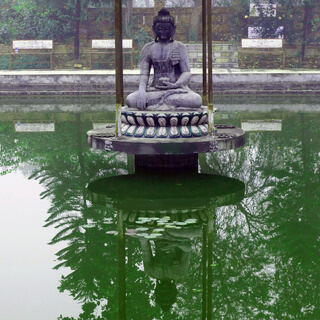
You are listening to The Adventures of Saraputa and Mogulana.
I'm your host,
Morris Sullivan.
I'll be joined today by a special guest,
Filmmaker Eugeiro Seki.
We'll talk about his film,
Carving the Divine.
My conversation with him reminded me of one of my favorite passages from the Dhammapada.
So let me tell you that story first.
So there was a Samanera,
A novice named Sukha,
Who became a novice at age seven.
So let me explain this.
The Buddha allowed ordination at that early age,
But these boys would remain novices,
Not fully ordained monks.
In many Buddhist countries,
You'll still see young people ordained at that age to get an education and things like that.
The rules are not quite as demanding for them as they were for monks,
And I suppose it's probably less complicated if they want to return to household or life,
Too.
Then anyway,
On the eighth day,
After he received novice ordination,
Sukha went with Saraputa on an alms round.
As they were walking along,
They saw various people going about their daily tasks.
There were farmers digging channels to irrigate their fields,
Carpenters shaping wagon wheels,
And fletchers,
Arrow makers,
Straightening the shafts so their arrows would fly straight.
Well seeing all this,
He asked Saraputa,
Can people really make these inanimate objects into what they want and guide them to go where they wish?
And Saraputa said,
Well,
Yes,
They can do that.
So this bright young novice thought about this,
And it occurred to him,
If you can shape a stick into an arrow that will fly true,
Then there's no reason you can't train your mind to realize insight,
To shape it so that it goes where you want it to go.
Once back at the monastery,
He shut himself up in his room and began to meditate.
Saraputa stayed close by to help keep the area quiet so that Sukha wouldn't be disturbed.
And before long,
The novice had become an arahant.
The seven-year-old had reached the final stage of the path and become fully enlightened.
Later the Buddha talked about Sukha's attainment.
The irrigator channels the water.
The Fletcher straightens the arrow.
Carpenter shapes the wood,
He said.
The wise one trains himself.
Well our guest today is a great example of how the wise train themselves.
Yujiro Seki vowed to master the art of film,
And then he turned his attention to the lineage of Japanese woodcarvers.
The result is a beautiful movie,
Carving the Divine,
That documents the discipline behind the beautiful statues in Japanese temples.
I think you'll enjoy hearing about him and about his creative process and its relationship to Buddhism.
Thank you so much for being with me.
This is great that you're able to do this.
I'd like you to start just kind of frame this in the context of your spiritual life.
What could you just tell me a little bit about your spiritual path?
Well when I was a young girl,
I didn't think anything about spirituality.
And Japan is a very secular country and many people don't care so much about spirituality.
And yeah,
It was until I came to the United States and I saw Japan from outside and I was able to see how I grew up and also Japan has a deep history of spirituality we take for granted.
So coming from that perspective,
And also I've worked on Buddhist sculptures of Japan,
The documentary,
I was able to learn a lot about spirituality.
And also I went through some illness for myself.
And when you become ill and when you kind of face,
Maybe you're going to die and stuff like that,
Then you have a tendency.
I think many people have a tendency to see something beyond what we can see,
What we can hear,
What we can smell,
Because what we normally face in our daily life is something practical.
Even what's going on right now in the world,
At this moment,
Either it's a COVID,
Black Lives Matter,
Or who's a president or something like that.
It's basically a temporal thing.
It does not go beyond our own existence.
And when I think about that,
Is life really worth it?
Or we can make some difference in life,
But what is that supposed to mean?
So this kind of question that I asked and I studied different religious traditions around the world,
Including Buddhism.
And there are so many wisdom human beings have created over the years,
Millenniums.
And I'm fascinated by it.
And I identify myself as an artist because I am creating something and I want to make a difference by creating things.
That's the purpose of my life,
To create things.
But at the same time,
I try to look for truth.
What is the truth?
By learning about the spirituality and the religion and the philosophy,
I question myself all the time,
What's the truth?
In this world,
I think we focus on what's practical again.
Science became,
In my opinion,
Is another form of religion.
Science can answer one type of question according to the formula that they came up with,
But many things science cannot answer.
So this is kind of what I stand.
And if you ask me if I'm a Buddhist or not,
If we're looking for the truth and trying to find out the truth,
Is to be a Buddhist.
Maybe I'm a Buddhist,
But I don't like to categorize myself.
I don't need to belong to any group to look for that path.
I understand completely.
Personally,
As a Dharma teacher,
I would rather someone not identify as a Buddhist and live a Buddhist life than to call themselves a Buddhist and not really do anything with that.
I think your expression of yourself as an artist,
I think that's a beautiful way of living creatively,
Which to me is what Buddhism is about.
Here's the thing,
Japanese people call themselves Buddhist.
It's for the convenience.
In the past,
We are forced to belong to a particular sect of Buddhism.
So maybe your parents or grandparents,
They belong to Shingon Buddhism,
Then you are a Shingon Buddhist.
If your family belongs to Zen Buddhism,
Then you are a Zen Buddhist.
And most of the people don't realize they're Buddhist or how they're going to do about it until some of your family members die.
Then they say,
Oh,
What am I going to do?
Which temple do we belong to?
So that's how Japanese people in the 21st century already operate.
Maybe in the past,
People are more spiritual,
People care about other things other than just the funerals.
My parents,
My dad,
My father is a Buddhist furniture maker,
Buddhist Buddha maker.
So I was surrounded by Buddhist object ever since that I was little,
But it was just a family business.
I didn't think anything of it,
But I think I was very affiliated with Buddhism ever since that I was little.
My father took me to temples all over the place,
And the environment that I grew up in was very special.
But I didn't think anything of it.
I think that's the difference between Japanese people and the people who practice different religious tradition in the West.
I think if I was born in West and be in the environment as I was,
Probably my family would be more spiritual or religious,
But it was not the case in Japan.
How long did you live in the United States?
I mean,
About 10 years.
I went to university and I worked there as a video director and all this.
So yes.
Yeah.
I don't know that it's that different for most people in the US.
You grow up,
Your family's Baptist or Catholic or whatever,
And so you identify as Baptist or Catholic.
And maybe you go to church once in a while,
Unless you like what you experienced,
Where suddenly you go,
Maybe I should think about what else lies beyond this,
Then all of a sudden it becomes interesting.
Do you find yourself attracted to or more comfortable with a certain school of Buddhism than others?
At this point,
I find each individual sect very inspiring.
I don't take any size or I don't belong to any group,
As I said.
There's a beauty in everything,
In my opinion,
Because the path they're trying to get to,
Maybe it's the same path,
But they were trying to find a different way to achieve that path.
As probably we know,
Meditation or Shinkantaza is not for everybody.
Maybe Nama-Midabutsu is the best way to go for some people or Daimoku.
Or simply go to Shingon temple and follow their way.
So if you become a Shingon monk,
You have many options out there.
This is only for Japanese culture,
But you can go to Tibetan culture,
Tibetan Buddhism,
Or even Televada,
Many options.
In the end,
I think we're looking for this one thing.
I don't know what that is.
So with that being said,
Maybe one day I'll find one particular sect more favorable than others.
But at this point,
I'm still learning stage.
So I want to talk about the documentary that you're working on.
When did you decide that you wanted to make a documentary about Japanese Buddhist woodcarvers?
Was there some particular thing that gave you the idea?
Well,
I think I mentioned that a little bit,
But ever since that I was little,
I was surrounded by Buddhist objects.
My father was a Buddha maker and all this.
And I didn't really realize that environment that I grew up in was somewhat special.
And I made a detective film when I was in high school.
And that was the time that I thought,
Wow,
This process of filmmaking is amazing.
So I decided to go to the United States and study cinema.
And in the beginning,
I wanted to make something cool,
Something like that.
But as I grew a little older and older and meet people from different cultures and learn about different traditions,
And I saw Japan from outside for the first time in my life,
I realized that the environment that I grew up in was somewhat special.
So I worked in Los Angeles in a design company as a director of video department.
And I made videos for business,
Businesses,
Commercials and promotional videos and all this.
And I wanted to be a filmmaker to make the film that inspires people,
But it was just kind of far away from that I originally envisioned about being a filmmaker.
This glorious,
Honorable job was not really something that I was expecting,
But it paid the bill.
It was kind of nice.
And if I am comfortable doing what I'm doing,
Then I'll be like this for the rest of my life and I'll never do anything.
So at least once in my lifetime,
I wanted to do something meaningful to myself,
To my people and to the world.
And I saw Buddhist sculptors of Japan as a perfect subject to work on.
And I can only do it,
I thought,
Because of my family connection,
I had access to bushi,
Japanese Buddhist sculptors and also temples.
You know,
Normally you are not allowed to go inside of the outer area,
But I was able to go to the outer area and shoot the very amazing footage.
And it's just something called,
Call me to do this.
So it's a number of reasons,
But that's how I started this long journey of making and carving the divine Buddhist sculptors of Japan.
You know,
Japanese Buddhism has kind of a special quality,
I think,
In that there are things where people really incorporate what they do as an expression of their spiritual practice.
It sounds to me like you're doing that with film,
The way a woodcarver does that with wood.
Even though you're not identifying yourself as a Buddhist,
It sounds like you're really seeing a parallel there between what the woodcarvers do and what you do in terms of expressing your spirituality.
Maybe subconsciously or unconsciously,
But you know,
Initially that was not my objective,
But it's a journey.
As I work on it more,
I realize how deep the tradition is,
How much wisdom the people put into for this particular art.
You know,
The art of confronting human suffering face to face,
1400 years old in Japan.
You know,
Buddhism is 2500 years or more,
But you know,
This particular statue tradition has been in Japan for 1400 years,
Very silently.
You know,
It's kind of in the background,
But it's always there.
And it's probably not going to go away anytime soon.
So it's a heart and soul of Japanese people.
So you know,
That's why I fight for it every day.
It's not just because it's a cool film.
People ask me,
What are you going to do next?
What are you going to work on,
You know,
Next for next project?
I say,
I don't know,
Because I got to put this work out there first.
I cannot think of anything else.
That's really interesting what you said about it being there and sort of quiet in the background.
You know,
You think of Buddhism in any spiritual practice,
Really,
And the people who come to mind are the people who give the Dharma talks and that kind of thing,
The people you see in the,
To use theatrical terms,
In the front of the house.
And yet,
You know,
The whole shape and context of Buddhist practice where you are is largely created by these people that are sort of quietly working in the background.
Yes,
Yes.
It could be very in your face for some people,
But for majority of the Japanese people,
They don't even think about it.
But,
You know,
When you go to Japan,
You see those statues everywhere,
Like on the street,
Temples,
In the household.
And it means a whole lot for Japanese people.
Do you have a favorite one?
Is there one that,
You know,
When you think of these statues that immediately comes to mind that talks to your heart?
Well,
Again,
I don't want to take it off,
Take any sides,
But,
You know,
I like,
You know,
Fudomi or statue.
Yeah,
It speaks to me,
You know,
Because,
You know,
I'm filled with a desire,
You know,
And I have to have my desire burned by the fire in the background and maybe,
You know,
That Fudomi can raffle me and just to put the rope around my neck and try to correct me when I'm being straight away.
And,
You know,
Just speaks to me.
You know,
That's interesting because he's one of my favorite Dharma protectors also.
And in fact,
I'm actually thinking about getting a tattoo of Fudo on my forearm as a reminder that,
Look,
You know,
The defilements are here and I need to be really taking,
You know,
Making a point to keep cutting those away myself,
But also,
You know,
In the community around me.
You called the lineage and practicing of wood carving as integral to Japanese Buddhism.
And I think we talked about that.
You said it's like the beating heart of Japanese Mahayana Buddhism,
Which is such a beautiful way of talking about it.
Could you explain more what you mean by that?
Well,
First of all,
Statues and,
You know,
Many Buddhas and bodhisattvas and wisdom kings and celestial beings and all this,
They are not Theravada tradition.
They are Mahinaya tradition.
So that's one thing.
And you know,
Japanese Buddhism is primarily Mahayana tradition.
And people can say it's a Virgina and,
You know,
Sutriyana and all this.
If people want to argue with the minor details,
That's fine.
But you know,
It's a,
You know,
And a big Mahayana umbrella.
And again,
It's been in Japan for 1400 years,
Quietly,
And sometimes in your face.
And you know,
People,
When people have difficult times,
They rely on those statues.
You know,
Maybe nowadays,
You know,
There's,
You know,
Medicines and people live more comfortably because of the technology and all this.
But back then,
You know,
When you are sick,
What are you going to do?
You go to a temple and you ask a favor for medicine Buddha.
So Yakushin yorai,
You know,
Something like this.
And you know,
You know,
Fudomiya too.
People more closely connected to Fudomiya back then than right now.
And you know,
There's a scholastic definition on each statue,
But people develop their own definitions and own meaning for those statues.
So this is the fascinating part.
And again,
The statues will try to answer the questions we have in our life.
And the modern science cannot answer that question.
As far as I know,
There's no formula to answer that question.
So they give us hints.
So you know,
That's what I think.
So you know,
I think it's an integral to Japanese culture.
And you know,
Once people figure out what this is all about,
People are going to get blown away.
But we are not living in that kind of a culture right now.
We are disregarding these cultures as a superstition from the past.
And I,
You know,
I mean,
For some people,
Maybe not everybody,
But you know,
I think in general sense,
We rely so much on what we can hear,
What we can see,
What we can smell,
Yet we don't have the answer to some of the important questions.
But you know,
We avoid these answers,
Trying to even question the answers.
They try to not even face that answer.
I mean,
I think people pretend as if these questions don't exist,
If that makes any sense.
And when you are about to die,
I think we're going to think,
So now what?
I'm so glad that you said all those things that you just said,
You just saved me a lot of trouble because I'll be able to refer people to what you just said when they ask some of these questions about things like,
Why is this statue here?
So you know,
Most American Buddhists,
As in Westerners who converted to Buddhism or got interested in Buddhism,
Tend to have a lot of questions about things.
And like,
What is that statue?
Why is it there?
Was that a real person?
You know,
These kinds of things.
And to say,
Just find meaning in looking at this statue,
You know,
Is such a beautiful thing.
And I think that's part of the reasons why we need artists,
You know,
Because artists will do that.
You know,
Here's a way to experience your spirituality without coming up with a bunch of words.
And you must have gotten to know a lot of interesting people doing that.
Is that part of why you do this?
You get to talk to interesting people and find out what they think.
You know,
Like,
Coming to divine TV has started as an introductory video for Buddhism.
So initially,
I came up with a scholar.
And you know,
We just started talking about Buddhism from the inception of Buddhism to the modern age.
And it was just five to 10 minutes long each time.
You know,
We asked,
You know,
Many difficult questions,
But we tried to answer it to five to 10 minutes,
Which is not really possible.
But I think that's how we thought we could get people interested in Buddhism.
Because Buddhism is a very profound,
Buddhism is amazing.
At the same time,
It's a little bit hard to get into if you don't know anything about it.
You know,
If you maybe from coming from a Western Abrahamic tradition,
It's a little bit difficult,
I think,
You know,
If you grew up in Buddhist background,
Maybe it's a little easier.
But you know,
I just thought that taste of what Buddhism is about from the scholastic point of view.
Then as I do it,
You know,
I started to realize,
Oh,
Man,
This is great and everything,
But this is not sufficient at all.
And also,
You know,
Talking about Buddhism from a scholastic point of view doesn't do justice to practitioners.
So I was like,
Okay,
We talk about Zen Buddhism and all this,
But let's bring Zen Buddhist priest to hear about what they have to say,
What he has to say or what she has to say.
So you know,
Zen Buddhism,
Rinzai Zen,
Soto Zen,
Nichiren,
Shingon,
And Jodo Shinshu,
Jodo Shuu.
So you know,
We focus a lot on Japanese Buddhism,
But sometimes we invited practitioners from Tibetan Buddhism,
Even Theravada Buddhism,
So that people can get big picture.
Still it's a big picture.
It's a tutorial,
A tutorial YouTube channel.
That's why I don't normally talk about random stuff.
Because random stuff will confuse people,
I thought initially.
You know,
Sometimes I invite people,
Different people,
And talk about something that's not related to my main objective,
Which is to introduce Buddhism in an entertaining way,
Interesting way,
And exciting way,
And get the whole picture.
So that's the purpose of covering the divine TV.
And you know,
We all even invited somebody who is very knowledgeable about the Buddhist statue,
A scholar,
Mike Schumacher,
And you know,
We talk about the different category of statue.
So we tried to give a basic education so that,
You know,
People can get into the world of Buddhism and the Buddhist statue.
So I don't,
And my purpose is not to confuse people.
So that's how we started that covering the divine TV.
So you've encountered a lot of Western Buddhists,
I guess.
What do you think about the growth of interest in Buddhism in the West?
Well that's probably you know more than I do.
No?
Yeah,
I mean,
I know a fair amount about what's going on,
But I'm just curious,
You know,
From your perspective,
From the perspective of someone who grew up in a culture where,
As you said,
Everyone,
You know,
Considers themselves Buddhist,
You know,
What have been your impressions of encountering Western Buddhists?
Well,
First of all,
Western Buddhists,
Especially practitioners,
Many of them are more serious than Japanese Buddhist practitioners.
You know,
Maybe if I say that somebody would kill me,
But you know,
Many Western Buddhist practitioners,
They choose.
They choose to be Buddhist,
Whatever happened in their lives.
I think that takes a lot of courage,
A lot of patience and a lot of discipline,
You know,
Kind of leaving,
You know,
What they had in their previous life behind,
To some extent,
Because maybe,
You know,
Your friends might say,
Hey,
Why are you being Buddhist?
You know,
Why aren't you coming to church anymore?
So what happened to you?
So I think people who take Buddhist seriously in the West are more serious about Buddhism.
You know,
I might be wrong sometimes,
You know,
People might be just to be interested in Buddhism because it's different,
That it's cool.
But you know,
In Japan,
You know,
Many of the priests,
They became a priest because their families are priests' background.
And you know,
Many Buddhists claim to be Buddhist because their families are Buddhist.
So I think in that sense,
I think many Westerners who want to learn about Buddhism,
They are very serious.
You're looking for a response to the suffering in your life.
And Buddhism seems to meet that.
And so I think you do maybe put more energy into your practice.
And if you just grow up and you're surrounded by it,
You kind of take it for granted.
I think it's kind of like that,
Like I said,
With the Americans who grow up Baptist or Catholic or whatever.
And so they just sort of take that sort of casually.
So what's the status on the film?
It was supposedly start distributing,
Maybe last year,
But because of COVID,
We were kind of slow,
Still,
Unfortunately.
So you know,
Hoping that sometime next year,
We can make it happen.
We are still going through film festivals.
That's why we are not allowed to show it in public for the most of the cases outside of film festivals.
But we've been getting a lot of good responses,
Of course,
You know,
Because I'm promoting it,
I have to say,
But you know,
The result is amazing.
Because I think that has also a lot to do with people's curiosity too.
I think the film does a lot better in the West than Japan.
Because people are interested in seeing something that they've never seen before.
It's a good day,
They are going to this mysterious world of Japanese Buddhist who covers,
They have no idea what's going to happen.
And they have some kind of imagination.
And I love to break that imagination.
And once they see it,
They feel something different.
And also the film is not going to tell people how to think what to think.
That's what I'm very proud of about the film.
Because in the documentary world,
It became like a place for a filmmaker to express their opinion.
So it's almost like a college essay.
You know,
You have an introduction,
Middle paragraph and the conclusion,
And I'm going to convince you.
And you know,
Hopefully you're gonna think like I do.
You know,
So majority of documentaries now,
Documentaries nowadays,
I feel something like that.
And there's nothing wrong with that.
You know,
I think it's good that people express themselves in this art.
But the reality is,
If they agree with your point of view from the beginning,
They'll love your film.
But if they don't agree with your point of view,
They don't like your film.
It's kind of difficult to convince people to think something,
Think completely differently about certain subjects.
So rather than that,
I want people to go through their own journey and reflect on their own lives and to find out about themselves.
I'm just a guide.
I'm just a hand.
Of course,
You know,
I'm a filmmaker and,
You know,
My subjectivity is still there.
But at the same time,
I try to be as far away as possible,
Just a hand.
So I hope people will enjoy it.
That's good.
So what what kind of people do?
Will the people who come to the movie,
What who will they encounter?
What kind of people will they encounter?
Well,
As a regular film,
In regular film festivals,
You we see a whole lot of different kind of people.
Here's the thing.
Unfortunately,
Buddhist sculptors of Japan is not sexy title.
Is there something like a Justin Bieber documentary?
So it's not like something that everybody wants to watch.
But once they watch it,
They will change their mind.
They maybe initially they thought,
Oh,
That's a religion film that,
You know,
Maybe trying to tell you about,
You know,
Being a Buddhist is good or something.
So but that's not the case.
You don't need to be a Buddhist to watch it.
You don't need to even understand anything about Buddhism to watch it.
But I still did a carbon,
The divine TV to raise awareness of Buddhism,
Because if you understand more Buddhism,
You can even enjoy the documentary better.
But I didn't do that for the documentary.
You don't need to know anything about Buddhism.
But people who are interested generally are Buddhist,
Wood covers,
Japanese culture enthusiasts,
Japanese art enthusiasts,
Museum people,
Scholars.
But again,
Anybody who watch it,
They'll find something different.
So my next goal is how to promote the film to the regular people and say this film is a core.
You don't need to be Buddhist.
Well,
You know,
I was just thinking about things like like tea masters,
For example,
I've met a couple of those in it.
And they are very interesting,
But in very ways,
They're very subtle.
You know,
It's not something that's going to be easy to portray on film.
It's very true.
Actually,
You're right.
They are interesting people,
But in a different kind of way.
And as a Japanese people,
We take it for granted.
So that's another thing.
Those traits that you find in the movies for Japanese people,
They are not as exciting as Western people,
If that makes sense.
So,
You know,
The work ethic they have,
For example,
It's not so special for Japanese.
Oh,
Yeah.
You know,
He's a master.
Oh,
Yeah.
I understand.
You know,
The masters,
They're like that.
But for Western people or non-Japanese people,
They might think,
Wow,
Those people are so amazing about their details and they're so disciplined or something like that.
What's your mission in life?
I mean,
What do you hope to accomplish with your work?
I think this tradition is an incredible tradition.
And I think it's missing in our world right now.
As I said,
It is a superstition from the past for most of the people.
You know,
If we cannot prove something scientifically,
It is not worth anything.
Scientific Western science or modern science.
But life is a very mysterious thing.
And we want to find a purpose in our lives,
At least,
You know,
I do.
And to see this tradition,
This is my best wish for people to go through their journey and to discover about themselves.
And it is a Japanese tradition,
But also this is a universal experience.
It's the culture in the context of Japan.
But anybody who's going through life,
Went through the suffering in life and find the purpose in life and how to figure out and overcome death in life can relate to that.
That's why when I show the film around the world,
Even though they don't believe in Buddhism,
Even the film show in the Islamic country,
Iraq,
You know,
People find something.
So I take this project as a bigger than myself.
I will die one day,
Snow later.
But if I can leave this work behind,
I think,
You know,
I've done something.
So that's why I fight for this.
And that's what I would like to accomplish.
That's a big idea.
Thank you for joining me for Episode 8 of the Adventures of Seraputa and Mogulana.
I hope you enjoyed hearing from the modern-day Dharma superhero,
Ujiro Seki.
I promise to let you know when I hear more about Carving the Divine's release.
I hope his example has inspired your own practice as the Fletcher's and Carpenter's inspired the Samanera Sukha.
Now,
Go save the world.