Welcome to a journey to the origins of cacao.
An adventure from the depth of the jungle to the cup in your hands.
So get comfortable,
Find a quiet place where you can close your eyes and allow yourself to be guided for the next 15 minutes.
We will follow the path of cacao,
Where it comes from,
How it grows and how it found its way to you.
Let's take a deep breath in and out.
We find ourselves deep in the rainforests of South America.
The air is thick,
Humid,
Filled with the vibrant sounds of life.
Not of cities or machines,
But of insects.
So many that all of their voices blend into a sylphid.
In the distance a river is rushing,
Water splashing against the rocks,
Birds call out.
And then a rustling,
A movement in the undergrowth.
We follow the sound,
Our feet sinking to the damp earth,
Mud clinging to our steps as we weave through the dense vegetation.
And there in the trees we see the source of the rustling,
A monkey,
Leaping from branch to branch,
Moving effortlessly through the green canopy.
We watch as it pauses by a small tree,
No more than seven meters high,
Its shape resembling a hazelnut bush.
But the monkey isn't interested in the tree itself.
It has its eyes on something else,
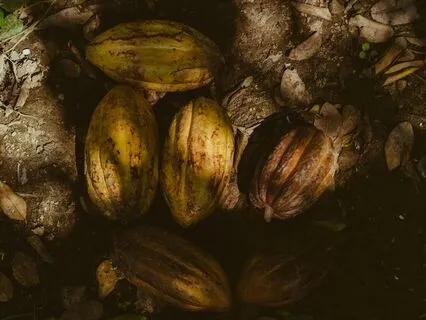
A golden yellow fruit,
About 20 centimeters long.
This is cacao,
Growing wild in the rainforest as it has for hundreds of thousands of years.
A tree that,
If left untouched,
Can live for over a century,
Thriving in the shade of the towering jungle giants.
A tree that bears its fruit not just on the branches,
But sometimes directly on its trunk.
We know now cacao has been harvested in South America for over five and a half thousand years.
We found traces of it in ancient drinking vessels from Ecuador and Peru,
Long before it became the cacao we know today.
It was already cherished as a sacred plant.
We return our focus to the rainforest around us.
It's alive,
Buzzing,
Chirping,
Breathing.
Perhaps thousands of years ago,
The indigenous people followed monkeys like this one.
Or maybe they followed a capybara.
There's many creatures in the Amazon love cacao,
Not just for its seeds,
But also the sweet pulpy fruit that surrounds them.
Let's take a step into the past,
Into one of the first villages that ever discovered cacao.
Imagine we're breaking open a cacao pot for the first time,
Revealing around 20 to 40 seeds inside,
Surrounded by a soft,
White pulp,
Similar to lychee.
The smell is nothing like chocolate.
Instead,
It's fruity,
Citrusy,
Like oranges or like berries,
Sometimes a bit like banana.
We taste it,
Savoring the freshness.
This is the flavor that,
In good cacao,
Still lingers today.
And at first,
It was this pulp,
Not the beans that people used.
They made juice,
Jam,
Or even lightly fermented it into a drink similar to apple cider.
Now,
Imagine you found this fruit in the jungle,
But do you really want to wade through the mud every time you crave it?
Do you want to chase the monkeys to find it?
No,
You want it closer to home.
And so,
Thousands of years ago,
The first cacao gardens were created.
These weren't plantations like we see today.
They were forests,
Thriving ecosystems,
Where cacao trees grew alongside towering rainforest giants,
Medicinal plants,
Spices like cinnamon and ginger.
And essential crops like cassava and plantains,
The staple foods of the Amazon.
We take a deep breath.
The air is rich,
Filled with the scent of citrus blossoms,
Orange flowers,
Lime.
Maybe there's some acai palms around.
We use their leaves for roofing.
Everything is connected.
And this way of growing cacao within the embrace of the jungle has lasted for thousands of years.
Now,
Let's step back into the present.
We follow a modern day cacao farmer through his cacao forest.
The air is still thick and humid,
Buzzing with bees and insects.
The trees above us are heavy with fruit,
Mangoes ripening in the sun,
Dropping to the ground where they ferment,
Filling the air with their sweet,
Tangy scent.
Beneath these trees,
Cacao thrives.
Some parts are still green,
Others ripening to yellow or deep red.
The farmer begins to harvest,
Cutting each part by hand,
One by one.
It's slow,
Careful work,
A process repeated thousands of times across the jungle.
And as we watch,
We feel a deep sense of gratitude towards these people.
The hands that,
In the heat of the tropics,
Carefully gather each fruit so that we may enjoy cacao today.
In the heart of the village,
Families gather to open the pots.
The sweet pulp is sometimes eaten,
Savored for its fruitiness.
But the real treasure,
The beans,
Are collected and placed into buckets.
Their aroma is still fresh,
Almost floral,
Filled with hints of banana,
Berries,
Citrus.
These beans won't be processed here though,
They'll be taken to a central collection point where farmers work together,
Because they know that unity makes them stronger.
At the collection center,
The beans are placed into large wooden boxes.
400 kilograms at a time.
And over the next 5 to 7 days,
Something magical happens.
The beans ferment,
Breaking down their bitterness,
Absorbing the rich fruit flavors of their pulp.
The air is thick with a scent of transformation.
Vinegar,
Lactic acid,
Alcohol.
This is where cacao begins to take on its deep,
Complex character.
And then,
The final step,
The drying bed.
Imagine stepping into a greenhouse.
The air is warm,
The scent unmistakable.
And for the first time,
It smells like cacao,
Like chocolate.
The sharp notes of fermentation fade,
Replaced by something rich and deep.
The sun is doing her work,
Drying the beans,
Sealing in the flavors shaped by the journey from the jungle through the hands of the farmers,
Their families,
Through the slow fermentation and careful drying.
And this is why,
In every sip of good cacao,
You don't just taste chocolate,
You taste the rainforest,
The fruit.
The life that surrounds it.
With these impressions in your heart,
I invite you to open your eyes and take a sip of your cacao.
And know that in this moment,
You are part of something ancient.
Something sacred.
A journey that began thousands of years ago,
Now flowing through you.