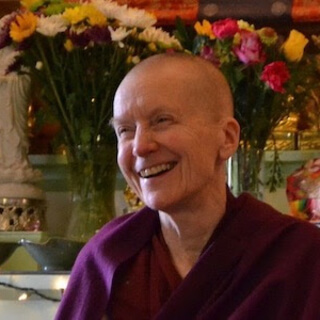
So let's do a meditation for a little while.
And we're going through this text,
The ornament,
Just looking at some of the main points covered in it.
And since the ornament for clear realizations explains the Bodhisattva's path,
What a Bodhisattva needs to do to reach enlightenment and benefit all living beings,
But it doesn't explain the actual methods for developing bodhicitta.
So at the beginning of each class,
I'm leading a meditation on some of the points that we meditate on in order to generate bodhicitta in our mind.
And so the last couple of weeks,
We've been meditating on the point,
Which is the first point in one of the methods for developing bodhicitta called equalizing and exchanging self for others.
And there is a meditation on this particular point of equalizing and exchanging self and others from Thich Nhat Hanh Rinpoche,
The junior tutor of His Holiness the Dalai Lama.
And it involves contemplating nine points.
Last week,
We did the first three.
And tonight,
We'll do the second three points.
So again,
This is to help us gain a sense of how ourselves and others are equal.
And therefore,
It isn't right to have a biased attitude,
A discriminatory attitude of only caring for ourself,
Or only caring for oneself and a limited number of people,
My friends,
My family,
And then not caring about all the other people and beings.
So we need to overcome that attitude in order to develop bodhicitta and progress to enlightenment.
So these next three points have reasons related to others.
Sorry,
The first three points have reasons related to others.
And the next three,
The ones we're doing now,
Have reasons related to oneself.
So the first one is to contemplate how everything that we have,
Everything we own,
Everything we use,
Everything we enjoy comes from others.
We are dependent on others for all of these things.
Even our body comes from our parents,
And our ancestors,
And our clothes,
Our food,
Our house,
All our furniture,
Everything,
Everything we have,
And everything we enjoy,
Music and books and movies and so on.
All of these things are dependent on others.
They're produced by others.
So since that is the case,
Is it right to ignore other people,
Other beings,
And focus only on oneself,
Me,
And my happiness?
So we have received an immeasurable amount of kindness,
Benefit from other beings in this life and in our previous lives.
And we will continue to receive benefit from other beings in our future lives as well,
All the way up to enlightenment,
Buddhahood.
They also help us attain that because to reach enlightenment,
We need to cultivate love and compassion and generosity and ethics and patience and all these positive qualities in relation to other people and other beings.
So they are essential for happiness,
Both now and long term,
All the way up to enlightenment.
So in light of this,
Doesn't it make sense that we feel grateful to them and do what we can to repay their kindness?
So the next point involves a possible objection that might come up in our mind that yes,
Others have helped me,
But they have also harmed me.
And this is true.
We do receive harm from others.
We've received harm from others in our past lives and we will receive harm from others in the future as well.
So we're not denying that.
But the teachings say that their kindness outweighs the harm they have done.
And if you do have doubt about that,
Just check the interactions that take place between people and between other living beings.
Are they mostly harmful and violent and aggressive?
Or are they mostly friendly and at least neutral,
Non-harmful?
So just think about that.
Like on this planet,
There are more than 7 billion human beings and most of us live quite close to each other and interact with each other a lot every single day.
So what's the normal way of interaction among people?
Are there more cases of people fighting and killing and harming each other or mostly do people just treat each other in a friendly way or at least in a neutral,
Non-harmful way?
Also another point is since we are trying to cultivate positive qualities,
Positive attitudes in order to reach enlightenment,
Is it beneficial to focus on the harm we've received from others,
The harmful behavior of others?
Is there any benefit in focusing on that and paying more attention to that than to their kindness,
The good things that they've done?
And then the third point is to contemplate how all of us,
All human beings and other living beings,
We're all impermanent by nature and we're all subject to death.
So given that,
Is there any point in discriminating against anyone and clinging to old hurts,
Old resentments?
So one way that might help us understand that is if you imagine you're in an airplane and the airplane runs into strong turbulence,
The plane is being knocked around and you might think,
Oh maybe we will crash.
In that kind of situation,
Would it make sense for you to start picking fights with your fellow passengers over small things or getting all upset about the person who didn't pay you back the ten dollars they borrowed?
So in a similar way,
If we contemplate how we ourselves and every other living being are going to die and we have no way of knowing when that will happen,
Does it make sense to cling to negative thoughts and feelings towards anyone and refuse to regard anyone with concern and kindness?
So as a conclusion,
If this contemplation has led you to feel a sense of equanimity,
A greater sense of equality of yourself and others and the importance of opening your heart to others and not discriminating amongst them,
Then cherish that attitude,
However small it might be,
And make the resolution to try to keep it alive in your mind and in your life as you go about your activities and especially in your interactions with others.