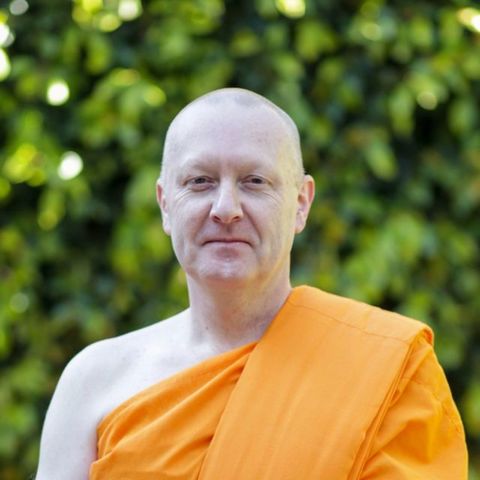
Last time you saw me,
We looked at blessing number 14,
Not leaving our work undone.
Today,
We will move on in our series on Enlightened Living to the first blessing in the Pillar of Society subsection,
Namely,
Blessing number 15 on generosity.
I should mention from the start that generosity is a subject I've already dealt with at length in some of my earlier lectures.
I talked about generosity as a way to overcome greed and stinginess in the mind in talk A027 in the talk entitled 7 Myths about Generosity.
Some of the objections to generosity we already looked at in that talk included that the welfare state makes generosity unnecessary,
That generosity is only for rich people,
That your previous experience of generosity haven't made you any happier,
That generosity should be secretive or random,
That generous people shouldn't expect anything in return,
That generosity only counts for the poor and needy,
And that generosity encourages corruption,
Bribery,
And holy rollers.
If you still have these sorts of attitudes to generosity,
Then perhaps you need to go back and listen to some of the earlier lectures again.
My hope is,
Though,
That by this point in the progression of my lectures,
You are slightly more sold on the importance of generosity,
Allowing me to spend more time looking at how to fine-tune our practice of generosity in order to lead to the very highest of blessings in life.
Before coming to generosity,
Though,
Let us look at the new grouping in the blessings ushered in by the practice of generosity.
The fifth grouping of the blessings of life usually referred to as becoming a pillar of society,
Consists of four virtues,
Namely,
Starting with generosity of course,
But continuing with blessing 16 on practicing the dharma,
Blessing 17 on looking after your extended family,
And blessing 18 on ethical working practices.
In the previous fourth grouping,
We have hopefully already established harmony in the family life.
That family harmony will act as a springboard to more challenging virtues involved in becoming a pillar of society.
Unfortunately,
Even if we have fulfilled all the previous blessings from 1 through 14,
We can still only consider ourselves to have broken even in our virtues.
In other words,
We have managed to steer clear of the minefields of everyday life that might otherwise cripple our future efforts to accumulate merit.
This is why in this fifth grouping,
We start to explore the virtues where we truly give back something to society and the wider world around us.
It will start to make us into the sort of person who society can trust and look up to,
In other words,
A pillar of society.
The law of karma states that we shall reap what we sow,
And if we provide for the happiness of others through our generosity,
The karmic outcome will include us being provided for in our own happiness and convenience.
Ironically,
The Buddhist perspective on generosity is characterized less by the material ways gifts benefit the recipient,
But rather focuses on the spiritual gifts brought to the giver.
Buddhism places great importance on generosity because it is seen as the origin of abundance.
There are some things that are universal truths that appear in the Buddhist scriptures and the Bible alike.
One of these truths is that there are many reasons why it is better to give than to receive.
Giving instead of receiving has many advantages.
For example,
It may make you happier since it's been proven that twice as many people who donated blood were happy compared with those who didn't do so.
Giving communicates something about our worldview because the opposite,
Hoarding,
Reflects the attitude that there is only a limited amount of wealth to go around,
And if we don't get it then someone else will.
There is research to show that being a giving person helps us live longer.
Giving increases our social connectedness,
Helping us receive others more positively and charitably,
While heightening a sense of real interdependence and cooperation in the social community.
Giving is contagious with many real world examples of the idea of pay it forward,
Which have inspired others to show their generous side.
Giving gives your life meaning,
Bridging the disconnect between who you think or say you are and who you actually are.
Giving increases self-confidence and trust in those who receive our gifts that they will do the right thing with what they've received.
Giving allows you to listen to others differently and also to look at your own resources without attachment.
Giving fosters contentment and promotes a universal good.
Finally,
Giving helps to create lasting relationships such as marriages or generally makes you a likeable person.
Generosity can therefore be considered an indispensable prerequisite for becoming a pillar of society.
Within the context of Buddhism,
The Pali word dāna,
Used for generosity,
Means sacrificing your own possessions for the benefit of other people wholeheartedly with the intention to honour the virtue of that person or to assist a person of similar social standing or to help someone who is worse off than ourselves.
If you are not wholehearted about giving,
Then it cannot really be considered to be dāna.
The Buddhist usage of the word generosity is therefore broader than the equivalent word charity in Christianity which is usually restricted to giving to the poor and needy.
In the spiritual sense,
Dāna sometimes refers to our intention to give.
Sometimes it refers to the thing we want to give.
Sometimes it refers to the abstention from wrongdoing such as forgiveness.
In this particular blessing,
We focus on the intention and the gift because we have already mentioned abstention from wrongdoing in blessing 9 on self-discipline.
According to the Buddhist teaching in the first verses of the Dhammapada,
Our intentions are the important precursor of every outcome,
Good or bad,
That may happen in our lives.
Some reasons for giving are less noble than others.
That is,
The more noble the intention behind an act of generosity,
The more merit will be generated by the gift.
Therefore,
To maximise the merit from giving,
It is useful to be aware of the spectrum of intentions available so that we can practice generosity for the best of reasons.
According to the Buddhist teaching in the Pātamādāna Sutta of the Aṅguttara Nikaya,
Some reasons for giving are self-centred while others are more noble.
As many as four self-centred reasons for generosity include giving because you want something in return,
Giving under duress,
Giving in order to pay back a debt,
Or giving to procure a future favour.
These four reasons are no more than ways of keeping up good relationships with the people around us.
There is no real merit in such giving,
Any more than virtue signalling a politician who wants to win votes might do,
Or giving away free samples to boost store sales.
Although there is nothing wrong with such giving,
Because they lack purity of intention,
They will fail to generate very much merit in the mind,
And thus hold little interest for us in the pursuit of Buddhist perfections.
Instead of these,
The Buddha advocated six nobler intentions for giving.
He recommended giving for giving's sake,
In other words,
Giving for the joy of it.
Secondly,
The Buddha recommended giving to keep up family tradition.
Thirdly,
He recommended giving out of sympathy for the monastic community to support the monks from whom we receive so much in the way of teachings.
Fourthly,
The Buddha recommended giving as a way to make yourself a more praiseworthy person.
It's not that we are fishing for compliments,
But because generosity generally is a behaviour praised by the wise.
Fifth,
The Buddha recommended giving in order to improve the quality of the mind.
Lastly,
The Buddha recommended giving to pave the way towards a heavenly destiny.
All these six reasons for giving are sufficiently noble to accrue merit in the mind.
So supposing you wanted to practice generosity in a way most likely to produce the biggest blessings in your life.
You could plan for this by following a checklist with five items,
Namely making a positive intention or resolution,
Choosing an appropriate gift,
Making yourself pure as the giver,
And afterwards harbouring no regrets.
The first stage of practicing generosity is to make a positive intention or resolution.
As a Buddhist,
You may purify your intention by recollecting the virtues of the triple gem and the power of generosity to uproot stinginess from the mind,
Sparking joy for the act of generosity you plan to do.
Having made your intention,
Make sure you follow through because,
According to the Anguttara Nikaya's Va-Nitsa Sutta,
If someone pledges to offer a certain gift but later fails to do so in any future business transactions,
They will have the karmic retribution of consistently losing money.
One formal way of declaring an intention so that it can ensure long-lasting outcomes from the act of generosity is to make an overt act of resolve.
Traditionally,
Buddhists may raise the gift intended for offering to their foreheads while making the wish.
Making a wish or resolution is like manifesting one's destiny.
However,
We also need to be careful about what we wish for in order to avoid courting disaster by wishing that,
For example,
Your enemies come to a sticky end.
An example of a skillful intention made before offering alms might be,
Through the power of this good deed,
From this day forth,
May my mind never fall under the influence of greed or stinginess,
May I always be surrounded by those whose minds are free of the taint of stinginess.
In studying the Dharma,
May I always be blessed with teachers who are open-handed in their teachings,
May I be well provided for,
And may the power of this generous deed help me to enter upon Nirvana without delay.
Nibbāna pāchāyohotu.
Or,
More briefly,
According to the traditional Pali,
Suttīnaṃ vattamedānaṃ asavakkayāvahamhotu.
Which means,
May these alms that I have given on this day be for an end of all defilements.
The second stage to effect generosity is to seek out or buy an appropriate and wholesome gift via your honest efforts.
Some people expect to find joy in giving stolen goods,
Such as picking daffodils in a public park to offer on a Buddhist shrine.
However,
The Buddha taught that there is no joy to be had in the giving of gifts obtained in dishonest or even devious ways.
In short,
We need to give thought to both the quality and the nature of the gift.
In terms of quality,
Generally,
Since we are practicing generosity to generate merit in the mind,
Rather than merely for utilitarian purposes,
The idea would be to give gifts that are of a better quality than things we would use ourselves.
If it comes to giving something like a bruised fruit or leftovers,
Or having a whip-around for someone,
Although this might be a useful way to help someone who is poor or needy,
It's not the sort of giving that maximises merit in the mind of the giver.
As for the nature of the gift to be given,
I should start by reminding viewers that not all objects of generosity are physical gifts.
Where the objects are material,
They are described by the Pali word vatthu-tana.
Objects of generosity that are not physical include the giving of vocational knowledge or viti-tana,
The giving of spiritual knowledge or dhamma-tana,
Letting go of our anger by forgiving a person or apaya-tana,
Behaving in a humble way or apajjaya-na,
Helping others out by volunteering or vayavaccha,
Transferring merit to others or pati-tana,
And rejoicing in the merit of others or patta-numodana.
Where a gift is something material,
Generally,
Things suitable for giving to the monastic community would include any of the four basic requisites,
Clothing,
Food,
Shelter or medicine,
And these four are sometimes subdivided further into ten categories which would include food,
But not aphrodisiacs,
Drinks,
But not alcohol,
Cloth or clothing,
But not immodest clothes,
Vehicles,
Shoes or fares for travelling,
Flowers,
Candles,
Incense,
Medical creams,
Bedclothes or beds,
Shelter,
And finally fuel.
Failing this,
The gift could be of money with which any of these could be bought.
At the same time,
There are some objects which,
When gifted to the monastic community,
Would not lead to the arising of merit.
Gifts that you might need to think twice about making over to someone else might include the usual categories of vice and sleaze,
But in a Buddhist context would include alcohol for anything other than cleaning or disinfectant,
Matchmaking services,
Cigarettes,
Weapons,
Musical instruments,
Poisons or drugs.
In conclusion,
A gift that would lead to a fruitful practice of generosity would be clean,
Refined,
And attractive to receive.
At the time of giving,
You should do your best to relinquish your attraction for the appearance,
Sound,
Smell,
Taste,
Texture,
Or mood of that object.
For example,
Thai people have the tradition of not sniffing the perfume of a flower before putting it on a shrine.
Third stage of fruitful giving would be to purify yourself before giving the gift.
This might refer to sparking joy in the mind or taking the five or eight precepts to ensure that your own sense of integrity is as perfect as possible.
In addition,
The meditation master Rungpho Watpaknam suggested to bring your mind to a standstill at the center of your body as a practical way of amplifying the merit arising from the giving.
Furthermore,
Our main contemporary teacher in the Dhammakaya tradition in Thailand,
The Venerable Dhammachayo,
Encouraged philanthropists to conjure joyous enthusiasm in their mind every time they do an act of generosity,
Because it will indelibly etch that positive emotion into their minds.
Whenever there is the opportunity to give a gift,
You should spark joy in the mind to inspire and motivate ever greater philanthropy in the future.
The fourth and final item on our generosity checklist is afterwards to harbor no regret in the mind.
Having offered the gift,
Make sure the gift is gone from your mind too,
By thinking only of the joy of giving and not allowing any feeling of regret to enter your mind.
One practical way to banish any reluctance from the mind is to transfer the merit of one's generosity,
Or patitthana,
After the fact,
By making the intention that any good deeds might also benefit our deceased relatives wherever they have been reborn,
In accordance with the Pali verses,
I dang ya tanang ho tu sukita ho tu yatayo.
May this merit accrue to all my deceased relatives.
May all my deceased relatives be happy.
So,
In conclusion,
There are four things that will ensure that the giving we do will bring the maximum of merit.
The first is to prepare a pure gift.
The thing which we give must be something that we have come by in an honest way or bought with money that is honestly earned.
The second is to ensure pure intention.
Pure intention for giving means sparking joy,
Wholeheartedness,
Or willing before making the gift.
The same applies not just to the period before the act of giving,
But also during and after the act of giving too.
The third is to seek out a pure recipient.
If the recipient is a layperson,
Ideally they should be someone who keeps the precepts.
If they are a monk,
They should be a monk who is strict in their department or is actively practicing for spiritual attainments.
Lastly,
Even we,
The giver,
Should be pure.
We too need to be established in our precepts,
Or at least spark joy in the mind,
Or at least maintain our attention at the centre of the body.
Since the opportunity to give donations doesn't come around too often,
When it does,
We should try to make an act of generosity we do pure on all four levels.
So we have time for a quick story from the scriptures about an exemplary act of generosity.
Many aeons ago,
But towards the end of the career of cultivating the perfections of our present Buddha,
He was born as a hermit called Sumetha.
He trained himself in meditation until attaining magical powers,
Being able to fly through the air.
One day as he was floating through the air,
He saw a group of villagers making urgent repairs to a road.
He asked why they were in such a rush to repair the road,
And they replied that the Buddha Deepankara had already arisen in the world,
So they were repairing the road so the Buddha could pass through in safety.
Sumetha,
The hermit,
Asked the villagers permission to rebuild part of the road himself,
And the people of the town were glad of his help.
They thought he would use his hermit's powers to magic the road to completion,
So they gave him a large piece of road that ran over a piece of subsided ground with a deep hole in it.
Sumetha,
However,
Wanted to cultivate generosity the hard way in order to fulfill his perfections,
So instead of using magical powers,
He started to mend the road by the sweat of his brow.
Consequently,
He had not finished leveling his piece of road when the Buddha and his disciples reached the place.
Sumetha thought,
The road I built is not finished,
Never mind,
Only two meters remain,
So I'll lie down in the hole in the road myself to form a human bridge.
When the Buddha arrived,
He bowed at the feet of the Buddha and invited the Buddha and all his disciples to be a field of merit and walk over him as he lay in the unfinished piece of road.
The Buddha and all his disciples walked over his body,
And instead of feeling aches and pains,
Sumetha was filled with joy to have been of service to the Buddha.
And that happened to be the lifetime in which Tipankara Buddha gave Sumetha the prophecy of his own Buddhahood that he would need to go on to attain full enlightenment,
Four Asamkhaya,
And one hundred thousand eons later.
It was also the lifetime that the Bodhisattva recognized generosity as the foundation of all other perfections.
So,
To return to today's subject of generosity,
Let's think for a moment about who might be on the receiving end of our generosity.
We need to remain aware that generosity in Buddhism has a very broad definition.
An act of generosity might be intended to help those who are poor and needy,
Who have a status that is worse than ours.
Equally,
We might practice generosity out of friendship to those of a similar status to ourselves.
Lastly,
We might give to those of a higher status to ourselves,
But the reason for the gift would not be out of that person's need for what we're giving them,
But as a way of expressing our respect for them.
The nebulous term status,
Which I have been talking about for the recipient,
Is often connected with the idea of purity,
Especially in terms of precepts,
Attainments,
Or spiritual vocation.
The logic of generosity is that the purer the recipient,
The greater the meritorious outcomes yielded to the giver,
Even when the value of the gift is equal.
Furthermore,
As we shall see,
A gift given to the whole community of monks yields even greater meritorious outcomes to the giver than a gift to any individual recipient,
Whatever their level of purity.
In this connection,
The Buddha taught in the Dakinavivanga Sutta of the Majjhima Niggaya that the amount of merit yielded to the giver by a gift to an individual,
Known in Buddhism as Patipukkulikattana,
Is in proportion to the purity of the recipient.
Even if the food is given to a humble animal,
It will bring to the giver long life,
Ayu,
Good complexion,
Vanna,
Happiness,
Sukha,
Strength,
Pala,
And intelligence,
Patipanna,
For no less than 100 lifetimes.
Even if the gift is given to a person who does not keep the precepts,
The gift will bring the same fruits for a thousand lifetimes.
If the gift is given to a person who does keep the precepts,
The gift will bring the same fruits for a hundred thousand lifetimes.
And if the gift is given to a hermit or ascetic outside the Buddhist monastic community who has attained some degree of mental powers,
The gift will bring the same fruits for a trillion lifetimes.
And this is not to speak of a gift given to someone who is practicing four,
Or who has already attained sainthood at the level of stream-enterer,
Once-returner,
Non-returner,
Arahant,
A Shakya Buddha,
Or a fully enlightened Buddha,
For whom the merit yielded is even more.
These are the extent of the merits arising from offering a gift of food to an individual recipient.
But incredible as these meritorious outcomes may seem,
They are still small compared with the fruits of a gift given as sanghatana,
Which means for the sake of the whole monastic community.
The challenge of giving to the community is that most people lack the motivation to help strangers,
Or to give merely out of principle.
They would much prefer to go to a particular temple and single out a particular monk for their attention.
They need a personal connection between themselves and a monk before they will reach out with any support.
They may be narrow-minded and look down on monks of low rank.
Of course,
They still receive merit from their good deed,
But since they favour a particular monk,
The fruits of their merit are slightly reduced from what it could have been,
As it does not encourage unity in the community of monks.
Giving to the community signals broad-mindedness in the giver that magnifies and multiplies the outcomes of the merit beyond what any individual gift could achieve.
The Buddha taught that anyone who is sufficiently broad-minded to support the Sangha in this way will receive not only many lifetimes of merit,
But merit that is incalculable.
The Buddha specified the duty of Buddhist householders towards members of the monastic community in the six directions of the Sikh Lovada Sutta as keeping an open house to the monastic community and supplying the monastic community with their basic material needs.
In other words,
It is the duty of every Buddhist householder to be generous in their support of the Sangha.
The Buddha specified that monks earn their livelihood by alms and not by other means,
In order that they will be able to devote their time to their real duties of study and meditation,
In order to be able to be pure in body,
Speech,
And mind,
And to be a field of merit for their householders,
While at the same time fulfilling their duty as teachers to those householders.
Of course,
The government could allocate a budget out of taxes to support monks in the same way the state finances the church in many Western countries.
But because Buddhism has,
Like the Protestant Church,
Always emphasized the importance of separation between church and state,
The price of this independence is that Buddhism must rely on the symbiotic relationship between monk and laity at the grassroots level,
Which cannot be manipulated by any politician.
By supporting the monastic community,
The idea is that the householders maintain the intactness of the Triple Gem for perpetuity.
Unfortunately,
This support relies on the good reputation of the monks,
And it's extremely damaging to the monastic community whenever members of the monastic community cause scandals.
The repercussions of one or two bad eggs can adversely affect the whole monastic community worldwide,
Since householders withdraw their support for the monastic community out of uncertainty as to which monks are practicing in earnest.
It takes authentically practicing monks to salvage the tarnished image of the monastic community,
And to stay the downward spiral that would otherwise lead people to abandoning Buddhist practice.
Unless we are a professional philanthropist with a private income,
The practice of generosity may well conflict with other financial pressures in our lives.
And in this respect,
I will give you a quick flashback to the Seven Myths lecture where I described the four changes of a millionaire's heart,
The factors which underpin financial security,
Upon which you can build the habit of generosity.
At that time,
We counted four underpinning factors,
Diligent and honest acquisition,
Taking good care of what you have,
Associating only with good friends,
And spending or donating only within your means.
To put it another way,
One needs to be generous in a way that won't cause regret at a later stage.
It may require a degree of budget planning.
Real-life philanthropists plan how much they're going to set aside for charitable good works,
And we,
Of modest means,
Should certainly be no less careful.
In some religions,
They even set a target for you.
For example,
In Islam,
Zakat is set at 2.
5% of your income.
From the point of view of Buddhism,
They try to work out the answer in terms of pie charts.
And this pie chart has five segments to it,
Which you shouldn't assume to mean 20%.
But supposing your income is the whole amount in the diagram,
Then what you should actually use on a day-to-day basis should be just one of the five segments.
And if you are still working,
And this advice is from a time when there was no welfare state,
Then obviously you've got your working capital,
Which is to do with the turnover in your business.
On top of this,
You need to put something aside in case of emergencies,
Just in case your medical insurance doesn't cover everything.
For the third segment,
If you want to keep your friends,
Then you need to put aside something for maintaining friendship,
Even things like being hospitable to friends or putting up guests.
We go into more detail on business finances,
Which can be divided into your immediate needs and business emergencies,
So that's not the medical ones,
And reinvestment.
They actually put figures on that.
50% is recommended to be reinvested.
For the last segment,
There are financial tributes of various sorts,
And this is of particular interest to us in this blessing because it is where generosity comes in.
Tributes towards your extended family are something which you'll hear more about in blessing 17.
And there are tributes needed for us to provide hospitality.
There are tributes for the deceased,
So performing funeral or memorial rites for the benefit of friends and relatives who have passed away.
And of course there are tributes in the form of taxes.
Think in most advanced western economies,
They would take a larger chunk from your pie than the notional 20% shown here.
And I think you may find that it's not optional either because they take it from you even before you get it.
There's also a tribute towards something known as customary religion,
Which means things which people in your locality give importance to,
Like for example having a stock of candies available for kids who may come trick-or-treating on Halloween night.
Finally,
We come to the segment that advocates supporting the monastic community and basically the meditation infrastructure,
Which would be the generous aspect of our budgeting.
So it's said that if you value generosity then you should be asking yourself whether you've covered at least these five sectors yet or not,
Or is the factor of working capital almost completely taking over your whole budget.
As I said earlier,
Generosity is always an optional part of life,
But it's a sensible option if you hope to cultivate the generous side of yourself.
Generally generosity refers to giving away what is excess to our needs,
And the habit trains us to be able to distinguish between need and want,
And eventually to overcome the tendency to want more and more without end.
Let's say you have a big plate of food and you know that half will be enough for you.
To give the other half to a hungry friend is considered to be generosity or dāna.
However in some places in the scriptures,
Such as the four virtues of the householder or karavāsatthamma,
The Buddha advocated overlooking our hunger if it's necessary to feed the starving.
Such giving is a more developed form of generosity known as self-sacrifice or chāṭhā.
In pursuit of the perfection of generosity,
The Buddha-to-be cultivated self-sacrifice to the point he was willing to sacrifice not only his material possessions but also parts of his body such as his blood or his eyes,
Otherwise known as upatāna-paramitta,
And to lay down his life or paramatthāna-paramitta for the sake of spiritual cultivation.
A final point about generosity concerns the reason why some people who perform an act of generosity seem to receive the fruit of their deed immediately,
Whereas others are kept waiting for a long time.
For example,
Someone is generous and immediately comes into a fortune or is crowned king or attains enlightenment.
In this connection there's an additional factor in the performance of generosity which influences the swiftness with which the merit will give its fruit.
It is mentioned in the Sāpurī-Siddhāna of the Anguttara-Nikaya,
Otherwise known as the style of giving by a noble one.
Here it's taught that giving at the appropriate time will bring the giver wealth and the wishes of the giver will come to fruition without delay.
Generally,
The merit arising from a generous deed,
Especially in terms of the reduction of stinginess in the mind,
Will be in proportion to the four pures I mentioned before.
Apart from these factors,
The outcome of material generosity is affected by the type of gift offered.
Elaborating on the Samyutta-Nikaya's Gīndādāsutta,
Offering food such as a meal for monks will bring the specific meritorious outcome of long life,
White complexion,
Good health,
Strength and quick-wittedness.
Offering cloth or clothing such as robes for monks will bring the specific meritorious outcome of good complexion.
Offering transport such as vehicles,
Choose a lift or a fare on public transport will bring the meritorious outcome of happiness.
Offering light such as candles,
Lanterns or fuel will bring the meritorious outcome of outstanding eyesight.
Offering shelter such as a place for the night will bring the meritorious outcome of everything being provided for you.
Offering permanent property such as buildings,
Trees,
For example,
Will bring the meritorious outcome of long life,
Strength and security of personal property.
Time-limited offerings such as hospitality for guests or giving to someone who's about to travel or the first fruits of harvest will bring the meritorious outcome of wishes coming true in a timely fashion.
Offering forgiveness such as releasing condemned animals or forgiving others will bring the meritorious outcome of long life.
Offering knowledge such as a lecture or needed advice will bring the meritorious outcome of intelligence or swift attainment of wisdom.
Therefore,
The idea of cultivating generosity might be to give the sort of gifts that you've not given before to make sure you are covered in terms of the expected future outcomes.
For today,
I'd like to finish off with a story which gives the example of generosity by a couple who were extremely poor but who also made the mistake of hesitating because of this.
There was once a couple who were so poor that they had only a loincloth each and had to share a single shawl between them.
If the husband went out of the house wearing the shawl,
Then the wife had to stay at home and hide in the house.
If the wife went out of the house,
Then the husband had to stay at home.
They couldn't go anywhere together because they had only that single shawl between them.
One day,
The husband went out alone to hear an all-night teaching by the Buddha.
He was filled with faith and decided to offer the shawl to the Buddha.
He took off the shawl,
Then thought of what his wife might say and changed his mind.
He listened to the sermon further until midnight and again his heart was filled with a determination to offer the shawl.
But then he thought of his wife and he changed his mind again.
In the end,
He had to listen to the sermon almost until dawn and this time he mustered the courage to make the most important gift of his life.
He went ahead and offered the shawl to the Buddha without any further hesitation,
While claiming the words,
Chittamme,
Chittamme,
Which means,
I have conquered it,
I have conquered it.
Also in the audience was King Patanatti,
Who was sitting nearby.
And generally,
If anyone shouts anything about conquest near a king,
They will normally have their head chopped off.
But in this case,
The king was curious to know what such a poor man had conquered.
The Brahmin replied that he had conquered his stinginess.
And the king thought such a person is rare and therefore set the man up in life with a standard of living fit for a millionaire.
The Brahmin took everything he'd been given by the king and again offered it to the Buddha,
Keeping only one shawl for himself and one for his wife.
The king therefore gave the man even more possessions.
In the morning,
Once the man had returned home with his newfound wealth,
The Buddha revealed to the rest of the monastic community that if the man had managed to conquer his stinginess at the beginning of the sermon,
He would have been made four times as rich.
If he had conquered his stinginess at midnight,
He would have been twice as rich.
However,
His hesitation in performing his generous act until dawn had blunted the power of his meritorious intention.
The Buddha concluded that if anyone ever has the faith to do a good deed,
Then they should do that good deed without hesitation before the intention is overtaken by stinginess.
In conclusion for today,
The practicality of being generous means giving things that you have earned in an honest way.
It means giving something that you know will be appreciated.
Where appropriate,
You should choose gifts that won't be used in an unintended way so the giving will not cause you regret later.
To maximize the merit arising from generosity before giving,
Work on the quality of your own mind.
Don't look down upon the recipients as charity cases and avoid looking down on those who receive your gift.
Finally,
Don't forget that worthy recipient for your generosity might equally well be a friend in need or those for whom you want to express your respect.
So,
This session I have introduced to you blessing number 15 on generosity.
For my next session with you,
I'll move on to blessing 16 all about Dhamma practice,
Which explains how things like lack of prejudice can contribute to becoming a pillar of society.
Hopefully as a result of today's session,
You will be curious to see how generosity can add value and meaning to your life.
So for today,
This is me Pratt Nicholas signing off for now.
So long folks and stay safe.