Hello and welcome to Tricycle Talks.
I'm James Shaheen,
Editor-in-Chief of Tricycle The Buddhist Review.
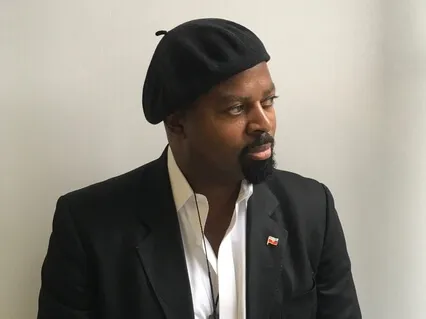
When poet Ben Okri was just seven years old,
He and his family moved back to Nigeria on the eve of civil war.
Ever since,
He has been fascinated by what he calls cusp moments,
The periods just before catastrophe strikes.
His new novel,
The Last Gift of the Master Artists,
Takes place in an African society just before the Atlantic slave trade.
In the book,
He sets out to examine the spirit of a culture on the eve of its destruction.
In today's episode of Tricycle Talks,
I sit down with Ben to discuss how writing can help us face what we refuse to see,
How Buddhist teachings have influenced his work,
And why he believes that art is most powerful when it brings us to a point of crisis.
Okay,
So I'm here with poet and novelist Ben Okri.
Hi,
Ben.
Thanks for joining us.
A real pleasure.
How are you today?
Very good.
How are you?
I'm good.
I'm good.
So we're here to talk about your new novel,
The Last Gift of the Master Artists.
But before we talk about it,
I'd like to ask you a little bit about your background,
Where you grew up,
How you grew up,
And how it influenced your approach to your work.
Would you mind talking about that?
I was born in Nigeria,
Born in the middle of Nigeria,
A place called Mina.
But that's not where my parents are from.
My mother is an Easterner and my father is a Southern.
And I grew up in the West.
So in many ways,
I'm representative of a Nigerian.
I was there till about the age of a year and a half.
My parents brought me to England.
My dad came to study law in England,
And I was here till about seven.
Went back on the eve of the Civil War.
We didn't know it was the eve of the Civil War,
By the way.
We just went back innocently.
I had a wonderful homecoming.
And then shortly afterwards,
The Civil War broke out,
Which changed my life in all manner of complicated ways,
Because the war turned out to be domestic as well,
Because my mother was from the East and my dad was from the South.
It was a war that affected us very personally.
But after the war,
I continued my education.
Wrote,
Began writing in Lagos.
I still remember the day I began writing.
Then came to England to study literature.
Carried on writing.
Fell on some hard times.
Wrote my way out of them.
I've been writing,
Dreaming,
Thinking,
Traveling,
Asking questions ever since,
As well as being a cultural activist,
Climate activist.
And many,
Many things besides.
I write plays,
Novels,
Essays,
Aphorisms,
Children's books,
Short stories.
And there's a strong spiritual dimension.
Well,
That does give me some context for the book,
Because it does take place in Africa,
In a fictional culture,
I think,
That is unraveling.
And the book is The Last Gift of the Master Artists.
And turning to the book,
It's actually a rewrite of your earlier novel,
Starbrook.
Can you share a little bit about the book and what inspired you to write it and then rewrite it?
I wrote Starbrook out of a very profound impulse that had been haunting me for a long time.
And I think the best way to express it is to say it was the impulse,
It is the impulse,
To tell the story or to capture the mood and the spirit of Africa before the slave trade,
Before colonialism,
Before any encounters with different kind of consciousness,
When it was most itself.
And I want to just tell the story on the eve of this catastrophe,
Which was the slave trade,
This silent catastrophe,
Because when it happened,
The people did not know that it was happening.
And I wanted to convey this strange mixture of people living their complexity and the innocence of their lives,
While this new element,
This new disaster was creeping upon them without them being aware of it.
I'm fascinated by Cusp periods,
Periods just before major changes,
Because I have an intuition that we sense profoundly what is to come.
We don't know that we do.
And many of our artworks,
Many of the things that perplex us that we do,
And we don't know why we're doing them,
Is because we sense this thing coming as if it's already here.
And so I was fascinated by that,
That intuitive aspect of the human spirit and the intuitive aspect of art,
That clairvoyant aspect of art in relation to the human spirit.
But then I also wanted to just look at Africa itself,
Its traditions,
And what were the fault lines,
And what were the great strengths of its civilization that we need to not return to,
But draw upon as a kind of deep spiritual resource.
So I wrote this book called Star Book,
And it was called Star Book because the premise of the whole book was that the whole story came to the narrator from two sources,
From an unfinished fragment,
An unfinished saying that the mother said to him,
But she didn't finish it.
And then the other source was this universal book Among the Stars,
Which is in all great spiritual traditions,
This sense that there is a kind of universal memory,
A universal consciousness,
That this consciousness contains past,
Present,
And future.
So it was from these dual impulse,
A cultural one,
A spiritual one,
A historical one,
And a mythical one,
That's more than dual,
Called Star Book,
Published in 2007.
And then as the years passed,
Certain things began to bother me.
I became aware that when people read the book,
They saw it as a fable.
They did not get properly the dimensions of this slave trade that was just about to fall upon a people.
They didn't get that.
They still saw the whole book as a kind of a fable.
And the political dimension of the book,
The historical dimension of the book,
I think,
Was somewhat diluted by the way in which it was written,
By the tone.
And over the years,
I just decided slowly that I had to revisit this book.
And one day I did,
And I spent seven years carefully going back over the tone,
Because I believe that a key to a book like this is its tone.
You say that you concentrated mostly on the tone,
And you worked to strip down the emotion to arrive at a new clarity,
As you say.
How did you adapt the tone to meet what you felt was needed in our current time?
What was it about the tone that you needed to change?
Well,
I realized when I reread the book,
Yes,
The book was about this cusp moment in African history and African consciousness just before the slave trade,
Just before a catastrophe was about to fall upon it.
I realized that I had unwittingly or unconsciously written about our own cusp moment right now.
I realized that it was a double moment that I was writing about.
This,
Of course,
Makes sense,
Because you don't take the trouble to write a book this big,
This deep,
So full and rich,
Requiring so much passion to come to the edge of my art.
You don't do that if the book is not also speaking to the present moment.
And that for me,
I think,
Was a great revelation,
That we are in a cusp moment,
And that we are on the eve of a catastrophe that might fall upon us if we do not change and transform our consciousness and become aware of it and bring about the changes necessary to save our world.
That for me was a revelation.
When I realized that it was actually a double story,
A double language,
That it was addressed in a double universe,
A universe of then and a universe of now,
Then I found my tone.
I realized that the tone had to be a simpler,
Clearer tone,
Anguished but hopeful tone.
It had to be a tragic but transcendent tone.
Very difficult.
You mentioned in a few interviews I read that the Atlantic slave trade had receded too much in the background the first time you wrote it,
So people took it as a metaphor.
And in fact,
To bring it to the fore is really addressing our current moment at the same time that it's addressing our own cusp moment.
We talk about the looming environmental crisis,
Which is already upon us.
We're at a cusp moment,
Both politically and culturally.
You write about a culture that's unraveling from within and at the same time threatened from without.
Do you sort of feel that we're in the same kind of moment?
Yes,
I do.
It's quite uncanny.
It's uncanny and quite disturbing.
I feel it very much in Britain.
Something is hanging over us.
I look at world history.
I look at the struggles around the world.
You look at the war in Ukraine and how it's in danger of escalating into something else.
I look at the Amazon and the way in which they're destroying the forests and the trees with incredible thoughtlessness.
I look at our traditions.
I look at our politics.
I look at how increasingly heartless we are towards our fellow human beings,
To migrants.
I get the feeling that there's a kind of a big unraveling,
But I don't feel that this is necessarily doomed to be tragic.
I think all cusp moments present humanity with two paths,
A path of great opportunity in which to sort of ask the deepest questions and to reform and transform and to reshape itself from a place of truth or continue along the fault lines and the cracks that's opening,
Not ask the questions and race along to a slow and not so slow destruction.
It always presents us with two paths and we have to choose.
I think it's important to stress that.
It's not necessarily doomed,
But we have to make a choice as to what kind of people we're going to be,
What kind of humanity we're going to be.
Throughout the book,
I did definitely have this sense of knowing that something is a foot that something is changing and at the same time,
A kind of denial and a kind of trapped sense of an inability to properly see and to act.
You say we have a choice and at times,
However,
It feels like I think of Yeats as the second coming.
We don't know what's about to be born and that frightens us and many of us simply turn away from it.
Yes,
Absolutely.
The very strength of what looms,
Of what hovers above us,
The very strength of it is also terrifying.
At great cost moments,
People on the whole don't want to face it.
I honestly cannot think of many moments in history where people have faced their cost moment with clarity and courage.
I really honestly cannot think of any.
This is why these fables,
These stories,
These themes are so important to us.
I don't think we are fated to always be in denial when catastrophe and danger and something fearful looms ahead of us.
I don't think we are fated to be.
We always have a choice to wake up and face it in some way and I think that is one of the responsibilities of the artist and of activists.
They have something in common.
It is about in some way waking the consciousness of people as well as giving people a sense of clarity and hope at the same time.
On the whole,
We human beings,
We are at our best when the crisis is upon us.
We are not so good just before it is upon us.
It is very strange.
I am just getting a sense as you are speaking of what you meant when you said that your main inspiration was,
And I am quoting here,
To recreate the time just before a people's lives changed forever.
To look in the spirit of the people and find out what made them susceptible to the destruction that they partially helped bring about.
So you did talk a little bit about why that particular moment interested you,
But what does it mean then to look at the spirit of a people and how did you go about doing this?
Because I can't help but think of our own moment and I think the book speaks to our own moment and it speaks,
As you say,
To our histories and it also speaks to this particular moment in time in Africa before the slave trade changed everything forever.
So I wonder what you mean by the spirit of the people because I have to ask myself what is the spirit of,
Say,
Our own modern life or people?
Yes,
Well the spirit of a people is a very complex thing,
But it ends up manifesting itself in what a people do,
What they choose to do,
And what they choose not to do.
It manifests in their traditions,
Their rituals,
But all of these emblems really of what the spirit of a people leads them to doing or to not doing.
The thing about culture is that it's constantly changing,
It's never really static,
And it is constantly susceptible to manipulation and to use.
In doing my research into the African spirit,
Its history,
Its cultures,
Not just in Nigeria but across the continent,
I found that there were many things worthy of drawing attention to but two struck me the most that I think is pertinent to our times.
A culture gets to a point where it solidifies,
It becomes very fixed,
And then in relation to any crisis that comes upon a people,
The culture responds in one of two ways.
Either it is open or it is closed.
Finally,
There are not that many other variations.
It's either open or it's closed.
I felt that there was a closeness about the culture I was looking into in the last gift of the master artist,
And this closeness had to do in a certain sense with an inner security,
A kind of a security about its own traditions,
About the meaning of its rituals,
The meaning of its history.
There was a kind of a repleteness.
Repleteness can sometimes and often lead to being closed.
You're so full and rich in yourself that actually you don't really need to pay much attention to anybody else and what's going on in the rest of the world.
And at certain points in history,
This very closeness,
This replete closeness can become an undoing because it means you're not aware of what's happening just as we are right now in a slightly different way.
We're closed.
We're closed to what science is telling us.
We're closed to what nature is telling us.
We're closed to what our artists are telling us about where we are.
You look at cultures being closed all over the place,
Closing their boundaries.
And nationalism,
Extreme nationalism is a kind of extreme closeness.
I don't know if it comes from repleteness or not,
But the effect is the same thing.
And I think there's a collective closeness.
This denial you talk about when you don't want to face something,
Where in a way you're closing the door of your heart,
You're closing the door of your imagination,
You're closing the door of your vision,
You're closing in some ways even the door of your sensibility.
That's a small strand of what I meant.
You do talk about this closeness and this not looking outside of this complete culture that one exists within.
At the same time you write about how people can forget who they are and become strangers even to themselves.
So how do you see that part of it playing out?
I see what you're talking about with the closeness in this country.
Everybody's arguing about immigration.
They're getting hysterical about it.
We've been through this before.
I mean,
This is not the first time we've been through this.
So there's that closeness that reflects a kind of psychological closeness of the sort that you're talking about when you describe this pre-colonial culture in Africa.
But then there's also failing to see ourselves.
I think the two things are linked.
When you close yourself off from the world in some way,
You can only do that by closing yourself off from yourself.
And I'm not sure which comes first,
Whether you've closed yourself to yourself,
Which makes it possible for you to close yourself from the world or whether the closing yourself from the world causes you to close yourself from yourself.
Personally,
I think in the hierarchy of causes,
I always say that the highest cause,
The most powerful cause is the inner cause.
I would today say that it is when we become close to ourselves that we start closing the door to the world and to truth.
You know,
A tradition,
A culture is a very,
Very sensitive thing.
It can't be codified in words on a page.
It really comes down to how people live.
What is important to them?
What is the deepest foundation of who they are?
How far have they moved away from that deepest foundation?
A culture does not become a culture that is to say,
Achieve some sort of quiet greatness,
Something that is quite rich and replete.
A culture does not become a culture if it does not come from some foundation that was nourishing,
That enabled it to grow and to make sense to a people,
For people to buy into it and do so joyfully,
Celebrate its traditions.
Culture does not become a culture if it's not nourished by something living and vital.
It's not easy keeping a direct line to that nourishment,
To that source,
To that original vitality and truth.
It is not easy and sometimes very often cultures lose their way and forget what they wear and what they are.
Do you think that a sign of a culture being cut off from that line of nourishment sometimes expresses itself,
An obsession with preserving that culture,
A self-conscious attempt to preserve something that otherwise was organic and that was simply nourished by a whole number of things?
Absolutely.
Thank you very much.
That's a wonderful piece of wisdom you just shared with us there.
Absolutely.
The opening line of The Farmish Road goes,
In the beginning there was a river and the river was once a road and because it was once a river it was always hungry.
I hope I've not misquoted my own book there.
But exactly what you say began as a fluid thing and then the excessive desire to codify it,
To fix it,
Turns it into a road.
It's no longer a fluid thing and when it becomes a road it's already started to die.
One of the things that occurs to me is that people have this misconception that there was a time when their culture was fixed,
When it wasn't changing and assimilating all sorts of influences.
It never was that.
It never was that.
So why would it be that now?
Why would it stop changing now?
Exactly.
But I think the desire to fix it itself is a political desire.
It's something that is done deliberately by people for their own ends.
I think the fixing of it is often a deliberate thing and then passed on to the rest of the culture.
I don't think it's something that people do in themselves.
I think it's something that not just our leaders but interested groups do to us.
It's one of the things I examine in The Last Gift of the Master Artist.
Who fixes it?
Why do they do that?
To restore it to its original vitality is very,
Very,
Very difficult.
That makes sense.
I wonder though you often hear people saying the culture is changing too fast and actually I might see that as a source of richness and possibility but others want to respond by,
As you say,
Fixing it.
But fixing it is killing it really.
We've seen examples of that in the past.
Yes,
Fixing it is killing it.
Interpreting constitutions by the absolute letter is also a form of killing it.
The Bible tells us that.
All the great religious traditions tell us that.
Things are done in history often for historical reasons and those historical reasons might not be valid anymore two thousand years or three hundred years down the line.
And so to hold on to that thing and say this is how it must be forever,
You end up being an enemy of the human spirit.
You end up being a tyrant of the human spirit.
You end up being a murderer of the human spirit.
And yet,
On the other hand,
We human beings,
We need stability.
We need certainty.
We need boundaries.
We need to know that this is what you ought to do.
This is what the seasons are like.
This is what the month is like.
We need some sort of shape within the vastness of the universe.
So I think it's how to keep a balance between the stability that we need and the fluidity and the openness without which we cannot grow.
Now I'm moving away a little bit from my list of questions but that just prompts me to ask then,
Can things change too quickly for a culture to feel so threatened that the speed or rate of change is simply too much?
If a culture feels that things are changing too quickly,
Then the first question we ought to ask is that what is it about the culture that makes the rapidity of this change?
We're asking the wrong questions.
We have to ask therefore about the culture itself,
The spirit behind the culture.
If it's changing too fast,
What is it about the culture?
What is it about the spirit of the people that has made it possible for this too fast change to come about?
Because we've all been part of it.
We've all contributed to it.
We're in it.
Where is it coming from in us?
It goes back to asking who we are and what we are.
I don't think the culture has always been like that.
So we need to ask why that is.
And I don't think it's true anywhere of all cultures that a sudden point comes along when it changes too fast.
And if that is the case,
Then there's two things that strike me.
One,
We need to know ourselves better.
Two,
What does this acceleration mean?
This acceleration might not have to do with the culture itself.
It might have to do with the times,
With something that we're racing towards,
Something that is pulling us.
Right.
In the society you describe in the book,
You talk about flaws in the culture that they're not looking at or injustices in the culture that they're not looking at.
And aside from this threat from without that ultimately destroys it,
There is this threat from within because they're not looking.
And I think that also speaks to our cultural moment,
If I'm not mistaken.
Absolutely.
Looking at that,
You make it clear that this culture is unraveling also from within,
And it has to do with a reckoning that they're not looking at,
Their own flaws.
And I think likewise,
In this country,
Part of the rapid change has to do with a reckoning or a catching up with things that we've refused to look at.
Yes.
A reckoning and a catching up with things we've refused to look at,
Which have created their own problematic contribution to the state of things,
Which then,
As it were,
Accelerates the need for us to catch up in not facing injustices and things that we need to face.
The things that not faced themselves then contribute,
They add their own chaos,
As it were,
To the culture and to the times,
Which then adds to the acceleration.
It's like a dynamic system,
But this one is a dynamic system of chaos.
Same thing with the climate environment.
They're not facing creates more of the basis for disaster and catastrophe,
Which then itself accelerates the process.
That's the next question I was going to ask.
You write that you see parallels between your original novel and our current environmental crisis,
Particularly in our quote,
Hastening towards an end that we refuse to see.
Just very simply,
Why do we refuse to see?
How can art,
In this case,
Your writing or the writing of many others,
Help us turn toward painful realities?
Because you talk about hope.
I remember in a conversation with Ruth Ozeki,
You're pointing to a problem that is frightening,
Problems that are very difficult to see.
One,
Why are they difficult to see?
And two,
How do you present this in a way that inspires people not to turn away?
I don't think as a culture almost anywhere in the world,
Except amongst maybe the people who are living constantly on the edge of crisis.
And even then,
I'm not so sure.
I don't think that we are taught to face ourselves.
I don't think in our education or in our cultural systems across the world that we human beings are taught to face ourselves,
To face our difficulties,
To face our lies,
To face our untruths.
Because the person who's going to teach you to do that,
They would have to have done it themselves,
Right?
The person who's going to teach you to do that,
They would have done it themselves.
They would have to be an exemplar of self-facing and the facing of difficult truths.
And the person who taught them would have to have been an exemplar.
And we're not good at it.
Because we're not good at it,
There are so many truths.
And the thing about truths unfaced is that they grow.
Truths unfaced,
Injustices undealt with and unconfronted,
They become monsters.
They don't just sit down there and remain the same.
They grow too in an accelerated rate.
As we grow,
The more we unface something,
The bigger it gets.
It doesn't get smaller.
If you're not facing it,
It means that you're adding to it every day,
Which is to say not only is it growing,
But you are then adding to it.
You're increasing its power and its strength.
Most of the things that we have to face,
That you say that are difficult,
That now are monsters,
Were once very,
Very small things that could have been faced in a moment of openness,
A moment of humanity,
In a moment even of compassion,
A moment of a sense of fairness.
But for many reasons,
It could be reasons of selfishness,
It could be reasons of profit,
It could be reasons of wanting to have our people better than other people,
Have our tribe better than other people,
Have family better than others.
Whatever those reasons are,
We don't face them,
We add to them and they become monsters.
So when you ask me,
Why is it that we don't face things?
It's because we've made a history.
We've made an epic history of not facing stuff.
And most of these things we've not faced,
We've not been facing them for thousands of years.
We've passed on the not facing to our children and to the next generation and it gets bigger and bigger and worse and worse.
And they're here amongst us and these things become monsters.
Let's take a quick break and we'll be right back.
For the past 30 years,
Tricycle The Buddhist Review has been the leading source of Buddhist news,
Culture and conversation in the West.
Now you can enjoy even more of your favorite Tricycle offerings with our new subscription tier,
Tricycle Premium.
For just $99 annually,
Tricycle Premium includes the perks of a standard print and digital subscription,
Plus access to monthly virtual events,
35% off our online courses,
A special premium-only newsletter delivered to your inbox,
And a free digital gift subscription.
Upgrade now at tricycle.
Org slash subscribe.
Now let's get back to our conversation with Ben Okri.
In the novel,
You deal with this through the preferred art of the culture that you describe through sculptures which reveal that which is otherwise unspeakable or show truths that are considered dangerous or unpalatable,
So much so that they are covered up and eventually removed.
And it's precisely the dynamic I think you're describing.
In the novel,
However,
When a sculpture is removed,
Its absence figures almost more prominently than its presence and it continues to haunt the minds of the members of the village,
Just as these truths we don't face haunt us.
So we see this playing out in our culture.
When the history of slavery,
For instance,
Isn't taught,
Its absence is all the more destructive.
So can you share more about the dangers of these absences?
We think these dangers are just in the reactions of people,
Their protests,
Their cry,
Their howl,
Their resistance.
I think that's one very small aspect of the dangers of that absence.
The real danger of the absence is that each day that we refuse to face these truths,
These things,
These injustices,
We are contributing to them.
And each day that we refuse to face them,
We too are dying from them.
This is something that all the great spiritual traditions talk about.
We die from our not facing of our truths.
We die in spirit.
We die in heart.
We die in sensibility.
I have to ask again,
There's a very hopeful message to the novel at the same time,
Despite the gravity of the current crises we face.
And you position this novel as a quote,
Mythic and poetic recovery.
What did you have to recover?
And how do you view the role of myth,
Which plays an important role in the book?
You asked a question earlier,
Which we didn't talk about,
Which is very pertinent to the one you're asking now,
Which is what can the artists do?
You pointed these things that people don't want to face,
That we don't want to face.
If you draw attention to it too strongly,
People recoil.
If you do it too gently,
It treats it as entertainment.
One thing that the artist can do is to remind us that we are not who we are at present.
I think it's one of the biggest mistakes we make as human beings.
We think that who we are right now is what we are.
But all the great artists remind us that actually it's not.
It's just what we've become.
Where right now,
The sum total of our habits,
Our courage,
Our cowardice,
Our love,
Our negativity,
All of that.
And what the greatest artists do,
What the greatest art does,
What art does at its best,
Is to remind us of what we actually,
Truly and essentially are,
Deep inside us.
And that's the recovery.
And that's what myth does.
Myth is not just telling you a story that Hercules had these 12 labors,
He was this guy that once lived.
I think myth is saying through the figure of Hercules that we can solve what seemed to be the almost unsolvable problems that history and that we ourselves can bring upon ourselves,
That we have a valid basis for heroic consciousness.
And that this heroic consciousness,
This thing deep inside us,
If we could liberate it,
We would be to our times as Hercules was in the story,
We would be able to clean the stables,
Divert the river,
Flush out the centuries of unfacing in a great moment of transcendent truth.
That's what myth does.
That's what art does.
Art reminds us of the original greatness that sleeps in us.
It's from this that one has some basis of hope for dealing with what's hovering over us.
I remember now in listening to your conversation with Ruth Ozeki,
You mentioned that you,
While not a Buddhist,
Have been exposed to Buddhism,
Or perhaps even momentarily had a Buddhist practice.
And you emphasize the interconnectedness of our suffering in the book too.
I wonder what was your exposure to Buddhism,
However brief?
I had in my teens in Nigeria,
During the years of asking questions,
Because adolescence is among many other things,
The age of questions.
Asking questions about the world and about the universe and about us and about truth and suffering.
You have to remember,
I'm a child of war.
I saw the horrors of war.
I saw what people could do to one another.
People who were neighbors,
People who were happy one day and the next day there were corpses floating down a river.
In asking these questions,
I turned to the great spiritual traditions and one that I found that gave me great solace and actually led me in many ways on this path that I'm on now and have been for some time,
Was the Buddhist tradition.
And the thing about the Buddhist tradition,
Apart from its great teachings,
Was that it made me aware of the absolute truth,
The majesty,
The true kingdom of our inwardness.
Society makes us live on our skins and on our flesh and our bodies externally.
My encounter with Buddhism was the first thing that really taught me to turn inward and gave me one of the greatest gifts of this life.
In the novel,
Individuals are tasked with creating the art of their own healing.
Can you share more about what this looks like?
How can art support us in healing?
And in your case,
It's writing.
If I could contribute in any way to a practice in any culture,
It would be to add this element to our lives,
That everybody in some way be an artist.
Being tasked with the art of your own healing is actually being tasked with the art of your own self-discovery,
Your own self-alignment.
It's not the solving of the equation of who you are,
But it's finding that which can help the divided parts in you function together and be as one.
Maybe one of the most difficult things,
One of the most necessary things.
We have too much division,
Torn in too many directions,
We're confused by too many things.
Dreams,
Memories,
Desires.
The Buddha talks about desire and fire and suffering.
This dividedness that we have in silence leads to the chaos of our lives.
That's what Edward draw attention to when he talked about us being distracted by distraction from distraction.
Art helps us unify.
It's a miraculous thing that it does because it doesn't work through the conscious mind.
It doesn't work through conscious reason.
It works with reason,
Works with instinct,
Works with a sense of harmony that you have inside you.
It brings together your history,
Your memory,
Your failings,
Your faults,
Your traumas.
It works with all of these things,
The good,
The bad,
The evil,
The mean,
The wonderful,
The magical.
It works with all of these things and it externalizes them.
It gives us a chance to sort of make visible our demons,
Make visible our angels.
And in doing that,
It helps to heal us.
It opens us,
It frees us.
Using that wonderful Kafka phrase again,
It cracks the frozen stream inside us so that what is best in us can flow again and not be fixed.
That's very nicely said.
I'm also particularly curious about the role of wonder and awe in this book.
And on the one hand,
You position your work as mythic and drawing upon elements of wonder and astonishment,
Yet you write at the same time that among the masters,
Quote unquote,
Astonishment is suspect and too much myth and amazement can diminish people's capacity to look inward.
How do you find a balance of just the right amount of astonishment and not being carried away and being able to remain grounded and look inward?
Oh my goodness,
You do ask really beautiful questions.
Wonderful,
Wonderful questions.
You've picked on an almost impossible paradox.
Yes.
You see,
The thing is when we live outside of our truth,
When we live in our state of destruction,
Our state of the tyranny of desire,
The quietness,
The peace,
The magic tranquility is closed from us.
And when we have moments when this peace,
This tranquility,
This magic inside us can come through,
When we have moments like that,
That's wonder.
On the other hand,
In telling stories,
We need astonishment to stun our distractedness into silence and wonder.
It's a very strange thing.
You look at almost all the great traditions,
Stories of the Buddha,
There are many stories,
There are stories of clarity,
Where he tells one of his followers to just go fetch water from a river that they've just crossed.
To stories of wonder where he sits under the bone tree and all these angels and demons.
These two things exist within all the traditions,
The clarity and the astonishment.
And I think it's because both are needed for us at different times in our evolution,
At different times in our development.
There are times when we need the wonder and the astonishment to still us,
To still our raging restless minds,
To still us for a moment and for us to go,
Wow,
What is that?
Wonderful.
And at other times we need the profound lesson of tranquility and clarity.
But I think inclining too much towards the wonder becomes a distraction for a tradition.
And every now and again,
I think all great traditions go from the simplicity to the richness and the wonder and astonishment,
And they go right round back again to the simplicity in a constant cycle.
We are really talking of a different paradigm.
We're talking about a spiritual paradigm here,
Which is quite different from the historical one we've been talking about before.
I think it's important not to confuse them.
Right.
Well,
Thank you.
I'm going to come back to your conversation for our Ecology Summit with Ruth Ozeki.
You said that art is most powerful when it brings us to a profound crisis.
So how does this guide your work?
The thing is,
We always need to be brought to a crisis because we're always not facing stuff.
What we talked about earlier,
This accumulation of unfaced truths,
Unfaced injustices,
It's always there unless we have collectively reached nirvana,
Collectively reached enlightenment.
We are sunk in Beckett's pit,
As it were.
We're constantly in this world of illusions,
As Ruth said herself.
We're constantly in it,
And we therefore constantly need to be brought to a crisis whereby we are compelled ourselves to confront this condition that we're in that we don't want to look at.
So art has to do the three things we talked about,
But the crisis is one of them.
We need to be brought to a point where we're forced to ask ourselves.
I don't think the work should be doing it.
The work should bring us to a point where when we go on a walk or when we find ourselves in our life or deep in our sleep or whatever it is,
We're brought to a question that we can no longer avoid,
That we can no longer escape,
And we have to deal with them.
In other words,
We're brought to the edge of where we can start to begin to liberate ourselves.
I think if art can do that,
It will do one of the most wonderful things that can be done.
You said that writing is the closest thing to spiritual practice for people who have no spiritual practice.
How is it for you?
Is writing a religious or a spiritual practice?
Writing for me is many things,
Many,
Many things indeed.
It's a quest for truth,
A political tool,
A spiritual practice,
Absolutely.
It's a weapon of activism.
In Nigeria,
In Africa,
I come from a place where there's much suffering,
Much injustice,
Where our politicians don't care about the people as much as they should and have helped to give rise to an unhappy history.
And I think writing has a responsibility there,
A social responsibility to draw attention to what's wrong and what can be done.
So it has a social dimension.
It has a political dimension.
I can't escape that.
I can't get away from that.
Any more than I can get away from the suffering that I see anywhere.
The minute it hits my consciousness and I'm lucky enough to be gifted with the inspiration to respond to it in some way,
I have to.
I can't escape it.
But the spiritual practice side,
For me,
Is the core of it because the act of writing is an inward act.
You can't write from your outwardness,
Not even when you're writing the most outward-ish things,
Blockbusters and Buddhist rippers.
Just the act of sitting down there and conjuring images and telling a story and trying to show something of the choices that people make and how their lives are shaped by those choices,
The consequences of their actions.
The very act of being on the inside and looking at the human destiny,
The human story,
The individual story itself is on the very edge of a spiritual practice.
And for me,
Writing is I go inward in order to look much more profoundly,
Not only inward but at the world in which I find myself.
I have to stress,
Writing is not a substitute for meditation or for the true spiritual practice.
It is not and never has been and never can be because that practice has to be done with oneself alone,
Not with a pen or a typewriter or anything.
One has to make that journey to one's inner kingdom and to the kingdom of the universal oneself and with others.
A spiritual practice is its own very,
Very particular thing,
But it informs everything that you do if you let it.
I think we're richer,
Fuller in all the things that we do if it's informed by an authentic spiritual practice that has the integrity of truth,
The truth of wanting to face oneself and the world.
There's so many spiritual practices that themselves contribute to people denying the world,
Not wanting to face the world because they think that their spiritual practice is replete and sufficient and that if they're at peace,
They don't need to really face anything else,
They cannot deal with what's going on around them.
Full spiritual practice is about one's repleteness,
But it's also about the repleteness of everybody else.
It's a mutual thing.
One is in a spiritual journey with others and it should overflow into the world and contribute to the world and help towards the transcending of illusion and the journey towards enlightenment and towards truth and prosperity and peace for everybody.
Ben Okri,
Thanks so much for joining.
For our listeners,
Be sure to pick up a copy of The Last Gift of the Master Artists out November 15th and available for pre-order now.
Thanks again,
Ben.
Oh,
Thank you.
It'd be wonderful being in conversation with you.
I hope we meet someday when I come to the States or when you come to London.
There's a dinner and a walk waiting for you.
That would be fantastic.
I will accept that invitation at some point.
It was so great to finally get to talk with you.
You've been listening to Tricycle Talks with Ben Okri.
We'd love to hear your thoughts about the podcast,
So write us at feedback at tricycle.
Org to let us know what you think.
If you enjoyed this episode,
Please consider leaving a review on Apple Podcasts.
To keep up with the show,
You can follow Tricycle Talks wherever you listen to podcasts.
Tricycle Talks is produced by As It Should Be Productions and Sarah Flemming.
I'm James Shaheen,
Editor in Chief of Tricycle The Buddhist Review.
Thanks for listening.