Meditation Preparation In order to get the best from our formal meditation sessions,
We need to ensure that our internal and external environments are optimized.
Internal Preparation In the real practice section,
The concept of setting an intention was introduced.
The idea being that you would repeat a short sentence prior to beginning a session that reminds you of what you're about to do,
Why you're doing it,
And what is necessary for success.
For example,
For the next few minutes,
I will be mindfully meditating to improve my calm,
Clarity and focus.
I will gently return my focus back to the breath for the duration of the session.
This short sentence works as a brief reminder and a quick introduction to mindfulness practice.
Great for when we're starting out or when we have limited time to meditate.
However,
We can extend this preparation process into a full induction,
One that will prompt to attain and maintain the mindfulness state for hours on end.
When I plan on sitting for 30 minutes or more,
I start the session with the following induction,
Adapted from John Yates' book,
The Mind Illuminated.
It takes around five minutes to complete,
But these are minutes well spent.
Following this induction,
I find that I'm better able to become mindful and maintain it.
I found it helpful to place the following six steps on a poster in my meditation space to act as a reminder.
Meditation – Formal Mindful Induction Take a couple of minutes to go through each of the following sections in detail,
Then complete five minutes of breath-focused mindfulness meditation.
1.
Motivation Why have you chosen to meditate?
What is the purpose of your ongoing practice?
For example,
Is it awakening,
Improving interpersonal relationships,
Or focus?
2.
Purpose What do you hope to accomplish in this session?
For example,
Maintaining your unbroken attention on the breath.
3.
Expectations Make sure you do not get caught up in the expectations of progress.
Despite your goals and purpose,
Remind yourself that you can only have the meditation that you are having.
4.
Diligence Make a pledge to engage with the practice fully.
Make a commitment not to engage in daydreaming,
Future planning,
Rumination,
Or other temptations.
5.
Distractions Take a moment to consider your current mental state.
What could be a potential distraction,
Both internally and externally?
Acknowledge and address them.
6.
Posture Make sure you are in an ideal meditation posture prior to beginning.
Now set a timer for five minutes,
Close your eyes,
And practice mindful,
Breath-focused meditation.
Give it a try now.
7.
Transitional Preparation When we are first learning to meditate,
It's beneficial to have a dedicated space in which to practice.
The specifics will be unique to you,
But in general,
You will want to find a place that is free from distractions,
Comfortable,
And available.
Distractions include most forms of technology.
Phones,
Televisions,
And laptops are a definite no-go.
These items are specifically designed to be as engaging and as addictive as possible,
And if present,
You may find yourself tempted just to take a quick look on social media during a session.
The reality is that unless you are meditating,
You are not meditating.
Sounds pithy,
I know,
But it's true.
I'm sure that you've already recognised some of the many games and rationalisations that your mind will throw at you in an attempt to stop you from meditating.
Eliminate all potential distractions from your meditation space,
Including other people.
A dedicated meditation room is ideal,
But temporary dividers or curtains also work as a great visual reminder of your practice.
A closed door or screen may help both you and other people not to talk to one another during a session.
You will want your meditation space to be inviting and comfortable.
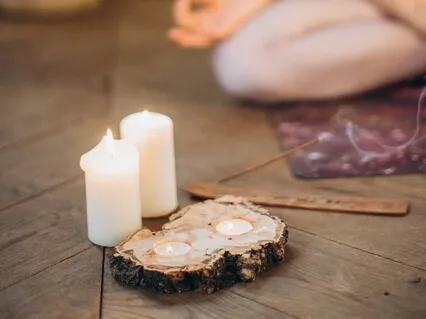
Some people create a shrine of sorts,
Adorned with incense,
Crystals,
Icons,
Or portraits,
Representing important aspects of their spiritual journey.
None of this is necessary,
But feel free to add them if you wish.
You may also want to have access to a meditation cushion in order to keep your body upright and comfortable,
As well as a light shawl to throw over your shoulders for warmth.
The ability to control the temperature is desirable,
And extreme heat or cold is not conducive to a beginner's mindfulness experience.
Finally,
It is important that your meditation space is available for you to use.
This means that your family and roommates know when you are meditating and will take steps to respect your practice.
Have a chat with them about meditation.
Answer their questions and let them know what you need from them,
And be sure to let them know how your meditation will help them.
For example,
Each morning from 7 to 7.
30 I am going to be in this room meditating.
Please be as quiet as possible and do not disturb me unless there is an emergency.
I am learning how to meditate in order to be the best parent,
Sibling,
Person possible.
It will help me to be more kind,
Calm,
And caring,
And it will help me to be totally present with you when we are together.
There will of course be some hiccups,
And you may need to specify what exactly is considered an emergency,
But these conversations are worth having.
Not only will doing so enable you to have an unimpeded meditation practice,
But you may also convince the people around you to join in.
I have two dedicated meditation spaces.
The first is inside a cupboard in my writing office.
It was created by my partner to be used as both a meditation area and a prayer space.
She has placed a collection of icons,
Candles,
And other spiritual and religious paraphernalia inside,
Which are used to enhance the feel and make it quite inviting.
The second space is outside on an undercover couch.
I have placed a couple of pillows and a sheet for warmth and comfort.
Weather permitting,
I will lean towards the outdoor setting,
As I find that there is an added peacefulness that comes from the warmth of the sun,
A cool breeze,
And the sounds of nature.
Of course,
You do not need to have a dedicated space to meditate.
My mindfulness can be practiced anywhere.
In bed,
A car,
An office cubicle,
Or under a tree.
Get creative and you will certainly be able to find a place to sit and observe the breath.