This is part two of drawing a moon mandala.
Using this drawing practice as a meditation,
Bringing a sense of focus,
Clarity,
And connection with the universe.
If you haven't completed part one,
I would suggest that you go and find that recording and then have the page in front of you from part one,
As well as a compass,
Pen,
Pencil,
Eraser,
And ruler.
Pause this now if you need to get your stuff ready and we'll get started.
On your page,
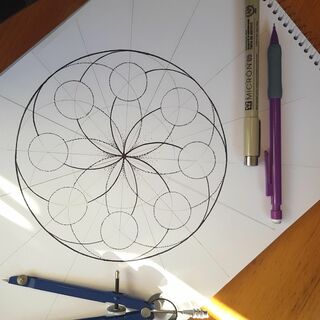
You have the eight phases of the moon in small circles around the inner edge of the large outer circle.
We're going to start today by learning about the moon phases in order,
Starting at the top and moving in a clockwise direction.
So breathe into all these empty circles and feel yourself connected with the moon as we go through.
Starting at the top circle with a pen,
Start dotting.
Use each dot as a way of focusing.
Dot the circle however you see fit,
But make sure there's dots throughout the whole thing.
This first moon phase is the new moon.
It represents new beginnings.
It's considered a time for fresh starts and rejuvenation,
Especially women regaining their strength after a monthly cycle.
It's time for setting new intentions,
Putting the past behind you.
Self-care,
Fresh start,
And a clean slate.
Moving on to the second phase on the right.
Here we'll take the compass and adjust the compass to the size of this small circle.
So put the compass point in the center of this small moon phase circle.
Reduce the pencil side of the compass about three or four millimeters smaller than the edge of that circle.
Now move the compass point that's in the center over to the left and this should create an arc on the inside of the circle.
Only draw on the inside,
Not the complete circle.
So when you have your crescent drawn,
It's a crescent moon you can see on the right side.
We'll be filling in with dots,
The large non-crescent part,
And you can start that now.
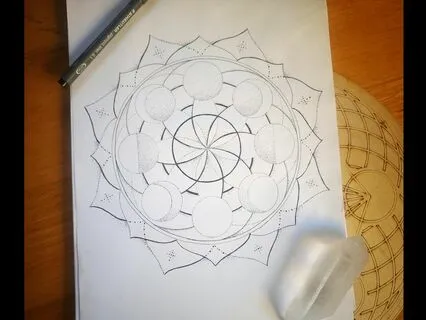
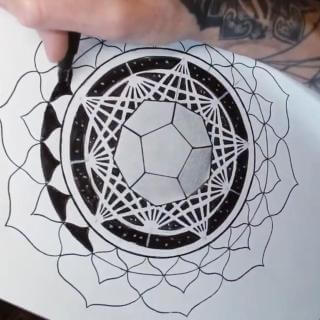
Have a look at the image on the meditation for an example and start dotting.
This is called the waxing moon,
Waxing crescent,
Where the moon just starts to be emerging,
Start to see the reflection of the sun.
This is the rebuilding phase as the moon has rejuvenated and emerged again.
It's time to realize your hopes and desires for the coming month,
As well as working on self-confidence and compassion.
Every lunar cycle lasts about 29 and a half days.
This part,
The waxing crescent moon,
Is about day three till six.
Fresh energy.
Moving on now to the moon on the right.
The waxing crescent moon is about day three to six in the 29.
5 day lunar cycle.
Moving on clockwise,
The next moon on the right is the half moon in the waxing.
Waxing means the moon is going from a new moon and the sun is slowly illuminating it to a full moon.
And then it wanes from the full moon,
Goes down and becomes smaller to the new moon.
This is the first quarter moon,
So take your ruler and draw a dotted line or a line in pencil down the center,
Lining up the ruler edge with the top or bottom of the page so it's straight.
Dot the inside,
The left side,
And fill this area with dots.
The first quarter moon is about action.
Thought to be the stage of obstacles,
This is the pause in the lunar cycle,
A time when challenges,
Decisions,
And actions come into play.
This should be a time of reflection This should be a time of reflection regarding your intentions and their obstacles.
It's a time of momentum and growth,
Pushing forward and commitment.
It's a time of empowerment.
Another crescent moon going clockwise further,
So this is the bottom right,
But this time take your compass the same length that it was before and move it over to the right from the center of the circle to draw a crescent along the left side.
Try to make it about the same width as the last crescent above,
But it will be an opposite way,
So this one's facing the opposite way.
Fill this one in where you're filling the part closer to the middle of the mandala,
So dot the crescent part,
The smaller crescent that you just drew.
This is the waxing gibbous.
As we're almost at the full moon phase,
This is the last stop.
Time to adjust,
Refine,
Edit our intentions in the face of challenges from the first quarter that we just passed through.
It's a time of courage,
Patience,
And thankfulness.
Now moving down to the bottom full moon.
This is the moon that will leave blank.
Make sure you've dotted or lined around the outside.
This is when the sun and moon are on opposite sides of the earth,
And the face of the moon is entirely illuminated by the sun.
Thought to be the most powerful lunar phase,
Many believe that this is the most charged spiritual phase.
Emotions may be running high as the sun and moons operate in different zodiac signs,
But new opportunities and power surges are often available to those ready to accommodate them.
It's a moon that is around day 13 to 17 of the cycle.
Represents success,
Fertility,
Full light,
Illumination,
And fulfillment.
On the left now,
We're going into the waning side.
So the moon is reducing now from the full moon,
And this one is the waning gibbous.
The gibbous is the large sort of concave part that's illuminated.
So we'll draw another crescent just the same as the top right crescent that we did.
However,
This time we'll be dotting in the crescent part on the inside.
So take your compass to the middle point,
Move it over to the left about three or four millimeters,
And draw your crescent on the inside of the small circle.
And start dotting the crescent part.
This is a moon that represents a period of evaluation,
The ideal time to reflect on the events of the past few days.
Readjust intentions to the rest of the month,
Finding solutions,
Acceptance,
Introspection.
On to the seventh phase,
Which is the last quarter,
The third quarter.
So again,
Line your ruler up with the top or bottom of the page,
And draw a line down the center,
Going through the middle point.
Dot on the inside,
As we've been doing the whole way.
As you dot,
I'll explain to you about the third quarter.
This is the time of letting go anything that's no longer serving us.
It's the ideal opportunity to clean,
Cleanse,
And purge.
It's about self-reflection,
Awareness,
Changing perspectives.
And it happens about the 21st to the 24th day of the cycle.
And on to the last phase that we haven't dotted yet.
This is the waning crescent.
Right before the moon disappears for the new moon,
And starts the cycle over.
The waning crescent,
We'll draw a crescent here,
The same as the bottom right,
Yet we're dotting the big part,
Not the crescent part.
So put your compass in the center,
Move it to the right a little bit,
And draw your crescent.
This is the balsamic moon,
The waning moon.
It's about surrendering to whatever has happened that is out of our control.
Practicing compassion and self-care at this time is important.
And getting ready for the next cycle.
Surrendering,
Rest,
Recuperation,
Releasing attachments,
Reflect,
And let go.
And if you need a few extra minutes to finish off your dots or shading here,
You can pause this recording as I move on.
The last part of this mandala will have us drawing lotus petals around the edges.
We'll draw 16,
Eight overlapping eight.
And we'll use the 16 points that we mapped out in the last session.
Hopefully you haven't erased it.
So the first thing to do is to take the compass and make it really big,
As big as the outer edge of the circle.
And go maybe two or three millimeters bigger to draw a double circle around the entire thing,
Giving it a little bit of space,
A double circle.
Now from here,
We'll take the compass about two centimeters bigger than that and draw another circle.
And then for our final circle,
Go two centimeters bigger than that,
Or to the very edge of the page,
So you don't go off the page,
And draw your final circle.
So we've just drawn three circles around the outside of this mandala.
This will be our guidelines for the lotus petals.
Now using your artistic creativity here,
We will be drawing this lotus petals freehand,
Yet perhaps you'd like to start with a pencil and go over it with the pen.
Looking at the example,
Perhaps,
The first lotus petals are smaller.
They're ones that pointing straight up,
Straight down,
And then to the left and to the right as well.
They point in line with the moon cycles.
So with the point being straight up,
Line your pencil or pen up with the left side at the top,
The very first of those three circles we just drew near the edge of the mandala,
And draw a bulging line about halfway through,
And then a concave line the other way.
So it goes over halfway and then under halfway,
And a little point which would be at the very center at the top of the second circle.
You may want to look at the photo here.
On the other side,
We'll try to match those concave and convex over under lotus petal,
Starting at the right,
Moving over and under and lining it up with the point.
At the second circle of those three that we drew.
Here you'll have your first lotus petal.
Do our best to try to make these similar all the way around,
And if they're not,
That's okay because there is perfection and imperfection,
And we are not computers.
We're only doing our best.
So if you feel frustration,
Just use it as a lesson in teaching you to let go of these little things that can happen to everybody and to keep going.
As you draw these lotus petals all the way around,
There will be eight of the small ones.
I'd like to read to you a little bit more facts about the moon.
The moon is 400 times smaller than the sun,
And yet 400 times closer to the earth than the sun.
Thus,
We see them as the same size.
We only see one side of the moon,
Yet the moon does have two sides.
They look different.
The near side has fewer craters.
The moon has no atmosphere.
Hence,
Temperatures can fluctuate wildly.
When astronauts have landed there,
They've landed around the lunar dawn,
Which is the ideal time and temperature.
Lunar dust is toxic to humans.
The moon has moon quakes.
Earthshine is a name given to sunlight that has bounced off our planet's deserts,
Clouds,
And ice caps and can be seen on the moon.
The moon's phases are a result of interplay between the moon,
The sun,
And the earth.
The phases have been linked to madness.
The word lunatic often comes from this association.
That was a fact that I put in part one,
But I liked it,
So I thought I'd repeat it.
The moon actually has mountains on it.
The tallest is called Mons Huygens.
It's five and a half kilometers high.
A solar eclipse is when the moon is between the sun and the earth.
It occurs during a new moon at some point.
A lunar eclipse is when the moon moves into the earth's shadow cast by the sun.
This occurs during only a full moon.
A blue moon is when there's two full moons in one month.
The moon is 384,
000 kilometers from earth,
Or 238,
000 miles,
Which would take about 130 days to drive a car there.
A super moon is 30 percent brighter on average when it's closer to the earth at 360,
000 kilometers.
There's also what's called a micro moon when the moon is furthest from the earth,
Which results in smaller tides.
Okay,
After you finish these lotus petals,
We'll move on to the second round,
Moving around the page,
But these ones won't be straight up and straight down.
They're the petals midway.
So starting at the top,
That double line that we drew,
Draw the same lotus petals over and under to the point at the very top,
The very outermost circle.
These will be a little bit taller lotus petals.
You can use dots here or lines,
It's up to you.
Where this lotus petal intersects the other one,
I've put small and big dots.
Use your creativity.
You may also want to shade behind these petals or add embellishments inside of them.
This will be the last step before we end.
Make sure to go over everything in pen,
Add the embellishments that you'd like,
And I'll tell us a few more facts about the moon as you look on this.
The moon is usually referred to as more maternal fertility,
Rebirth,
Femininity,
And the sun is more referred to as the paternal.
The moon is made from silica,
Alumina,
Lime,
Iron oxide,
Magnesia,
Titanium dioxide,
And sodium oxide.
In many traditions in mythology,
Rabbits have been associated with the moon.
The moon only reflects approximately 7% of the sun's rays,
And a moon glade is the reflection of the moon on water.
So this marks the end of our mandala.
I hope that you enjoyed the meditation and you get some more sense of focus,
Clarity,
And feel more connected to the moon.
Don't forget to erase all the pencil marks.
Do your little embellishments as you'd like.
Refine it to make it your own,
And now you have a visual representation of an image that you created that can help you feel connected to the lunar cycles.