My name is Max Comis.
I'm a registered mental health counselor intern in the state of Florida,
And welcome to my channel.
Of course,
If you have any imminent mental health concerns,
Please reach out to a mental health professional in your area or call 1-800-N-A-M-I.
This video is going to be the first in a series of Ask Me Anything questions.
Questions that I received from my friends on Instagram.
And the very first question and the most prominent question that I received was,
How do we deal with anxiety naturally?
And what I'm going to do is answer this question in a series of steps,
Going from the most tangential,
The most gross,
Down to the more subtle.
So,
Number one.
The number one thing that you can do for anxiety is exercise,
Lift weights,
Challenge yourself and run,
Do a sport,
Do yoga.
Anything that you can see progress in and see yourself build mass and build endurance.
Because that sends a signal to your brain that says,
I am strong,
I am incapable.
In any scenario that I walk into in everyday life,
I'm going to be okay.
So that's going to leave you less anxious and more confident.
Exercise.
Number two,
Expose yourself to difficult things.
Go out to new places,
Meet new people,
Take on new challenges.
What provokes anxiety in you,
Expose yourself to it willingly.
And the more you do it,
The easier it's going to get.
Number three,
Diet.
If you have enough electrolytes swimming around in your neurosynapses,
Potassium and sodium,
Then you're going to be fueled.
If you don't have those things,
Then you're going to be more fatigued and potentially anxious.
If you don't have carbohydrates and proteins fueling your body,
Then you're more likely to be,
Again,
Fatigued and potentially anxious in the situations that you're in.
Number four,
Pranayama.
This is the yogic word,
The Sanskrit word for breath work,
Training your breath.
And it's become fairly popular in the recent years.
And the idea is to retrain yourself to breathe slowly and deeply.
The more we stretch out the muscles in between our ribs,
The more we work our diaphragm,
The more we expand our lung capacity,
The more we'll be able to handle ourselves in difficult situations of life because we'll be able to regulate ourselves more easily with the breath.
The following steps are going to be a little bit more subtle.
And the next one is develop a sense of meaning and purpose.
Know your values.
Know what you stand for.
Know who you are.
Know what you want out of life.
And the more you develop this internal core structure,
Then you're unperturbable to the world.
The world cannot shake you because you know who you are and you know what you stand for.
Number six,
Make time for stillness.
Make time for silence.
In the everyday life,
We're usually running to work.
We're usually anxiously sitting in traffic.
We're usually very fast paced talking with people.
And my suggestion is to simply sit in stillness,
To simply sit in silence,
Do the opposite of what society is doing.
Society wants to turn you into this anxious mess.
You have to cultivate stillness and silence within yourself and get away from the societal habits of anxiety.
Take the time for yourself.
Develop that peace.
That goes into number seven,
Which is as you get deeper into that stillness and silence,
As you embrace that more in your life,
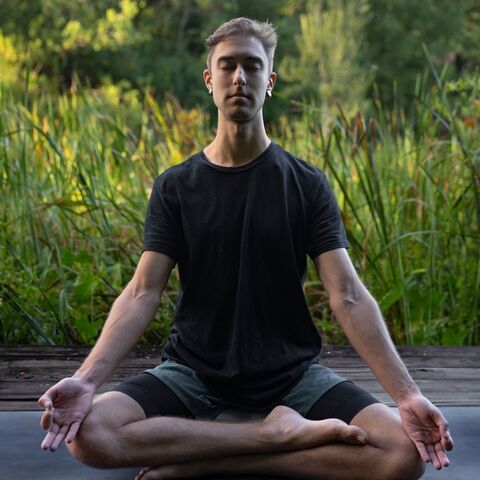
Develop a practice of witness meditation.
Now this is a specific form of meditation that looks at the part of the psyche that observes or witnesses your thoughts and emotions.
So sitting in meditation posture or laying in a meditation position like savasana.
Then we can not get caught up in the thoughts and emotions,
But we can see them as passing clouds.
Okay,
I see anxiety.
I see anxious thought.
And slowly,
You'll create more distance between yourself and the thought.
And it will have less control over you.
You'll become increasingly autonomous and be able to choose your response.
Okay,
I don't want to react to this thought in this manner.
I don't have to be anxious.
I choose to react with calmness and stillness from here on out.
This takes time and it is a cultivation practice.
I recommend doing this 20 minutes a day,
Every day,
For about seven days.
And the studies show that this will result in active changes in the cortical regions of the brain.
And I will link those studies below.
And number eight,
The final thing that I will recommend as you become more observant of your thoughts,
Emotions,
Like anxiety,
Is to keep a journal of those instances of anxiety and watch the narrative behind it.
Potentially sit with a psychotherapist if these thoughts and emotions get to be too overwhelming.
Some of us come from very traumatic pasts and it takes a guide to help walk us through those.
So again,
Journal about what you see as you observe your thoughts and emotions.
Journal about your reactions to the world,
Your triggers.
Notice how you respond.
And over time,
You'll be able to catch them and create a new response instead of the old response.
Create a new narrative for yourself.
This is your life and you are never subject to the habits or patterns of the past.
You are never victim to the society around you or the culture around you.
You can always choose how you want to live and how to move forward.
Thank you for being here today.
If you enjoyed these tips and this video,
Be sure to hit the like button and the subscribe button below.
Thank you so much.