The human mind,
If it is not trained or practiced,
Will flow downwards to lower places.
Like water flowing down from a high place,
It goes down to low places.
Down to rivers,
To the sea,
To the ocean.
Now if we want to use water,
If we want to use it in a high place,
We must apply driving force.
We must pump the water up,
Apply pressure,
For it to rise to a higher place.
The mind is the same.
It constantly flows according to the power of defilements,
Greed,
Anger and delusion.
But if we want our mind to become higher and better,
We must go against the flow,
Go upstream to higher ground.
We must use the power that can push the mind upwards.
This strength and power,
In the principles of Buddhism,
Is called the five spiritual powers,
Namely diligence.
There is diligence and effort.
Just like when we are determined to create some goodness,
Whether it is giving or undertaking the moral precepts,
Or practicing meditation,
Making the mind firm,
Calm,
Concentrated and endowed with wisdom.
If we remain idle in the ordinary way,
Nothing can develop.
Everything must be deliberately cultivated.
We practice to build the spiritual perfections,
Building the perfection of giving,
The perfection of morality,
The perfection of wisdom.
And the greatest merit,
Indeed,
Is meditation.
This meditation gives rise to wisdom.
But one who practices meditation,
Even when wisdom has arisen,
Is still one who remains firmly established in generosity and morality at all times.
So in this year,
We must increase our strength.
If our diligence is small,
Then we increase our diligence.
If last year we could sit in meditation only a little,
Then we increase it.
If mindfulness during the day is still little,
Then we increase it.
We don't get lost in or carried away by the progress of the world.
If we become lost and indulge in it,
It is called wasting a great deal of time.
But to learn nothing about the world,
Know nothing at all about it,
It's not possible.
There must be moderation and giving it an allocated amount of time.
At this time,
It is for receiving and being aware of various sense objects,
The many stories of the world.
But this time is the time when we must switch off what we receive from the external and turn to knowing the internal matters within our own mind.
Because if we receive too much,
When sense objects enter the mind,
Our mind becomes filled only with a sense of self,
Only me,
Only them.
Because matters in this world are all matters of greed,
Anger and delusion,
Of oppressing one another,
Of all them being matters of the sense of self.
But we still keep some awareness of those matters in order to know others and know ourselves,
To know how to protect ourselves from dangers that may come to us,
Or to prepare ourselves in advance before various dangers can reach us.
This is what is called being an intelligent person,
Who has to live in the worldly path.
Along with this,
Training the mind is indispensable,
Absolutely indispensable.
We must develop the mind,
Raising it higher,
Not letting it sink down as before,
As it did last year.
We must have diligence and effort to cleanse our mind.
Even though suffering arises from causes,
If we do not create the causes,
Then suffering does not arise.
It's like a stone that has heaviness.
If we don't lift it up,
The feeling of heaviness does not arise.
So it is likewise.
When we understand this,
We come to train,
To practice,
To practice the dhamma,
To train mindfulness,
To train concentration,
To build up our spiritual strength so that it becomes better.
Because having faith alone also requires caution.
Faith itself is also a spiritual power.
At the beginning,
It is belief,
Faith,
But if one believes too much,
Without reason,
It becomes blind faith.
This is something we must be careful about,
Ensuring that our mind also has wisdom,
Believing with wisdom,
And having proper knowledge and understanding of various matters.
For example,
In meditation there can be things that appear special.
Sometimes when we believe too much,
It can cause our minds to become deluded,
Just as King Ajatasattu believed there were data in that way.
Therefore we must know that in truth,
Practice remains within the scope of generosity,
Morality and meditation,
Or morality,
Concentration and wisdom.
Belief must have correct reasons and causes.
It may then become the right path to follow.
Because faith is like the rudder of a boat.
When there are strong waves and storms,
We can steer the direction properly.
We believe that what we do today will surely bring us happiness.
We believe that the next life truly exists,
And we are unwavering in creating virtue and goodness.
Therefore this firm faith becomes a map in the heart,
Giving direction and correctness amid the many things that could cause our mind to waver.
All external things can make our mind waver,
But if we are firmly established in the Buddha,
The one who knows,
The one who is awakened,
The one who is joyful,
And in the Buddha's Dhamma teachings,
Which point out and guide us to abandon evil,
Cultivate good and purify the mind,
Then we walk according to the Buddha's teachings.
As for the Sangha disciples,
They are not merely the living human beings that are monks.
They are those who practice well,
Practice rightly,
And practice straightforwardly.
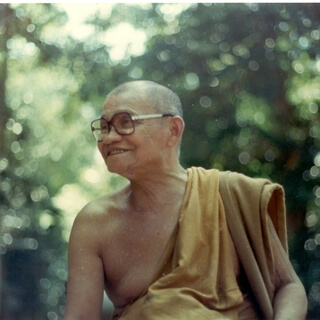
From the time of the Buddha down to Venerable Ajahn Man and Venerable Ajahn Chah,
We take their teachings as our guiding principle.
However they taught,
We follow their teachings in that way.
Then we're able to know the Dhamma or see the Dhamma following them.
Thus they are called Supatipanno,
Ujjupatipanno,
Nyayapatipanno,
Samicipatipanno.
They are truly the Sangha disciples of the Buddha.
In this way our faith is firmly established in Buddhism,
Unwavering,
And neither blind nor deluded by incorrect teachings.
When there is faith,
It does not mean that we will succeed.
We must also have diligence and effort to drive the faith that we already have,
So that it can move forward.
Because faith without diligence,
Without energy,
Is compared to planting a tree but not watering it,
Not loosening the soil,
Not making the effort to plant a tree.
Not making the effort to look after it against the insects at all.
There is nothing to protect that small tree.
And what happens then?
Even if the seed is a good one,
Once it is planted and not properly cared for,
It cannot grow and flourish.
It is like a small child that is born,
Isn't it?
The parents must have diligence,
Care,
Attention,
Protection and nurturing in every way,
Until the child can rely on themselves,
Grow up,
Walk,
Speak and understand the world.
The mother must continue to protect and guard against dangers,
Until the child comes to know the things of the world well,
And only then can they be safe and free from harm.
Therefore,
Having faith must be accompanied by diligence and effort.
Be careful.
This diligence is not ordinary diligence.
Diligence in practice must be diligence in abandoning what is unwholesome.
Unwholesome actions exist through body,
Speech and mind.
They are all unwholesome.
When they arise,
There must be diligence.
There's diligence,
Energy,
Perseverance.
And there must be patience,
Forbearance,
For the unwholesome states that arise constantly.
The eye sees form,
The ear hears sounds,
The nose smells odours,
The tongue tastes flavours,
The body contacts tangible objects,
The mind knows mental objects,
And then feelings of liking and disliking arise.
When liking is very strong,
Then thoughts of greed and covetousness can arise.
When disliking arises,
There can be anger,
Ill will and harmful intentions.
If we do not guard mindfulness well,
We will speak and act accordingly.
So,
We must always be careful with our mind.
It is not that one becomes a practitioner,
And when the new year arrives,
The mind automatically becomes new.
Just because a new year has come about,
Does not mean it can make our mind new.
The Buddha said that the Tathagata is only one who points out the path,
One who gives guidance,
But we ourselves must do the practice.
We must act in accordance with his teachings.
He has already pointed out the path.
If we walk according to the path he has shown,
We will be freed from suffering,
Whether a little or a lot.
We will be able to live in this world,
In this life,
With well-being and ease,
Appropriate to our condition,
Appropriate to our status,
Appropriate to the status of being a householder,
A monk,
A nun or a novice.
Each will receive happiness from conducting themselves and practicing in accordance with the Buddha's teachings,
Until there arises clear knowledge and understanding regarding the body,
Regarding the body as composed of the four elements,
Regarding the body as impermanent,
Suffering,
Not-self or as emptiness.
Then we will understand that form is emptiness.
When form is emptiness,
It shows that the forms we see,
Forms of animals,
Forms of people,
Forms of all material objects,
Seen as forms,
As beings,
As selves,
With this name and that name,
Are merely conventions.
If we look deeply,
They arise from composition,
From the coming together of various masses of matter.
When we contemplate and see it in this way,
We will see that they truly do not exist.
They are just such shapes and forms.
When we analyze them,
They are merely elements according to nature,
Not animals,
Not persons,
Not selves of me or them.
When it's like this,
Our mind then sees that form is emptiness.
So what is emptiness?
Emptiness is that we conventionally designate these things as this form or this or that,
Which is the form that we see.
Here to speak in reverse,
Form in truth is emptiness.
Emptiness is emptiness.
All phenomena are emptiness.
Seeing in this way,
We see the Dhamma,
Just as Venerable Anya Kodanya,
Or the group of five ascetics,
Or the disciples of the perfectly enlightened Buddha,
Or Lady Visakha saw,
Seeing precisely this truth.
In order to see it,
We must train,
Be diligent,
Practice,
And first abandon the unwholesome states that arise,
Which envelop our mind.
We then strive to cultivate merit,
Strive to do wholesome deeds.
The unwholesome states that have not yet arisen,
We do not let arise.
Those that have arisen,
We abandon them.
And with wholesome states,
We strive to cultivate them.
Such as giving,
Morality,
And meditation.
Morality,
Concentration,
And wisdom.
We practice them often,
Do them often,
Develop them greatly,
Until our mind becomes well established in giving,
Morality,
And meditation.
Those things that dominate and overpower our mind then recede,
Because concentration becomes established as momentary concentration,
And the defilements grow distant from the mind.
If concentration is weak,
Defilements return again.
So we practice a great deal.
As concentration arises little by little,
The defilements retreat little by little,
But they are not yet destroyed.
But eventually,
Concentration improves,
And becomes access concentration.
While listening to Dhamma talks,
We contemplate in accordance with the content of the Dhamma.
That Dhamma does not belong to this monk or that monk.
It is the Dhamma teaching of the perfectly enlightened Buddha.
The monk may have memorized it,
Or laypeople may have memorized it,
And then relate it and explain it for us to hear.
But when we contemplate the content of the Dhamma,
Wisdom can arise.
When in our minds,
Morality,
Concentration,
And wisdom comes together,
We then see that these things are conventions.
At that moment,
Liberation arises in the mind.
Understanding the true nature of reality,
Seeing material and mental phenomena as being impermanent,
Unsatisfactory,
And not-self.
The mind becomes joyful,
Fulfilled,
And transformed.
This is a mind that has become new,
But it does not become new all at once.
It becomes new little by little.
One who has accumulated spiritual perfections will,
Before no long time,
Be able to transform the mind into something new.
From being an ordinary person,
To a virtuous person.
And from a virtuous person,
To a noble person.
And this is coming from training and practice.
Because of purifying the mind with morality,
Concentration,
And wisdom.
We must have diligence and effort.
We cannot stop.
But we must not rush too much or be too lax either.
Then it will not succeed.
Rather we must put it into practice.
Practice until wisdom arises.
Until insight arises.
Sometimes it is compared like this.
A marathon runner knows when to run fast and knows when to ease off.
We must know how to practice.
It is not that we only rush ahead until our bodily system is harmed.
That would also be incorrect.
For example,
If we practice by not sleeping,
But have no concentration,
No stability of mind,
There will only be agitation.
Doing this too much will lead to problems with physical health.
So we should assess our strength and practice accordingly to the strength we have.
But all practice is the same in this respect.
It must be accompanied by mindfulness and wisdom.
Sometimes we see certain monks that even after fasting for 15 days,
They are still strong and able to lift 3 or 4 kilograms.
At Wat Nong Pa Pong,
For example,
There was the practice of drawing water from the well.
We used a tin can and lowered it down to scoop up water,
And then pulled the water up.
Even after fasting for 15 days,
There was a monk who could still pull up the water.
I saw them,
They were very strong,
According to their physical condition,
They had a lot of energy.
But for some monks,
Some individuals,
Fasting for just 3 days,
Like myself,
When I fasted for 3 days,
I already had no strength.
Because at that time,
In my fourth rains retreat,
My body weight was very low,
Only 45 kilograms.
And after fasting another 3 days,
I had no strength at all.
Lying down still,
I reflected and considered,
If I continued fasting,
I would not be able to do anything.
I would wither and dry up.
My strength would keep diminishing,
And I'd probably die first.
So I contemplated with wisdom,
And returned to eating normally,
So that I would have the strength to walk meditation and sit in meditation.
Seeing companions fasting for 15 days,
I couldn't go and follow them.
Thus,
The Buddha taught us to know our own strength,
To know how much we are capable of doing.
The Buddha's vehicle is a large vehicle,
Able to carry many things.
The vehicles of the great teachers are also large,
While our own vehicle is small.
So we must be diligent,
Act with wisdom,
And proceed according to our own capacity.
Not doing things to the point that our body becomes worn down and damaged.
Therefore,
In this life,
In this year,
May you have diligence and effort.
Cultivate meditation and practice in accordance with the faith that you have,
Using your firm resolve as your compass to move forward.
Have truthfulness and integrity in your actions.
Even though your life may be a lay life,
You can still know and understand the Dhamma deeply.
May you all have happiness all through the year and forever onwards.
May all of you be far removed from all illnesses and dangers in every respect.