Coming up is the annual commemoration of Magha Puja.
Magha is the full moon day of the third lunar month,
So the 15th day of the third month according to the lunar calendar.
This is the occasion that the Buddha gave the Awada Parimokkha,
Of which this teaching was given just once.
There is the not doing of anything bad or unskillful,
Cultivating goodness to its fullness and to purify one's heart.
And then the Buddha taught further about kanti.
Kanti,
Forbearance,
Patience,
Is the quality that is the highest incinerator of the kilesas,
The mental defilements.
We may have heard this for a long time already.
We have heard of it in the suttas and texts,
But maybe haven't yet used forbearance ourselves.
We may see that it's an old teaching.
The Buddha has attained parinibbana for 2,
567 years already,
So we may not see the value of the teaching.
And especially those born in recent generations,
We may even more likely not see much value in this teaching.
This word kanti,
Forbearance,
We need to take it to use in leading our lives.
Since childhood,
Young students need to have forbearance in their studies and learning.
We can remember that as a child,
Deep down,
We didn't really want to learn the academic subjects.
But when it was physical education,
Then the kids were very happy.
They don't need to revise,
Memorize,
Think.
There's no need to be that focused.
It is more relaxing.
So this is being attached to happiness.
So when studying,
We need to have forbearance.
If we don't have forbearance and we aren't determined,
Then we won't succeed.
We need to endure our physical bodies with hunger,
Thirst,
Bodily pain,
And especially when we have sickness.
And those that have recovered from past sicknesses,
They'll know clearly that the body is suffering and torturous.
If we have nice and beautiful teeth and then we have a problem with them,
The root of the teeth decay or the nerves die,
Then it's a lot of pain and torture.
And we all have probably passed some of our own experiences of this,
Or more so if one is 40 years and older.
But it's uncertain,
Because even those of younger age may have experience with it.
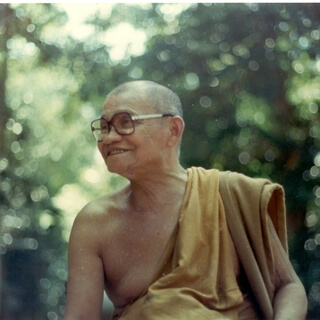
Venerable Ajahn Chah had a lot of experience with teeth.
It was torture and lots of pain.
Ajahn Chah had the doctor pull out all the teeth,
To not leave any.
To go to the doctor many times,
Traveling was troublesome.
So Ajahn Chah had them taken all out.
The doctor was worried it was dangerous.
But Ajahn Chah said he would be responsible for it himself.
So as a disciple,
The doctor followed Ajahn Chah.
And Ajahn Chah said it was very torturous and great pain.
He had to stop the feelings with his high level of samadhi,
Concentration.
But we can't do it like Ajahn Chah.
It's dangerous.
We have no strength of samadhi.
So we need to endure.
Sometimes we can't sleep.
Or someone who has the flu has pain and coughing all night and can't really sleep.
If one is young,
Then it won't be a problem.
But older people will have issues.
Because they don't get enough rest and sleep,
Then even more complications come up.
So sometimes we say the word forbearance or patience.
But one who is experiencing the pain will know it,
What it's like.
In the past,
There were monks who had malaria.
One monk had malaria,
And another monk didn't have malaria.
The fever from malaria was severe.
It was painful.
You couldn't even have anything come to contact the body.
It was that much pain.
For the monk who wasn't malaria,
He thought that the other monk didn't have forbearance.
So he said,
If I had malaria,
Then I would enter samadhi and the pain would be gone.
It was a good thought.
But later on,
That monk who never had malaria,
Caught malaria.
And then he knew for himself what it was like.
He couldn't have anything contact his body,
Otherwise it would be too much pain.
Then another monk asked,
At that time you said you would enter samadhi and it would disappear.
He answered,
At that time I was probably thinking about a normal fever.
He didn't know how severe malaria could be.
So some monks get it very severely.
We may talk about forbearance,
But if we haven't gone through it,
We may not understand it.
Or someone who has shingles has a lot of torture.
But those who have never been sick with it won't know what it's like.
So we should give encouragement to others.
We don't go saying to them that they're not enduring it enough.
Because we have no experience with it.
But it's good to teach children and grandchildren to have forbearance.
Because we are grown up and we need to teach the younger generations to have forbearance.
The firmly established forbearance is like the earth that does not waver.
We can compare it that there is someone pouring dirty things,
Perfumed things,
Disgusting things,
Whatever it is,
Good or bad,
And the earth can be indifferent to it likewise.
So we need to forbear like that.
But we won't be able to do it straight away.
We slowly and gradually train in it.
Here,
Sometimes we meet someone bad in society,
And we need to bear with it.
But if we can't endure it,
Then we need to escape from them,
Find a way to evade them.
Because if we are close to them,
When we come into contact with them,
We can take in their mood,
And it can defile our minds.
So in work,
We need to forbear.
And especially in Dhamma practice,
We need to have forbearance.
The Buddha taught directly to the monks that if a monk doesn't have kantip,
Forbearance,
They are not learned and wise.
They need to have forbearance.
So training in forbearance has a lot of value.
We can be anywhere,
And we'll be able to stay there,
No matter how difficult and troublesome it is.
Venerable Ajahn Chah said that what Nampa Pong did not teach samatha,
Tranquility,
Or vipassana inside meditation.
It taught torture.
It taught to endure.
If you endure,
Then you can get wisdom.
You can see the aniccang dukkhang anatta,
Impermanence,
Unsatisfactoriness,
And not-self.
If you have a high state of mind,
Then if you want it hot and get it cold,
Or you want it cold and get it hot,
Then you will endure it.
Monks need to train in it.
If we follow our desires,
That whatever we want,
We want to get that,
Then we won't see ourselves.
We won't see suffering.
If we train ourselves and go against the defilements,
Then we will see suffering.
So we have to have forbearance towards many things.
Sometimes being with bad people,
We need forbearance.
Or in doing good,
We need to have forbearance.
Waking in the morning at 5am.
Some wake 4am,
Then have to sit meditation at 4.
30am.
To do it for one or two days,
We can do it.
But for a week,
A month,
A year,
Can you bear that?
Being born in this world,
We have to experience many things.
But newer generations may not know what forbearance is like.
Their parents have built everything for them,
So their forbearance is a bit low.
Because they are born with money around them,
They have ease with everything.
So they don't know what suffering,
Difficulties and hardships are like.
There are some people that will train them in this.
The adults make the children be ordinary workers working under others,
Or to have some difficulties,
To live life being poor.
Sometimes there are rich people,
And they make their child work somewhere difficult,
And then tell the child they don't have any wealth.
The parents have no wealth.
And the child believes this.
But later on,
They learn that their parents have high status.
But the parents wanted to train the child to have forbearance,
In earning a living and making money.
But the important forbearance is towards the authority of the mental defilements.
If we can't have forbearance with it,
Then we will just have desire.
Whatever it is that we want,
We have to have it.
If we don't get it,
Then we're all upset and make a fuss.
Or if one has a lot,
Then one loafs about,
Spending lavishly,
Not saving and being thrifty,
Just enjoying and indulging and following the current of the world.
And then one's money and wealth can disappear.
Someone who can have forbearance will gain a lot of benefits.
The Buddha said that one who has forbearance will be loved by all others.
But one without forbearance will not be loved by others.
And there will be grudges and resentment towards one.
There's a lot of drawbacks in it.
And when it's time to leave this world,
They are unsettled and agitated.
But if we know that it will be a lot of pain,
These days the doctors can help the body to be peaceful to a level where there won't be so much pain.
Because if there's a lot of pain,
Then one's forbearance may not be able to handle the pain,
And one's mind can be lowered.
So have we ever thought of why monks need to be twenty years old to ordain?
Why is it that at eighteen years old they can't be ordained?
It has been laid down that at twenty years old,
One can endure heat,
Cold,
Hunger,
And thirst.
Before this,
The Buddha had not yet laid down a rule about it.
And at eighteen years old,
One could ordain.
At fifteen,
One could come to ordain.
But later they saw that,
Having ordained,
And they were hungry at night.
When it was hot,
They had a problem.
When it was cold,
They had a problem.
They couldn't endure physical pain.
So the Buddha laid it down that one had to be twenty years old till one could come to ordain as a bhikkhu,
A monk.
So there is an origin of the rule laid down like this.
And one needs to have forbearance towards one's mind states.
If we have anger or ill will,
We can control it well.
So one who can forbear will have sati,
Mindfulness,
To look and be aware and not hold any grudges to anyone.
Then they won't have many dangers to themselves and they are with mindfulness when they pass from this world.
So training in forbearance has a lot of benefits as explained.
And there is a story in the Zen tradition.
The Zen teachings teach to know clearly in the present moment,
To understand it with clarity.
Here there was a Zen monk disciple who thought he had high noble qualities even though he had just ordained.
And he had learned the core Zen teachings and thought he had attained something.
So he went to pay respect to the Zen master and said,
I have come new to the Zen tradition.
May the master teach me a special knowledge because the other duties are too ordinary,
About washing the bowl,
Mopping the floor and cleaning.
This monk was a new student and just ordained and wanted a deep teaching to practice with because of his strong faith.
But he still had only a little wisdom.
So he asked the Zen master,
I have come new to the Zen tradition.
May the master teach me a special knowledge.
He wanted something special.
He wanted it quick and fast.
What could he do to gain enlightenment?
The Zen master Jiao Chou asked something ordinary.
Have you eaten breakfast yet?
The disciple was confused and thought,
I asked a dumber question,
But the master is talking about eating.
But he answered,
I have eaten.
Thank you,
Master.
And the master still didn't teach and asked,
Have you cleaned your bowl yet?
The disciple said,
I have cleaned it.
The Zen master ordered him,
Then go mop the floor clean.
Now the disciple lost his patience.
He showed his displeasure by asking in a mocking way,
Why are you asking about eating,
Cleaning and mopping?
I want the deep teachings.
Why won't you teach me?
He wanted the teacher to teach deep teachings,
But the master taught in a simple way.
The Zen master said,
If you don't wash your bowl and mop the floor,
Then I don't know in what way you'll be able to gain enlightenment.
Because to gain enlightenment requires having mindfulness,
And then one can attain the state of awakening at any time.
There is no need to teach in a deep,
Methodical way.
Teaching simply.
To have mindfulness in eating,
Mindfulness in washing dishes,
Mindfulness in mopping the floor,
Cleaning the house,
And one can gain awakening.
In the present day,
There are a lot of people harming each other,
And there are many troubles and problems in society.
And with the increase in communication devices and more newer technologies,
It does give us more ease and convenience.
But there is an increase of people harming each other in the online world.
There is more wrongdoing than in the past.
And it's quick and fast too.
It's just at the tip of the finger.
If we want to listen to Dhamma,
It's at the tip of the finger.
But to scold and criticize someone,
To bully people,
Is at the tip of the finger.
So one can do wrong and get in trouble with the law or go to jail,
Just at the tip of a finger.
So it's a lot of danger.
We need to be careful.
Have forbearance towards all the mind states and our sense experiences.
Don't harm others.
This is an ideal upheld by the Sangha,
And it is for all of us as well.
So be determined in this and learn it.
The Dhamma is not old-fashioned.
In the present day,
If you learn it,
You will see the Dhamma and attain to the Dhamma.
May you grow in blessings.