Hashkiveinu Adonai Eloheinu B'Shalom,
B'Shalom If you want to truly get free from the Egypt of emotional suffering,
You first have to be fully present with the Egypt.
Meaning,
Bring your awareness deeply into those feelings that keep you enslaved.
This is meditation.
In this episode of the Torah of Awakening Jewish Meditation podcast,
You'll get a taste of this freedom through Parshat Beshalach,
Followed by a guided meditation based on the Hebrew letter Yod.
Enjoy.
Okay,
Here's the verse we'll be looking at.
This is the verse that comes after the children of Israel leave Egypt,
But before the splitting of the sea.
And God says,
Speak to the children of Israel.
He's talking to Moses.
They should turn back and encamp before this place called Pi HaChirot.
And it's not clear exactly what that is.
It sounds like it's some kind of idol,
Like some kind of statue of a god.
You shall encamp facing it by the sea.
So,
We often hear the advice that we should get out of situations,
Get out of jobs or relationships that don't serve us,
Which is good advice.
For sure,
We shouldn't be in situations that aren't supportive and healthy to us.
But,
Sometimes staying in a situation,
Even if it feels bad,
Is the right thing.
For example,
When a father abandons his family,
Doesn't he do it because the responsibility feels bad to him?
Doesn't he just want to be free?
In that case,
It's obvious that freedom,
In the ordinary sense,
Is not the highest value.
Because,
Freedom in the spiritual sense doesn't necessarily mean leaving behind that which imprisons us.
Rather,
If we want real inner freedom,
We must turn toward our bondage,
Not turn away from it.
Turn toward it.
This may feel counterintuitive.
If we want freedom from pain,
It's natural to want to get away from whatever's causing us the pain.
Just as in the Exodus from Egypt,
The Israelites cry out because of their suffering,
And Moses leads them out of Egypt to freedom.
That's the ordinary way of thinking.
Leave Egypt behind.
But,
There's a hint of something different in this week's reading.
When we think of the Exodus story,
It's common to imagine the Israelites fleeing Egypt,
Then coming to the Sea of Reeds and getting trapped with the Egyptian army behind them and the sea in front of them.
But,
Look at the text.
They had already passed the Sea of Reeds.
They were already on their way when HaShem tells them,
V'yashuvu,
Turn back.
They deliberately turned around and backtracked,
Coming to camp at Pi-Ha-Chirot,
In front of the Sea of Reeds.
There,
The Egyptian army caught up with them,
And there the miracle of the parting sea occurred.
Now,
Pi-Ha-Chirot literally means mouth of freedom.
It's a description,
In a sense,
Of the splitting sea itself.
So,
The message is,
If you want to truly leave bondage behind and go through the mouth of freedom,
You have to first fully turn back toward your oppressor.
Is there something or someone that triggers you,
That stresses you out,
That makes you angry or uncomfortable?
Those feelings are not external.
Those feelings are actually within you.
They are only brought to the surface by the external trigger.
Until you can be present in the face of those feelings arising,
And not get caught,
Not get seduced by them,
Not get possessed by them,
Then you will be in bondage,
No matter how far you flee from the external trigger.
Instead,
Shoove.
Shoove.
That means return.
Don't run away.
Return to this moment,
And be present with any discomfort.
Make friends with it.
Be with it.
Dwell with it.
Because that is the mouth of freedom.
Ordinarily,
We keep emotional pain alive by feeding it with our thoughts.
We feel the pain and so we think stuff about it,
Which is like food for it.
It keeps it alive.
Just as the soldiers of Pharaoh rode after the Israelites on their horses,
So the mind is the rider,
And the emotion is the horse.
The mind,
That is our thoughts,
That's the rider.
That's what is managing the situation.
That's what's controlling what's happening next.
And the emotions,
The reactions,
That's the horse.
Together they pursue us and seek to drag us back into bondage.
But if we use our mind in a different way,
Stop feeding the emotion with our thoughts,
And instead become present with your feelings.
Bring your awareness down to your actual experience,
Without adding extra interpretation,
Without adding extra commentary,
And the army drowns in the sea,
So to speak.
That is the army of thoughts and feelings that keep us in bondage.
They drown in the sea of consciousness.
That's because all of your pain,
All of your constriction,
All of that is nothing but a form of awareness.
It arises in awareness.
Awareness takes the form of the pain,
Of the constriction.
Bring your awareness into the Mitzrayim,
To the constricted form of awareness.
It may hurt a bit at first,
But the constriction cannot persist in the light of presence.
Through being conscious,
It will let go.
And you too will be able to sing.
Ashira ladonai,
I will sing to the divine.
Ki ga'ol ga'ah,
Transcendent and exalted.
Sus v'rochvo,
Rama v'yam.
Horse and rider are cast into the sea.
That is,
Mind and feeling,
Thought and emotion,
Are cast into the sea of consciousness,
Dissolved in an ocean of bliss.
The midah we need to accept this moment with simplicity is the midah of trust.
Trust,
Trust.
We can bring forth this quality of trust any moment we're feeling the opposite of trust.
Any moment we're feeling anxiety,
Any moment we're feeling the urge to resist,
To judge,
To think that things should be other than how they are.
Remind yourselves,
Oh wait a minute,
Let me trust Hashem.
The divine intelligence has brought me here to this moment.
What is my task right now?
What is the Moses within instructed to do in this moment?
This is all represented by the letter Yud.
The letter Yud,
Which is the smallest of letters,
Is like making yourself small,
Making yourself permeable to the truth of what is.
So let's do this.
Kavanah,
This intention,
Chanting together.
I am trusting,
Planting these seeds of Yud deep in your awareness.
I am trusting,
I am relaxed,
I am simplicity.
And our chant from Psalm 15.
Who may dwell or sojourn in your tent?
Which is really a metaphor for dwelling in the tent of this body right now,
Being in this temple of consciousness.
But also,
Who may dwell on your holy mountain?
That's beyond the tent,
That's the open space,
Beyond the vessel,
The temple of the body.
Recognizing that our consciousness encompasses the fullness of the outer world and the inner world as it appears to us right now.
It's all arising within awareness.
And to know ourselves as that awareness,
All we need to do is,
Just moving through the world,
Moving through our lives with simplicity,
Accepting the moment as it appears.
And preparing for meditation,
Checking your body to be in a comfortable but alert position,
Aligning the top of your head with your spine,
Pulling up towards the heavens,
And taking an attitude of generously offering your attention to the fullness of what arises with simplicity,
Like the letter Yud.
Bringing your right hand to your heart,
And just being the simple offering of your attention to whatever is present now in awareness with L'cha on a long out-breath,
Deep breath,
And bringing left hand to your belly,
Feeling gratitude for the sustaining power of all of your organs.
Drawing that light down from your belly,
All the way down to your feet and toes,
Pouring downward from there,
Down through the floor,
Down into the earth.
Also rising up now from your belly,
Up into your chest,
Shoulders and neck releasing any excess tension,
Spilling down through your arms,
Connecting back to your belly and your heart,
Bringing your attention to rest more deeply on the flow of your breathing,
Flow of the air,
Each breath a miracle sustaining you in this life.
Rising up,
Face and facial muscles,
Brain and nervous system,
Bringing a little smile to your lips,
Being the loving,
Benevolent,
Indwelling presence,
Conscious now in the body,
Na'ase,
Deep breath in,
And your right hand up from your heart to lightly touch your forehead as awareness opens up from the body,
Shining outward into this space around you,
Resting on the boundaries of the room,
The objects,
The sounds vibrating in the atmosphere,
And recognizing that this field of awareness that has no boundary or border within which the inner world of thoughts and feelings arise,
As well as the outer world,
This vast field of consciousness is who you are at the deepest level,
Beyond thought,
Beyond feeling,
Beyond the body,
Beyond the sense of personality,
All of that is arising within the field of consciousness and you are this field,
You are this openness,
V'nishmah,
Deep breath in,
Kissing your fingers,
Relaxing your hands,
V'bono shel olam,
Bless us to meditate deeply,
To bring forth the quality of the yud,
Of simple trusting the moment,
Trusting Hashem as this moment is brought to us,
Atahu,
Atahu,
You who are not separate from anything or anyone,
We encounter you who are not separate from this awareness that we are,
Atahu.
Coming back into some movement,
Taking a nice stretch,
May we be imbued with this quality of trust as we move through all of the different experiences and impulses and drives that arise within and beyond us,
To return ourselves to shuv again and again,
To this basic attitude which is so liberating,
The simple act of trusting what is right now.
Oseh shalom b'mromav,
Hu yaaseh shalom aleinu,
V'al ko yisrael,
V'al ko yoshvei tevel,
V'imru,
Amen.
Shalom,
I hope you've enjoyed this Torah of Awakening.
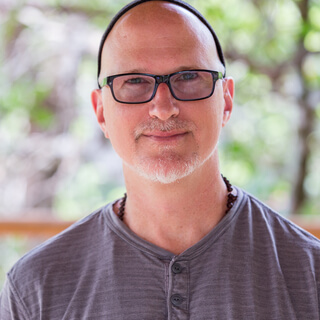
I'm Rabbi Brian Yosef Schachter-Brooks.
Until next time,
All blessings.