Welcome to the Religion of the Month Club,
A podcast where we discuss texts from the world's scriptural traditions.
Today is the first day of Vaisakha in the year 2078 of the Hindu calendar.
In this episode,
We will be discussing the second chapter of the Bhagavad Gita.
The First Chapter of the First Book of a Sacred Text For this first round of episodes,
I've been focusing either on the first chapter of the first book of a sacred text,
Or on a self-contained book.
For example,
In the first episode,
I covered the first chapter of Genesis.
Then I covered the first chapter of the Dao De Jing.
And for our episode on Theravada Buddhism,
I covered an entire sutra.
This time I'm doing something a little different.
I'm skipping ahead to the second chapter of the Bhagavad Gita.
The reason for this is that the first chapter is really a setup,
And it's a bridge chapter between the rest of the Mahabharata and the Bhagavad Gita,
Of which it is a part.
So the Bhagavad Gita exists as a relatively small book within the larger epic of the Mahabharata.
The Mahabharata describes an epic war between good and evil that takes place over many generations,
Involving gods and humans.
And it,
Along with Ramayana,
Are the two great epics that have been culturally defining for much of South Asia.
Not just India,
But also Indonesia and many other parts of East Asia.
The Bhagavad Gita is not a Veda,
It's not an Upanishad,
And yet it has one of the largest impacts of any sacred text of any religion.
Many people have come across the Bhagavad Gita in the form of the Bhagavad Gita as it is,
Which is published by the.
.
.
I forget what it's called,
But they're commonly known as Hare Krishnas,
Because they sing Hare Krishna a lot.
But it's also influenced everywhere.
It has influences everywhere.
So,
I'm skipping the first chapter because the first chapter really just describes the war that's taking place,
Which is not really central to the message of the Bhagavad Gita.
It's important that the Bhagavad Gita takes.
.
.
It's significant that the Bhagavad Gita takes place in the midst of this war.
And as you'll hear in the beginning,
You hear Arjuna complaining,
Or lamenting to his chariot driver,
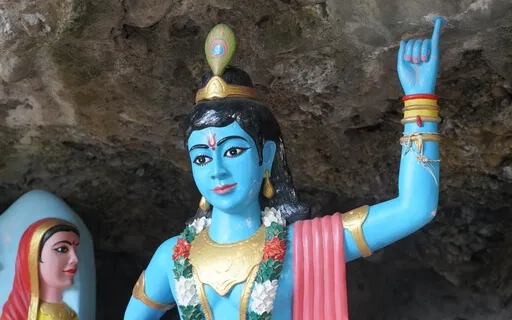
Krishna,
That he doesn't want to go to war.
He doesn't want to go to war because he knows the people on the other side.
They're his extended family.
They are people who he has great respect for,
And so he's having trouble dealing with the fact that he is supposed to go to war and fight and likely kill these people.
And I will leave it at that.
This chapter is a lot longer than most of the passages that I've been reading so far,
So I'm only going to read it once,
And then I will follow it with my commentary.
Sanjaya said,
To him who was thus overwhelmed by compassion,
Whose troubled eyes were full of tears,
Who was deeply depressed,
Madhusudana spoke these words.
The beloved Lord said,
From where does your weakness come at this time of crisis?
It is not befitting,
The noble-minded,
Nor does it lead to celestial realms.
It causes disgrace,
O Arjuna.
Do not yield to this weakness,
O Partha.
It is inappropriate for you.
Relinquishing this poor faint-heartedness,
Stand up,
O scorcher of the enemy.
Arjuna said,
How shall I,
In battle against Bhishma and Drona,
O Madhusudana,
Fight back with arrows against those who are worthy of my respect,
O slayer of the enemy?
Indeed,
Rather than slaying greatly revered gurus,
It would be better to subsist in this world by begging for alms.
For slaying such gurus,
Though they desire selfish gain in this world,
Surely would taint with their blood any pleasures I might enjoy.
And we know not which of the two is better,
Whether we should conquer them or they should conquer us.
For having slain them,
We should not wish to live.
They who are standing here before us,
The sons of Dhritharashtra.
My very being is afflicted by a piteous weakness of spirit.
My thoughts on Dharma are completely bewildered.
I ask you,
Tell me what is definitely better for me.
I am your student.
Instruct me,
For I have offered myself unto you.
Indeed,
I cannot foresee what would dispel this grief that is drying up my senses,
Even if achieving an unrivaled flourishing kingdom on earth or the sovereignty of celestial beings.
Sanjaya said,
Thus having spoken to Hrsikesha,
Gurakesha,
The subduer of the enemy,
Said to Govinda,
I shall not fight.
Having spoken thus,
He fell silent.
Hrsikesha,
As if about to laugh,
O Bharata!
In the midst of the two armies spoke these words to him who was feeling despondent.
The beloved Lord said,
You have grieved for that which is not worthy of grief,
And yet you speak words of profound knowledge.
The learned grieve neither for those who have passed on nor for those who have not departed.
Never truly have I ever not existed,
Nor you,
Nor these kings who protect the people,
And never shall any of us ever cease to be,
Now or forevermore.
Just as the embodied while in this body passes through childhood,
Youth,
And old age,
So also the embodied attains another body.
The wise person is not bewildered by this.
Certainly,
Contact of the senses with matter,
O Arjuna,
Which results in cold,
Heat,
Happiness,
And suffering,
Comes and goes,
And is impermanent.
You must strive to tolerate this,
O Bharata.
Indeed,
The person whom these do not trouble,
O best among men,
The wise for whom suffering and happiness are the same,
That one is prepared for immortality.
Of the impermanent one finds no being,
One finds no non-being,
Of the permanent.
Indeed,
The certainty of both of these has been perceived by seers of the truth.
Now,
Know that to be indestructible by which all this is pervaded,
No one is able to bring about the destruction of the ever-present.
These bodies,
Said to have an end,
Belong to the embodied,
Which is eternal,
Indestructible,
And immeasurable.
Therefore,
Fight,
O Bharata,
One who considers it,
That is,
The self,
A slayer,
And one who thinks it is slain.
Both of these fail to understand.
It does not slay,
Nor is it slain.
It does not take birth,
Nor does it ever die.
Such a being has never come into being,
Nor shall it ever come to be.
It is unborn,
Eternal,
Everlasting,
And primeval.
It is not slain when the body is slain.
One who knows this,
To be indestructible,
Eternal,
Unborn,
And ever-present,
How and whom does that person slay,
O Bharata,
And whom does that one cause to slay?
As a person abandoning worn-out garments acquires other new ones,
So the embodied,
Abandoning worn-out bodies,
Enters other new ones.
Weapons do not pierce it,
Fire does not burn it,
And water does not moisten it,
Nor does wind wither it.
It cannot be pierced,
It cannot be burned,
Moistened,
Or even withered.
Eternal,
Present everywhere,
Stationary,
Immovable,
It is everlasting.
This self is unmanifest,
It is inconceivable,
It is spoken of as unchangeable.
Therefore,
Knowing this to be so,
You should not grieve.
Further,
If you think of this self as always being born or always dying,
Even then,
O mighty-armed,
You should not grieve for this.
Indeed,
For one who is born,
Death is certain,
And for one who has died,
Birth is certain.
Therefore,
Since this process is inevitable,
You ought not to grieve.
Unmanifest are the beginnings of beings,
Manifest are their interims,
O Bharata.
Then again,
Unmanifest are their endings.
What is lamentable about this?
Rarely,
Someone perceives this self,
Rarely another also speaks of it,
And rarely indeed another hears about it.
Even having heard about it,
No one truly knows it.
The embodied,
Eternally indestructible,
Dwells within the body of everyone,
O Bharata.
Therefore,
You should not grieve for any living being.
Moreover,
Considering your own dharma,
You should not waver.
Truly,
For a warrior,
Nothing better exists than a battle fought according to dharma.
And if,
By good fortune,
What is gained is an open door to the celestial worlds,
Happy are the warriors,
O Bharata,
Who obtain such a fight.
Now,
If you should not undertake this battle,
Which is in accordance with dharma,
Then,
Abandoning your own dharma and reputation,
You shall meet with misfortune.
Also,
People certainly will speak of your undying infamy,
And for one who has been honored,
Such infamy is worse than death.
The great chariot warriors will believe you have retreated from battle out of fear,
And among those who once held you in high esteem,
You shall come to be taken lightly.
And many unspeakable words your enemies will speak of you,
Deriding your ability.
Now,
What could be greater misery than this?
Either having been slain,
You shall reach the celestial world,
Or conquering,
You shall enjoy the earth.
Therefore,
Rise up,
O Kaunteya,
Acting with firm resolve for battle.
Acting the same in happiness and suffering,
Gain and loss,
Victory and defeat,
Then prepare for battle.
Thus,
You shall not suffer misfortune.
This discernment has been explained to you in the philosophy of Sankhya.
Now hear about this in the practice of yoga.
Be absorbed in yoga,
With discernment,
O Paratha,
By which you shall throw off the bondage of action.
Here there is no loss of effort,
Nor is any diminution found.
Even a little of this dharma delivers one from great danger.
Discernment that is resolute in nature is singular in the world.
O descendant of Kuru,
For many branched and endless is the discernment of those who are irresolute.
Those who lack understanding speak this flowery language,
Delighted by the words of the Vedas,
O Paratha,
Declaring,
There is nothing else.
For the self full of desire,
Whose intent is on the celestial world,
This flowery language bestows another birth as the fruit of action.
Preoccupied with various ritualistic acts,
This self is directed toward the goal of worldly pleasure and power.
For those attached to worldly pleasure and power,
Whose thoughts are stolen away by this flowery language,
Discernment that is resolute in nature is not discovered in perfect meditation.
The domain of the Vedas is the three essential qualities.
Be free of these three qualities,
O Arjuna,
Beyond duality,
Always established,
In pure existence,
Beyond acquisitions and security in possession of oneself.
As much value as there is in a well,
When all about it waters flow abundantly.
Such is the value of all the Vedas,
For a Brahman who has realized knowledge.
It is inaction alone that you have a claim,
Never at any time to the fruits of such action.
Never let the fruits of action be your motive.
Never let your attachment be to inaction.
Established in yoga,
Perform actions,
Having relinquished attachment,
O conqueror of wealth,
While remaining the same in success and in no success.
Such sameness is said to be yoga.
Still,
Action is by far inferior to the yoga of discernment,
O conqueror of wealth.
Seek shelter in discernment.
Miserly are those who are motivated by the fruits of action.
One absorbed in the yoga of discernment casts off in this world both good and bad acts.
Therefore,
Be absorbed in yoga,
For yoga is skillfulness in action.
Indeed,
Those wise ones,
Who are absorbed in the yoga of discernment,
Relinquishing the fruits born of action,
Who are freed from the bondage of repeated births,
Go to a place beyond suffering.
When your discernment crosses beyond the jungle of bewilderment,
Then you shall become completely indifferent to that which is to be heard and that which has been heard.
When this discernment is no longer perplexed by the heard scriptures,
When it shall remain without change,
When discernment is unchanging within perfect meditation,
Then you shall attain yoga.
Arjuna said,
What is the description of one established in profound knowledge,
Who is established in perfect meditation,
O Keshwa?
How would one established in thought speak?
How would one sit?
How would one move about?
The beloved Lord said,
When a person gives up all selfish desires arising from the mind,
O Paratha,
Satisfied within the self,
By the self alone,
Then that person is said to be established in profound knowledge.
One whose mind is undisturbed in suffering,
Who is free from desire in all kinds of happiness,
Whose passion,
Fear,
And anger have departed,
Such a person established in thought is said to be a sage,
One who everywhere is without sentimentality upon encountering this or that,
Things pleasant or unpleasant,
Who neither rejoices nor despises,
The profound knowledge of such a person is firmly established.
And when one withdraws completely,
As a tortoise,
All of its limbs,
The senses from their sense-objects,
The profound knowledge of such a person is firmly established.
Sense-objects fade away,
For the embodied who does not partake of them,
Except for the taste,
For one who has seen the Supreme,
Even this taste fades.
Indeed,
Even for one who is striving,
O Kaunteya,
For the person of discrimination,
The impetuous senses forcibly carry away the mind.
Restraining all these senses,
One should be seated while absorbed in yoga,
Wholly intent on me.
For one whose senses are under control,
For that one,
Profound knowledge is firmly established.
For a person dwelling on the objects of the senses,
Attachment to them develops.
From attachment,
Selfish desire develops.
From desire,
Anger develops.
From anger comes bewilderment.
From bewilderment,
Disturbed memory.
From disturbed memory,
Loss of discernment.
From loss of discernment,
One becomes lost.
Without being absorbed in attraction and repulsion,
As the senses are moving toward their objects,
With self-restraint,
The self that can be governed attains calmness.
In calmness,
The cessation of all one's suffering occurs.
Indeed,
For one whose thought has been calmed,
Discernment is quickly established.
There is no discernment for one who is not absorbed in yoga.
And for one not absorbed in yoga,
There is no meditative state.
And for one who has no meditative state,
There is no peace.
For one who is not peaceful,
From where is happiness to come?
Indeed,
When the mind is being pulled by the roaming senses,
Then just one of them can carry away one's profound knowledge as wind does,
A ship at sea.
Therefore,
Almighty-armed,
Whosoever has completely withdrawn the senses from the objects of the senses,
The profound knowledge of such a person is firmly established.
During that which is night for all beings,
The deeply meditative person is awake.
During that time in which beings are awake,
That is night for the insightful sage.
Continually being filled,
The ocean remains unmoved and stands still,
Though waters enter into it.
That person into whom all desires enter in the same way attains peace.
Not one who is desirous to fulfill such desires.
Abandoning all selfish desires,
A person moves through life free from worldly longings.
Without the sense of mine,
Without the notion of I am acting,
That one attains peace.
This is the state of the feminine energy of Brahman,
O Paratha,
Having attained which one is not bewildered.
Being established in this,
Even if only at the end of one's life,
One reaches the nirvana of Brahman.
You may have noticed some connections here between what Krishna is telling Arjuna and what the Buddha was saying in the first turning of the wheel of dharma in the last episode.
And that's not an accident.
Siddhartha was rebelling against the established norms of Hindu culture at the time.
And his criticism did not go unnoticed.
So actually a lot of what Siddhartha noticed and what turned into Buddhism was actually reabsorbed back into Hinduism.
And we see some of this in the Bhagavad Gita.
The Bhagavad Gita was written in the 4th century BCE.
Now one of the things that people often struggle with with the Bhagavad Gita is this very first section where Arjuna says that he doesn't want to kill his,
Essentially his extended family and friends.
And Krishna says,
No.
If you don't do that,
You will be,
You know,
People will think that you're a coward.
You will not be fulfilling your dharma.
And this seems to fly in the face of the Hindu ethic of ahimsa,
Which is to do no harm.
And in a way it does.
It contradicts that.
And the way that Krishna explains it is he says,
Well,
No one is really,
No one really ever lives or dies because we are all eternal.
And this is,
You know,
This can be a comforting thought in some ways,
But it also can be a dangerous thought,
Or it could be a dangerous thought.
I've heard it said that samurais in Japan were very fond of Zen for a similar reason because it basically taught them that everyone's already dead.
So there's nothing wrong with killing people.
And it sort of comes across as very sociopathic in a way.
However,
I think that if we think of it in terms of,
You know,
Maybe don't take it quite so literally,
Take it as a parable.
A parable may be taken to its extreme,
Which is a common theme in East Asian literature,
Is to take these teachings to the extreme.
Now,
Hopefully,
You know,
You won't be called upon to murder anyone,
Although if you are in the armed forces you very well might be.
But the idea of having to do something that causes suffering is often a situation that we may in fact find ourselves in.
I became acutely aware of this when I had a child.
And I realized at a certain point that the best thing for my child was sometimes to not respond to her cries.
This was when we were trying to sleep train her.
That to respond to her cries did nothing for her,
Really,
And it did nothing for me.
It did nothing for anyone in our family.
It only perpetuated the problem that she needed to learn how to go to sleep by herself.
And this is,
I think,
Something that every parent can relate to in some way,
Maybe not with sleep training per se,
But with some cases of just that there are things that you need to do for your child that your child doesn't like,
And may complain about,
And may be very upset about.
And that is upsetting to you as a parent,
As somebody who loves your child.
But since you have a wider view of what is going on,
You can and should make that choice.
And it is actually the courageous choice,
The correct choice,
Sometimes to cause suffering.
But you need to have that larger point of view that Krishna talks about.
Now,
Whether or not you believe in reincarnation or the undying nature of the soul,
I think there is something to this idea of,
When you pan out,
A lot of these things that are suffering don't matter in the long run,
Or matter but in ways that you wouldn't necessarily expect.
So the rest of the book of the Bhagavad Gita,
Which the rest of this second chapter goes into to some extent,
And then is elaborated further in the rest of the chapters,
Is essentially,
One might say,
Is how to attain that point of view,
That consciousness,
That raised level of consciousness that is able to perceive what's really going on,
And to become detached from the suffering that's happening right here and now.
So he talks a little bit about the Vedas.
He also talks about,
Is very critical of people who basically just repeat these flowery words,
And who don't have real understanding.
This occurs in the Gospels as well,
Where Jesus criticizes the hypocrites,
I think it was the Pharisees,
For knowing the law but not really understanding the spirit of the law.
So here,
Krishna is kind of doing the same thing.
Krishna is considered to be an avatar of God.
In most traditions I've seen him thought of as an avatar of Vishnu,
Who is the preserver of the universe,
And the triumvirate of Brahma,
Vishnu,
And Shiva.
Brahma being the creator,
Vishnu being the preserver,
And Shiva being the destroyer.
All these gods,
Of course,
Have many,
Many aspects,
And should not be understood only in terms of that,
But that's something that a lot of people have heard of,
So I thought I'd mention that.
Interestingly,
I have heard from one tantrika,
A Shakta tantrika,
So that is basically a gaudish worshiper,
That Krishna is an avatar not of Vishnu,
But of Kali.
And there are certain aspects of this text that I think do contribute to that hypothesis,
But I just throw it out there since I know that a lot of people are interested in Gaudish traditions and in tantra.
So,
Towards the end of this second chapter,
We have the beginning of a description of Yoga,
And for those who want to know more about this tradition of Yoga,
I do recommend reading the rest of the Bhagavad Gita and also the Yoga Sutras by Patanjali,
Which was also an influence on this book,
Predates this book.
One of the things that's interesting about both this book and the sutras of the Buddha is that they are espousing a school of thought of overcoming desire and becoming disinterested or detached in order to attain liberation or nirvana.
And one of the things that's interesting about this is that they were both making this teaching available to the masses in a way that hadn't been done before.
So,
Prior to this,
It was only the Brahmins who had access to this information and who were expected to lead a spiritual life.
The Kshatriyas,
Or the warrior caste,
That's what Arjuna is,
They were just expected to lead and be political figures and to wage war and that sort of thing.
But here,
He's taught to take up the spiritual life.
And I think that's important for us today as householders,
For those of us who are householders,
Which is of course most of us.
And I don't mean that in the literal sense,
Although I mean that as well,
But I just mean people who have jobs and maybe have families and who are not renunciates.
In fact,
I think the Bhagavad Gita goes a bit further than the original sutras because the original buddha sutras were really just two monks.
The idea even then was that while anyone could become a monk,
You didn't have to be born into a certain caste to become a monk,
It was something that you did have to renunciate life.
And if you weren't a monk,
Basically the plan is you need to just live a good life and eventually if you're lucky you'll be reborn as a monk and then you can get liberation.
Here,
Krishna is telling Arjuna that he can start on this path right now and he doesn't need to be reborn as a monk.
He,
In fact,
His destiny,
Quite unlike Siddhartha who left the kingdom behind and who abandoned his wife and child and abandoned his kingdom to become a monk.
Arjuna is expected to continue in his role,
To continue his dharma as a war leader.
And that,
In fact,
He has an important role to play in the drama of life,
That this epic battle that is taking place needs to take place.
It needs to happen in order for the universe to be made well again.
And we have stories of these epic battles between good and evil all over the world.
I think of the Arthurian mythos is all about this battle between good and evil and that basically in the time of greatest darkness a hero of the light emerges.
And in that case it's Arthur and in this case it's Arjuna.
Arjuna with his chariot driver,
Krishna.
I think the most important verse in this chapter to me is verse 47.
It is an action alone that you have a claim.
Never at any time to the fruits of such action.
Never let the fruits of action be your motive.
Never let your attachment be to inaction.
This,
I think,
Is very important for anyone really.
The last line,
Never let your attachment be to inaction,
Is an important postscript to this message.
Basically saying you need to act,
You need to not be attached to the results of your action,
And you need to not be attached to inaction.
Trying to not do anything isn't going to work.
This comes up as well in Taoism where there's this sense of wu-wei which means inaction,
But sometimes you see it as wei-wu-wei,
Acting without acting.
One of the things that comes up again and again in Taoism is that wu-wei does not mean not doing anything.
It means not acting out of lust of result.
That's exactly what we have here.
It is an action alone that you have a claim.
Never at any time to the fruits of such action.
Basically,
You must focus on the action at hand,
And doing it for its own sake,
And letting go of what you hope will come out of that action.
If you are attached to the results,
You will be disappointed,
And you will be very frustrated.
I think that comes up again and again just in life where we often do things for some other purpose.
We do things to fulfill a goal.
We end up focusing on the goal instead of the thing that we're doing to attain that goal.
If you do that,
I think you're not going to be happy.
You're going to be constantly seeking after the next carrot.
Whereas if you are focused on the action itself,
It doesn't mean that the result doesn't matter,
But just that that should not be your motivation as much as possible.
Of course,
Sometimes we have to do things for the goal.
You have to work to make a living to feed yourself.
Hopefully,
You can find a job that you can get some pleasure out of,
Some enjoyment out of,
But most people need to work in some way in order to make a living.
But if you can try to find a job or try to find a path that is fulfilling in and of itself,
And also provides you a livelihood,
That is definitely the best way to go.
But again,
That goal of trying to find your vocation,
Trying to find the perfect job or whatever,
Can fall into this trap in itself.
Suddenly you find yourself looking for this,
Doing everything in order to set yourself up for this perfect job that you're going to have.
And again,
It only leads to disappointment.
I speak from experience in that regard.
Many times I've tried to pursue careers that I thought would be great,
And on the way found that I was really unhappy.
And I've come to realize that it's just a matter of focus on what's here and now,
And try to do what's best in the doing as opposed to the fruits of the action.
So with that,
I'll conclude this episode.
Thank you very much.
Thank you for listening.
I hope you will join us next month when we discuss the first chapter of the Gospel According to Mark.