Namaste sannyasa family and everyone.
A very warm welcome to all of you in this daily live meditation session with me,
Dhyansa.
We are meditating on 112 meditation techniques of Vigyan Bhairav Tantra.
And we are going to continue on to meditation number 60.
We have come a long way in this journey.
And I salute each one of you,
Each one of the sannyasa family members,
Who have walked this journey with me over the last two months.
So many different techniques,
So many different experiences,
Knowingly or unknowingly,
You have established for yourself something that will serve you for the rest of your life.
Something,
The warmth of the fire will serve you,
Will keep you warm throughout your life.
So this practice that you have established for yourself,
This Tantra vibration that you have brought in your life,
It will serve you for the rest of your life.
And now is the time not to stop.
Whatever happens in your life,
Do not break this continuity.
If for this long you have managed to fight with different circumstances in life and give space,
Give time,
Give energy to this Tantra vibration,
This Tantra vibration is going to serve you back.
So let this vibration continue for until this journey ends of Vigyan Bhairavtantra.
Whatever happens,
Do not break this continuity.
If it feels like a marathon,
Take it as a marathon.
If it feels natural,
Just simply flow along,
This journey until we finish these 112 meditation techniques.
And I promise you,
In the Sannyasa family,
We will have a celebration when we will finish this journey.
Celebration of something that has been established for you forever.
For today's session,
Let us begin with few questions from the meditators in our Sannyasa family,
In our community,
Because these questions are not only their questions.
These questions are questions of all meditators,
Wherever they are,
Howsoever they are listening,
They are tuning into these sessions.
The first question.
Is there a better time of day to meditate and why?
These questions are,
You can say,
Beginner questions,
But they remain relevant for a long time in everyone's practice,
Because as the sensitivity grows,
As this inner awareness of oneself,
Of where we are and what's happening to our life,
When that sensitivity,
When that awareness changes,
These questions,
They also have different meaning,
Different answers for oneself.
So the question is,
Is there a better time of day to meditate and why?
For this,
You have to do a small experiment.
You have to take a pen and a paper,
And every hour you write down a few things about how you're feeling,
How your state of mind is,
How your state of energies are,
How you're feeling,
What your moods are,
What kind of emotions are coming in your life,
What kind of thoughts are coming to your mind right now.
And if you will see and collect this data point in your life,
Every hour you collect this data point in your life,
You will see that these 24 hours that you have,
They are forming a cycle,
The cycle which is repeating.
No two moments are the same,
But two moments can be similar.
Please understand this carefully.
No two moments of life are the same.
They're never the same,
But they can be similar.
So this similarity of moments,
If you put them together,
It creates certain zones.
It creates certain phases in your day,
In your night,
In your time,
Where you experience a certain mood,
Where you experience a certain opening in your consciousness,
Where your energies are in a certain way,
Your thoughts,
Patterns are in a certain way.
So if you map out your own data over 24 hours,
You will see that at specific times,
You feel in a certain specific way.
As an example,
At 12 o'clock or one o'clock,
The hunger strikes.
No matter you had eaten something at 10 o'clock,
But since you're used to eating at 12 o'clock,
Suddenly from nowhere,
Even if at quarter to 12,
You tell yourself you will not feel hungry,
At 12 o'clock,
You feel hungry.
The hunger arises.
So the whole body,
Mind and energies,
They live in patterns.
And you have to understand that you're living these patterns 24-7,
And there are different phases in these patterns,
And therefore this question becomes relevant.
Is there a better time of day to meditate and why?
So first of all,
Once you understand your cycles of time within 24 hours,
You will see that there are those pockets,
There are those zones where you naturally feel more contemplative,
Where you naturally feel more closer to yourself.
If you can identify those time zones,
If you can identify those slots,
That is the best time for you to meditate.
But if you want to generalize,
Then there are two ways of looking at it.
One is,
Anywhere there is a transition,
Anywhere there is a shift of gear,
Is a good time to meditate.
As an example,
Dawn and dusk,
These are two moments,
Two phases of time,
Every day that you experience,
Where there is a shift from day to night,
And from night to day.
In that transition,
There is no day,
There is no night.
In that transition,
You are also going through a transition in your consciousness,
Where the energies are neither right nor left.
They are in the middle,
They are in the Sushmana,
They are neither in the Ida,
Neither in the Pingala,
So you experience a certain centeredness.
So if you can meditate,
Then you meditate at the time of dawn or dusk.
These are one way of looking at it,
Transitory times where meditation is easy,
Because your consciousness is in also a transition.
The transcendence through your consciousness is very very natural,
Very very easy.
The energies are in Sushmana.
The other time that you could have is if you meditate very early in the morning.
That is the best.
This time between 3 o'clock,
4 o'clock,
5 o'clock,
6 o'clock,
Before the waking state,
Before this world wakes up for you,
In this time zone,
In this phase,
The energies are the best.
This is the best time known as Brahma Murat.
Why the significance of this time?
In this time you are closest to yourself,
You are closest to God.
In this time you are in your ground state.
For those who are devotees of science,
This is the time where the cortisol level is the lowest in your body,
Where whatever is the state of your body,
If you are going through pain,
This is the time where you will feel the most pain in your body.
The rest of the time,
Different biochemicals in your body,
They create,
They make up your body,
Your experience of the body,
Your experience of the mind,
For the situation that you are in.
And you are never really in your true ground state.
So if you want to experience your true ground state,
The time,
The magical time,
Is after 3 o'clock,
4 o'clock,
5 o'clock,
6 o'clock in the morning.
This time frame.
But,
Once again,
If you have no chance to meditate in the morning,
In this time frame,
Or catch these dawn and dusk,
Any time is a good time,
As long as you come to this time again and again.
You fix a particular time in your life,
It could be before sleeping,
It could be before you have dinner,
It could be any particular time that is convenient in your life.
You bring meditation to that time,
And then meditation will take care of the rest.
As your awareness,
As your consciousness starts to unfold,
As your inner intelligence,
Inner sensitivities,
Start to rise,
You will orient yourself in the day,
In the week,
In the year,
All by yourself.
Because in that awareness,
In that consciousness,
You will get those signals that consciousness will tell you when to meditate,
When not to meditate,
That consciousness will guide you,
Will orient itself in the day,
In the week,
In the yearly cycles,
And you will know the best times for your meditation.
So,
Just to summarize that,
The best time is,
First of all,
If you can be aware 24-7 in your day,
You will know when your consciousness is having that opening,
Is having that lucidity,
Is having that state where you can enter yourself,
Where you can be with yourself.
If that's not the case,
You try to catch dawn or dusk.
If that's not also possible,
You try to meditate very early in the morning,
Before the whole world wakes up.
And if even that is not possible,
Then fix some time in your day,
Some time in your,
Before sleeping,
When you can meditate.
Keep it regular.
That's question number one.
The second question is,
Is there like a right frequency of daily meditation,
Once,
Twice or more?
Once again,
A question that arises to a beginner,
But is relevant to those who have been meditating regularly as well.
Is there like a right frequency of daily meditation?
See that these meditation practices,
These are anchor points in your life.
And these are taking you out of all what is happening in the craziness of the external,
And establishing an anchor,
An anchor in yourself where you remain centered.
So,
As many anchors as you need is the right frequency of meditation.
Mooly Shah,
He went to an interview to become a captain of the ship.
The interviewer,
He was asking questions,
And one of the questions was,
So if you are in the middle of the ocean,
You are sailing in the middle of the ocean,
And there is a five meter high wave,
And you see that the ocean is getting turbulent,
The clouds are getting dark,
What will you do?
Mooly said,
I will simply take the anchor,
I will put the anchor down,
Let that ship rest for a while,
And wait for the weather to become better.
The questioner said,
Okay,
Good answer.
What if the waves are now 20 meters high,
And the ocean is completely turbulent,
The clouds are very very dark,
And it's stormy,
And it's just getting worse,
What will you do?
Mooly said,
I will,
No problem,
I will take another anchor,
And throw it in the ocean,
Let the ship stabilize,
And wait for the weather to be better.
The questioner said,
Okay,
What if the waves are 50 meters,
And there are storms coming all the time,
And everything is completely out of control,
What will you do?
Mooly said,
No problem,
I will take the third anchor out,
I will throw it in the ocean,
And let the ship stabilize,
And wait for the weather to become better.
And so on,
The questioner kept on saying that the weather becomes worse and worse and worse,
And Mooly kept on responding,
Bringing another anchor,
Throwing in the ocean,
Stabilizing the ship,
Waiting for the weather to become better.
Then the questioner said,
Where are you getting all these anchors from?
Mooly said,
Wherever you're getting all these bad weathers and waves from,
From the same place,
I'm getting the anchors.
So,
As many anchors as you need for your meditation practice is the number of frequency,
Is the frequency that you need in your daily meditation practice.
So I would say,
If you are retired,
If you have not much to do in life,
If the weather is good,
Meditate,
Meditate once a day.
If you have a job,
If you have a lifestyle which is bringing some clouds,
Some turbulence,
Meditate twice a day.
If you have two jobs,
If you have lifestyle which is crazier than having one job,
Meditate three times a day,
And so on.
So,
It depends on your lifestyle.
If your lifestyle allows you to be silent,
To be centered,
Once is enough.
This reminder,
This going back to your own truth,
This going back in your inner space,
Once is enough.
But,
If your lifestyle is not this simplistic,
If your lifestyle is more complex,
Then you need more time.
There are more questions,
We may need more time.
We will continue with the questions tomorrow.
For now,
To sit in silence,
To sit in meditation,
To sit in contemplation,
We will simply bring our awareness to this moment,
To this time that we are all together,
To this space that we are all in,
And move into silence with that for the next minutes.
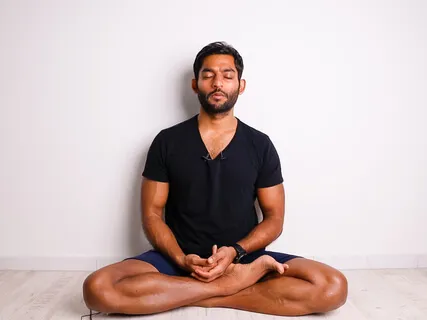
Please close your eyes.
Take a posture that is comfortable for you.
This is a way of becoming a better person.
If you have a question or comment,
Please post it in the comments section below.
And,
If you have any questions,
Please post it in the comments section below.
Thank you for listening.
And,
If you have any questions,
Please post them in the comments section below.
Allowing your body to find a restful posture with your head,
Neck and back aligned.
Your awareness turned inwards towards your inner space and simply observing your inner space allowing the sensations in the body allowing the activity in the mind to rest as you simply observe your inner space allowing the activity in the mind to rest allowing the activity in the mind to rest allowing the activity in the mind to rest allowing the activity in the mind to rest if thoughts arise,
Let them rise,
If the thoughts fall,
Let them fall if you simply observe your inner space,
Remaining in awareness with silence if thoughts arise,
Let them rise,
If the thoughts fall,
Let them fall,
Let them fall if you simply observe your inner space,
Remaining in awareness with silence if thoughts arise,
Let them rise,
If the thoughts fall,
Let them fall,
Let them fall,
Let them fall if thoughts arise,
Remain in awareness with silence if thoughts arise,
Remain in awareness with silence if thoughts arise,
Remain in awareness with silence not aware of anything in particular not your breath,
Not your body,
Not your mind simply awareness,
Free floating awareness you you you not holding your awareness anywhere allowing your awareness to expand you you you you you meaning aware in silence coming to this moment,
This very moment after all the errands of your mind as you allow the awareness to free float coming back to this moment,
Coming back to the center with awareness and silence be here un-supported,
Un-anchored without trying to hold yourself be here in this moment with silence and awareness you you you you and very gently and slowly you may open your eyes remaining center without trying to hold your awareness,
Remaining in this moment without trying to hold the moment and taking this natural balance,
This centeredness to your daily life on your spiritual journey,
If you also have questions,
You are more than welcome to share those questions in our community in our community of meditators who learn and grow together,
Who are on this journey towards self-discovery,
Towards truth,
Towards going deeper in oneself,
In understanding who we really are if that is your calling as well,
You are more than welcome to join our community of meditators,
Our sannyasa family please write me an email with your introduction,
With your calling for sannyasa family and what can you give back to this sannyasa family thank you very much,
Namaste