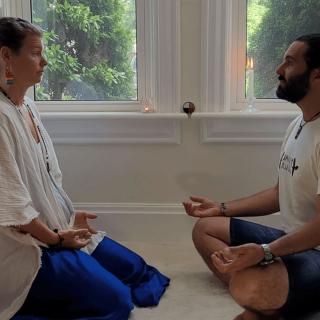
Good morning everybody.
I think if you just sit down.
Can you guys see us and hear us well?
Over the snowblowers and heaters.
Hi Rosie.
Hi.
Hello.
So you guys can hear us and see us well.
La la la la la.
Yes,
Okay,
Amazing.
Sorry about the noise sometimes.
We had a lot of snow yesterday and there is people with snowblowers.
We traveled the snow like three times and it was like a lot of snow.
So for those of you who don't know me,
This is your first time.
My name is Emilio Jose Garcia.
I normally do the live here by myself.
But today I invited my wife Samantha because what we are doing today,
It's an intentional dialogue.
Hi Amy.
So I see the comments a little bit small.
So we're not going to be focusing on the comments a lot when we are doing this,
The practice,
Okay?
But we will leave a little bit of time for Q&A.
So I think what we can do first is we can explain what Imago Dialogue is and the steps that are involved.
So Imago Dialogue was,
I first found it from a book from Harville Hendricks.
And if someone can type his name in the chat,
That would be great.
So the book was called Getting the Love that You Want.
So it's Harville and Helen Hendricks.
They are a couple and they have been doing this work for like a long time.
So I learned that structure a friend of ours,
They were doing some counseling and she told me about,
Have you guys heard of Imago Dialogue?
And I was,
What is that?
Imago Dialogue?
What is that?
So I went online and then I found a book at the local library,
Getting the Love that You Want.
So I read the book and then Samantha and I started to practice it.
And then now- Did we?
Kind of,
Yeah.
We started but it didn't really sink,
I would say.
So we tried but it didn't sink.
So after that,
We did a program that we are finishing now,
A six month program with John Wineland.
And then in that program,
One of the first practices that he uses is he took that Imago Dialogue technique from Harville Hendricks and Helen and then he added a couple of things.
Please either get- Don't hear the background noise.
Please either get closer or push the camera to see you fully.
Oh,
Okay.
Just makes it harder for us to read your comments.
Yeah.
The further away the phone.
That's fine.
We're old.
What do you say?
We'll do our best here,
Okay?
Okay,
Now get closer.
So you can get closer.
So is that better?
Okay.
Can you guys see us now?
Sorry,
I cannot put the phone the other way because this timer doesn't allow me to do landscape with the phone.
I don't know why.
Better,
Okay.
So John Wineland took that structure and then added a couple of steps,
Okay?
So the steps of this Intentional Dialogue is first of all,
Both partners need to be on board of doing it,
Okay?
So for example,
If I have a chance with her,
I will come to her and I will say,
Samantha,
I would like to do an Intentional Dialogue.
And then she will respond yes,
Or she will respond no,
Now is not a good time.
But then we are going to aim to do it between 24 hours,
Okay?
Within 24 hours.
Yeah,
Within 24 hours.
So she has the opportunity to say,
Emilio,
Right now is not a good time for me,
But let's do it after lunch.
Let's do it before going to bed.
Let's do it.
And then we agree on a time.
So it's important that you agree on a time and make it happen,
Okay?
So once you are sitting in front of each other to do the dialogue,
The next step is to do a Nervous System Regulation,
Okay?
So basically you are going to take- We don't really do that though.
Well,
Sometimes we just make sure that we are not too charged,
That we are not able to listen,
And we make sure that we are not too neutral either.
So it has to be a little bit in between.
So we will say with each other,
Is this a good time?
Are you feeling okay?
Can we do the dialogue?
And then she will say yes.
Can I share?
Yeah,
Of course.
That it's really hard to accept it when your partner is asking you for a dialogue,
Which we both can attest to,
Because normally it's because something that's happening is the habit or the behavior you're constantly using,
Which is causing the frustration.
And so when someone says,
Can I do a dialogue?
You know it's about that.
And you're like,
I don't want to talk about that.
I don't want to fix what's going on.
And so you can feel really not attacked,
But called out.
And so that's why there's the 24 hours.
Yeah.
So that's a rule,
Okay?
And then again,
Like sometimes it's what somebody said.
We,
Relationships are difficult guys.
And we put the finger,
We put the finger in the places where we feel the most hurt and we react.
We get triggered very easily.
I normally punish other people who may trigger you the most because they love you the most.
They know you the most.
You spend the most time with them and it's normal to get charged with things.
Okay.
It's normal to get charged with stuff and then you just get in this dark place and then it's just not fun.
So this intentional dialogue is going to allow you to hopefully move that energy,
Move that stuff that is bothering you.
Amy said that it's because we're potentially operating from a more self-aware place that we can engage in it.
And I think you're right,
Amy.
We've both been doing so much work and trying to notice patterns,
Notice behaviors,
Notice feelings.
And it's really hard work,
But it is getting easier.
That's the truth.
We've done it for six months.
Yeah.
That's how long we've been working.
And we are clearing out a lot of stuff.
But again,
What I say,
One of the main rules is both people need to be on board of doing this.
Okay?
So it's okay if you introduce a video of a couple doing it,
If you introduce them to this recording or whatever,
So that people can get used to the idea of it because it takes a little bit of time to get comfortable.
Because it's going to be touching stuff that is sensitive,
Right?
So you ask for a dialogue step one,
And then you do that,
You make sure that both people are okay,
It's the right time,
And we are in the right space mentally and emotionally to do it.
And then that's when we are going to say,
For example,
If I start,
I will start sharing something with Samantha that is bothering me.
And this is my feelings,
Okay?
She doesn't have to agree to it.
It's not about her,
It's about how I feel.
Okay?
So I will say something like,
Samantha,
When you did this,
I felt this way.
Or when you did that to me,
Or you said that to me,
I felt X,
Y,
And Z.
So I am expressing how I felt.
And then she will mirror what I'm saying.
She will repeat the exact words as close as possible.
Okay?
So that I feel validated.
So and then she's reflecting what I'm saying.
And then after that,
She will always ask,
Did I get it?
And then is there more?
And then I can keep going for as long as I need,
Okay,
Until I am complete.
And then she will say,
That makes sense.
And then she will emphasize with me.
So she will say,
I can understand that when I did that,
You felt that way.
So she's validating and emphasizing how I felt.
And it doesn't mean that she has to agree with you.
It's not about who's right or wrong.
It's about being seen and heard completely.
And that's why you repeat exactly what that person says,
Because it's important that I hear what I just said in my own language.
And that's why the person repeats.
And we're just going to do a real dialogue for you.
It's going to be charged.
I know it is.
You know.
Okay?
And then once she validates me and then she says,
She will ask me,
Okay,
Did I get it?
Is there anything else that you need me to acknowledge?
Or say.
Or say.
And then if I feel that- That I haven't already.
Yeah.
And if I feel that there is something that I need her to tell me,
I will say,
Yes,
I need you to tell me why I'm said.
And then she will say that,
And then I will feel complete.
And then we will switch roles.
Then she will have the opportunity to share,
And then I will do the same steps.
And then at the end of this process,
We are going to do praise.
That this is something that John Weiland adds.
Doing praise is very important.
Do we have a timer to make it official?
Because it's supposed to be 90 seconds each.
It's 90 seconds each.
Yeah,
I have a timer.
Okay.
Okay?
So we are going,
Are you guys ready for us to model an example?
Hi,
Roxie.
Vital work for growing relationships if both on board.
Yes.
You're brave and humble.
Thank you.
Oh,
Thanks,
Amy.
It's not easy.
I'm going to get a timer.
Amelia's going to get a timer.
Yeah,
While Amelia was getting ready for this video,
I was playing the piano a little bit.
I'm learning how to play the piano.
And that's very humbling just to try and learn something new.
So trying to get myself to be like,
Oh,
You know,
This will be the easy part.
We've done this a lot.
You're welcome,
Karen.
You're welcome,
Dee.
And Maria.
It's nice to meet everyone.
Amelia talks a lot about Insight Timer.
Sorry that I'm not as into technology.
I'm trying to remove a lot of it from my life currently because of my own behaviors.
So yeah.
Wow.
And then another thing that I didn't say is that when you are starting doing this,
It's okay to agree together in a time limit.
Okay?
And sometimes it's okay to say,
Okay,
I want to spend maximum this amount of time doing this because sometimes this can go forever and it can be too much for one of the partners.
So it's okay if at the beginning you agree or okay,
How long are we going to spend doing this?
Because that way you can be more concise,
Especially at the beginning,
Because if not,
It can drop for too long.
I don't know.
Are you sharing this with people?
Because the truth is we always use the piece of paper until it became habitual because even sometimes I notice later on in our dialogues,
We would sometimes skip a part or it's really hard as you're learning to not rebuttal or comment or something they say triggers you and you want to do that.
So the piece of paper with the steps really helped us stay focused and on track and be like,
No,
No,
No,
Wait,
It's not your turn.
It's my turn.
Let's go back to what it says on the page.
Yeah.
Actually,
Before doing dialogues,
Before doing that,
We used to use a timer.
Okay.
When we were really charged,
We used to do two things that I have shared with you several times.
We would stand up first,
Hold hands,
And we would jump together like this.
Okay.
Jump.
And then by the end of 30 seconds to a minute,
I can tell you that we will be both kind of smiling and having fun.
And then we will sit and we will set a timer for maybe a minute.
And then if I am talking,
I had the time and I click on and then I will speak for a minute and interrupted.
She could not interrupt me.
When the minute was over,
I pass the time and I have to listen.
Okay.
So that was our prior Imago dialogue technique that we had,
But now the Imago had added a lot of layers.
So maybe for those of you who have partners that are not on board,
Maybe using a timer at the beginning can be a good starting point.
Okay.
Okay.
So let's do a real dialogue and I have no idea what she's going to bring up.
Okay.
But hopefully it's not too charged.
Okay.
You,
You did this to yourself,
Mister.
Well,
I know it's important because when you guys can see something real,
It's more powerful than just reading a script.
Okay.
We're looking into each other's left eye.
So it's helpful when you first learn,
You take your finger and you point to your left eye so your partner can see it because this is where we're focusing.
We learned that.
Okay.
Now a minute.
Okay.
So now like if we are,
We can just,
I will ask,
Hey,
Sam,
Uh,
I would like to do an intentional dialogue.
Is it a good time?
It's a perfect time.
Okay.
And then we will not be sitting here.
I will be like in the kitchen or whatever,
And then we will come to normally to this space,
But you can do this anywhere you want.
You can sit on the couch,
Whatever.
This is our space that we practice together.
Three,
Three months into the program,
We are going to get to the dialogue.
We're not stalling.
Um,
Three months into the program where we were doing this work,
We were doing a makeshift space and this used to be our daughter's like creative art place.
And it's in our room.
We're in a two bedroom apartment,
So we kind of misuse places.
And anyways,
She's three now and she could do that stuff in her own room.
So we moved it all out.
We set this up with yoga mats.
We always burn some candles,
Try and make it as like soft as possible.
We're on blankets.
He's on a couch cushion.
There's blankets.
So that's really important is having a space.
Yes.
Making comfortable.
Okay.
Okay.
So Samantha,
Thank you for doing a dialogue with me.
So are you ready?
I'm ready.
Okay.
So nervous system check or we,
We don't really do that.
How are you doing?
Are you ready?
Out of 10?
I feel six.
You're feeling a six.
Yeah.
So if we're six,
We don't have to do anything.
Okay.
So normally you say between zero is I don't feel anything.
10,
I am supercharged.
I want to leave.
So you want to be between four and six so that that way you have charge,
But it's not too much that is going to avoid you to listen and actually communicate.
So she's a six and I will say.
And Emilio,
How are you feeling out of 10?
I am a seven about this morning.
Okay.
Is there anything I can do to calm you down?
Yeah,
Just touch my baby.
Yeah.
How are you feeling now?
I'm feeling six,
Five and a half.
Okay.
Okay.
So I'll start.
So that brought me down a little bit.
So breathing and head touching me brought me down.
Okay.
And walking to networking,
But I'll talk to you later.
Okay.
Thanks.
I'm glad to hear we're talking to them anyway.
Okay.
Emilio yesterday when it was a snow day.
So I mean yesterday when it was a snow day,
We got an email the night before from the childcare center.
We got an email from the night before from the child care center and it said that most likely the school would not be open.
And it said that most likely the school won't be open.
And we knew that you had your workshops with Insight Timer.
And I knew that I had my workshops with Insight Timer.
And you didn't ask clearly.
And I didn't ask clearly.
Permission to say,
Can you watch Eva for me?
Permission to say,
Can you watch Eva for me?
I felt like you almost assumed that I had to.
So you felt that I almost assumed that you had to.
And I had an in-person piano lesson.
And you had an in-person piano lesson.
And a yoga class.
And a yoga class.
That I had to move and change.
That you had to move and change.
To facilitate that for you.
To facilitate that for me.
And then this morning.
And then this morning.
When I am a guest speaker.
When you are a guest speaker.
You were really negative in the house.
I was really negative in the house.
Breathing.
Breathing.
Growing things.
Growing things.
And I interrupted that.
And you interrupted that.
And said,
Are you OK?
What's wrong?
I said,
Are you OK?
What's wrong?
And you couldn't look at me.
And I couldn't look at you.
And you wanted to be angry.
And I wanted to be angry.
And I asked you.
And you asked me.
If you needed help.
If I needed help.
And then you started saying that I should be volunteering to help.
And then I started saying that you should be volunteering.
Even though I was clearly practicing.
Even though that you were clearly practicing.
The piano.
The piano.
Say again.
Yeah.
Is that more?
Yes.
When you behave that way.
When I behave that way.
It makes me think.
It makes you think.
And feel.
And feel.
That you don't take.
I don't take.
My art seriously.
Your art seriously.
And I know that I'm different.
And you know that you are different.
And I'm changing my career.
And you are changing your career.
To be an artist.
To be an artist.
And a creator.
And a creator.
And I am exploring.
And you are exploring.
What that looks like.
What that looks like.
And it makes my soul.
And it makes your soul.
Feel alive.
Feel alive.
So when.
So when.
When I see you angry.
So when you see me angry.
And when you tell me.
And when I tell you.
That I'm not taking your call seriously.
And I'm not taking my call seriously.
It kills me.
It kills you.
It makes me not want to be around you.
It makes you not want to be around me.
It makes me feel like you don't.
You don't understand me or see me.
It makes you feel that I don't understand you or see me.
Because what I was doing.
Because what you were doing.
Was filling my cup.
Was filling your cup.
So that I could be 100% for you.
So that you could be 100% for me.
And it looks really different.
And it looks really different.
Than how you would do it.
Than how I would do it.
You OK?
Is it more?
OK.
That makes sense.
I can understand how me not taking your act seriously.
How me not respecting your spades.
How me not behaving nicely when I am frustrated.
And maybe just be nicer around you.
Even if you're not engaging with me.
How that energy can affect you.
And how you were supposed to have the house for yourself.
And you volunteered to do this call with me.
And how I was setting the spades.
And then interrupting your practice.
That is important.
And how I prioritize my call.
There should be a practice.
And I made it more important.
I can see how you feel.
Not important.
And you feel that I am not taking your act seriously.
And that my work is more important than yours.
Did I get it?
Yeah.
Is there anything else that you wanted to add on it?
Yes.
That I understand your workshop was important and involved more people.
So you understand that my workshop was important and involved more people?
But that it was still a gift that I switched our time with Eva so that you could have that free time.
That it was still a gift that you were willing to change that time with Eva.
And I have no possibility of that workshop.
There was just no day that we would not expect.
Again?
Yeah.
Any more?
No.
What about the last one?
OK.
So that will be her part.
And now it's my opportunity to do my part.
OK?
Here we go.
Sam?
Sam?
Sam?
When I am about to do my first workshop on Insight Timer ever.
When I am about to do my first workshop on Insight Time.
Insight Timer.
Insight Timer ever.
I don't know what to expect.
I don't know what to expect.
I am not familiar with the logistics.
I am not familiar with the logistics.
I don't even know how many people are going to show up.
I don't even know how many people are going to show up.
I was a little bit nervous.
I was a little bit nervous.
So when snow day happened.
So when snow day happened?
I just didn't feel like I couldn't cancel my workshop.
I just feel like I couldn't cancel my workshop.
So I felt that I was failing as a dad.
So I thought that I was failing as a dad.
Because it was my time to take care of Eva,
But I couldn't.
Because it was my time to take care of Eva,
But I couldn't.
I also didn't know that you had a yoga session.
I knew you had a piano practice.
I also didn't know that you had a yoga session.
I knew that you had a piano practice.
So it was very conflicting for me.
So it was very conflicting for me.
To make a decision that would make everybody happy.
That would make a decision that would make everybody happy.
And this morning.
And this morning.
When I was trying to set the space for us.
When I was trying to set the space for us.
We were supposed to practice in the dining office.
We were supposed to practice in the dining office.
And I had everything ready because that's my normal spot.
And I had everything ready because that's my normal spot.
But like 25,
30 minutes prior to the call.
But 25 or 30 minutes prior to the call.
You told me that you didn't have yoga.
You told me that you didn't have yoga.
And that we can do it in the house.
And that we can do it in the house.
I normally don't do it in the house.
I normally don't do it in the house.
So when I was trying to set up the space.
So when I was trying to set up the space.
I was finding difficulties.
I was finding difficulties.
There is no outlet close by.
There is no outlet close by.
We need an extra light.
We need an extra light.
I was using a power bar that wasn't working.
I was using a power bar that wasn't working.
I couldn't find the exercise to print it easily.
I couldn't find the exercise to print it easily.
And it was our call.
You were present.
You were in the living room.
And it was our call.
And you were present in the living room.
So when you see me charged.
So when you see me charged.
And you don't intentionally ask me or know that I may need help.
Sorry.
When I am charged but you don't ask me.
When I am charged.
Yeah,
You see me frustrated.
You see me frustrated.
Trying to create the space for us.
Trying to create the space for us.
But it seems like you don't really care.
You are doing your own thing.
Sorry.
It seems that you don't really care.
You are doing your own thing.
You are doing your own thing.
But my energy is also affecting you.
But my energy is also affecting you.
So I was frustrated.
So I was frustrated.
I was annoyed.
I was annoyed.
And I also was ready.
And I also wasn't ready.
When you wanted to stop me.
When you wanted to stop me.
And tell me,
Emilio,
What's wrong?
Emilio,
What's wrong?
You need to calm down.
You need to calm down.
Do you need help?
Do you need help?
You have to tell me in advance.
You have to tell me in advance.
So you started engaging with me.
So you started engaging with me.
And I was not ready.
And I was not ready.
Because my priority.
Because my priority.
Was to set up the space.
Was to set up the space.
So that we can do this call.
So that we can do this call.
Did I get it?
Is there more?
Yeah,
I am trying.
I am trying.
To avoid.
To avoid.
Being frustrated sometimes.
Being frustrated sometimes.
When things are.
When things are.
Needing to happen.
Needing to happen.
Quickly.
Quickly.
And I just need to make it happen.
But it's not happening easily.
And I just need to make it happen.
But it's not happening easily.
So I'm trying to don't get so frustrated.
So I am trying not to get so frustrated.
But when you see me at that stage.
But when you see me at that stage.
Maybe I would really appreciate.
Maybe I would really appreciate.
If you can remind me.
If you can remind me.
Emilio.
Emilio.
Step in your masculine.
Step in your masculine.
And ask what you need clearly to me.
And ask what you need clearly to me.
Because I was feeling that frustration.
Because I was feeling that frustration.
Because I deeply,
I think I wanted you to help me.
Because deeply,
I think I wanted you to help me.
This was our call together.
This was our call together.
And I was feeling that you didn't care.
And I was feeling that you didn't care.
But you were affected by my mood.
But you were affected by my mood.
So I would really appreciate it.
Maybe next time you don't.
So I would really appreciate.
Maybe next time.
You don't take it so personally.
You don't take it so personally.
And maybe you remind me of that.
And maybe you remind me of that.
Like Emilio,
You are not being clear.
Emilio,
You are not being clear.
Is there anything I can know?
Is there anything I can do?
And maybe I can be clear at that time.
And maybe I can be clear at that time.
And start building that muscle more.
And start building that muscle more.
Of just being clear.
Of just being clear.
And asking for what I really need.
And asking for what I really need.
And you can always say yes or no.
And you can always say yes or no.
Did I get it?
Is there more?
No.
It makes sense that you're experiencing nervousness and uncertainty when the day before your first workshop there's a huge pile of snow dumped on us and Eva's school says that they can't take her.
Which means that everything that you had scheduled and I had scheduled is completely disrupted and needs to be managed.
And doesn't have the same freedom of responsibility.
And that you felt like I want to spend the day with Eva but I can't just cancel this workshop.
Especially when it's the first one.
It also makes sense that this morning you felt frustrated and probably like you were running up against all of these things.
Fuck the lighting doesn't work.
Fuck now there's no outlet.
Fuck this outlet plug doesn't even work.
Like just getting frustrated and frustrated and frustrated.
And then having somebody witness that.
That maybe normally you'd be on your own setting that up.
And it's then calling you out and bugging you about you're already frustrated.
So it makes you feel even more frustrated.
Because if it was your space there would be no one around you to witness that.
So it wouldn't be a big deal.
And it makes sense that you were ready to be approached in the middle of your frustration.
Like obviously that's not helpful.
And the ways in which I said step into your masculine and calm yourself down weren't the right delivery at the right time.
And it makes sense that you would like me to remind you to be in your masculine and to ask for clear help if you need it.
Did I get it?
Is there anything you want me to say or acknowledge that I haven't already?
Yeah,
That I love your art and I really take it seriously and I know that it's really really important to you.
Sometimes I just get driven by my frustrations and that doesn't mean that I don't care about you or your work or your art.
I'm just going away with it.
And so you love my art and you see it as being important.
Yeah,
My frustration.
And your frustration is not directed towards you or your art.
Your frustration is not directed towards me or my art.
Did I get it?
Is there anything else?
Okay.
So now the person who starts offers praise.
And that's my start.
So a minute and 30 on the timer.
So 90 seconds,
You can adjust that.
Okay.
So I am grateful for you because when you were in the middle of asking where the fucking worksheet was and what module and can I help and I came in and when I was like,
Well I thought it was here,
It's not here so keep looking and you were like,
Oh by the way,
I know that your piano sounds nice.
I was like,
That compliment made me feel really,
Really good.
And I know that you've said to me before that you like just being present when I'm playing and that makes me feel really good that you want to be close and also be a witness,
I guess,
For my ego so that I feel good when someone claps for me.
But I am grateful because you have created an entire work around what you said you always wanted to do and it's really humbling to watch how quickly you made it happen that you always knew and felt called to not give up and you didn't and you literally created a place where we get to learn and benefit from all of these people but that we can also share what we've learned and that feels really good.
And I also love how techy and capable you are that like,
You know,
I can set things up but you are always like taking special care of how it looks and how it feels and how it sounds and I think that's really special and important to you.
So now it's my turn to do 90 seconds.
Wait,
Wait,
Wait.
Yes.
Okay.
It's my turn.
Thank you so much for being here today in this call.
I really appreciate you being able to be vulnerable in front of people and you supporting my work.
I love how you yesterday you were able willing to change everything around to make my workshop happen and support me and everyone made that for me when it was my day.
So you were very nice and kind.
I really love seeing you seeing your creative side being explored.
I really love you pursuing your piano playing your painting,
Getting out your own studio,
Transforming it into such a really cool sacred space at ECS George.
And still invite me over and still help me.
Let me help you and let me enjoy that too.
But that's your space and I really love the energy that you are creating around it.
And I love how Eva Watson's that and how she's also learning how important it is that both of us embody what we want and need and how we each other give us space and support each other in a nice and healthy way.
I really love the beautiful space that you create in our bedroom for us to practice and for us to deepen our practice and our time together with intention.
And yeah,
I just love having such a nice panel that is willing to do this anytime.
I am frustrated and sometimes even if you don't feel like doing it,
You always sit down and allow me to shake.
So thank you.
And then we just do a little bow.
Okay,
Just something just to close the practice.
Okay.
So that's that's how let me put this closer so that we can see the chat.
So that's how an intentional dialogue can look like.
Every couple is going to be different.
There is no right or wrong way of doing this.
Following the structure,
It is really,
Really helpful.
So as Samantha was saying,
I will encourage you to just find the steps.
You can just go on Google and just type Imago dialogue framework and then you will find the steps or I can share that in the circle too.
So for you guys to have.
But now we have some time to for Q&A like I don't know any questions you may have,
Anything that you would like us to talk about.
I don't know.
We haven't been looking at the chat so forgive us if we miss stuff.
But now it's your opportunity to say What can we do if partner is initially resistant to the structure?
How do we approach something like that?
You know,
John spoke about that in the program and there were people in the program who were practicing with good friends,
Not even a relationship because you can do this work on your own.
So I actually think that the best thing to do is say,
OK,
My partner doesn't want to do this.
How would I do this?
How would I speak it anyways?
And you can practice the dialogue.
And I think it's more about for me,
I have to be really open to hearing what he says because like as much as I want to blame him sometimes for you know,
All this crap that's affecting me,
It's like the truth is like I do the same thing to him and I need to if I expect if I expect change,
Then I have to be willing to change too.
So I think doing the work yourself can be helpful.
So some people were asking,
Are you looking at your left eye all the time?
It's important to keep eye contact.
So when you are doing this practice,
Your presence is very important.
Your presence means you are looking at the person in the eyes.
You are actively listening.
You are not thinking what you are going to say.
You are actively listening.
You are experiencing their emotions.
You are breathing with them.
So you are being in the present moment.
OK,
That's why you have to check with each other first to make sure that you are you have the capacity right now to do the dialogue because it takes a little bit of energy from you to do it.
OK?
I actually lost concentration for one minute because the snow blower was right beside our window.
I was like of course he is right beside us blowing.
I don't know what he is doing.
But I broke eye contact and my mind had wandered.
So that's why I had to ask Emilio to slow down and repeat what he had said because I actually broke my eye contact.
That's how powerful locking eyes is.
It really does keep your brain completely focused on what they're saying.
So people are asking like are all these emotions totally present?
What happens with them?
So guys for us our experience after doing Imago dialogues,
Anytime we do an Imago dialogue,
We always learn something from each other.
We always learn something from ourselves,
Become aware of something that we can change,
Something that we can process,
Something that we can try differently.
And we also learn from I always learn from her things that I wasn't aware of.
It's like wow I didn't know that when I do that you feel so not supported in your art because that's not my intention at all.
But it comes out that way for you.
So that's your reality.
So I learned that so I know for future times I know how important it is for me to make sure that I don't do that because I know that that hurts her.
So that's just one example.
Emotions may arise.
Sometimes they may take time and personal work outside of the dialogue of you actually becoming aware,
Meditating on it.
And sometimes you have to do further dialogues to go deeper.
And so Don you were asking like do those feelings go away?
Do we come with a complaint?
And the truth is yes you can.
I had a different complaint but it actually like was the same.
So my complaint was from the night before when it was just assumed that I should give up my day to care for our daughter so that he could maintain his.
That was what I was going to bring.
And then this morning just intermingled with that same feeling,
That same complaint.
And the truth is I don't feel any of that anymore.
I can't describe that being able to release and have him hear that I don't have any resentments.
I don't and I'm not making it up.
Like I legitimately am like you do like my art.
Okay good.
But like letting it out and like I cried because I was very emotional about it having that release has allowed me to let it go.
I know he thinks that I'm trying my best to be an artist so I don't know why sometimes my brain tells me the other the other thing.
So what happens when you are too heated?
Someone was asking.
When you are too heated in the moment it is not at the right time to do a dialogue.
That's why we did the first check in about your nervous system.
Where are you at?
Are you way high?
Because when you are way high you are not like that's what happened to me this morning.
I was frustrated trying to set this up.
That was my priority and she was trying to engage with me when I was probably an eight.
I was frustrated but I had nothing to do with her.
Right?
She was just playing the piano but she was witnessing me throwing the power bar,
Grabbing another one,
Man getting around.
But then that's not the right time to do it.
So what do you do?
Yes,
If it's your own charge you will go for a walk you will do something and you will reflect about it.
You will see what's happening here.
Why am I so triggered?
Why am I so charged?
And then you will become aware first of your own emotions and then when you come to the dialogue that you are hopefully between a four and a six there is still some charge but you are able to share.
You are able to communicate clearly what happened and why and how you felt.
And as Samantha was saying sometimes you are feeling resentment,
Frustration and after the dialogue that's released and it's no longer there.
And it's like wow it doesn't exist anymore but it did exist before so it was real before but now I was able to release it.
Charlotte just asked how do you feel?
She wanted to know if we both feel,
Feel and understood.
Like do you feel heard and understood about yours?
Yeah of course I do because I was able to to communicate what I felt.
I was able to hear her repeating that to me and then I was able to ask her to acknowledge something that I I didn't clearly listen to here.
So she was able to say that I care about her art that whatever however I feel it doesn't mean that I don't care about her art it doesn't mean that I don't feel it's important and I never feel that my work is more important than her work.
But I needed her to tell me.
And Glenn and Don both just asked do we schedule these or we just do them as we come up?
And right now so after month five it wasn't working that we were just doing it as it came up because it didn't feel we weren't as connected doing these things so we actually made two days a week to practice and that's also when I created the practice space so that it's like there's no excuses the space is always here we just have to light the candles.
And so Monday mornings at six thirty because that's when we have time and Thursday nights at nine o'clock we do a practice so it doesn't always have to be a dialogue but often times dialogues come up because that's a great time that we've dedicated to each other and then if we don't do a dialogue we'll do one of John's practices right now because we have access to them.
I feel that an intentional dialogue needs to be requested anytime you are feeling a charge anytime someone is feeling a charge they are responsible to raise that up and say hey I am feeling charged and I do need to do an intentional dialogue even if it's a little thing that is bugging you it's better to get it out of the way sometimes a dialogue can take five minutes because it's something very simple right sometimes we have more time and then we go deeper and then new stuff comes up and maybe when we finish the round I have stuff that it's coming up for me now that it wasn't there before so I go again and then maybe she goes again and then we do this cycle a few times until we feel complete so sometimes the dialogue.
.
.
It is best to try and sit deeply though and not do it repeated back and forth because it can be very hard if especially if something is coming up it's important for you to save some of that stuff if it didn't come out.
Yeah is it advisable to do this with children?
You can you can use this framework with anyone okay I do it with Eva Eva when you drew marker on my hand I really didn't like that it made me feel like now I have to wash my hands this is an example this never happened I don't care if she draws on my hand but you can say it like that when you did this it made me feel this when you told me you didn't want to come play that hurt my feelings it made me feel like you didn't want to play with me ever like you can you can childisize it.
And when something happens to her and she is really just crying like losing it we normally go to what happened Eva and then she starts describing what happened and then we go through so what happened so you fell down and why did you fell down and how do you feel and is it hurting?
That method we got from a book called The Whole Brain Child which was recommended to us by a counselor and it's so good so if you do have children and you want to learn more ways and ways to connect with them The Whole Brain Child and How to Talk So Your Kids Will Listen and Listen So Your Kids Will Talk those two books were game changing for me to be able to understand how to work with Eva.
Have there been times that you didn't feel complete in the dialogue?
No because at that specific moment you need to own you need to take responsibility for your own needs if I don't feel complete I will ask for what I need and if I don't have the clarity then I will allow myself to say yes I am complete for now but I know I have to do deeper work with myself first before bringing this to the dialogue because I still don't have clarity enough to bring that to the dialogue sometimes that happens to me and somebody in the chat said that they had done this with their partner and it made them fall in love with them all over again after they finish and that's something that's really important is that this always ends on praise and gratitude and when you sit back into no matter what came out and the dialogue you had when you really consciously put yourself back into a position of gratitude and love and praise you really remind yourself why you're with this person and the things that you love about them and when it's been really hard for me because it's hard to get back into gratitude if there's anything lingering I remember a moment so I'll take myself back to the time we first met or the last time we sat at this one cafe and so taking yourself and getting yourself back to gratitude totally works It's very normal when you are frustrated especially with your partner that that lingers in there for a long time and we are focusing our energy always on the negative,
Always on what happened always on the frustration and this dialogue gives you the opportunity to clear that out but gives you the opportunity to shine the light on us she's saying all the good things that are also here that sometimes we don't shine the light on because we are focusing on the frustrations all the time right so that's an opportunity for that Glen asks how much did you find out about your own communication style,
Preconceived intimacy ideas and childhood past pains in the John Wineland program like literally it has been all encompassing for me so not only did I identify my unmet childhood need but the qualities in which I attracted and am attracted to in him negative and positive and then my communication style I mean nothing for us has really worked better than Imago so far which is a second stage communication first stage is like essentially tantrums and like being angry and like storming out or throwing things like that's tantrum and then what we're doing is second stage which is healthy dialogue so giving each other respect hearing each other repeating each other and then the third stage is the art the artful way of expressing so that can be even in complaints Emilio hates that I leave things kind of in the way of his chores so I often put something on top of the recycle bin and so he's come up to me with the thing that I've you know put in his way and he'll like play with it or he marched around when I left coffee espresso grinds in the grinder and we agreed that we always clean it out ready for the next person and so instead of being like why did you leave this here again like this totally sucks and makes me frustrated he like played with it and juggled with it and so it reminds me that I did what he really dislikes but it does it in a way that's playful that I can be like oh I'm really sorry I'm gonna do better I promise you know like that's the artful way yeah so if you guys read any of the Harville,
Hendricks and Helen books the one that we got it had a lot of couple exercises and a lot of those exercises are going back to childhood wounds,
Childhood traumas,
Childhood programming however you want to call it inner child work however you want to call it but we all were raised and we all started to create our framework about the world when we were little depending on the people that we had around us okay parents,
Family who raised us our environment created the beliefs that we have right now and if we don't question them if we don't understand them we have a lot of hidden dynamics that happens when we are interacting with people some people receive love in a different way than others some people give love in different ways than others some people have specific limiting beliefs that are triggered by specific things so that's why some of the work especially in couples dynamics is to really understand what are my childhood beliefs and my childhood programming and why do I receive love this way and is it the best way or can I change it so you are trying to reprogram your nervous system and your brain in things that have happened for how many years guys 30,
40,
50,
60 years Amy asked the question of have we ever started a dialogue and stopped and yes we totally have I've asked to stop one time and it was actually a time where we had both gone and then something had come up for Emilio and he wanted to go again and I was like I don't have the capacity to go again I'm out so that happened to me that's why that rule is important especially for those of you who are going to start dumping a lot of stuff you have to create a healthy boundary if your partner is just getting started maybe you say we're gonna do 10 minutes and then you actually put a timer on and when those 10 minutes are done you are done start building slowly somebody also asked when you are just getting started with dialogue do you start guns blazing or do you start with lighter things and yeah the idea is we love each other we're dialoguing because we want to have a better relationship not because I want to prove to you how upset or frustrated I've been I'll start with something I don't remember what the first thing was that we started with but it was just this is again this is not about who's right or wrong this is about what am I feeling now what's triggering me now that you do and sometimes it is not her fault that she's triggering me that's an opportunity for me to understand why am I being triggered by what she just did why am I having this huge emotional reaction to this how can I change that or how can she change how can I communicate to her that that hurt me or that she needs to be more gentle or maybe I have to question my own belief I love seeing John Wineland's name put in the chat I can't even tell you how much this has changed our life like it has changed our life it was hard for us to sign up it was a lot of money and but for me it was like this is this is like we face these things again and again and again and again we've been together for 10 years it doesn't seem to be changing we've tried everything John Wineland literally opened up a door for me to want to stay yeah any any intentional couple work that you will get involved with and it doesn't matter with who as long as both partners are willing to explore different ways of doing things that's gonna be a game changer for any of you because there are so many different techniques that you can learn Imago dialogue for us has been one that it's consistent I think it's growing and there is a challenge of a 30 day challenge of every day you have to do an Imago dialogue with your partner and that seems hard but you can find 30 things very easily even like I don't like when you leave the coffee spoon on the counter there can be so many little things someone asked about culture culturally yeah can I answer yeah that so in in my experience from what I witnessed in John's program there were almost 100 people so 50 couples and they were from all over the world and it definitely in my culture and my being raised this is not something that I've ever witnessed before I feel like this movement of having dialogue of understanding the three stages of communication I feel like it's cross culture so a lot of people face these kind of problems and issues it's more about the open minded of the individuals regardless of race country ethnicity language there were people who didn't speak English in this program and they were translating and being in it because they wanted to fix this problem that they had and they felt in their heart there could be a way but they just they needed the tools and really John gave us tools that's what he did and I want to add to that cultural differences too I had the opportunity to travel and she also did in many many different countries for a really long time and I can tell you that that's another example of like inner child programming so a kid that is born in India is going to be very different than a kid that is born in Australia is going to be very different than a kid born in South Africa that a kid born in Marrakesh that a kid born in Abu Dhabi so different cultures have different beliefs different ways of seeing the world so when you are for example in India because I was there almost a year you can see that there is a lot of rules that people have to follow in order to get married in order to get couples that here are not accepted and vice versa it's very different right so that's when you get the opportunity to express what is your comfort level what are the rules that make you feel well and what do you need to feel well and to feel loved and to feel how do you express love how do you receive love and that's going to look very different depending where you have been raised depending what kind of religion you are part of and depending what kind of society you are involved with so it's a matter of communicating clearly what do you need what do you believe and how do you receive love how do you give love what's frustrating you and then just starting opening up those things and questioning those things too because maybe I saw in India for example lots of people living in big cities they were confronted with beliefs that they had from their parents but they are changing and every generation changes every generation evolves in a different way same in Spain same in Canada same in every country so it's an opportunity for you to question and to set the tone for the next generation hopefully Is there any last questions that oh wow there's so many I don't know how you read them all so quickly any last simple questions I think we could probably take two more and then I I have an appointment and thank you so much for everybody's positive feedback and also being witnesses to our what's the name of the program?
Depth and Devotion Depth and Devotion Samantha reference Emilio should be masculine does he say be feminine so masculine and feminine are energies that we all have regardless of sex okay so I have masculine and feminine energy Regardless of gender so everybody can tap into masculine energy and feminine energy masculine energy is it's more about making decisions about creating structure about communicating clearly and feminine energy is more about flowing creativity feeling emotions so I need to tap sometimes more into my masculine especially with her because she's a very strong person she's very masculine so sometimes we crash if I try to be masculine with her sometimes we crash because I am afraid of being masculine sometimes and she's too strong so I'd rather she be masculine and I so it is it is beneficial for me to talk about okay you be the masculine and I be the feminine Emilio tonight you're gonna be the masculine and I'm just you know trying my best to fight my masculine suppressant yeah because that's really hard for me it's work for me somebody asked is this good for PTSD and the truth is with post-traumatic stress what I understand when people get close to the feelings that trigger them it often causes like a negative cycle of going back into those feelings so when you work with someone with PTSD it has to be something that they very much understand what's going on for them and they know and have those warning words or you know like safe words that they can use if things are getting too close because I know when they when they enter back into trauma it can be just as traumatic again so you have to be really careful in and around that where do you find the program?
Maybe somebody can help with the link I don't think he's running it right now but he is doing a Valentine's intensive you just type John Weiland and then you will find information but again that's just one program there are many other ones you can go down a YouTube rabbit hole of watching some of his talks it's pretty good so there are I believe guys for those of you who mention mental health,
PTSD stuff like that sometimes there is not a right or wrong approach sometimes you just need a combination of things to work okay sometimes you need your own therapy and then you can do the intentional dialogue and then you can do other things all combined together because it's just a life is a holistic thing that with different things components working together so it's not that one thing is going to solve everything you have to you have to nurture your relationship you have to nurture yourself you have to understand your trauma you have to like understand your triggers and those triggers are going to show up as you individual and as a couple dynamic so the intentional dialogue is going to help you with the couple dynamic but also it's going to allow you to become aware of more things about yourself too so I've been doing counseling for a year so six months prior to us starting that program and still continuing and I'm processing trauma and I think that doing both was actually the bigger breakthrough for me because the work I'm doing in the inside and then our last call John said it's 80-20 80% or 70-30 or 60-40 but really 80-20 he stressed for himself that 80% of the work happens here so that I can show up for that other 20% with my partner and be the best that I can be so basically 80% of the work I will do independently she will do independently in whatever way we need and then 20% or 30% will be together as a couple practice and it's not just sex it's just showing up doing a amount of dialogues maybe spending an evening chatting about something maybe it's about talking about what do we want to see in our lives or maybe doing one of the exercises that was included in one of the books from Harville Hendricks that they have a lot of exercises that we did some of them and they were wonderful so there are many different ways that you can nurture your couple time in many different ways okay?
Cool.
So guys time is up I hope that you guys enjoyed this session I hope that some of you start practicing this technique with partners feel free to invite them to listen to the recording it will be available shortly thanks for having me as a guest speaker Amelia and for hosting is there any specific topic that you would like us together to cover in a future talk?
Just be specific about any specific more on this conscious and healthy can we do this again Samantha?
He talks about you all the time only good things right?
Only good things.
Thank you so much hopefully okay so we can some of the things we are happy to share together maybe I can do time management for parents and couples and how we allow ourselves to be creative and support each other in the form of creating a week that we both understand that we both allow each other's creativity flow time and then without neglecting couple time and parenting time and family time and everything so that will be something that maybe trigger management for self make it into a workshop what about a parenting session maybe an ecstasy more of a.
.
.
Okay okay perhaps integrating PTSD triggers okay thank you so much everyone.
Thank you guys so much for being here today I will see you again on Thursday and until then have an amazing rest of your day adios