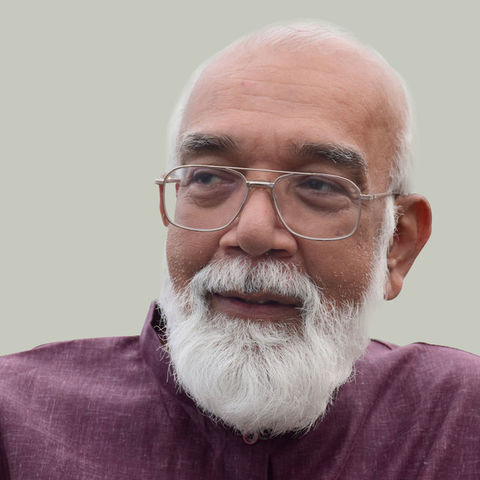
Vachaspati Mishra.
So that Vachaspati Mishra has also written a commentary on Yoga Sutra,
That what we are studying.
Vachaspati Mishra.
So he has written commentary on more than six great books,
Including Yoga,
Patanjali Yoga Sutra.
So you see the message is that he was so much absorbed into the knowledge of the real self.
So when you're totally absorbed into the knowledge of the real self,
Outside you find out one person inserts you,
Other praises you,
Third helps you,
Supports you.
Fourth gives you some problem,
But you are totally absorbed into the knowledge.
So when you are absorbed into the knowledge,
That intellect does not receive any conflict from outside.
So because he was writing a commentary on Brahma Sutra,
There is another sutra which talks about what is the real self,
What is the nature of the real self.
And he spent at least five years and he was so much absorbed that he forgot that he was married.
But anyhow,
His wife was serving him.
Wife was also intelligent.
So wife was serving him.
But once he completed and then his mind started looking outside.
He was definitely looking,
He was aware that someone is serving.
But he lost that idea of a relationship.
That is what happens.
We do it when we fight.
But he did it when he was absorbed into the knowledge.
His wife name was Bharmati.
So once he has finished and the wife came with a cup of tea.
Who are you?
The Vajasmitra Mishra asked,
Who are you?
I'm your wife.
Oh,
Did I get married?
Almost six years ago.
I'm your wife serving.
You were busy in writing the commentary on this text.
So he was extremely sorry for that.
And he named that book Bharmati.
So Bharmati book is very famous.
B-h-a-m-a-t-i Bharmati text is very famous.
Coming back,
Eastern wisdom or yoga is an instrument of knowledge that reveals the real self in me.
See that the real self is self-existent.
Self-existent means it is independent of anything outside.
People,
Place,
Things,
Ideas,
Opinion.
It is self-luminous like the sun.
It is all pervading.
But what happens?
We identify with body-mind complex.
That is constantly changing.
So identification is the error.
It is the ignorance.
So master says we are ignorant.
So what is that ignorance?
Ignorance is error in my understanding in the intellect.
That I am the real self.
That idea,
That thought,
That knowledge does not settle in the intellect.
So due to ignorance,
We think we will die one day.
How do we think I will die one day?
Body dies.
So why we study every week few times?
Because there is an error in understanding.
Are you getting it?
There is error in understanding.
So say for example,
Stephen says every time we meet,
I am Stephen.
Monday,
Thursday,
I am Stephen.
Let me tell you I am Stephen.
Saturday,
So he says again,
Let me introduce,
I am Stephen.
Come on,
I know it.
I know you,
You are Stephen.
There is a clarity,
Isn't it?
There is a clarity,
Right?
But do you have a clarity?
I am real self.
Tell me.
If you have clarity,
You are done with.
So what master says is the error in understanding.
That what is that error?
It is that error in the intellect.
So that is why the role of the Eastern wisdom is to know what I do not know.
Remember,
What is the rule of yoga?
Why they have,
Why Patanjali has written 195 sutras?
Why only in one sutra he can do it?
Because the error continues,
The ignorance continues.
The rule of the yoga is to know what I do not know and what I can know.
To enter into freedom,
Peace and happiness.
That is what we say ignorance is.
Knowledge will remove ignorance or error by,
So first it will remove the error and practice by practice the knowledge is realized.
This is all about yoga,
Tantra,
Mantra,
I said.
Now think of this from where this error comes.
Now I have started using the word error instead of ignorance.
Because last week I had one student.
So he said,
I said the same thing.
Ignorance causes the suffering.
No,
But I'm fairly very smart.
I'm very intelligent.
Then why you are suffering from stress?
Our question is totally different way.
You may be a nuclear scientist,
But if you are suffering from the stress,
Then there is a problem of error.
There is a problem of ignorance.
Right?
So why this error comes?
Now see that why is this?
I feel like crying when people are suffering.
God is not crying,
But I am crying.
I have become greater than the God.
Come on.
Come on.
So we put the reasoning in the logic.
More and more,
Why put the reasoning in logic?
To clear the doubt,
To drop the error.
I told you before also,
I had a beautiful woman in India.
Her father-in-law died.
She was always bubbling with the energy when I was living in Delhi.
But when her father-in-law died,
She started crying and her crying was louder than all the people.
I said,
How come this woman who was always bubbling with the peace and joy,
How come she has started crying?
So I took her to the room.
I said,
Why the hell you are crying like this?
Everybody is noticing.
No,
No.
I was told by my mother-in-law that I should cry when someone dies,
Then I should cry.
Think of this error,
Error in associations.
Another friend of mine who also joins the session sometime.
So he said,
Sir,
During COVID-19,
I had to attend a service when my relative died.
Then why he joined?
Because he was,
He told me openly,
He said,
If I do not join the service of my relatives,
Then they will also not join myself when I will die.
I'm more worried about my death.
The people will not join the service.
I'm just giving you some ideas.
I have to think if I want a permanent peace and happiness.
So there comes from this idea,
From this knowledge comes the understanding of indifference.
So we don't go to the modern psychology to understand what is indifference.
Indifference to what is error in our personality.
That is the fourth.
Indifference to those people who are suffering.
That idea comes from yoga.
If I'm real self,
The real self is always in permanent happiness.
Then how and why my mind moves with emotional upsets and crying,
Why it should move.
So it does not mean if someone died and you are attending the service and you start preaching people.
Come on,
Keep a smile on the face.
Remember this,
We have to follow the social norms,
But how to follow that social norms?
My intellect should be clear.
It should be free from error.
Are you getting it?
It should be free from that error.
What is that error?
Not understanding clearly.
Error comes because of association.
So,
And that association is nothing but attachment.
So I'm not clinging to anything in the world outside.
That is an idea of indifference.
That is the fourth one.
We have covered friendliness,
Compassion,
Joy,
And now the fourth one,
Upiksha,
It is known as Upiksha.
It translates as indifference.
Indifference.
So indifference,
What yoga says,
It is the state of equanimity.
Keeps the mind cheerful in all conditions.
You are living in the Himalayas for 10 years.
Now you have a tolerance of cold.
Now you come to Arizona.
What do you say?
Oh,
I want to live in AC because I don't,
I hate heat.
This is not indifference.
You are making fun of yourself.
Even if you lived in the Himalayas for 10 years.
What is that?
What is it?
The intellect do not allow that feeling of opposite heat and cold to influence you.
That is what the indifference,
Same thing.
This fourth one,
Indifference is opposed to fear,
Rejection,
Attachment,
Detachment,
Delusion,
Wrong notion,
And wrong identification.
Then only you live into the state of indifference.
So first I have been telling you,
This sutra says,
First cheerful inside the mind by understanding,
Then practice to change the mind.
And then now you are moving outside.
Friendliness to those people who are good,
Compassion to those,
You know,
You see now you can divide that.
But first the cheerful is there,
Wisdom is there,
Clarity is there,
Insight with that clarity,
With that knowledge,
You build a relationship.
If that happens,
You will succeed in meditation.
So we are studying those sutras where our mind says I did not understand this.
So Patanjali says follow this.
You see that we started with nine obstacles,
Four symptoms,
And then the master says the regular practice with the wisdom will remove all the obstacles,
You will succeed in meditation.
And then we came to this four great tips to remove the obstacles in daily life that will help you succeed in meditation.
It means these four qualities,
Four traits in the mind,
In the intellect will help us to succeed in meditation.
And the fourth one is Upaksha or indifference.
First step is the discernment.
I must understand,
I must separate.
Why to separate?
I must remove the error in my intellect.
What is real and what is unreal?
The discernment between pain and the pleasure,
Between the love and the hate,
Between the good and the bad.
No,
I'm suffering too much.
No,
I have lot of problems.
So now see that you are moving.
You are moving with your emotion.
How come you are suffering?
I don't have money.
So you come out and you pay me and I go to the liquor store.
I have my mind should be clear.
First step is the discernment.
What is real and unreal?
The discernment between the pain and the pleasure,
Love and the hate,
Good and the bad inside attachment and detachment,
Changing and unchanging.
Second step is to keep opposite of real and unreal at a distance in the mind.
That when I feel the opposite feelings,
It is nothing but the error in my intellect.
Third step is to perceive the reality of things,
People and condition.
Now take the same example.
The guy who lived in Himalayas for 10 years and now he is worried.
He is totally upset living in Arizona.
We have been living without any challenges and problems.
We have acclimatized ourselves.
And the guy who lived in Himalayas for 10 years,
He has lot of blame and complaints.
So he is not getting rid of the opposites.
So there is no indifference.
So once we have completed the three steps,
Then we come the fourth step to move the mind in equanimity to think,
To speak and act according to outer events and condition.
It will develop a big shock.
It will develop the fourth one.
Then the mind remains very cheerful and calm inside.
Now see many people misunderstand the Dalai Lama tradition.
They say that may all beings attain a happiness that is spatially exalted.
You know,
This is their mantra.
I'm translating into English.
We have lot of mantras.
We have no dearth of the mantras.
May there be freed from the ocean of their unbearable suffering.
So we are repeating it that,
But in the mind,
In the intellect,
The error in the intellect must go.
May they never be separated from the happiness of pure liberation.
So like this,
There are a lot of statements.
It helps you to succeed in meditation.
But if you misunderstand that these are the practices of meditation,
Then you have an error in understanding.
The Gita,
Our Krishna,
Great master Krishna,
I think I covered last week.
So that verse comes here.
Buddha,
Yukta,
Jahati.
I must integrate,
If I use the word must integrate,
Intellect.
The intellect has the right knowledge in performing action in the world outside.
You are crying and I hug,
You know.
Why you are crying,
I'm okay,
Okay.
And then,
You know,
I have lot of sympathy now.
Yoga doesn't advise this.
Even in your relations,
Even in your family members.
No way.
We feel our relationship is good,
You know.
Oh,
Oh,
You hurt your toe?
Because you did the blender.
That's why you hurt your toe.
Help them,
But with intellect should be with the wisdom,
Not with an error.
The body is constantly changing.
Sometimes we hurt,
Sometimes we have sickness.
Yesterday night,
I had lot of shivering and the fever because of COVID-19.
I did my second dose on Tuesday.
Total shivering,
Total sweating is there.
Total shivering,
Total sweating is there.
It is going to happen.
These are the changes.
So what Gita says,
Budhi yukta jahati means I must integrate intellect in every thought,
Speech and action.
What is that intellect?
Knowledge,
Knowledge of what?
Knowledge of the real self.
So that my intellect does not live in error,
In ignorance.
And then I perform my action.
See what happens in life.
You enter into the state of indifference.
So what he says,
What master says,
It's beautiful.
He defines yoga.
So when we integrate,
Now instead of intellect,
I'm using another word.
When we integrate the knowledge of the real self in every thought,
Speech and action.
What he said,
Tasmati yogai,
Yajasva,
Yoga karmashu kashram.
That is yoga is skill in action.
That is yoga.
That is yoga.
And what is yoga?
Yoga is skill in action.
It means when I'm living in the world outside day to day with my relations at home,
With my friends,
With my foes,
And all some are foes,
Friends and enemies.
Some people are well-wishers,
Others are not.
So we find lot of different people.
So here the Krishna says yoga is skill in action.
What is that skill?
Thought,
Speech and action unites with the knowledge of the real self.
So what is the result?
Mind remains cheerful.
And when the mind remains cheerful,
Then it always succeeds in meditation.
So Krishna has categorized at least eight or nine different types of people.
Patanjali has summarized into four types of people.
Friendliness,
And then he says,
I have to have an attitude of friendliness to those people.
Friendliness,
Then compassion,
Then joy.
And then we had upeksha,
Indifference.
So I have to practice first in the intellect.
I have to think.
Practice in the intellect means what?
I must think.
Randy is a bad girl and I don't want to talk.
No,
That's not enough.
This is an error in judgment.
No person is bad and good.
Do you see that?
My intellect should be refined.
This is for myself.
Do you see that?
Do you see?
We brand people instantly.
No,
Brandy helps me.
So she is a very good,
She's very good.
She doesn't help me,
She becomes bad.
Maitri karuna mudita upeksha na masukh dukh punya punya vishaya na bhavanat chitta prasad naam chitta prasad chitta,
Mind,
Prasad.
Ah,
Full of happiness,
Joy.
Body has a shivering.
So I de-identified myself with the body.
I changed my shirt twice.
It was a lot of sweating.
But then I was totally,
I said,
No,
Let me do relaxation.
Why to think about it?
So by four,
It went away.
That is the part of the nature.
Chitta prasad naam,
Four categories of the people.
So here he explains the four categories.
Who are happy?
Be friendly to them.
Who are sukha dukh,
Who are suffering?
Have a compassion to them.
But means compassion comes from the cheerfulness.
It is not sympathy.
It is much deeper.
It is the state of the mind filled with the wisdom.
Third mudita.
No,
Karuna mudita.
Mudita,
The joy with those people.
Who are,
Who's your mind says that you are good people?
They are good people.
So let me have,
Let me have my expression of joy and indifference to those people who are,
Who are apunya.
So apunya means wise or you can say,
Ah,
Who always criticise,
They always engage themselves into blame,
Complain,
Game.
Many people comes to me,
You know,
When in relationship with a couple,
No,
No,
No,
He,
She is,
He's crazy and she is crazy.
So I only say,
Hmm.
No,
You see that she has done this.
Hmm.
There are many ways you can deal with those people.
And then I simply ask a question.
Do you come to me to change yourself or change your husband or wife?
That is why you are narrating a good story.
Is it worth,
Will it change you or do you want to change yourself?
Is it not an error to blame and complain others?
Find out.
This is what this message is.
So next week,
Master says,
Did you,
You did not,
Patanjali will say that you did not understand these four aspects,
Okay,
Come on.
We will help your mind by breathing.
The next sutra is all about breathing practices and we will understand deeply.
Let us start our practice.
Now eyes are closed.
First eyes are closed,
Body is steady and looking inside.
There are many other mantras.
We will be changing the four mantras also,
But let us do it today the same mantra.
So these four lines of the mantra helps us to go deeper and it helps us to cultivate all the four traits.
So first pay attention.
Did you remember that out of the nine obstacles,
One obstacle,
We studied that when we do not follow the preparatory steps carefully,
We fail.
So what are the preparatory steps in our meditation?
First is body is steady,
The mind is looking inside.
Check,
Is the mind looking inside or still it is going somewhere?
Second point,
Being comfortable.
Look at the neck joint,
Feel the sensation,
Being comfortable.
And it is not habitual.
Every time you do it,
You enter into knowledge of sensation,
Steadiness and comfort here and now.
Every day is new.
Remember,
My friends,
You have been doing the practice regularly now.
So looking at the mind,
Feeling the sensation,
You're comfortable and there is a steadiness.
And now check where the mind is moving.
Mind still wants to go inside.
Mind says,
What is next inside?
Take me there,
Give me the knowledge.
Or other option,
The mind is running outside.
So you are going to go inside.
You are going to go inside.
The mind is running outside.
So when it starts running outside,
You have visiting.
Then the mind says,
You are already totally uncomfortable.
What the heck you say comfortable?
You see,
I have to be alert and aware in the journey.
Look at the entire body,
My friends.
All the joints,
Hip joint,
Knees,
Ankles,
Toes,
And then,
Experience sensation,
Comfort and steadiness.
Good.
And see,
Mind says,
Okay,
Let me go deeper.
Let me remain in the space inside.
It enjoys,
Why?
Because cheerfulness is there.
Do you see the point?
Error in understanding must be removed in every step.
Then the knowledge is realized in the practice.
Very good.
Now being carefree.
Thoughts are coming and going carefree.
Dig deep inside.
What is the meaning of being carefree?
Free from the cares.
Who cares and causes the trouble?
Mind.
Mind says,
Let me move the body.
Mind says,
I have lot of thoughts.
Mind says that,
No,
Today I do not feel good.
So they are all thoughts.
Separate yourself from all the thoughts.
You are not the thoughts.
Thoughts are totally different from you.
That is the meaning of being carefree.
And,
And I feel everyone loves nyasa,
All purification with the om.
So we will continue with that all around purification of the mind.
Why?
Error is there.
So let us start breathing little,
Deep in the silent breathing,
Not very deep,
Not very short,
So that you feel comfortable.
Comfort level continues,
Being carefree continues.
So now I give a simile metaphor.
The breath is your car.
Mind is your driver,
Your mind.
And where it is driving?
Inside in the highway,
In the space.
Why the space?
So that we get far away from the word.
Why?
To remove the error in judgment,
In error in knowing.
But we,
Oh,
Then we add om also.
Why we add om?
So that we remind the mind,
Goal is om.
What is om?
Real self.
Where it is deep inside the heart.
So everything is clear,
No error.
Now start as you inhale,
Move the mind from the right shoulder to the fingertips in the space inside,
Singing,
Reciting,
Om mentally.
And as you exhale,
The mind moves from the fingertips to the shoulder,
Where inside.
So it means inside means the mind is constantly aware of the space.
Can I say mindful of the space?
Mindful of the om.
You remember the goal all the time.
During the practice,
You forget the goal,
Where I'm going,
I'm going to the house and you forget it and you take an exit.
No exit please.
And now move the mind inside the left arm in the same way.
As you inhale,
Mind moves inside the left arm from the shoulder to the fingertips in the space,
Which is the highway,
Reciting,
Om.
While exhaling the same,
Om continues.
Om,
Mind remembers,
Addresses the goal om.
I just gave you an example.
Once the mind says,
Now I know the om,
You stop reciting.
Until then,
Move the mind inside the right leg.
From the right side of the waist to the toes.
Do you remember all the four points?
I believe so.
Breath,
Mind moving,
Space,
The citation of om.
Fifth point,
Maintaining the steadiness,
Being comfortable with the body.
Sixth point,
Being carefree.
How can I follow all the six points?
You claim that you are doing multitasking,
But this is not multitasking.
You need only to maintain awareness and alertness of the goal.
Everything falls into right place.
My,
Continue my friend,
And now move the mind inside the left leg.
Now I customize the practice every time.
So sometime,
A particular practice will deepen your practice,
Will deepen your experience.
So pick up that when you repeat the practice at your home.
When you repeat the practice at home.
So that that error in the intellect will go away.
Now inside the spine from the crown of the head to the tailbone,
When you inhale,
Mind moves in the spine,
The space.
When you exhale,
The mind rises from the tailbone singing,
Ahhhhh.
Our masters used a very specific word in imparting that knowledge.
It came to my mind,
Continue.
So he says that,
Master says that recitation is without any external instruments.
Singing,
When we say singing,
It is done with the instruments.
See that?
So we are reciting.
You know,
Sometimes we interchange the word,
I'm just making you clear.
We are not here to become a singer.
That is why you see that I don't add any music from outside.
Now leave this nine times with a mantra.
You have all understood the four traits that lives in the state of cheerfulness of the mind.
And I see all those four traits are differently explained.
If the mind is not in the state of the cheerfulness,
How can I say may there be well-being for all?
Let us chant,
You chant mentally with wisdom,
With the knowledge.
Expand your mind to the entire world,
Including yourself seeking well-being for all.
Sarvesham swasthir bhavatu Your mind is expanding,
Looking at everyone,
Including the friends and the foes.
You see that we have added everything.
Friend,
Foes,
Suffering,
Well-wishers,
May there be well-being for all.
So we merge all the four traits into this mantra.
So that is why we don't talk of loving meditation or kind meditation,
Etc.
Sarvesham swasthir bhavatu Sarvesham swasthir bhavatu Ask your intellect what it means well-being for all.
Include yourself also.
When you do not include yourself,
You become a preacher.
When you include yourself,
Then you become a meditator.
Second line,
Sarvesham swasthir bhavatu.
Now understand the significance.
We say sukha,
The word sukha is or shanti.
It's a good space.
If your mind lives into the infinite space while reciting this mantra,
The peace will come to you.
That is the secret.
So why the master is saying?
Because when you are seeing this,
Reciting this mantra,
The mind picks up the other thoughts.
The moment it picks up the other thought,
Then it is not a good space.
Not a good space.
Then actual the peace is not there.
You may feel it.
Sarvesham shantir bhavatu.
Here bring all the emotions.
You are bringing that emotion to the peace.
No problem.
But if you bring that emotions,
Because you say I'm moved by the suffering of that guy,
It will not work.
You are not in a state of cheerfulness.
Sarvesham shantir bhavatu.
Sarvesham shantir bhavatu.
I believe you are understanding all the four traits are included at a subtler level in these mantras,
All the shanti mantras.
Pick up any shanti mantra.
And when you dig deep inside,
You understand you will find not only these four traits,
But more than 10 different traits are there.
Third line.
Sarvesham puranam bhavatu.
Puranam the sense of completeness.
Mind only is wandering when there is no sense of completeness.
Wholeness.
You know we say wholeness,
Holism.
Sarvesham puranam bhavatu.
Everyone is complete.
If you see all are different.
And if you see everyone is real self,
No issue,
Real self is always complete.
Sarvesham puranam bhavatu.
Do you see a point that your intellect,
The knowledge in the intellect is helping you to deepen the practice?
We people miss this point.
We forget that knowledge.
We say,
Okay,
If I breathe through the right nostril,
This will happen.
If I breathe through the left nostril,
This will happen.
This is the greatest mantra.
Nothing will happen.
Sarvesham puranam bhavatu.
Sarvesham puranam bhavatu.
I believe you are experiencing knowledge,
Centered in the intellect.
You are practicing,
The knowledge will be realized.
This is what the meditation is.
Sarvesham mangalam bhavatu.
Do you remember I said well-being,
Peace and the wholeness when they merge together it creates an auspicious moment.
Now look at Patanjali.
You remain cheerful,
Every moment is auspicious.
Sarvesham mangalam bhavatu.
Sarvesham mangalam bhavatu.
Sarvesham mangalam bhavatu.
Now every time you say,
Om Shanti Shanti Shanti.
When you say,
Om,
Mentally the mind goes deep inside your heart into the infinite space.
You say,
First Shanti,
It's a crown of the real self.
Second crown Shanti,
Third crown Shanti,
Continue by yourself.
Om Shanti Shanti means the intellect discovers it is,
Om is the real self.
I gave you an example.
I know Stephen.
Stephen,
You need not to repeat it again and I know your name.
I know.
So once your mind says,
I know my real self,
Stop the mantra,
Stop the practice,
You will be there until then.
So do you know how long we have to do?
Some people ask me,
How long I have to do the practice?
Till you reach to the goal.
The way I see Lara,
All eyes goes to Lara.
What about when you say,
Om?
Check what happens in your mind.
You are the best judge,
My friends.
You are the best judge,
My friends.
You are the best judge,
My friends.
You are the best judge,
My friends.
You are the best judge,
My friends.
You are the best judge,
My friends.
Om Shanti Shanti.
The knowledge in the intellect,
Practice yourself,
Helps you to realize.
What to realize?
The knowledge is realized.
And what is that knowledge?
It is the knowledge of the real self.
Do you see that how long we have to travel and how near we have to travel?
Do nothing remain as you are in the state of doing nothing and listening.
Shanti Shanti Shanti.
Some people told me in earlier sessions because when I chant,
The body is filled with the tremendous vibrations.
But in those moments that Om,
The mind,
Accepted that Om is your real self.
Nothing with me.
Om Shanti Shanti Shanti.
Shanti Shanti Shanti.
Shanti Shanti Shanti.
Bring your mind on the right hand.
Your mind on the left hand.
Lift your both the palms.
Place it on your eyes.
Open the eyes inside.
Know your experiences.
Bring the hands down.
How are you Lara?
I'm good.
I had an interesting experience.
I was definitely watching the mind.
So I was deep in.
But then there was a lot of stuff happening too.
There was lots of stuff that needs to be done.
So that's my experience.
The moment you say you are watching the mind,
You are totally separate from the mind.
You can only watch me if I'm separate from you at a distance.
So what happens if you keep watching?
The mind drops all its craziness.
You are bound to go into the meditative state.
That is the knowledge.
Beautiful.
How are you Brandy?
Just after the meditation started stretching your hands?
Yeah it was very still.
And I had similar experience as Lara.
I was able to watch my mind and stay separate.
Beautiful.
Yeah it was really relaxing.
Thank you.
Do you see error?
That's what I say.
Error,
Ignorance,
They both are the same thing.
Error in the intellect.
What is that error?
That I am the body.
I am not the body.
That I am the thought.
Thought says I am depressed.
It is the thought.
But if I separate my mind from the thought,
Where is the depression?
It doesn't happen to those people.
They have to start with the beginning.
How are you Stephen?
I am really good.
Meditation was complete blankness.
There was nothing.
It was me here listening to you,
Totally settled.
And when I got to the end,
As soon as you started the Aum Shanti,
I had this vibration in my chest.
Yeah,
That's beautiful.
That's what I explained before.
When I am saying it,
The intellect says I know where is the Aum.
It goes inside and sometimes your heart is filled with the joy,
Sometimes the whole body.
Now you see the experiences that you get because of you,
Not because of me.
It's your experience.
Beautiful.
How are you Sam?
I am really good.
In trying to describe my experience today,
It was that lately when we meditate and I have the thoughts,
I don't care about them,
But they still leave an impression on me,
Meaning they stay in my.
.
.
I remember what my last thought was.
I went to a state today where a thought would go by and then another thought would come and I'd be like completely forgot about the previous one.
That's a good.
.
.
It was even more of a narrow look at that and I'd say,
Whatever,
It's gone,
Doesn't matter,
Okay.
And then move on,
But it was very deep and quiet and content with that those thoughts go by and if they don't come back,
It doesn't matter.
Beautiful.
It's a deeper state.
I'll talk in detail in future sessions.
Thought do not chase us,
We chase the thought because we have an impression of liking,
Disliking,
Of pain and pleasure.
So once we have a clarity,
100% clarity,
No thought dares to create any problem.
How are you John?
Lara,
You know Sara,
You referred Sara to this group who just joined and who left?
She's a friend of Kate's,
She's part of the teacher training.
I don't know her really well though.
Okay,
Okay,
Okay.
I just wanted to know.
Yeah.
Everything,
Everyone should be familiar,
Otherwise,
You know,
I have to speak about disclaimer,
Disclaimer,
Disclaimer in every session.
You can put her as family.
Okay,
That's good.
How are you John?
Well,
Thank you.
That was very peaceful.
Very peaceful,
Beautiful.
How are you Barbara?
I feel very joyful and very calm,
Almost as if I'm floating.
That's good.
That's a beautiful experience.
Wonderful.
Yes.
And how are you Terry?
It went by really fast and I couldn't,
The movement was pulling me away from being able to experience the stillness and stuff so I'm not sure.
I don't think I was able to stop him.
I feel like the movement is pulling me into having thoughts and I don't like it but I'm trying to remain indifferent but I don't think I'm succeeding today.
But I'm so happy.
In the very beginning you were smiling and cheerful.
Yeah,
I don't know why it always starts up right at the time when I relax,
It's like as soon as I relax and start to go there and that's when it sees an opportunity to jump in.
Yeah,
Yeah,
Yeah.
I don't like that,
You know.
Now I'm giving a solution.
Think of it today.
We are talking of stillness in the body,
We are not talking of the stillness of the body.
Okay.
Now,
The solution is done,
Stillness in the body,
Not stillness of the body because body cannot be made still.
It is made still even after the death,
The body is not still.
It is constantly fragmenting.
Do you see that point?
Do you see that knowledge?
Remove that error and you will see things will change.
Then your mind will not go,
Oh,
What is happening?
There is a stillness inside.
Let the body move.
So in the beginning process,
What we do,
What we do,
We say still the body for the beginners,
For the casual seekers,
But as we progress further,
We ask them recognize the stillness in the body.
It is not the stillness of the body.
Are you getting it?
So once you are stillness in the body,
That stillness in the body comes from the knowledge,
It is an awareness,
It is a pure consciousness.
It has nothing to do with the body.
How are you,
Sangeeta?
I am fine,
I am fine.