Okay,
Is the AV okay?
Good,
Okay,
Great.
I ask that because there's so few good talks given on meditation that is one of the reasons why these talks given here,
They are broadcast live streamed all over the world.
I'm not quite sure how many people listen in on a Saturday afternoon,
But certainly we get many questions from overseas at this time.
And those will be asked at the end of this session.
So,
First of all,
I usually introduce some aspect of meditation for 15 minutes.
And that's just to give a little bit of information on meditation,
How it works.
But more than that,
It's when you start meditating,
If you just rush into this room and you sit down,
It does take a while for the mind to become calm and alert.
And if you just rush and then sit down straight away,
You're wasting your time at the beginning of the meditation.
You just need to know what happens before you sit down.
It also will affect your meditation.
And so just being able to sit down here and listen to me,
And sometimes it doesn't matter what I say,
Just to listen means you're focusing your attention,
Not on your thoughts and problems and difficulties of your life,
But on something else.
And that focusing,
And I try to speak in a soft voice,
Will actually calm you down.
So that when we start meditating in about 15 minutes time,
The mind will already be a bit peaceful.
And because of that,
It means it's easy to take it further into peace.
Remember this mind to calm it down is not to send it to sleep.
There's something else which is not talked about nearly enough,
That when you do calm down,
You actually re-energize.
If you really are still,
You may go through a little bit of sleepiness at first,
But just bear with that,
Because then the energies,
Natural energies,
Come up and you become very alert.
In my life,
Especially as a monk,
Even as a lay person,
Meditating a lot,
You find your energies really start to increase.
Your internal energies,
And this is not based on tea or coffee or red ball or anything like that.
There's a natural energy which comes in.
It's always,
Say,
Your brain.
I've read different reports,
Some people say the brain is about 30% of the energy you consume,
Sometimes somewhere about 25%.
But certainly,
If you look at the size of your brain,
It does actually eat up and use a huge amount of the energy which you put into your body.
And you can imagine,
Just a nice little visualization,
Just imagine your brain relaxing and being peaceful,
And like a car,
By being parked safely in a garage,
So you don't need to turn on the electricity supply or turn on the gas or the petrol,
Whatever's driving your car.
That can actually be just preserved,
But it's much better than that.
It's as if the natural energy will come up into your brain and will make it very alert.
And you feel that in meditation.
Sometimes at the end of the meditation,
You really feel alive,
More aware,
More perceptive than you've felt for a long time.
And that general tiredness,
Which you may have got used to,
Because that's what you live with most of the days,
Just disappears,
You feel alert,
Awake,
Here,
Rather than just exhausted.
And that's certainly something which,
To give you some examples,
I've had to make use of,
Because being a teacher,
And sometimes being quite popular,
Sometimes I have a lot of work to do.
And one experience which just comes up was years ago,
When you could,
Not years ago,
A year and a bit ago,
When I would travel a lot,
I accepted an invitation to go to Singapore.
And it was,
They were trying to present Buddhism,
Dharma,
Meditation,
All these wonderful teachings in a different format,
By making a little play,
A theatre play about this.
And they asked me,
Ajahn Brahm,
Would you be willing to perform in that play?
Now of course it's not right for a monk to go acting,
But they said you just have to play yourself.
So there was a time at the end of the play,
When I had to come on stage and just basically give a talk,
Make it up as I go along.
And I looked at it and I thought it's an interesting way of presenting the Dharma.
So I agreed to it,
But then it was a very difficult time schedule for me.
You've got the early morning plane to Singapore,
And so it's not just flying off at a certain time,
You get to the airport two hours before.
And then just when you arrive,
Straight from there to the theatre for the matinee show.
And after performing the matinee show and just getting told exactly what I had to do and when to do it,
And trying to remember then having performed,
Then everyone else went off to dinner.
Have me,
I don't have dinner.
And obviously by that time I was really tired.
So I just asked,
I remember asking them,
Is there a quiet place in this theatre?
And they didn't have a quiet place.
It was just really noisy.
So I went here,
Went there and found a little place.
It was like on one of the fire exits.
The fire exit door was closed obviously,
Went right to the very end of it,
And there it was quiet.
So I could disappear and meditate.
I remember that,
Just when you start meditating,
Your head is down,
You're really tired.
Had to get up early from here and go to the airport and it's about five o'clock in the afternoon,
I hadn't stopped,
You know what it's like.
And then my head was down.
And I know how to deal with the sleepiness of meditation.
I never fight it anymore,
Because I realized that sleepiness means you've got low energy.
If you fight that low energy,
You're wasting energy.
Just leave it alone.
Let it recover by itself.
So sitting down,
Head drooped,
Really tired,
But just,
Okay,
I know you,
As mindful as I can,
Not doing anything.
And as I was just mindful,
Just being peaceful,
Just not doing anything,
Just watching,
Even though it was very sleepy,
What I was watching,
There wasn't much life in it.
Then you found after a few minutes,
The awareness was increasing,
The energy was getting better,
And after about a quarter of an hour,
20 minutes,
My back straightened up by itself.
You know,
I never straighten up my back by myself,
I never tell it what to do.
I sit here and just watch it and it does it by itself.
That's one of the wonderful feelings,
Experiences in meditation.
You realize when you trust your body,
Leave it alone,
It just balances itself,
You know,
All on its own.
And after about half an hour,
45 minutes of meditating,
Hours,
Just I thought I'd had a cup of coffee or,
Say,
Some Red Bull or something.
What do you have in your bag,
Ajahn Brahm?
Nothing.
Just I know how to meditate,
Just how to relax my brain.
You know,
Many people know how to rest their body,
Maybe.
I don't think they do,
Really,
Because when you go to sleep at night,
You're just still dreaming about all sorts of stuff.
But to really rest your body,
So you can put it down on your bed nice and comfortable,
Just really relax and have a really nice deep sleep,
Even that feels great.
But to be able to relax and rest your brain as well,
So no thoughts,
Doing no work,
Just on idle,
Just being peaceful,
Not holding it peacefully,
That's more stress,
Letting it be peaceful.
And so you're doing no effort at all,
No stress,
No holding,
No work,
No doing anything,
You're just there watching because you're not doing anything.
You do find that the awareness starts to grow and grow and grow and you trust that you don't need to think,
You just know that you're waking up,
Deeply waking up.
And of course afterwards,
When you did the afternoon part of the show,
And you were really buzzing then,
Whatever you do,
Whatever you say,
You really give it power.
And it's a wonderful thing to be able to do just that much.
I'm not talking about getting enlightened,
I'm not talking about getting rid of cancers,
I'm not talking about anything,
It's just this feeling,
More energy in your mind.
So you can be more aware,
More efficient.
And the other thing which it gives you is like innovation.
See different ways of doing things,
Different ways of speaking,
Different ways of looking.
Because a lot of times we have become so brainwashed,
So conditioned,
So,
You might even say hypnotized by our culture,
Of always doing things in the same way.
And there's a problem in life,
Always do it the same way,
What should I do,
This is what you're supposed to do.
Instead of actually stopping,
Energizing yourself,
I may be seeing a different way of dealing with things.
And that is just things like sicknesses.
I've been teaching this for such a long time now,
That there's nothing wrong with being sick.
I don't know why it is that when people get sick,
You feel ashamed of your sickness,
That somehow you've let other people down.
I told this story not so long ago,
I was actually on a retreat last week,
Or just over a week ago.
But anyway,
That when,
Oh,
About 30 years ago,
I was sick,
I think it was the last time I was in the doctor's surgery.
Just sitting in the back waiting in the room,
Waiting for my appointment.
And as I was sitting there waiting for my appointment,
Just minding my own business,
Being peaceful,
I didn't look that well,
Never found out what it was,
But who cares,
It went by itself.
I was sitting there,
In my monk's robe,
In the doctor's surgery in Byford,
It was the nearest doctor's at that time.
And I was sitting there and one of the prison officers came in.
Now at that time I was teaching in a local prison almost every week.
So I knew all the prison officers,
A lot of the residents,
The criminals.
And when I was sitting there,
The prison officer came in,
He had a bad back,
He took one look at me and he said,
I never expected to see you in a place like this.
It was like I was in a pub,
Or in a casino,
Or in a brothel or something.
Well,
Yeah,
It's a doctor's surgery.
Because I was a meditator and he thought,
You know,
Live a nice peaceful lifestyle,
He said,
Oh,
You monks don't get sick.
And for a moment or two,
I felt ashamed,
Embarrassed.
I mean,
It's a stupid thing to think,
Isn't it?
Everyone gets sick sometimes,
Even great doctors get sick.
I get sick a lot.
But anyway,
When I saw that thanks to that fellow,
I said,
What's wrong with being sick?
It's part of life.
And it was from that time I started changing my attitude to sickness.
This is what I mean,
Innovation,
Simple things.
And that was just such a simple thing to say,
There's nothing wrong with being sick.
So if you went to go and see the doctor,
You've heard this many times,
Those of you who've been here regularly,
You never,
Please,
Don't tell the doctor,
There's something wrong with me,
I'm sick.
Don't speak like that.
You tell your GP,
Doctor,
There's something right with me.
I'm sick again.
In other words,
We're not stigmatizing sickness.
And we're seeing it as part of life,
Not something to get rid of as soon as possible,
Something to understand,
Care for and let happen.
It is the body's way of dealing with problems which exist in the body.
You know,
Sometimes if you can let those bodily responses do their job,
Sometimes you don't need so much medicine.
One of the diseases we did get in Thailand when I was a young monk over there was scrub typhus.
I just thought the Western monk got it sooner or later because it was in the ground,
Little mites in the ground and they'd bite you and such tiny little bites but they would give you the scrub typhus whose symptoms were so similar to typhoid,
Very heavy fevers,
But we're mostly young and fit so it would not kill us,
But just put us in hospital for a few weeks.
Until eventually they found that they all thought that there was no scrub typhus in that area because the locals had developed immunity.
But when we got it,
There was two monks who got scrub typhus at the same time.
One took medication,
The one didn't.
They wanted to find out,
Sort of,
What's the difference.
I don't know if I should say this,
But this is a true story,
Years ago.
The one who took the medication,
The one who didn't take the medication,
The fever lasted the same length of time.
And after the fever had broken and the fever was no more,
The one who took the medication took about a month or two to fully recover.
The one who didn't take the medication took about a week to recover,
Totally back to normal.
It's very interesting that did the medication work or did the body have its own resources?
Both of them were pretty fit and healthy,
So I think it was for those two,
It was a fair description of what happens and how we can innovate,
Do things slightly differently,
And who knows what the outcomes can be.
But to be able to do that,
You can't think it through.
You have to feel it,
Know it from inside,
Rather than go on some theory of anti-vaccination or do vaccination,
Or sometimes all those theories,
Instead of feeling it yourself,
What does my body need?
And I trust my body.
Every time there's a little bit of sickness,
Some of the things which I innovate to do,
It's just a simple thing to take a rest.
Because I saw in the jungles of Thailand,
That's what animals do,
When they get sick they find a bush or a little cave and they just go in there to rest.
And if the fever isn't that bad,
Then of course after resting they come out afterwards and they're better,
They're healed.
Sometimes they die under those bushes.
But to see how nature dealt with those diseases was an eye-opener for me.
So little by little,
When we have inner energy,
We don't worry so much,
We're peaceful.
It's amazing the different options you can see.
Sickness is there to teach us all that,
So we look after it,
Care for it.
We don't stigmatize it.
It's part of our life.
Anyway,
That's just a little bit of an introduction.
Sometimes when I start talking,
I say,
What am I going to talk about?
Well,
Once I get going,
It's very hard to stop.
I'm sorry that I'm stopping now.
So we're going to do a meditation about 45 minutes.
I will lead the first part of it,
And it's always a bit of a debate for me,
How much should I lead the meditation and how much should I be quiet?
So trying to find a balance,
I'll probably lead the meditation about 15 or 20 minutes.
And it's a 40,
45 minute meditation.
So most of the time I'll be quiet to allow you to,
Once you're directed to have some mindfulness and some peace,
Then I'll leave you alone so you can enjoy and experiment and innovate your own meditation path.
And if that doesn't work for you,
Please give me some feedback.
Don't just sit there and just fall asleep or get enlightened or fly through the air.
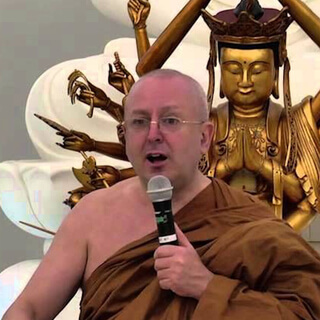
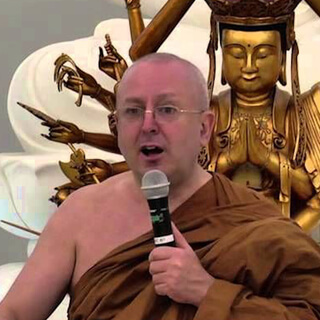
Please don't fly through the air because if you go too high,
You'll get your head cut off with those fans.
So no levitation,
Please.
It's okay to laugh sometime,
Come on.
What's that old joke about how did they discover hamburger patty?
That was when the US Marines decided to put an ejector seat in the helicopters.
Okay,
Some people are giggling.
It's not the best joke,
But anyway.
So don't levitate,
Otherwise you'll be hamburger patty,
The fans.
Okay,
Okay.
So sitting here,
Close your eyes.
With your eyes closed,
You have more attention.
You're not having to look at stuff.
So your brain has got more openings to feel.
Feeling your body.
I was really surprised.
As soon as I do this and stop talking and start feeling my body,
I find all these mistakes.
My belt is too tight,
My legs are not really comfortable.
Loosen the belt.
That's much better.
Get the legs nice.
Once I think that I have got a good posture,
Then I look at it more closely.
I'm careful.
Because I don't want my legs to go to sleep during meditation.
I don't want them to be aching and in pain.
I don't want my butt to ache or my back to hurt.
It's been there,
Done that.
It's not necessary.
So I'm really aware to adjust the posture.
And when I think it's really okay,
Then I go deeper into my posture.
I become aware of my legs.
Sitting on a chair or sitting on a stool is not important.
What is important is your legs are comfortable there.
If you want a chair,
If you want to move your feet apart or put them under the chair,
More away from the chair,
You find out the best posture today.
And you'll discover the best posture today is not always the best posture last week.
You find out the one which is best for you.
If you're on a cushion,
Make sure that cushion is in the right position underneath your butt.
My cushion is too far back,
I'm going to adjust it.
Hmm,
Better.
So I'm still looking at my legs,
Making sure they're reasonably comfortable.
I don't care how long I take,
Because this is important.
This is the combination of mindfulness and kindness,
Kindness to my own body.
Ah,
That's good.
Once your legs are happy,
Ask your legs,
Are you okay down there?
I can leave you alone and go further up my body,
Past my butt.
If you're on a chair,
Please,
Fidget now rather than later.
Check your back.
Now sometimes people feel they should always have a straight back when they're meditating,
There's no such thing as a straight back,
My back is always curved.
Sometimes if you're on a chair you can lean back.
If that's more comfortable for you,
Fine.
You'll find the best posture for you.
Go up your body to your shoulders,
Relaxing your shoulders as much as you can.
And sometimes to do that I do the opposite first of all,
Just scrunch them up as much as I can.
And when I scrunch them up to the maximum scrunchiness,
Then I let go.
And when I let go,
It goes to a place which was far more relaxed than when I began.
I go down my arms,
Past my elbows and hands.
I don't have many problems with elbows and wrists.
If you have a problem there,
Just pause.
Say you've got a bad elbow,
Pause as you pass that elbow and just learn how to relax.
Because sometimes if there's an ache or a pain there,
There's something tight,
Constricting it,
Pressing on it,
Stretching it.
And if you can somehow loosen what's around that area of pain,
Let go of both ends of whatever's being stretched,
Expand what is being compressed.
After a while of trial and error,
You learn how to do that.
Take your muscle and just relax it.
The same way that you can flex your wrists or open up your hand or close up your hand.
The same way you can control muscles around areas of your body which have been injured and those muscles are sometimes overreacting.
You can loosen them.
And with that loosening of muscles,
Say around the elbows,
The pain starts to get less and less and less.
It's a wonderful thing to know that you can relax your own body,
Parts of it.
It creates a lot of peace and happiness and ease in your body.
Please make sure your phones are off.
Then you go from your hands back up to your shoulders and your neck.
And for your neck,
Make sure your head is well balanced on top of the neck.
Too far forward,
Too far back,
The neck's going to wake.
Too far to either side,
It's going to be imbalanced and cause pain.
So find the optimum position for your head on top of your neck so your neck feels comfortable.
And then go to the front of the face,
Especially the muscles around the eyes and the mouth.
Sometimes you can feel they're tight.
Sometimes that can,
Different types of tightness will demonstrate different emotional problems inside.
It doesn't matter which emotional difficulty it is.
See if you can relax those muscles.
Again,
Trial and error,
You soon learn how to lessen the tension around your eyes and how to relax the mouth.
When you get to those feelings of relaxation on your face,
You'll find that many of the emotions which cause that tightness,
That they're also lessened,
Sometimes fully disappear.
And then before you leave the whole body alone,
You notice this body all together now,
Not in parts.
And you're sitting here,
Having relaxed part by part.
If there is some part of your body which still needs some attention,
Please give it that attention.
Relax it,
Calm it,
Adjust it.
But I don't usually leave my body to go to the mind until the body feels really relaxed.
There's a special type of sensation of relaxation which is usually accompanied by a pleasant feeling of delight.
Like you've just rested in bed and you're just about to get up,
But it's so cozy and all your muscles are at ease.
Or you've had a really nice massage.
And all the bones and sinews are just so at ease.
Once I start to be able to be mindful of the delight of relaxation,
I stay with it a bit longer.
It's now come up in me.
My body feels really pleasurable,
A special type of pleasure,
A very deep relaxation.
Once that has been established,
I can go inside.
Inside now onto my peace-ometer.
Just like thermometer,
My speedometer.
How peaceful am I right now?
I usually give it a number,
One to ten.
Ten is very agitated,
One is very peaceful.
So I know an important part of my mind,
How peaceful it is.
And also as I keep my awareness on that peace-ometer,
What causes it to be more peaceful?
And what disturbs my mind?
In meditation that's such an important thing to know and understand.
Why do we get disturbed?
What is the source of peace?
And I learn to be in the moment,
Present moment awareness.
Other times of the day,
Yes,
You may have to plan and remember.
The meditation is where one takes a holiday from the past and the future.
Getting away from all of that by trusting in the experience of now.
Knowing that you learn much more from the present moment than you will ever learn from the past.
And that now is where your future is being made.
So let our mind rest in this beautiful present moment.
And after a while,
See if you can notice the delight of being free from all that past and future.
Yeah,
Past and future are important,
But the present moment is more important.
How do you feel right now?
What's happening right now inside of you?
And allow your mind to rest in the present moment.
If you try to hold it in the moment,
It's unpleasant and the mind will run away.
Experience the delight,
The freedom,
The peace of now.
And if possible,
Enjoy this moment enough so you don't need to give it a name.
You don't need to have a conversation about it.
And so you don't need to capture it.
In other words,
Trying so hard to remember things,
Take notes,
Figure out what it means.
Leave all of that till later.
Now is the time for inner peace.
And soon,
When the peace is strong enough,
You'll be able to watch your breathing,
The breath meditation.
You know the breath as it's coming in,
You know the breath as it's going out.
You don't need to watch this anywhere in your body.
You know what it's doing,
How you know you don't need to worry about.
Just you know the breath coming in,
The breath going out.
If necessary,
As you're breathing in,
Breathe in peace,
Or health or energy.
As you breathe out,
Breathe out,
Let go.
Let go of any physical or emotional quality,
Which is a disturbance for you.
And breathe in good things,
Peace,
Energy,
Joy.
I think it is the time now for me to be quiet.
When I start speaking again,
I'll be here for a few minutes before the end of the meditation.
Okay.
Okay.
Okay.
Okay.
Okay.
Okay.
Okay.
Okay.
Okay.
Okay.
Okay.
Okay.
Okay.
Okay.
Okay.
Okay.
Okay.
Okay.
Okay.
Okay.
Okay.
Okay.
Okay.
Okay.
Okay.
Okay.
Okay.
Okay.
Okay.
Okay.
Okay.
Okay.
Okay.
Okay.
Okay.
Okay.
Okay.
Okay.
Okay.
Okay.
Okay.
Okay.
Okay.
Okay.
Okay.
Okay.
Okay.
Okay.
Okay.
Okay.
Okay.
Okay.
Okay.
Okay.
Okay.
Okay.
Okay.
Okay.
Okay.
Okay.
Okay.
Okay.
Okay.
Okay.
Okay.
Okay.
Okay.
Okay.
Okay.
Okay.
Okay.
Okay.
Okay.
Okay.
Okay.
Okay.
Okay.
Okay.
Okay.
Okay.
Okay.
Okay.
Okay.
Okay.
Okay.
Okay.
Okay.
Okay.
Okay.
Okay.
Okay.
Okay.
Okay.
Okay.
Okay.
Okay.
It's getting close.
The last few minutes of meditation.
How are you inside?
How do you feel?
How much peace is there?
And how delightful is that peace?
What caused it?
What hindered it?
This is where we enjoy the fruits of meditation.
We also learn.
Learn what makes it deeper,
Learn its obstacles so we can overcome them.
When the body is relaxing,
When the mind is peaceful,
The body relaxes.
I always look at my body after the meditation,
It feels so much better than when I started.
At ease,
At peace.
And now you're prepared to come out from the meditation.
I will ring the gong three times.
Please listen to every sound and just let the last ringing of the gong take you out from your meditation.
GONG And a little smile is always nice.
Thank you.
It's okay,
Relax,
There's plenty of time.
Come,
But don't rush.
Very good,
Okay.
We have some questions here from New Zealand,
Canada,
Adelaide,
Indonesia.
So anyway,
Let's have these questions first of all.
From New Zealand,
Thank you for your teaching Ajahn.
What is Bawangajitr in meditation?
It's mentioned in Thai Forest meditation books,
Thank you.
There's all sorts of terms which you come across from time to time.
And some of these terms have no connection to how the Buddha taught.
Bawangajitr is,
Or the Bawanga,
Is one of these.
And sometimes it is worse used when I was in the Thai Forest tradition.
Please remember I was there from 1974 to 1983,
Mostly with Ajahn Chah,
But also with many other monks as well,
With Ajahn Mahabharat,
Ajahn Thay,
Ajahn Bair,
Ajahn Singh Thong,
Just to name a few,
Ajahn Pian.
So I was fluent in Thai at that time.
My Thai and my Lao was the language of Ajahn Chah,
But way,
Way better than it is today,
Because I was using it every day and hardly speaking any English.
I understood what they were talking about.
Bawanga was something which they used basically,
That when you're in meditation and you become almost semi-conscious or unconscious,
You're just too tired,
And the mind just goes into very deep Stawth and Taupa and you don't know what the heck's going on at all.
So it's not a very good state,
As it was described by the Ajahn Chah and the Lao Mahabharat.
But later on,
Of course,
So you wake up,
The deep meditations are where you are fully conscious,
Fully aware,
But the consciousness is just from the mind.
To understand,
Maybe I should go into some basic Buddhism.
Buddhism has always had six senses,
Sight,
Hearing,
Smell,
Taste,
Touch,
And knowing,
The knowing is the mind sense.
And part of the meditation is to calm down the five external senses,
Sight,
Hearing,
Smell,
Taste,
Touch,
Allowing the mind,
The knowing,
To become very strong.
Sometimes you are knowing stuff of the five sense world.
You know,
You're not sort of have your eyes open,
But you know sort of sights.
You fantasize about them.
You can have sounds and give yourself an inner commentary,
But your mouth is not speaking.
So this is called,
You know,
What the Buddha called,
His karma vitakha,
It's the thoughts about the five sense world.
But the real sort of deep meditations are where those five senses just really calm down so much.
The five senses just turn off.
And when you turn off the five senses,
If you do it the proper way,
Develop lots of energy and power in the mind,
As I was saying before the meditation began,
Then you get so much awareness and joy.
And when those five senses disappear,
You're not unaware at all.
You're incredibly aware,
More aware than you are right now.
All the energy is focused just on the sixth sense.
And they become the realms of nimittas and jhanas,
To talk about another time,
That's very deep meditation.
I usually only talk about those things on retreats.
But anyway,
The Bhagavad Gita is usually by many marks,
You know what they're talking about,
Just don't even bother with that.
It is something which was added on,
Which is not necessary.
And now from Canada.
Any time I experience a bit of peace,
It's like the momentum ends and habits of thought kicking again.
Ah yeah.
After the enlightenment experience,
What causes and conditions are there if I never had to come out of deep meditation instead of just entering Parinibbana?
Okay,
That's two questions there.
But first of all,
It's a strange thing that sometimes people do get quite deep meditation,
Get very peaceful,
And then they destroy it.
They don't last in there,
They're having a beautiful time.
No,
It's enough.
It's as if that when you start meditation,
You have a look and aim,
A goal,
And when that goal is achieved,
Then you sort of stop meditating.
And the goal is not that much,
Just wanting a bit of peace.
But when those questions come up,
You have a bit of peace.
What's that peace like?
And if you really know that peace,
If you're mindful enough,
That peace is delightful,
It's joyful.
Why on earth does anyone in their right mind want to throw it away?
So there's one thing which I used to do when I was a young meditator.
I'd meditate and meditate for a while and got very peaceful.
I'd say,
Okay,
This is enough peace for today,
Let's get out.
And I thought,
If I stay,
What it would be like?
If I get out,
What would it be like?
And it was very clear,
I'd done that so many times,
I'd come out,
I'd be busy again.
But if I should just stay in that peace,
I'd have much more enjoyment,
Even maybe get more peaceful.
Why on earth come out?
So it's not like the momentum ends,
It's you,
Stop that momentum,
Taking it deeper.
And habits of thought kick in again,
Because you want them to kick in again.
And a lot of times it is also because sometimes we get scared.
We're getting very peaceful,
It's very beautiful,
But okay,
This is enough for me,
I don't want to get enlightened yet.
But no,
Just go deeper,
Just let it be,
Let it stay there,
Don't interfere with it,
Don't try and control it.
The fear is because you're out of control.
Wonderful to be out of control.
That story which I said in the retreat last week,
When I was flying somewhere on Air Asia,
Just reading the in-flight magazine,
And there was an article by an aircraft pilot who was predicting the aircraft of the future.
And he said in the aircraft of the future,
In the cockpit,
In front of the aircraft,
There will only be two beings in the front of the aircraft,
The pilot and the dog,
That's all.
No more people or beings,
Only one pilot,
One dog,
Even on long haul flights.
And the job of the pilot,
The only job of the pilot is to feed the dog.
And the dog's purpose is to bite the pilot if he touches anything.
In other words,
It will be totally automatic,
It's apparently the safest way to fly.
And also,
You've got to have someone up there to make the passengers feel comfortable,
That's all.
But that actually shows that a lot of this is an automatic experience.
If you just had the cockpit with no beings in there at all,
People would be scared.
Just like in meditation,
If you realize this is an automatic process,
It's getting so peaceful,
Just let it go further.
You don't do it,
You actually disappear.
And it happens all by itself and it's beautiful,
It's wonderful,
It's joyful,
It's just absolutely 100% great.
But then it's difficult to imagine you letting go.
It takes a bit of courage.
So the whole process happened.
What was it that girl,
She was on one of my retreats years ago,
I forget who it was now,
But she came to see me one morning really excited,
She said,
I thought,
Oh you've got a deep meditation?
I wasn't a deep meditation,
It was a good dream.
Okay,
What was the dream?
She said,
I dreamt I was in a car,
I was driving the car and Ajahn Brahm was in the passenger seat.
And she was driving really fast and she couldn't slow down for some reason.
And she got really scared and she saw we were going to go and head to a cliff,
This really big cliff,
And she couldn't slow down,
She couldn't brake.
She said,
We're going to die,
We're going to die.
And I turned to her and said,
Take your hand off the steering wheel,
Take your feet off the pedals,
Let go.
I can't,
We're going to die.
But apparently,
It's only a dream,
But she had the confidence in the dream to let go of the steering wheel and take the feet off the pedals.
You know what happened?
We went right over the cliff.
But as we were careening down the cliff at incredible speed,
They were just relaxing,
Saying,
Keep your hands off the steering wheel,
Feet off the pedals,
It'll be okay.
And she saw at the bottom of the cliff,
It wasn't like a right angle,
It had a little curve,
So the car could take that curve without crashing its front end.
And the trouble was,
At the bottom of the cliff,
There was a very sharp right turn and she wanted to get the steering wheel to turn right and I said,
Hands off the steering wheel,
Feet off the pedals.
And she did that,
She had enough trust in the dream.
So we went down to the bottom of the cliff and the car levelled out and just as the road turned a very sharp right,
The car turned all by itself in a sharp right.
And the both of us were just going in this car along this nice road,
Nice and safe.
And she hadn't done a thing.
She was taking the feet off the pedals,
Hand off the steering wheel,
The car did it by itself.
And I said,
Great,
Now go and sit down and do the same in your blooming meditation,
Stop getting involved.
And it was a nice little simile for her.
And the trouble is that we do get scared,
We're control freaks.
That's what we're learning in meditation.
Outside of meditation,
You want to be a control freak,
You can,
In meditation,
Just let go.
Be peaceful.
And trust this body and mind knows what to do.
Take your hands off the steering wheels of your meditation,
Feet off your pedals,
See what happens.
And anyway,
That's one of the reasons why habits or thoughts kick in again.
They say after being enlightened,
What causes conditions other than our heart to come out of deep meditation instead of just entering Parinibbana?
It is because the full in,
The full nibbana,
Parinibbana,
Is like karma,
You've got some,
What happens if you have a really deep meditation,
You just become enlightened.
And when you come out,
You have to come out again because it's cause and effect.
But sometimes to become what they call,
This is deep teachings,
To become a Buddha you have to want to teach.
And that is one of the reasons,
This is just for those people who know their Buddhism,
That when Siddhartha Gautama sat under the Bodhi tree,
Became fully enlightened,
Afterwards he just sat there doing nothing.
He would have died.
And just there would have been no Siddhartha Gautama of the Buddha.
Fully enlightened,
Yes.
But there's one of his old friends,
They called him Brahma Sahampati.
Sahampati was one of Siddhartha Gautama's fellow monks in the time of the previous Buddha.
Brahma Jala,
No,
Sorry,
No.
Sahampati became a non-returner.
That's just one off from being fully enlightened.
And so Sahampati came to congratulate the Buddha.
So we were monks together in previous life.
You got reborn,
Now you're fully enlightened.
I am sort of that much enlightened in the Sudha-vasa.
Well done.
But also,
Please,
Siddhartha Gautama,
Teach.
There are beings with little dust in their eyes.
Please teach for the benefit of all.
And that was an important part,
Just being asked what turned Siddhartha Gautama from being a silent Buddha to being a teaching Buddha.
So it was Brahma Jala.
After deep meditation,
He was so calm and peaceful,
He can't do anything.
Really still.
Anyway,
Next one is from Adelaide.
When I meditate,
I start to hear my heartbeat very clear.
Should I focus on this when I start to hear this?
Now that is one thing which is a distraction.
I've always found it a distraction,
Both when it happens to me or happened to me a long time ago and when it happens to others.
That the heartbeat,
You can't calm the heartbeat down,
Otherwise you're dead.
So usually what we do is a little trick that,
Again,
Please look at my face now,
Really focus on it.
And now you find you probably can't see the monk sitting on my right.
You zoom in and what's outside of that screen falls off the screen.
You can't see it.
It's what happens when you watch a TV.
So,
Say this was a TV and I look at the TV.
After a while my mind just focuses just on the sides of the screen.
I don't even see the white boundary of the screen.
That's the nature of the mind,
To focus in as far as it needs to and no more.
So if you can focus in on something like your breath or something like peace or something other than your heartbeat,
Focus in on it.
Say your breath is a good one.
Make the breath the centre of your attention.
You can hear the heartbeat but it's not the centre anymore,
It's over here somewhere,
To the left or the right.
And you keep focusing on your breath and soon the experience of your heartbeat falls off the screen.
You're not aware of it anymore.
That's how we can avoid distractions like that.
And from Indonesia.
Did you meditate without a teacher before?
How did you handle overcoming the hindrances when you're doing the meditation as a beginner,
Like monkey minds?
Monkey minds are something other than just hindrances.
But without a teacher,
The first time I learned how to meditate was with a teacher,
A very lucky,
A very good teacher.
He was one of the people who told me,
He said,
There is no such thing as a bad meditation.
It's a beautiful little piece of advice.
It's that all meditation you learn something,
You grow.
And sometimes you have your good meditations and in those days most of them were just ordinary meditations.
And that was where,
Please excuse me for these similes,
I know that some of you heard this so many times,
The simile of the migrant coming to Australia.
Migrant came to Australia,
He was a doctor in his home country but his qualifications weren't recognised.
So he had to get a job anyway,
Got a job on a building site,
A very fit,
Healthy man.
Monday,
Tuesday,
Wednesday,
Worked on that building site,
Really hard,
He was very skilled but didn't get any money.
Thursday he went and there as well,
Worked really hard.
When he went home his wife said,
How much did you earn today?
He said,
Nothing,
I didn't get paid at all,
I worked really hard.
These Australians,
They just exploit refugees,
Just because we're refugees doesn't mean I'm stupid,
They just exploit me,
Don't pay me anything,
This is really unfair.
And he didn't have anything to do on Friday and his wife sent him off to work anyway.
When he went to work on Friday he didn't work that hard,
He got a big pay packet and he came home really happy.
He told his wife,
Ha,
I finally figured out how it works in Australia,
From now on I'm only going to go to work on Fridays.
And of course,
You can't just do that,
You're paid on Friday for all the work you did on Monday,
Tuesday,
Wednesday,
Thursday as well.
When you get a nice meditation,
A peaceful beautiful meditation,
It's like payday,
It's for all those other meditations you thought were not that good,
You were learning,
The mind was growing.
So,
It's great having teachers like that because that encourages you to do more meditation and to actually to understand so many other parts of it.
One of the other things he taught me was what I call these days the ten push-ups.
Do you do exercise in the morning?
Hopefully you do,
I just go in front of my mirror and put my fingers on the side of my mouth,
One,
Two,
Three,
The ten push-ups to create some happiness and joy because that is essential for meditation.
Miserable people have a very difficult time to meditate,
Happy people,
Joyful people.
You find the mind wants to engage with the moment,
It's joyful and you're not afraid of joy.
I'm saying this quite carefully because people think,
Well,
I'm not happy,
Are you afraid of joy?
A lot of people are because sometimes when you're happy you're out of control again.
So,
That is the hindrances during the meditation,
You don't overcome them so much as understand them.
Now what is?
I already mentioned one of them,
The sloth and torpor,
The tiredness.
It's a low energy,
So if you're fighting the tiredness,
You're just making it worse.
So just understand it and let it go and it disappears.
And how to manage better the stress and tiredness due to being a doctor in a front line in a COVID pandemic?
Oh yeah,
This is over here in Australia,
Especially West Australia,
We've got it so good,
You must admit that so many people who do meditation are in places like Europe,
Around Spain and they have terrible times,
They just have to work so hard,
Otherwise people die.
So how do you manage that stress and the tiredness then?
As if you can,
Isabel,
You can take just a few moments and just remember what you've done.
Sometimes to generate this incredible energy from within,
Sacrificing yourself,
Just giving to others.
You just need a few moments.
Look,
I do that.
Sometimes I don't work as hard as you do,
Probably Isabel,
But sometimes you talk to people,
Answer people's questions,
Travel,
Do this,
Do that.
Sometimes my workload is great.
But then I should stop for a few moments,
Close my eyes,
What am I doing this for?
How many people am I helping?
And all those patients of yours,
If just one or two of them,
When they get better,
Can send you a card,
A personal card,
Dear Dr Isabel,
You've saved my life,
Sincerely.
You just got one or two of those,
I keep a couple of those cards in my desk,
In my office,
Over in Bodhinyana Monastery.
It's one of those two of those cards.
Dear Ajahn Brahm,
Sincerely,
Without what you taught,
I would be dead.
And I keep those,
And you read those every now and again,
Wow!
Because right inside,
A huge amount of energy comes out,
You realise you're actually serving in this world,
Big time.
What a privilege that is.
So if you can get a bit of that,
Then you're poor.
You've got energy again,
Not physical energy,
The mental energy which is much more powerful,
And that just goes into your body,
Gives you extra oomph.
So that's one of the good things to do,
But also be careful,
Because it doesn't work for you sometimes you get so tired,
You can't even do that.
But please also remember that COVID is temporary.
Fortunately,
We are going to give vaccines,
So you can see a little bit of light at the end of the tunnel,
So don't give up hope,
And maybe all those doctors throughout the whole world were just working their butts off,
And they probably already worked their butts off a long time ago,
They're working other parts of themselves off now.
Such amazing heroes.
And after a while,
Take a break.
Isabel over in,
I think it's the Isabel in Spain,
After the COVID is over,
Please come to Perth and come on a meditation retreat.
I'll give you the IP room,
Because you deserve it.
Okay,
So thank you for all those questions from overseas.
Anyone?
Questions from the floor here?
Yeah,
Oh yeah,
We're too slow with the.
.
.
If you have a question,
I'll just repeat it.
In some places in this world,
You go there and you've got really,
Really good power.
For want of a better word,
You go there,
People can meditate so easily there,
Even just that nine-day retreat.
I repeated it,
It's okay,
That's fine.
I told many of those meditators,
Go to Bodhinyana Hall,
It's really powerful there,
And they did,
And they found it was powerful there.
Much more powerful than Jhana Grove,
But Jhana Grove is increasing its power.
How that works,
I don't know.
What I know,
It does work.
There are some places you can go and sit there,
It's so easy to meditate.
Other places are very difficult.
So anyway,
Don't know why it works,
But it does.
Okay,
A lot of people are leaving because I've been talking too much again,
I did warn you about that.
But anyway,
We can actually pay respects now to Buddha,
Dhamma,
Sangha,
And then if you want to stay for a bit longer to ask some questions,
I'm most happy to entertain that.
Thank you.
Thank you.