Welcome to part three of this three-part introduction to Ayurveda.
Over the past two sessions you've learnt about some of the most important principles of Ayurveda.
The ten pairs of opposite qualities,
The five elements,
The three doshas and the personal constitution.
We're going to conclude today with an exploration of the vikriti,
Which is the state of the doshas as they are right now,
At this current moment.
The doshas are always being affected by external factors.
From the moment that we're conceived,
We're affected by the nutrition coming into our body,
We're affected by the climate and the environment and every impression that we take in through our senses has an effect on the doshas,
Sometimes in a very obvious way and sometimes more subtly.
The doshas also move through natural cycles during the day,
During the year and during our lives.
And the doshas are increased by factors similar to themselves.
Vata is increased by cold,
Light,
Dry,
Mobile and subtle qualities.
Pitta is increased by hot,
Sharp,
Light,
Mobile and oily qualities.
And kapha is increased by cold,
Heavy,
Moist,
Stable and gross qualities.
And there are times when we naturally experience a rise in each dosha and sometimes this is very mild and reduces by itself.
We may experience a slight increase in vata if we go outside on a cold,
Dry winter's day,
But this can decrease when we go back indoors and get warm again.
And if we're not exposed to the cold for too long,
It's not necessarily going to make us ill or cause any serious problems.
But when a dosha increases too far,
And when the factors persist that are causing that dosha to continue to increase,
The excess of that dosha can begin to cause symptoms and can eventually lead to illness.
There's a process that the doshas go through as they increase.
Each dosha has its home in the digestive system.
Vata's home is in the large intestine,
Pitta's home is in the small intestine and kapha's home is in the stomach.
When a dosha is exposed to too many qualities similar to itself,
That dosha begins to accumulate in its home and mild digestive symptoms begin to occur.
As the dosha increases,
The intensity of the digestive symptoms also increase and the dosha then spreads into the more superficial tissues of the body,
Usually affecting the skin,
The blood and the body temperature.
The dosha also moves into the mind,
Where mental and emotional disturbances can be experienced.
And following this,
If the dosha isn't treated,
It moves to a site in the body,
Usually into a weak area,
Where it settles itself and then more serious symptoms arise in that area.
And it's at this point that disease begins to manifest.
If we recognise the signs of imbalance in the earlier stages,
The dosha is much easier to treat and we can apply simple treatments to reduce that dosha and prevent more serious illnesses from developing.
Ayurveda recognises that most of the time,
Disease begins in the digestive system.
With this initial increase in the doshas,
But it's also recognised that illness and disease can have their roots in the mind and that trauma and deeply suppressed emotions can also cause the doshas to function improperly.
And Ayurvedic healing works through the principle of opposites cure each other.
The opposite qualities to the dosha which is out of balance are applied to reduce the dosha and to bring the dosha back to its natural state of balance.
Let's have a look more closely at the vata dosha.
Symptoms of a vata imbalance in the digestive system include intestinal gas,
Bloating,
Constipation,
Alternating constipation and diarrhoea,
And improperly digested food with particles of food in the stools.
A vata imbalance also causes dry rough skin,
Feelings of dryness throughout the body,
Feelings of coldness,
Poor circulation and cold hands and feet,
And vata can cause excessive worry,
Fear,
Anxiety and overwhelm and can make a person feel scattered,
Ungrounded and forgetful.
And when vata is disturbed,
It can also cause physical pain.
When pitta is disturbed in the digestive system,
Feelings of burning within the digestive system can occur,
And there can be acid reflux,
Hyperacidity,
Burning stools or diarrhoea.
There may be red rashes or red acne on the skin,
Feelings of burning throughout the body and feelings of excessive heat and hotness.
Emotionally,
There can be excessive anger,
Frustration,
Jealousy and envy,
And the person can become very critical,
Blaming or controlling of others.
And another symptom of a pitta disturbance is inflammation.
Finally,
Let's look at kapha.
A kapha imbalance in the digestive system can cause feelings of heaviness or sleepiness after eating,
Along with bloating,
Slow digestion,
A low appetite and mucus in the stools.
There can be an increase of mucus and feelings of congestion,
Water retention and the skin can become very pale.
Weight gain is another sign of a kapha imbalance,
And emotionally there can be excessive greed,
Excessive attachment to people,
Things and ideas,
Melancholy and depression,
And there can be feelings of lethargy,
Laziness and apathy.
And the kapha dosha also causes swelling in the body.
When there's an imbalance with the dosha,
The opposite qualities are brought in to pacify that dosha and to bring it back to its natural balanced state.
So a vata imbalance is treated with warm,
Moist,
Heavy and stable qualities.
A pitta imbalance is treated with cool,
Heavy,
Dull,
Stable qualities.
And a kapha imbalance is treated with hot,
Light,
Dry,
Mobile qualities.
To treat the imbalance,
The root cause of the imbalance needs to be identified and treated with its opposite quality.
And changes can also be made to the diet,
Lifestyle,
Environment and other factors to help support the rebalancing of that dosha.
Some of the main principles to take into consideration around applying ayurvedic treatments are firstly that the dosha causing the vikriti is always treated first,
Because that's the dosha that's causing the problem.
And also if the vata dosha is out of balance,
That is also given special consideration,
As it's the dosha that leads to the most illnesses and because it's the least stable dosha.
If the vikriti is different to the prakriti,
And especially if the dosha of your prakriti is a lot higher than the other two doshas,
Then it's also important to keep the prakriti in mind.
A pitta person with a vata imbalance will need to be careful not to overheat themselves whilst managing vata,
As this can lead to an imbalance of pitta.
So when ayurvedic treatments are given,
They take into consideration the vikriti and the prakriti of the person and work to bring all of the doshas back to a natural state of balance in the most effective way possible.
And when we're healthy,
We can use ayurvedic principles to keep ourselves healthy by bringing the impressions to our senses and by cultivating a lifestyle that balances the doshas that are highest in our prakriti,
To prevent them from increasing and also to make adjustments for the influence of the seasons and for the time of our lives.
Ayurveda teaches us that anything can be a medicine or a poison,
Depending on who is using that substance,
How it's being taken and in what circumstances.
So there are infinite ways that a person can be treated,
But there are some methods of treatment that are most often used,
One of the main ones being the diet.
Because the doshas live in the digestive system and the first symptoms of imbalance start here,
Changing the diet can have a very powerful and noticeable effect on the doshas.
Meals can be adjusted to match the qualities that are needed to balance the dosha that needs balancing.
So for vata,
Food will be warm,
Moist and heavy.
For pitta it will be cool,
Bland and heavy.
And for kapha it will be hot,
Light and dry.
Specific ingredients may be added or avoided to best treat the condition and spices are utilised to assist with the digestion of the food,
Specific to the doshas that need to be treated.
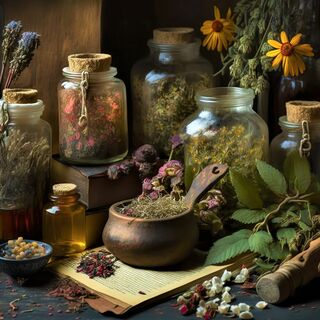
Herbal medicines are used to treat conditions and to encourage balancing of the digestive system and the mind.
And lifestyle adjustments are recommended to guide the person towards a lifestyle which is balancing for their constitution and the affected doshas.
Massage and body treatments are also widely used for both detoxification and rejuvenation.
And there are many different treatments which treat different conditions.
When there's a lot of toxicity to cleanse from the body,
The strong detoxification process called panchakarma may also be used.
And alongside these,
Ayurvedic treatments can work with all of the senses,
So the doshas can also be balanced with aromatherapy,
Colour therapy,
Sound and mantras and with yoga and meditation specific to the person and their condition.
So this three-part series has just been to introduce you to some of the core principles of Ayurveda to give you some understanding about how this system of healing works.
If you're interested in learning some more,
I do have some courses about Ayurveda here on Insight Timer,
Which you can check out on my profile.
And I'll be uploading more Ayurveda-related content in the future.