So what we're going to be focusing on here is coming up with a routine that we can follow.
I've done many different podcasts and one that keeps getting the most downloads is when I talk about stoic routines,
Morning routines,
Evening routines,
Work routines.
Typically,
If you ask people,
Do you have a routine,
They'll say,
Do you mean a morning routine?
And that is definitely the most popular kind of routine that many of us know about.
But in this talk,
I want to talk about more than just the morning routine.
We're going to be talking about morning rituals,
But I also want to talk about work rituals,
Social rituals,
And evening rituals,
And how we can link that into stoic practices.
A quick disclaimer on stoicism.
So I have many talks on my Insight Timer profile and my podcast about stoicism,
The basics of stoicism,
Key stoic ideas.
There are essentially two camps in the stoic community.
So one camp says that to be a true stoic is to kind of live every day the philosophy,
Where you kind of look at the four cardinal virtues,
Which is discipline,
Courage,
Justice,
And practical wisdom.
And essentially,
You just try every day to become a better person,
To develop excellence of character and virtue.
And even if in the short term,
You feel worse,
Even if you feel quote-unquote negative emotions,
Providing you are being a good person,
That's in the end,
The best thing you can do.
So this is sort of like a virtue-first approach to stoicism.
And people in this camp would say,
Hey,
Even if you're practicing stoic techniques,
If you're doing it for the wrong reasons,
Don't ever say you're practicing stoicism.
Like if you're practicing stoicism to become a billionaire,
If you're practicing stoicism to become a better soldier,
Don't ever call yourself a stoic because that is not what stoicism is about.
Then there's the other camp that says,
Well,
Okay,
Fair enough.
Stoicism,
Similar to Buddhism,
Is a way of life.
It's a philosophy of life.
But can we take things from this philosophy and apply it to our lives even if we don't fully commit?
And I think that I'm fine with that,
Actually.
If you don't want to become a full stoic,
Like if you don't want to become a full Buddhist,
But you find certain practices useful,
By all means,
Take them.
If you find a certain stoic exercise useful for dealing with your anxiety,
And that's as far as it goes,
I think that's fine.
Because I guess my fundamental worldview is that the more at ease that we are,
The less caught up in distorted thoughts,
The more reasonable we are,
The more our own cup is full emotionally,
The better we're going to treat other people and the better the world is going to be overall.
Typically,
The pattern that I see is when your cup is empty,
That's when you start trying to empty other people's cups.
That's when you start bullying and abusing and mistreating.
It's because you feel a lack within.
And I think the same is true for Buddhism as well.
You don't have to necessarily follow the noble eightfold path every day to still have a right to practice mindfulness meditation,
And to get benefit from that,
And to improve your relationships with that technique.
So I just want to tell you that you don't have to necessarily commit to the full stoic way of life to still derive benefit from it.
There's a book called Atomic Habits by James Clear.
I would say it's kind of like the Bible of habit formation.
It's definitely the most popular book on creating habits.
And James Clear,
The author,
Says there are four laws of behavior change,
Or habit formation.
And the four laws are,
Number one,
Make it obvious.
Number two,
Make it attractive.
Number three,
Make it easy.
And number four,
Make it satisfying.
So whenever you're going to be implementing a new habit,
Or a new exercise,
Or a new type of practice,
Always just run through that checklist in your mind.
How can I make this more obvious?
How can I make this more attractive?
How can I make this easy to do?
How can I make it satisfying?
So let's just take the act of general meditation.
How can you make it more obvious?
Well,
You could put your meditation app in a central point on your smartphone.
You could put a meditation cushion somewhere where you're never going to miss it.
You could put little reminders around the house,
Right?
Make it obvious.
How can you make meditation more attractive?
Meditation experts often say make a meditation space,
A shrine,
You know,
Get bells and incense and sort of different ornaments to make the practice more attractive.
You could also write a big list of all of the benefits you think you're going to get from this practice and write it out and put it next to your meditation space.
You can make it easy by not setting too much of a lofty goal.
If you're struggling to meditate for 20 minutes a day,
Why not meditate for 2 minutes a day for a week and then increase that to 7 minutes,
Then increase that to 15 minutes,
Then increase that to 20 minutes,
And then 30 minutes,
35 minutes,
And so on.
And the fourth law is to make it satisfying.
And this is one where you have to get a little bit more creative about it because if you're doing wellness habits and practices,
The idea is that they are intrinsically satisfying.
You feel better after it.
So if you go and do a big run,
For example,
I always feel satisfied after I've done a run because I get the endorphins.
But one way that I can increase the satisfaction is to perhaps track my run,
Kind of have my stats there so I can kind of see what I've been doing.
It makes it a little bit more satisfying to see how hard I've worked.
So yeah,
Run through these whenever you want to implement something new.
And the other thing as well is don't take on too many new things at once.
I'm definitely the type of person to do this.
If you're listening now,
You can share with me,
What's your style when it comes to habits?
Do you like to track habits in an app?
Do you just remember them?
Do you use a calendar?
Do you just feed into it each day?
What's your approach to creating new habits and practices?
I'm the type of person to make a big list and just trying to do everything at once.
But the truth is,
Whenever I don't do that and I just focus on one or two things at a time,
Things always go better.
So I'm also a big fan of the philosophy of essentialism,
Which can be described as the disciplined pursuit of less.
I'll create a course on this in the coming months.
But the idea is that in order to be excellent at something,
You have to be bad at something else.
In order to be successful,
You have to be unsuccessful.
And an essentialist is okay with this.
An essentialist just accepts,
Hey,
Here are the things I'm not going to be good at.
Here are the things I'm not going to spend my time doing.
And by doing that,
I'll also have time to focus on the things that really matter.
So one of the exercises I usually do with my clients,
My one-on-one clients,
Is that I ask them to imagine that they have two hours of free time per day.
And we get that space on a calendar.
And then I say,
How would you spend these two hours each day?
You only have two hours.
And this is a really good practice.
I had a lot of free time,
And then I had a child,
And then I didn't have much free time at all.
And so I kind of forced myself to become an essentialist through that process.
And I was,
Ironically,
More productive when I had less time because I was focusing more on the things that mattered.
We live in this kind of modern-day age where we think we've got to do everything to be winning in life.
So the morning routine that I've got to have has got to have 50 different components.
I've got to do it all.
I've got to meditate.
I've got to do breathwork.
I've got to do cold showers.
I've got to cram all of this stuff in.
Then I'll be a complete human.
And I'm going to be talking about a lot of different practices.
So this is why I'm talking about this now,
Because you could take that approach,
And there's nothing wrong with it.
But then I also think there's another approach which focuses more on depth rather than breadth.
And so sometimes I ask,
What would be better?
Someone who spends an hour doing five different practices,
Like a bit of journaling,
A bit of gratitude journaling,
A bit of breathwork,
A bit of exercise,
A bit of meditation,
A bit of stoicism,
A bit of reading,
And they do all of these things in an hour,
Or someone who simply meditates a very basic,
Silent,
Boring – I guess it wouldn't be boring if you did it right,
If you paid attention enough – meditation that you just did every day and focused.
I would wonder which one would be better.
It's not obvious,
Actually.
I don't think it would be automatically the case that cramming that hour with lots of things would be better.
It might be.
It might not be.
But I think the fact that that is not so clear-cut is interesting in and of itself.
So the first thing we're going to be looking at now is morning rituals.
So these would be things that I would recommend you do when you first wake up in the morning.
So one of the first things I would recommend you do is super easy.
I wouldn't say jump out of bed.
I personally would find it hard to jump out of bed really quickly and just get going.
So I'm going to give you practices that I think make sense psychologically.
Because I could say,
As soon as you wake up,
Go and jump into a nice bath.
You'd be like,
Well,
Okay,
But I'm not really going to be doing that 365 days a year.
That doesn't really quite make sense.
So the first exercise or habit that I want to recommend is something that you can do from your bed,
And that is to read over a quote.
Just the first thing to read is a quote.
So imagine that you kind of open your eyes,
You're still a bit groggy,
And you've got some pre-prepared quote on your phone or in a book next to you,
And you just open it up and you just read it.
You think about it for a couple of minutes.
So a quote that you could start with is,
There's a Marcus,
You could just search for this online,
There's a Marcus Aurelius quote.
So the quote goes like this,
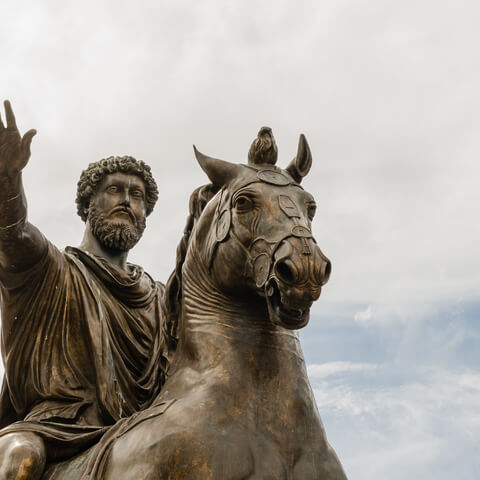
Marcus Aurelius writes in his book Meditations,
At dawn,
When you have trouble getting out of bed,
Tell yourself,
I have to go to work as a human being.
What do I have to complain of?
If I'm going to do what I was born for,
The things I was brought into the world to do,
Or is this what I was created for,
To huddle under the blankets and stay warm?
So you were born to feel nice instead of doing things and experiencing them.
Don't you see the plants,
The birds,
The ants and spiders and bees going about their individual tasks,
Putting the world in order as best they can,
And you're not willing to do your job as a human being?
Why aren't you running to do what your nature demands?
You don't love yourself enough,
Or you'd love your nature too,
And what it demands of you.
So Marcus Aurelius is just sort of,
I guess he's kind of nudging himself to be better in the mornings.
I guess the reason why he wrote this is because he struggled in the morning sometimes,
Because the Stoics were human beings with flaws and deficiencies and problems and emotional struggles.
Through the practice of Stoicism over time,
They weeded a lot of those things out,
But fundamentally they are and always will be human beings.
So that is a quote that you could read as a starting point,
Just to kind of nudge you to get going.
The next practice I would recommend in the morning is either a journaling practice or a meditation,
And I would recommend doing this as early as possible in the day.
So let's go over both.
Let's start with journaling,
And you could do both as well if you thought that would be useful.
So a good journaling practice to start the day would be quickly reviewing what you're grateful for,
But in a Stoic way.
So you wouldn't just list,
Oh,
You know,
I'm thankful for a roof over my head.
I'm thankful for clean water.
I'm thankful for that nice meal I had yesterday.
There's nothing wrong with that.
That's the sort of positive psychology approach.
The Stoic approach would say go a bit deeper and contemplate,
For example,
How your life could have taken a wrong turn very easily but didn't.
You know,
So was there a relationship that almost led you down a bad path,
But you saved yourself?
Did you almost have an accident when you were out,
Or did you fall,
But you didn't end up in hospital?
Were there near misses in life?
You know,
I was out today with my family,
And we were playing in a splash park,
And my son tripped,
And he hurt his leg.
He cried for about 20 seconds,
And he kind of had a bit of a limp,
But an hour or two later,
He was fine.
I may contemplate that and go,
Well,
What if he fell at a slightly different angle,
And then I had to go to the hospital,
And I had to spend the day in the hospital,
And then he had to wear a boot for the next week,
Right?
A small twist of fate,
That could have happened,
And how I should be grateful for what did happen in comparison to what could have happened.
So you go a little bit deeper.
Good practice as well,
Just in general,
For resilience is whenever something bad happens.
Now,
The Stoics wouldn't say that it was actually bad,
But that's how we label things,
Good and bad,
In our society.
Whenever something bad happens,
The first question to ask is,
What catastrophe have you avoided?
We often do the opposite.
When something bad happens to us,
We feel like a victim,
And we think we are experiencing a catastrophe,
Whereas a Stoic would say,
Oh,
Well,
What did you avoid?
That gets you to think a little bit differently.
It's like,
Okay,
This is not necessarily great for me.
This is kind of an obstacle,
But wow,
It could have been so much worse.
You often see these cliches that sound a bit annoying,
Often have a lot of truth to them.
Think about how much worse it could be.
If someone says that to you when you're having a bad day,
It's kind of annoying.
It's like,
Well,
That's not helpful.
But in the idea of it,
The root of it is very helpful.
It's helpful if you make that a way of seeing the world in a permanent sense.
It's not helpful if someone comes up to you and just says it to you,
Because you don't see the world that way.
The same as when people say to you,
Focus on things within your control.
This is not within your control.
It's like,
Well,
Yeah,
Okay,
That's not helpful because I'm really stressed.
But if you made that a practice to focus on things within your control,
And that became a way of being for you,
Where you started dividing the world every day,
Every hour,
Into what you could control and what you couldn't control,
Now that would actually be useful.
The same applies to Buddhism as well.
If someone says to you,
Just focus on the present moment,
Don't think so much.
It's like,
Well,
Easy for you to say.
I can't just do that.
But the root of it is very wise.
It's like,
By focusing on the present moment over time,
That becomes easier,
And you won't be so caught up in thought and so identified with thought.
So just pay attention to that in the future.
When people give you these trite cliches to try and help you,
It's not helpful,
But the place that it comes from,
The wisdom that made that cliche a cliche in the first place,
Is often quite profound if it was fully internalized,
And often comes from stoicism as well.
So you can look at gratitude.
You can also examine things like not just what catastrophe you've avoided,
But also imagine parallel universes where there's another version of you out there that was just extremely unlucky for whatever reason,
And just sort of compare your life to their life.
A small twist of fate and your DNA might have been different.
Your IQ might have been different.
Your siblings might have been different.
The place where you grew up might have been different.
We rely so much on good luck in life,
But we often don't contemplate that.
The next thing that you want to do for your stoic journaling practice is to think about obstacles that could come up throughout the day to mentally prepare yourself for them.
So one of the things I would do is I'd have a column on the left,
And I would have things that could catch me off guard,
Unexpected issues and obstacles that could come up,
And what is a very quick approach to them.
Sometimes it could be very simple ones,
Like when I take my son to school,
There's often a lot of traffic.
Sometimes there is,
Sometimes there isn't.
So I might say there could be a lot of traffic built up on the roundabout on the way to the school,
And then I'll just ask myself,
How do I deal with it?
Well,
Try and leave early.
If I get caught in traffic,
Practice patience.
Accept that this is just the way that the world works.
This is the way that traffic is.
This is the way that the road is going to be for the foreseeable future.
It now becomes an opportunity to practice patience rather than an opportunity to get frustrated.
You could argue that the source of all frustrations is expecting the world to not be as it is.
So things that frustrate us,
Let's just say you lose your car keys and you get all freaked out.
I can't find my car keys,
I'm in a rush.
A stoic would say,
Well,
In life,
Sometimes part of life is losing things.
Sometimes part of life is losing your car keys.
That is actually just how life is.
Very few people have ever not lost things when they've been in a rush.
The same is true for bad drivers.
We see a bad driver on the road,
We get really freaked out and angry,
Have road rage.
A stoic would say,
Bad drivers are also just part of life.
There will be bad drivers.
Don't be so surprised when you see one.
Just go,
Oh,
Of course,
Yeah,
Bad drivers,
They exist.
I'm going to try and minimize the damage of them being on the road,
But getting all angry and sacrificing my peace of mind is that helping me?
Is that helping anyone?
What we do in our journaling practice is that we have a list of potential obstacles and one of them could be certain people that you're going to be dealing with.
Then we come up with a quick solution to that problem.
Then the third thing that we will do is set an intention for the day.
What is our goal?
What is the one thing that we want to achieve today?
If we could achieve only one thing,
If we could just do this one thing,
What would it be?
That could be something like,
I want to stay calm with my children.
It could be,
I want to make my partner feel special.
It could be that I want to do this project that I've been putting off for months.
It doesn't matter what it is,
But having that one thing that if I can do this today,
I'll be happy about is very useful.
You can refer back to that often.
Then the final thing is to look at anything that's making you afraid.
Do you have any fears that are lingering?
Because anxieties,
Worries and fears,
If they're not addressed,
They can come out in very destructive ways.
Let's just say that if you use the example of a relationship,
If you have worries about your partner being less attracted to you,
For example,
Or not paying you much attention,
And you're not consciously aware of that,
It's just a kind of background anxiety,
Then you may say or do something when you're communicating throughout the day with your partner that is unskillful and is coming from a place of fear.
Or let's just say that you're afraid of a situation or a meeting in work and you're not addressing it,
You're pushing it down.
That's going to come out as kind of anxiety,
Avoidance,
Aversion.
Whereas if you actually say,
Hey,
I'm actually afraid of this,
What am I going to do to try and manage my fear?
What are some steps I can do to make myself more prepared?
You'll be able to act more skillfully when that happens.
I have a bunch of morning meditations.
On the topic of gratitude,
I have a gratitude course.
I currently have 12 courses.
I have a course on Stoic Anxiety,
Stoic Gratitude,
Stoic Negative Thinking,
Toxic Relationships,
Envy,
Managing Envy,
Which is one of my least popular courses because I don't think people like to associate themselves with having envy.
But I honestly think if you can learn to manage envy,
It becomes a superpower.
It's one of those feelings we like to push down.
Lucid Dreaming as well.
A Skeptic's Guide to Self-Improvement.
I kind of go over some of the realistic approaches to self-improvement rather than the ones lacking evidence.
And a few others as well.
The next habit that I would recommend in the morning is to do some reading.
What better to read than Stoicism?
It could just be 15 to 20 minutes of reading.
Seneca,
The Stoic philosopher says,
Each day acquire something that will fortify you against poverty,
Against death,
Indeed against other misfortunes as well.
And after you have run over many thoughts,
Select one to be thoroughly digested that day.
This is my own custom.
From the many things which I have read,
I claim some one part for myself.
So Seneca is saying that he reads philosophy or wisdom texts and then he's kind of scanning the text thinking,
What can I take here and make part of me?
And if you do that every day,
One thing per day,
That's 365 bits per year.
Just from my reading practice,
First thing in the morning.
I want to talk a little bit about cold exposure.
There's a lot of science behind cold showers and ice baths and things.
I do practice them.
I go through periods of practicing them regularly,
But I don't practice them for health benefits personally.
I practice them for psychological benefits.
So Andrew Huberman says that when you have cold showers,
It can boost your dopamine by about 200%.
It's also a hard thing to do.
I think doing hard things regularly trains you to be able to do hard things,
Which is I think a superpower.
I think if you can consistently get good at doing things that you don't really want to do,
Then you can get to a point in life where you can just set up a calendar or set of tasks that you think are good for you and right for you,
And you can just one by one do them.
You're not going to be governed by your emotions so much.
You're going to learn basically discipline.
Discipline is taking action without needing motivation.
Or as Mike Tyson said,
Discipline is doing something you hate like it's something you love.
So I like to do cold shower meditations rather than just cold showers.
And so I go into the cold and sort of imagine that I don't have access to a warm shower.
So it becomes almost like a gratitude practice as well.
This is the only way that I can wash myself is with the cold water.
And is it really bad?
Are there people in the world that only have access to cold showers and they love it and they don't think about it and they don't complain about it?
And why am I complaining about it?
And then you can step into the cold and examine those thoughts and those feelings with mindfulness.
And then there's another practice that I really like as well,
Which is a death meditation,
But it's not super morbid.
The idea is that you look into the mirror.
So when you brush your teeth in the morning,
You look into the mirror and you just think about your ancestors and the people that came before you in your lineage that also looked into a mirror and were also your age once and also had their life ahead of them and were also doing the kinds of things that you were doing and how they are now no longer here.
And it's not meant to be super morbid,
But just sort of realizing that life is very fragile and things can change.
One of my teachers says that death is certain,
But time of death is uncertain.
And I think that phrase is quite deep.
And I think just remembering that each day,
It's like death is certain.
We're all going to die.
Time of death is uncertain.
Some people think that,
And there's been many quotes like this from Socrates and Leonardo da Vinci that you philosophize in a way to learn how to die.
It's sort of the ultimate form of letting go.
You can look at one's spiritual practice and look at one's attachment to life as a sort of a metric.
I guess it's two things because it's someone who's very wise,
Someone like Socrates,
Is able to do two things simultaneously.
That is to enjoy life in a maximal way and to really extract the fruits and the meaning and the love and the lessons and the joy as much as possible,
But simultaneously be okay with letting it go in an instant if need be.
There's this sort of full engagement with no attachment.
That's the kind of balance that a very wise person can get to.
Epictetus compared it to going on a journey.
Say you get off a boat and you go and explore the town,
And you buy different things.
You pick up different souvenirs,
But then the captain of the ship calls you back.
You've picked up way too many things and you start complaining,
I'm not ready,
I'm not ready to go back.
Epictetus would say,
Well,
That's not a very wise person.
A wise person would say,
Okay,
Cool,
I'm coming back now.
I've had a nice look around and I'm ready to go back on the ship.
The ship is the beginning and ending of life.
The time that you have on life to look around,
To explore,
Is beautiful.
It's like a holiday.
It's something to appreciate how lucky you are to be able to get off that ship and to look around and to collect things and to form relationships.
But when the call comes to return,
Why fight it?
You knew this was part of the deal.
You can just spend a few moments when you look in the mirror in the morning just thinking about the people that came before you and how death is certain,
But time of death is not.
The next thing we all do in the morning as well is we all get dressed.
This is quite an important thing as well,
Because one of the questions that we can ask ourselves is what would we,
And I got this from William B.
Irvine,
The author of A Guide to a Good Life,
Is to ask yourself,
How would you live if you were the only person on earth?
What decisions would you make?
And so you could ask yourself,
What car would you drive?
What clothes would you wear?
How would you style your hair?
How would you present yourself if you were the only person on earth?
Now,
I don't think it's realistic to say that we wouldn't care and we would just be scruffy and messy.
I don't actually think that would be the case.
I think we would definitely care,
Because we're the only person on earth and it's kind of natural to groom and to feel good and to be clean.
I think that's a form of self-care,
Even if you are the only person on earth.
But then the question is,
How would you present yourself versus how do you present yourself knowing other people are going to be looking at you?
And then the follow-up question then is,
How much of my life do I live in reaction to other people's opinions versus how much of my life do I live that is coming from a place of authenticity?
And whenever you get dressed,
You can just ask yourself very simply,
Am I dressing in a certain way because I think I want other people to react to me so I can feel good?
I want other people to find this clothing good so I can feel good.
So in a way,
I'm kind of using other people's reaction as a sort of validation drug versus validating myself.
So dressing because I'm my own witness,
I'm happy with what I'm wearing.
My approach to a lot of these practices is,
So I've been through periods in my life of getting really meticulous with the details of habits,
Especially when I really got into nutrition and training,
It was very specific.
And then over time,
I realized a lot of that stuff,
It's not that it doesn't matter,
But if you think of it like a pyramid,
Life is a pyramid,
The base and the next level,
These things are the most important foundational aspects of the pyramid.
And then the things at the top,
The details,
They are not the difference that makes the difference.
That's how my friend Martijn uses that phrase,
Is that the difference that makes the difference?
Is cold exposure in the morning,
Evening,
Or the middle of the day the difference that makes the difference?
Or is doing cold exposure full stop the difference that makes the difference?
I've used cold showers a lot when I was grieving and I didn't really care what time of day it was,
It was just a practice to do.
And so I just,
Yeah,
I just kind of got on with it.