I'd like to start with a question.
To what extent do you feel overwhelmed?
You can answer as if I'm asking you about this exact moment,
Because maybe you've carved out a few minutes of peace so that you can listen to this episode.
But I'm just talking about in general.
Does life ever feel like it's just too much?
Too many things to do,
Too many emails,
Too many projects,
Too many people wanting something from you,
Too many tabs open in the browser and in your mind.
If you look beneath that noise,
The overwhelm,
The feeling of too many things,
You'll find anxiety,
Stress,
This feeling,
This knowing feeling that you're not doing enough,
That you're falling behind,
You're not living up your potential,
Other people are getting in front of you,
You're spread too thin and you can barely remember what you're trying to accomplish in the first place.
I completely get this.
I've been there and I am there on many days.
But I've learned something from the Stoics that I want to share with you in this episode.
The ancient Stoic philosophers who faced plagues,
Wars,
Exile,
The collapse of empires,
Had an insight that is very useful for us individuals in the modern world.
The insight is this,
We have more control than we think and we have less time than we'd like to believe.
At first that might sound a bit deflating but if you stick with me you'll see that this is one of the most liberating insights we can have.
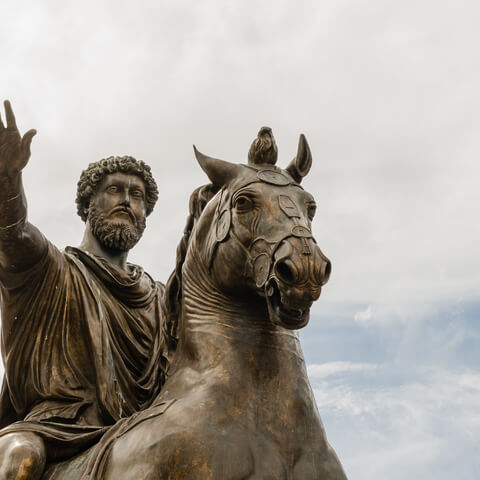
Marcus Aurelius,
The Roman emperor,
Somehow found time to write one of the greatest philosophical works ever while at the same time literally running an empire.
And he reminded himself of something constantly.
Do not act as if you were going to live 10,
000 years.
Death hangs over you.
While you live,
While it is in your power,
Be good.
Notice he didn't say be productive,
He said be good.
That means be present,
Be intentional,
Be wise with the time that you have.
Here's the truth that modern productivity culture doesn't want you to know.
You can't do everything.
You were never supposed to.
And once you accept that you can finally start doing the things that actually matter.
So in this episode I want to walk you through some really important stoic principles that have helped me and also countless others across 2,
000 years.
And in my own life I teach this stuff to my friend and to my coaching clients on a regular basis.
These principles will help you cut through distraction,
Calm anxiety,
And focus on what truly counts.
There's no gimmicks,
There's no hacks,
Just philosophy that works.
So let's start with the first hard truth principle.
Your time is limited.
You know this intellectually,
But do you really feel that way?
Do you live like your time is limited?
Most of us don't.
We act as if there will definitely be tomorrow.
There will always be next week.
There'll always be a time in the future when things calm down.
We scroll mindlessly.
We say yes to things that don't matter.
We waste entire evenings on things we don't even remember the next day.
The stoic philosopher Seneca,
Who was also a playwright,
A statesman,
A tutor,
He roasted his contemporaries for this.
He wrote,
Quote,
It's not that we have a short time to live,
But that we waste much of it,
End quote.
I'll say that again.
It's not that we have a short time to live,
But that we waste much of it.
Life isn't short because we lack time.
It's short because we squander a significant portion of it.
Think about your own life.
How much of yesterday did you spend doing things that really mattered to you?
How much was spent reacting to other people's agendas and moods?
How much of it was spent mindlessly consuming information or worrying about things you can't control?
I'm not here to shame you.
I waste time too.
We all do.
We're human and it's never been easier to waste time than with the internet and social media and so on.
But when we recognize our finitude,
When we truly accept that we have a limited number of days on this planet,
It becomes a form of motivation rather than something that depresses us.
Why is that?
Well,
Because it gives you permission to say no.
We can't do everything.
So let's stop trying.
We can't please everyone.
So let's stop performing.
We can't learn every skill.
We can't visit every country.
We can't read every book.
We can't master every hobby.
And that's fine.
That's okay.
It's okay to specialize.
It's okay to simplify,
To be an essentialist.
In fact,
It's more than okay.
It's liberating.
When you accept any limits that you have,
You can ask the question that really matters.
What do I actually want to do with the time that I have?
Instead of living by the belief that we should do what society tells us to do,
Or that we should do things that impress people on social media,
We should not do what our parents wanted us to do or what we thought they wanted when we were 20.
What matters right now with the life we actually have?
By saying no to the trivial,
To the time wasters,
To the energy vampires,
The commitments that drain us,
We are saying yes to what counts.
We are,
To put it nicely,
Reclaiming our life.
Okay,
Principle number two.
All right,
We've accepted that time is finite.
Good.
Okay,
That's the foundational understanding.
Now,
The second step.
What are we going to do with Here's a mind-bending idea from the philosopher Oliver Berkman.
His work is fantastic,
Highly recommend it.
He says that the sum of your attention is your life.
Whatever you pay attention to,
Whether it's meaningful work,
Quality relationships,
Creative projects,
Doom scrolling,
That is what your life becomes.
Your life isn't separate from what is happening in the background while you're distracted.
Your life is your attention,
Moment by moment,
Day by day.
So the question isn't how do I manage my time?
The question is what am I choosing to focus on right now?
Marcus Aurelius understood this.
He wrote,
Do external things distract you,
Then make time for yourself to learn something worthwhile.
Stop letting yourself be pulled in all directions.
And then he also said,
Concentrate every minute like a Roman,
Like a man,
On doing what's in front of you with precise and genuine seriousness,
Tenderly,
Willingly,
With justice,
And on freeing yourself from all other distractions.
Do what's in front of you.
This sounds a lot like mindfulness to me.
Not multitasking,
Full attention on the task at hand.
Not what might happen tomorrow,
Not what happened yesterday,
Not the 17 tabs open in your mental browser,
But what's in front of you right now.
This is the Stoic practice of presence,
Single tasking,
Giving your full attention to the thing that matters most in this moment.
And how do you know what matters most?
Marcus Aurelius had a beautiful question for that too.
He said,
Ask yourself at this very moment,
Is this necessary?
Pause on that.
Is this necessary?
Is this meeting necessary?
Is this email thread necessary?
Is this argument necessary?
Is this worry necessary?
Is scrolling through my phone for the 50th time today necessary?
Most of the time the answer is no.
And when you eliminate the unnecessary,
You create space for what actually moves the needle,
What aligns with your values,
Your goals,
Your purpose.
This isn't about becoming some hyper-efficient robot.
It's about intentionality,
Making conscious choices instead of sleepwalking through your days.
So here's my challenge for you.
Pick one core value or meaningful goal in your life.
Just one.
Maybe it's your health.
Maybe it's your creative work.
Maybe it's being a present parent or partner.
Maybe it's building a business.
Maybe it's contributing to your community.
Whatever it is,
Resolve to give it priority.
Not when you have time.
Not after everything else is done.
I'm talking about now,
Today,
This week.
Because if you don't decide what matters,
Someone else will decide for you.
And I can almost say with 100% certainty,
Their priorities are not your priorities.
So we've identified what matters.
What next?
Well,
It's time to focus.
But then reality hits.
Things don't go according to plan.
People don't cooperate.
You know what it's like.
Obstacles come up.
Setbacks happen.
That's life.
And suddenly we are anxious again.
Overwhelmed.
Paralyzed.
And this is where the Stoics offer us one of their most powerful tools.
The dichotomy of control.
Epictetus,
Who was once a slave before becoming one of history's greatest philosophers,
Taught this principle with radical clarity.
Some things are up to us,
And some things are not up to us.
That's it.
That's the whole framework in that sentence.
Some things are in your control,
Most things are not.
And your job is to figure out which is which,
And then focus all of your energy on the things within your control,
And let go of the things that are not within your control.
I talk about the dichotomy of control a lot in my talks.
I'm going to keep talking about the dichotomy of control because it's such a key principle,
And it takes a while to really embody.
The things within our control are intentions,
Our effort,
Our choices,
Our attitude,
And how we respond to circumstances.
What's not in our control are the people's opinions,
The outcome of our efforts,
The past,
The future,
Most external events.
Think about how much mental energy you waste worrying about things in that second category.
Will people like my work?
Will this project succeed?
What if I fail?
What if I look stupid?
What if the market crashes?
What if they don't respond to my email?
These are all things outside your control,
And yet we obsess over them,
Right?
Here's a common work scenario.
You're about to give a presentation,
Or pitch an idea,
Or launch something you've worked hard on,
And you're terrified.
Why?
Because you're focused on the outcome,
Whether people will approve,
Whether it will succeed,
Whether you'll look competent.
All of these things you can't fully control.
Now imagine shifting your focus.
Instead of,
Will this succeed?
You ask,
Did I prepare as well as I could?
Am I showing up with integrity?
Am I doing my best work?
Those questions ground you in the present,
In what you can control.
And here's what happens when you make that shift.
The anxiety decreases.
Not because the stakes are lower,
But because you no longer try to control the uncontrollable.
You're focusing on your effort,
Not the outcome.
Your process,
Not other people's reactions.
You just do what you can do.
You give it your all,
And then you let go.
This is the antidote to perfectionism,
And to things like overthinking,
And to the fear of failure that keeps so many of us stuck.
You are not responsible for controlling every variable.
You are responsible for doing your part with intention,
Focus,
And with excellence.
Everything else you can just let go.
Okay,
Let's take a brief detour here.
This might sound a bit philosophical,
But just stick with me,
Because it is very practical.
The Stoics had this exercise called the view from above.
I'm sure you've heard about it.
Marcus Aurelius did it regularly.
He'd imagine himself rising above his immediate circumstances,
Above Rome,
Above the empire,
Above the earth itself,
And then looking down at the vastness of all existence from a cosmic perspective.
And when he saw things from this cosmic perspective,
His daily earthly worries shrank.
The petty dramas,
Political intrigues,
Insults,
Setbacks.
From this cosmic perspective,
They looked tiny,
Temporary,
Insignificant in the grand scheme of things.
He wrote,
Look at the stars and see yourself running alongside them.
Thoughts like this wash off the mud of life below.
Now,
I'm not saying your problems don't matter.
Of course they do.
They're real.
They affect you and the people around you.
The point is that many of the things that stress us out in a given week,
You won't remember them.
In a week from now,
You won't even remember them.
And in a year,
They'll be completely forgotten.
In 10 years,
They're invisible.
So try this.
Right now,
Just for a moment,
Imagine yourself one year from today,
Looking back at this exact moment you're in.
What are you worried about right now that probably won't even register a year from now?
What drama feels urgent but is actually kind of trivial?
What are you ruminating on that you could simply let go?
This isn't about minimizing genuine challenges.
It's about distinguishing between what's genuinely important and what's just noise.
Because when you zoom out,
When you take the view from above,
You gain clarity.
You realize that most of your anxiety is self-generated.
That most of your stress comes from fighting things you can't change or obsessing over things that don't really matter.
And with that clarity comes calm,
Comes focus,
Comes the ability to return to the present moment and ask,
What actually needs my attention right now?
And here's where it gets interesting.
We're going to look at the principle of embracing productive discomfort.
Once you've cut out the distractions,
Focusing on what matters and let go of what you can't control,
You're still left with one thing.
The hard stuff.
Things like difficult conversations,
Challenging projects,
Uncomfortable decisions,
The tasks you've been procrastinating on because I don't know,
They're scary or uncertain or you might feel exposed to failure.
And here's where most productivity advice goes wrong.
It tries to make things easier,
To hack your way around discomfort,
To gamify and optimize until everything feels effortless.
But the Stoics understood something deeper.
Growth requires discomfort.
Progress demands difficulty from you.
Meaning is nearly always found on the other side of resistance and discomfort.
Marcus Aurelius wrote one of my favorite lines in all of philosophy.
The impediment to action advances action.
What stands in the way becomes the way.
I'll say that again.
What stands in the way becomes the way.
So the obstacle isn't blocking a path.
The obstacle is the path.
The difficult client,
That's teaching you patience and communication.
The project that keeps hitting roadblocks,
That's building your problem-solving skills.
The fear of putting your work out there,
That's the exact edge where growth happens.
Seneca said it even more bluntly.
Difficulties strengthen the mind as labor does the body.
Think about that.
If you went to the gym and only lifted weights that felt easy,
You would not get stronger.
You need resistance.
You need the weight that challenges you,
That makes you struggle,
That pushes you to your limits.
The same is true for your mind,
For your character and for your work.
If you only do what's comfortable,
You'll stagnate.
You'll coast.
You avoid the very experiences that would transform you.
So let me reframe discomfort for you.
If it's hard,
It probably means that it matters.
The thing that you've been avoiding,
That conversation you're dreading,
The creative project that feels too vulnerable,
The career move that terrifies you.
The discomfort isn't a bug.
It's more of a feature.
It's a signal that you're at the edge of your comfort zone,
Exactly where you'll grow.
I'm not saying throw yourself recklessly into danger or do stupid things just because they're hard.
The Stoics were not masochists.
But what I am saying is this.
Stop waiting for it to feel easy.
Stop procrastinating until you feel ready.
Stop avoiding the hard stuff.
Face it,
Step into it,
Do it.
Because on the other side of the discomfort,
That's usually where your best work lives.
That's where your growth happens.
That's where you become the person you're capable of being.
Okay,
Let's bring all of this together.
Here are the core principles we've talked about.
Number one,
Embracing your finite time and saying no to what doesn't matter.
Principle two,
Focusing on what's essential and giving it your full attention.
Principle three,
Letting go of what you can't control so that your anxiety reduces.
Four,
Gaining perspective to distinguish between what's the important and the trivial.
And finally,
Five,
Stepping into discomfort as the path to growth.
These are not just nice ideas,
They're practices.
They're tools and strategies you can use starting today.
So here's what I want from you.
As soon as you finish listening to this,
Identify one meaningful task or decision you've been avoiding.
Maybe it's reaching out to someone important,
Could be starting a project you keep putting off,
Having a difficult conversation,
Could be sitting down and focusing on your most important work without any distraction.
Whatever it is,
You know what it is,
It's probably already come to mind.
Now,
Commit to doing it today.
Not tomorrow,
Not when you feel ready.
Today.
Marcus Aurelius was right.
He said,
Do not act as if you are going to live 10,
000 years.
While you live,
While it is in your power,
Be good.
You don't have 10,
000 years.
You have today.
You have this moment,
This opportunity.
I recommend you don't waste it.
I recommend you don't let fear or perfectionism or distraction steal it from you.
Do the thing,
Take the step,
Move.
Because that's what stoic productivity is.
It's not doing more,
It's not being busier,
It's about being intentional,
Being present,
Focused on what matters,
Courageous enough to face discomfort.
And when you live like that,
When you align your actions with your values,
You let go of what you can't control,
You step into the challenges that matter,
You don't just become more productive,
You start feeling more alive.
I know that this stuff isn't easy.
Focusing is hard.
Letting go is hard.
Facing discomfort is hard.
But you know what else is hard?
Living a very distracted life.
Wasting years on things that don't matter.
Lying on your deathbed,
Wishing you'd done things differently.
The Stoics,
As I've said,
Faced very difficult challenges like war,
Plague,
Exile,
The collapse of everything they knew.
And yet they still found a way to live with wisdom and courage.
And you can too.
You have everything you need right now.
You have tools,
You have time,
You can choose.
So choose wisely and choose intentionally.
Choose to focus on what matters.
And if these ideas resonated with you and if you want to go deeper into these practices and explore more Stoic tools and build a life of focus and resilience and meaning,
Rest assured that this is just the beginning.
There's a whole journey waiting for you.
But for now,
Just take the next step.
Do the one thing you've been avoiding.
Make your time count.
You do not have forever.
But you do have today.
So make it matter.