Hello,
And thank you for being curious about this talk related to dementia and what I believe we can think of as its gifts.
In today's talk,
I'll share what I learned from two of my teachers at the Adult Day Program for clients living with dementia.
Mr.
C and Mr.
T are both survivors of military service who endured its sometimes invisible traumas for decades.
They are two of my favorite humans who taught me a lot about the liberating influence of imperfection.
When I was a child,
I cared a lot about doing things just right.
Most years I had perfect attendance in school and a high grade point average.
I suppose I didn't want to disappoint my parents and my teachers,
Or maybe I thought academic achievement was my job in a way.
I liked being a student and still do.
When I decided to enroll in graduate school in my late 30s,
I still cared about doing well with my projects,
But the more enjoyable part was following my curiosity and learning as much as I could about my chosen field of study,
Which by then was language disorders caused by brain damage.
There's so much we take for granted about our ability to communicate,
The way we learn to speak and then to read and write,
But it's fragile because it depends a lot on aspects of our physical bodies,
Which are also fragile and subject to injury,
Disease,
And normal aging.
In studying the brain,
I was beginning to appreciate that much of what happens in life is beyond our conscious control.
Rather than being bothered by that fact,
Struggling to be in charge of everything and to get things just right,
It was liberating to know that the element of the unexpected is always,
Always at play in our lives and that life becomes so much easier when we allow it to be so.
When I bought a used car a few years ago,
I relaxed into the knowledge that it was already imperfect and not because of me.
If a runaway shopping cart scratched a door or a rock chipped the windshield or paint,
So be it.
In fact,
I would have been burdened by the supposed need to keep a new car pristine for as long as possible when my reason for buying the car had more to do with it protecting me,
Not the other way around.
I also like to patronize secondhand stores where perfectly useful if unusual items from bygone decades are hidden among the familiar fashions and gadgets of modern times.
I think it's fun to repurpose things too.
The velvet curtain with the stain can wrap around a cushion to make a softer sitting place.
The jar with a lost lid becomes a vase.
The strange stone from Iceland,
A paperweight.
Accepting the imperfections and oddities of things,
Living with the dents and the cracks and the holes and the stains is excellent practice for embracing our own imperfections and those of our fellow humans.
At the Adult Daycare Center for clients with memory impairment,
Part of my job was to create a monthly calendar of mixed activities.
Coffee and conversation at 10 a.
M.
When the clients arrived,
Lunch at noon,
And afternoon chair exercises never varied on the schedule.
In the morning and again after lunch,
There would be live music or art or table games.
The calendar was a rough guide and there were lots of things that could derail the original plan for a day.
We all liked the activities with a wide margin of error.
Error is not really the right word.
The best projects left lots of room for the unexpected.
Bingo games featuring pictures instead of numbers became opportunities to reminisce about what we saw in the images,
Like the mocha hete,
A small stone bowl used to grind grain or spices.
For Mrs.
B,
Born along the Texas-Mexico border,
It reminded her of being in the kitchen with the women of her family,
Making tamales on Christmas Eve.
On days when half of the clients in the room were Spanish speakers,
Those rounds of loteria transformed them into Spanish teachers for the rest of us.
That's how I learned that pajaro means bird and cotoro is parrot and that chalupa is not just an item on a fast food menu,
It's a kind of boat.
When it came to art,
Participation varied greatly according to physical ability and equally relevant,
The client's capacity to embrace play.
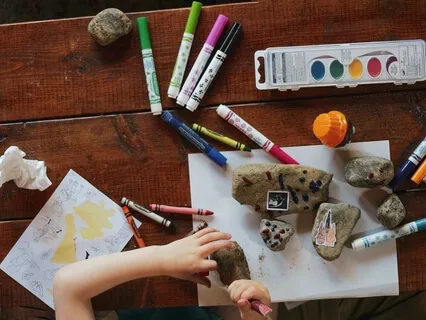
One very playful project involved rock painting.
Not painting pictures of rocks,
But painting on the rocks themselves.
The results were usually messy and beautiful.
Once everyone stopped resisting the idea of holding a paintbrush,
Maybe for the first time in decades,
Because certainly they were not artists and they were also definitely not in kindergarten.
Mr.
C,
A man diagnosed with Parkinson's disease,
Sits with a rock in front of him on the table.
A volunteer places something next to the rock,
A small paper plate with pools of paint.
His movements are slow,
Deliberate,
And I think back to what made his wife first notice a change in her husband.
She could no longer read his handwriting.
He would write a few letters of a normal size,
But as he continued,
The letters became smaller and smaller,
A disorder called micrographia,
Which is an early symptom of some neurodegenerative conditions affecting the basal ganglia within the brain.
Mr.
C was retired from a job that involved complex technical work,
But he was now troubled by things such as the clock on the wall,
Which he could not read,
And was convinced was moving backwards.
As time passed,
His paranoia extended to his interpretations of the behavior of those around him.
He became fearful,
Distrusting of people who cared about him very much.
For a few weeks,
He thought the center staff was poisoning his water.
He was certain his wife was having an affair and planned to leave him,
Although in truth,
Her devotion to him was irrefutable.
Perhaps because of his easygoing nature before illness presented itself,
He did not act out with anger or hostility towards staff or the other clients at the center.
His sense of humor remained,
And he was well liked by everyone.
And so,
With the paintbrush in hand that day,
He began to apply color to the dark gray rock.
A thick line of teal blue along the top,
Another on the bottom,
A bit of purple in the middle,
And then bold yellow.
Maybe it was meant to be the sun in a blue sky over a blue sea.
His arm shook as he held the brush,
And the resulting streak of yellow paint spread across the rock in a way he hadn't intended.
He looked up and smiled,
Acknowledging his mistake.
Mr.
C's wife had told me during a caregiver support group meeting that he thought of the center as his workplace,
And that to him,
I was his boss.
I smiled and took a closer look at the rock.
I told him it looked like a whale leaping from the water.
I seen people pay money for,
Hoping to witness such a thing on whale watching excursions in Monterey Bay or San Francisco.
He liked that interpretation,
Even though his face told me he still thought he hadn't done a good job.
But it was only because his hand shook from the tremors of Parkinson's disease that that yellow whale emerged from that purple sea,
And we all agreed it was a great day for whale watching on painted rocks.
Sport and games were not the only places we experienced the liberation of imperfection at the center.
Twice a week,
A wonderful band of retired volunteer musicians would visit to perform for an hour at a time.
They had been doing so for years before I started my job at the center,
And I know they would be performing today if we had not closed due to the shutdown caused by the coronavirus pandemic.
In fact,
I've heard that they're now meeting in a nearby park,
Safely spaced apart in the open air,
Because they love to play music as much as the clients at the center loved to listen to and watch them play.
There were some elders who would pop up from their seats,
Driven by the deep desire to dance,
And volunteers stayed alert to make sure those at risk of falling were held steady as they expressed the joy within.
Dancing may be the most perfect opportunity to express our joy for life in the present moment.
There were some clients who moved with the measured steps of their younger days,
The muscle memory very much still there,
Even in the presence of impaired cognition.
The waltz and the two-step,
The paso doble and the cha cha cha.
And then there was Mr.
T,
A self-described deadhead who still listened to the Grateful Dead and entertained our high school student volunteers with colorful stories from his psychedelic escapades in the 1960s.
Mr.
T loved to dance,
As if he were at Woodstock.
Eyes closed,
Swaying to the music,
Arms outstretched.
He was not a tall man,
But he filled the space around him and generated a lot of smiles from the clients,
The staff,
Volunteers,
And musicians.
Have you ever noticed it makes you happy to see someone else happy?
Mr.
T entered a zone in those moments at the center,
And you could almost picture him at some muddy outdoor festival in San Francisco 50 years ago when he was in his early 20s.
Not embarrassed,
Not worried about appearing foolish as he improvised his movements according to how the music felt in his body.
Here he was,
Alive.
And not merely alive,
He was free.
It made others feel good just to watch him move in the moment.
It still makes me feel good to remember him and to remember my dear employee,
Mr.
C,
Who passed away just a few days before the date of this recording.
Thank you for spending these minutes with me as I honor the lessons I learned from my teachers,
Mr.
C,
And Mr.
T.
I hope these thoughts about the liberation of imperfection will encourage you to more fully embrace and appreciate the things you might have considered flaws or shortcomings in others as well as ourselves.
Thank you too for being interested in a talk about dementia,
Which is often stigmatized as a dark and terrible topic.
I encourage you to connect with elders in your community who may be isolated,
Especially by the additional restrictions on togetherness.
There are still ways we can help each other with our small gestures of care,
Connection,
And curiosity.
I'll leave you today with one of many beautiful messages from Paramahansa Yogananda who said,
Seek to do brave and lovely things that are left undone by the majority of people.
Give gifts of love and peace to those whom others pass by.
Namaste.