Hello,
Friend.
This is a walking meditation,
Accompanied by medieval prose and verse.
It is designed to be listened to outdoors,
While moving,
But if this isn't possible for you,
You can also listen to it standing or sitting down.
Ideally,
This will be somewhere near a window,
Or anywhere else you can see natural light and the world outside.
If you are able to move,
Please start walking.
It doesn't matter where you walk.
You may be walking up and down your garden or a balcony.
You may be strolling through your neighbourhood.
You may be in a park,
In a woodland,
On a moor,
Or by the sea.
Choose anywhere you feel comfortable,
And where you are unlikely to be disturbed.
You may also like to choose somewhere with a relatively smooth path,
So you don't have to concentrate too hard on where you are stepping.
As you walk,
Take a deep breath,
And slow down.
Notice,
As you place one foot in front of the other,
Slowly,
Deliberately.
Notice,
As the sole of each foot comes into contact with the ground below you,
First one,
Then the other.
Take another deep breath,
And try to slow down,
Even more.
We are not walking today to race through the world,
But to notice it,
To be fully present within it.
Notice how the ground feels against the soles of your feet.
Is it smooth or rough?
Do you feel pebbles poking at the bottom of your shoe,
Or perhaps grass swishing past your ankles?
Take another deep breath.
What do you smell?
Do you smell trees?
Plants?
Flowers?
Do you smell rain?
Snow?
Or the ocean?
Or perhaps,
Do you smell the scents of a city?
Or of a town?
The smell of cars?
Or of lawnmowers?
Or of people cooking?
If you feel comfortable doing so,
Walk even more slowly now,
And gradually,
Come to a stop.
Look around you.
What do you see?
What plants or animals are nearby?
What colours do you notice first?
Which colours emerge?
As you look around more closely,
What do you see above you,
And what do you see below?
Now close your eyes,
And listen.
What do you hear?
Do you hear the wind in the trees?
Or the patter of rain?
Do you hear children playing?
Or dogs barking in the distance?
Take another deep breath,
And listen as the air enters your nostrils,
Or your mouth.
Listen as it fills your lungs,
And then comes out again in a long,
Deep sigh.
When you're ready,
Open your eyes,
And start walking again,
Slowly,
Deliberately.
As you walk,
I will read a series of poems and stories from the Middle Ages.
Each focuses in a different way on the natural world.
They ask what it means to move through this world,
To look at it deeply,
And to consider humanity's role within it.
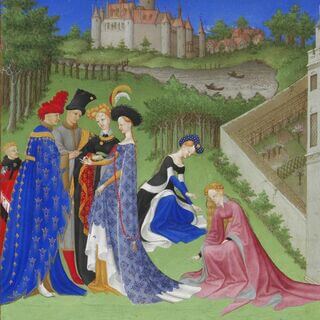
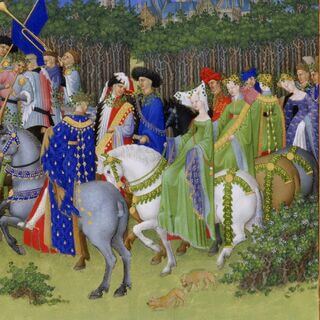
The first of these is the opening lines of the general prologue to the Canterbury Tales,
Written by the English poet Geoffrey Chaucer in the late 14th century.
Perhaps one of the most famous passages from the Middle Ages,
The general prologue opens with the return of spring to the earth.
April rains chase away the dryness of March,
And new shoots begin to poke through the soil.
A gentle breeze blows,
And birds begin to sing.
As the earth comes to life after the dark of winter,
People too are called to awaken,
And they embark on a journey,
A pilgrimage,
To the shrine of St.
Thomas the Becket in Canterbury.
One that April,
With his shores assault,
The draught of March hath persed to the rote,
And bathed every vein in switch-liquor,
Of which virtue engendered is the floor.
When Zephyr is egg,
With his sweet breath,
In spirit hath,
In every halt and heth,
The tender croppers and the younger son,
Hath in the ram his half-coursey run,
And smaller fowlers maken melody,
That sleep in all the niche with open ear,
So pricketh him nature in here courages.
Then,
Longing folk,
To go on pilgrimages,
And palmers,
For to seek in strongest rounders,
To ferner howlers,
Know in sundry londers,
And specially,
From every shearer's end of Ingerland,
To Canterbury,
They wender.
The holy,
Blissful martyr,
For to seek,
That him hath holpen,
When that they were sick,
Be fill,
That in that season on a day,
In Southwark,
At the Tabard,
As he lay,
Ready to wenden,
On my pilgrimage,
To Canterbury,
With full devout courage,
At nicht was come,
Into that hosteria,
Well nine and twenty,
In a compania,
Of sundry folk,
Be aventury faller,
In fellowship,
And pilgrims,
Where they aller,
That,
Towards Canterbury,
Wolden a reader,
The chambers and the stables were in weeder,
And well we were in is it at the best,
And shortly,
When the sun was to rest,
So had he spoken with him,
Every John,
That he was of his fellowship anon,
And made forward,
Early,
For to reese,
To take away their,
As he yell,
Devise,
Journeys,
Such as pilgrimage,
Bring people together,
In fellowship,
Through their shared purpose,
And common destination,
They bring together,
Sundry folk,
As we have heard,
People of different backgrounds,
Different characters,
Each with a story to tell,
As you walk,
You might look around you,
Who or what is part of your journey today,
What other humans,
Plants,
Or animals,
Share the landscape around you,
What is the nature of your fellowship in this moment,
What stories might your fellow travellers tell,
If they could,
Or if we could hear them,
As medieval authors remind us,
The natural world could be a place of challenge,
Or adventure,
But it could also provide a refuge from the human world,
When needed,
This is what we find in the tragic tale of Tristan and Isolde,
You may know the story,
Isolde has married Tristan's uncle,
King Mark,
But the two young people are deeply in love,
Rumours fly,
As Tristan and Isolde find it increasingly difficult to hide their feelings,
And eventually,
The king banishes them to the wilderness,
And yet,
Their exile from the court,
Turns out to be a welcome escape into a natural world,
That offers shelter,
Food,
And the freedom to be themselves,
This passage is from the Old Norse version of the tale,
Translated from French,
In early 13th century Norway,
I will read first in Old Norse,
And then in English,
After Tristan had joyfully and cheerfully returned to the court of King Mark,
It didn't take long for the king to discover the love that Tristan and the queen still felt for one another.
The king was saddened and greatly aggrieved by this,
And unwilling to endure it any longer,
He had both of them banished.
This seemed to be a pleasant alternative,
And they went out into the expansive wilderness,
Giving little thought to how they would obtain food and wine,
For they felt that God would grant them nourishment enough,
Wherever they were.
Both of them were pleased to be together with no one else around,
Of all the possible things in the world,
They desired nothing more than what they currently had,
For now,
They had what pleased their hearts,
Always being together,
Without guilt,
And taking delight in their love.
As they were enjoying this freedom,
In the forest,
They discovered a secret place near the water in a cliff,
That heathen men in ancient times had hollowed out and crafted with great skill and fine workmanship.
It was high and vaulted,
But the entrance was deeply hewn into the ground,
With a secret pathway far below.
There was a great deal of earth above the chamber,
And on top of that grew the most beautiful tree,
Which cast its shadow and provided protection from the heat and the burning of the sun.
Next to the structure was a spring with healthful waters,
And around the spring grew the sweetest herbs,
With the most beautiful blossoms that one could choose to have,
With a stream running eastward from the spring.
When the sun shone on the herbs,
They exuded the sweetest fragrance,
And the water was pervaded by the sweetness of the herbs.
All of this gave them pleasure and joy,
For day and night were spent in comfort and contentedness.
What brings you comfort and contentedness?
Who or what is a refuge for you?
Where do you experience freedom and safety?
Where do you find strength and beauty in the natural world?
Finally,
We will consider two riddles from the Old English manuscript known as the Exeter Book,
Compiled in the late 10th century.
This is one of the oldest surviving books of English literature in the world.
Riddles invite us to look at the world in new ways.
They ask us to pause,
To look with new eyes at the places,
People,
Or things that we might encounter every day.
Riddles bring out the strangeness of everyday objects by describing them in strange words,
In unexpected ways.
They invite us to wonder at the world around us,
And to marvel at even the smallest,
Or seemingly insignificant,
Pieces of creation.
I will read two Old English riddles,
Accompanied by modern English translations.
This is riddle number 29.
I saw a creature,
Wondrously,
Carrying plunder between its horns.
A bright air vessel skilfully adorned the spoils to its home from the journey of war.
It wanted to build for itself a home in that stronghold,
Cunningly arrange it,
If it could.
Then,
A wondrous creature came over the roof of the wall.
It is known to all earth dwellers.
It liberated the spoils,
And drove the stranger back to its home,
Against its will.
It departed west from there,
Going in strife.
It hurried forth.
Dust rose to the heavens,
Dew fell on the earth.
The night departed.
Afterwards,
No one knew the journey of that creature.
Do you recognize the journey of that creature?
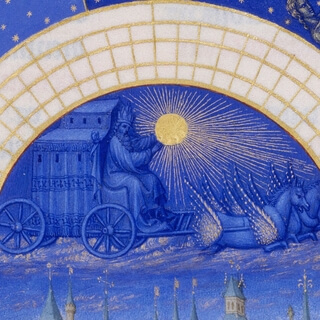
This riddle is often thought to describe the cycles of the moon and the sun.
The horned creature is the crescent moon.
The plunder it carries is the light of the sun,
Which we see as the moon grows in size,
Building for itself a bright,
Round stronghold.
The wondrous creature that comes over the wall is the sun.
As the earth turns,
The sun arrives to reclaim its light from the moon.
Vanquished,
The moon hurries away,
Without its light,
Into the west.
As you walk,
You might notice the light around you,
Has the sun appeared today,
In all its shining glory,
Banishing the night?
Or is its light more subtle today?
Is it weaker,
Paler,
Obscured by clouds?
What color is the light around you now?
Or is there dark around you?
Are you walking in dusk,
At night,
Or just before dawn?
Can you still see the moon in the sky?
If so,
Which moon do you see?
The full round fortress of the full moon?
Or the horns of the new crescent?
What do you see in the sky above you?
We'll close today with Riddle 66.
I am greater than this middle earth.
Less than a handworm.
Lighter than the moon.
Swifter than the sun.
All the seas' tides are in my embrace,
As are the green fields,
The bosom of the earth.
I am greater than this middle earth.
Less than a handworm.
Lighter than the moon.
Swifter than the sun.
All the seas' tides are in my embrace,
As are the green fields,
The bosom of the earth.
I touch the foundations.
I sink under hell.
I soar over the heavens,
The home of glory.
I reach wide over the homeland of angels.
I fill the earth with abundance.
The entire world,
And the streams of the oceans,
I fill with myself.
Say what I am called.
What is greater than this middle earth?
What is so expansive that it soars past the heavens and deep underground?
The answer to this riddle is usually thought to be creation.
Everything in the world and in the universe around us.
In this riddle,
Our planet is one small part of a larger,
Almost unimaginable whole.
And yet,
The force of creation described in this poem seems to care deeply about our little planet.
It holds the earth gently.
Both the sea and the land are cradled in its abundant embrace.
As you look at the world around you,
What abundance do you notice?
What forms of life do you see around you?
How are they embraced by the earth and by the universe that surrounds us?
How do the earth and the universe embrace you?
I am going to close the meditation now,
But if you'd like to continue,
Just press pause and restart the recording when you're ready to stop.
When you are ready to finish,
I invite you to stop walking for a moment and to look again at the world around you.
You might look to the right,
You might look to the left.
Perhaps you look up one more time into the sky and you look down to the ground.
You take a moment to close your eyes and listen to the sounds.
All around you,
You breathe in deeply,
Filling your lungs,
The fresh air of this beautiful planet flows through your body,
Filling you with life and a deep sense of connection.
With the world that surrounds you,
Then you wiggle your toes,
You wiggle your fingers,
Perhaps you roll your shoulders and bring some movement into your arms and your legs,
And when you're ready,
You open your eyes.
Thank you for meditating with me today.