Even so,
Lord Dvainabha Ananda replied,
He dressed and taking his bowl and outer robe,
He went into Kusannara with another bhikkhu.
Now at that time the Malayans of Kusannara had met together in their assembly hall for some business or other.
Dvainabha Ananda went to the assembly hall and announced to them,
Tonight,
Versetas in the last watch,
The perfect one's attainment of final nibbana will take place.
Come forth versetas lest you regret it later.
When they heard this from Dvainabha Ananda,
The Malayans with their young men and maidens and matrons were dismayed and aghast.
Overcome by grief,
Some tore their hair and wept.
Some stretched out their arms and wept.
Some fell down and rolled back and forth crying out,
So soon the blessed one will attain final nibbana.
So soon the sublime one will attain final nibbana.
So soon the I will vanish from the world.
So can you imagine if you'd actually known the Buddha?
And suppose you'd known him for a few decades?
And suppose you'd been able to listen to his teachings or suppose you'd been able to put alms food in his bowl?
And can you imagine the happiness you would experience putting alms food in Lord Buddha's bowl?
Can you imagine the serenity you'd experience as Lord Buddha spread loving kindness to his as he taught you?
Can you imagine the confidence and ease that you would feel when you saw the Sangha entering your town with the Buddha at their head?
So graceful,
So handsome,
Such clear complexion,
Perfectly mindful,
Radiating his metta.
And it's like for 45 years you could see that people would get attached to that and then you hear in a few hours we won't be able to look at the Buddha anymore.
So those who were not yet free of greed,
Those who still had attachment,
Tore their hair and wept,
Stretched out their arms and wept,
Fell down and rolled back and forth.
So this is it,
Isn't it?
One of the ways Lord Buddha describes dukkha,
Separation from the loved is suffering.
Do you think if you'd met the Buddha you would love him?
Do you think you would love the Buddha?
Do you think you would cry if you knew the Buddha and then he entered final nirvana?
But you wouldn't roll around tearing out your hair surely.
Mindful practitioners.
So all of the Malayans came and an under thought,
If I let the Malayans of Kusinara salute the blessed one singly one at a time,
The night will be over before they finish.
Suppose I get them to salute the blessed one with a single representative for each klandas.
Lord,
The Malayan named so and so with his children,
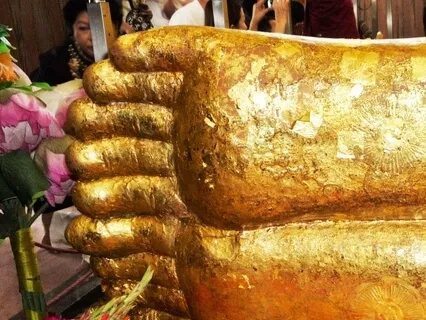
His wife and his retinue and friends salutes the blessed one with his head at the blessed one's feet.
And he did so.
And that way he got them to salute the blessed one within the first watch.
This is very beautiful.
The next part.
A wanderer called Subhada was staying in Kusinara at that time.
And he heard,
Tonight in the last watch the monk Gautama's attainment of final nirvana will take place.
And then he thought,
I have heard from senior elders,
Teachers among the wanderers,
That perfect ones appear in the world from time to time,
Accomplished and fully enlightened.
And tonight in the last watch the monk Gautama's attainment of final nirvana will take place.
And there is still doubt in me.
Yet I have confidence in the monk Gautama.
He can teach me the dharma in such a way that I can rid myself of this doubt.
So those who had faith in our Buddha called him the Buddha.
Those who were not yet followers called him the monk Gautama.
He went to the Malayan's Salatri Grove at the turn into Kusinara and he approached the Venerable Ananda and told him all that had occurred to him,
Adding,
If only I might see the monk Gautama,
Master Ananda.
The Venerable Ananda said,
Enough friend Subhada,
Do not trouble the perfect one,
The blessed one is tired.
The wanderer Subhada made the same request a second and a third time and received the same reply.
The blessed one heard their conversation and he told Venerable Ananda,
Enough Ananda,
Do not keep Subhada out,
Let him see the perfect one.
Whatever he may ask of me he will ask it only for the sake of knowledge,
Not to cause trouble.
From what I can tell him he will quickly understand.
Then Venerable Ananda told the wanderer Subhada,
Go friend Subhada,
The blessed one gives you permission.
So most of the devas from ten world systems filling all of space,
Five hundred bhikkhus,
All of the Kusinaras,
Not very long the Buddha is going to attain final nibbana but he makes time to teach one final person,
Very beautiful.
You see the compassion of Lord Buddha.
He went to the blessed one and exchanged greetings with him and with his courteous formal talk was finished he sat down at one side and then he asked the blessed one,
Gautama there are these monks and brahmanas each with his community,
His group,
Leading a group,
Each renowned and famous philosopher reckoned by many as a saint.
I mean Puranakasapa,
Makali Gosala,
Ajita Kesakambalin,
Pakuda Kachayana,
Sanjaya Belatiputta,
Anand Sikanta,
Natakuta.
So you imagine Northern India 2500 years ago a lot of spiritual practice occurring.
So all of these people are leaders of different sects.
Have they all had direct knowledge as they claim or have none of them had direct knowledge or have some of them had direct knowledge and some not?
Enough Subhada,
Whether they have all had direct knowledge as they claim or none of them have had direct knowledge or some have had and some not,
Let that be.
I shall teach you the Dhamma,
Subhada.
Listen and attend carefully to what I shall say.
Even so Lord.
Subhada in whatever Dhamma and discipline the noble eightfold path is not found.
There the first monk is not found,
The second monk is not found,
The third monk is not found and the fourth monk is not found.
I believe that means stream interists,
Once returners,
Non-returners and arahants.
In whatever Dhamma and discipline the noble eightfold path is found,
There the first monk is found,
The second monk is found,
The third monk is found and the fourth monk is found.
The noble eightfold path is found in the Dhamma and discipline,
Subhada,
And it is only here that these first,
Second and third monk is found.
Others doctrines are devoid of monks.
I think in Pali that's probably Samana in Thai,
Probably Pra,
Pra Ti Te Ching.
And if these bhikkhus live rightly,
The world will not be devoid of arahants,
Of accomplished ones.
Age 29,
Subhada,
I went forth seeking after what is wholesome and more than 50 years have now gone by.
Since then Subhada,
The time when I went forth,
Outside this dispensation never a monk is there who treads the way of Dhamma even in part.
So it's interesting to notice that Lord Buddha explains the eightfold path before he answers his question.
And once Subhada has understand the point,
Right mindfulness,
Right concentration,
Etc.
Then he basically says outside of the Buddha's dispensation there are not any true Aryans,
Stream interest,
Sakaragamis,
Anagamis or arahants.
The wonderer Subhada said,
Magnificent Lord,
Magnificent Lord,
The Dhamma has been made clear in many ways by the Blessed One.
As though he were writing the overthrown,
Revealing the hidden,
Showing the way to one who is lost,
Holding up a lamp in the darkness for those who I see visible forms.
I go to the Blessed One for refuge,
To the Dhamma and the Sangha of bhikkhus.
I should like to receive the going forth and the admission from the Blessed One.
So usually in those days this person has been practicing under other teachers.
The Buddha explains one who has already been a sectarian and wants the going forth and admission is usually put on probation for four months.
At the end of the four months if the bhikkhus are satisfied they give him the going forth and admit him to the state of a bhikkhu.
Then the Buddha says there are exceptions.
Subhada very humbly,
Lord if that is so let me be put on probation for four years.
At the end of the four years if the bhikkhus are satisfied they will give me the going forth and admit me to the state of bhikkhu.
But the Blessed One told the Venerable Ananda,
Ananda give Subhada the going forth.
Even so Lord,
The Venerable Ananda replied.
Then the wanderer Subhada said to the Venerable Ananda,
It is a gain for your friend Ananda,
It is a great gain that you have been anointed here in the Master's presence with the pupil's anointing.
The wanderer Subhada received the going forth under the Blessed One and received the admission.
Not long after his admission dwelling alone withdrawn diligent ardent and self controlled the Venerable Subhada by realization himself with direct knowledge here and now entered upon and dwelt in that supreme goal of the holy life for the sake of which clansmen rightly go forth from the house life into homelessness.
He knew directly,
Birth is exhausted,
The holy life has been lived out,
What was to be done is done,
There is no more of this to come.
And the Venerable Subhada became one of the Arahants.
He was the last of the Blessed One's disciples to testify.
Then the Blessed One addressed Venerable Ananda,
Ananda you may think the word of the teacher is a thing of the past,
Now we have no more teacher,
But you should not regard it so.
The Dhamma and discipline taught by me and laid down for you are your teacher after I am gone.
So we have the 84,
000 Dhamma verses,
Many of which Venerable Ananda had committed to memory.
And we have the five precept training,
The eight precept training and the novice training and the bhikkhu and bhikkhuni padimokas.
So Lord Buddha is saying those teachings and that code of discipline,
That's your teacher.
When I am gone you are not without a teacher.
So the Buddha is going to now give the opportunity to the monks who have come for the pair respects for the last time.
This is also very inspiring.
The Blessed One addressed the bhikkhus.
It may be that someone has a doubt or a problem concerning the Buddha,
The Dhamma or the Sangha,
The path or the way of progress.
Ask bhikkhus so that you may not regret it afterwards.
The teacher was face to face with us and we could not bring ourselves to ask in the Blessed One's presence.
And this was said,
The bhikkhus were silent,
A second and a third time the Blessed One spoke the same words and each time they were silent.
Then he addressed them thus,
Bhikkhus perhaps you do not ask because you are in awe of the teacher.
Let a friend tell it to a friend.
Isn't that beautiful?
The Buddha is calling all of those monks his friend,
Friends to friends.
You imagine he's had this blood gushing from his orifices.
He's tired and Ananda is often saying it's wonderful,
It's marvelous.
You see the wonderful and marvelous qualities of a teaching Buddha.
Someone who's put all that effort,
Millions of past lives into becoming the teaching Buddha,
Right up until the final moment he's willing to teach.
He wants to teach.
He wants people to be liberated through wisdom for a second time and a third time.
Friends,
Let it tell it to a friend.
And this was said,
They were silent and the very well Ananda said to the Blessed One,
It is wonderful Lord,
It is marvelous.
I have such confidence in the Sangha of bhikkhus that I believe there is not a bhikkhu with a doubt or a problem concerning the Buddha,
The Dharma or the Sangha or the path or the way of progress.
And the Buddha responds,
You Ananda speak out of confidence.
But the perfect one has knowledge that here in this Sangha of bhikkhus there is not one bhikkhu who has any doubt concerning the Buddha or the Dharma or the Sangha or the path or the way of progress.
The most backward of these 500 bhikkhus is a stream enterer.
No more subject to petition,
Certain of rightness and destined to enlightenment.
So every single one of the monks present was established in enlightenment at least that first level.
Then the Blessed One addressed the bhikkhus thus,
Indeed bhikkhus I declare this to you,
It is in the nature of all formations to dissolve,
Attain perfection through diligence.
And that was the perfect one's last utterance.
It is the nature of all formations to dissolve,
Attain perfection through diligence.
This is the process of the Mahaparinibbana.
It is a little long but I don't want to abbreviate it because it's like the most profound thing that can happen in the conditioned world or the unconditioned world.
So just ask you to pay attention to this really extraordinary process.
You see the spiritual adeptness of the Buddha and the incredible finesse and grace of this final act in the conditioned universe.
It's really amazing actually.
The Blessed One entered upon the first meditation,
That's the first jhana.
Emerging from that He entered upon the second meditation,
The second jhana emerging from that,
He entered upon the third meditation.
Emerging from that He entered upon the fourth meditation.
That's the four rupa jhanas.
Emerging from that,
He entered upon the base consisting of the infinity of space,
The fifth jhana emerging from that.
He entered upon the base consisting of the infinity of consciousness,
Sixth jhana Emerging from that,
He entered upon the base consisting of nothingness,
Seventh jhana.
Emerging from that,
He entered upon the base consisting of neither perception or non-perception,
Eighth jhana.
Emerging from that,
He entered upon the cessation of perception and feeling,
Which is the highest possible state of concentration.
Then the Venerable Ananda said to the Venerable Aniruddha,
Lord,
The Blessed One has attained final nibbana.
So Aniruddha was foremost in divine eye,
Equal to the Buddha in divine eye.
So Venerable Aniruddha could see exactly what the Buddha's mind was doing.
It's pretty amazing.
And Aniruddha replies,
I believe Aniruddha and Ananda were cousins.
No friend,
The Blessed One,
Has not attained final nibbana.
He has attained the cessation of perception and feeling.
Then the Blessed One,
Emerging from the cessation of perception and feeling,
Entered upon the base consisting of neither perception or non-perception,
Eighth jhana.
Emerging from that,
He entered upon the base consisting of nothingness,
Seventh jhana.
Emerging from that he entered upon the base consisting on the infinity of consciousness,
Sixth jhana.
Emerging from that,
He ended upon the base consisting of the infinity of space,
Fifth jhana.
Emerging from that,
He entered upon the fourth jhana.
Emerging from that,
The third jhana.
Emerging from that,
The second,
And back down to the first jhana.
Now,
Emerging from that,
He enters into the second jhana.
Emerging from that,
The third jhana.
Emerging from that,
The fourth jhana.
And on emerging from the fourth meditation,
The Blessed One attained final nibbana.
So he went upwards through all the eighth jhana,
And then that very,
Very fine absorption,
And then back down again to the first,
Up to the fourth,
So that's the four rupa-jhanas.
And just between the rupa-jhana and a rupa-jhana,
The Buddha's mind is released into the nibbana element.
With the Blessed One's attainment of final nibbana,
There was a great earthquake,
Fearful and hair-raising,
And the drums of heaven resounded.
When the Blessed One's attainment of final nibbana,
Saka,
Or Indra,
Ruler of the gods' utter distanza,
Formations are impermanent.
Their very nature is to rise and fall.
And there is none arises but must cease.
True bliss lies in their stilling.
It's a very profound verse.
We actually chanted that at the site of the cremation today.
Anicchowata sankara upadivaya domino,
Upajitavani rujanti,
Tesang upasamo sukho.
Formations are impermanent.
Their very nature is to rise and fall.
There is none arises but must cease.
So that is every condition is of the nature to cease.
But this is the really good bit.
True bliss lies in their stilling.
Tesang upasamo sukho.
So that's where we see that nibbana is not nihilism.
The Buddha isn't obliterated.
Putting down the conditions,
What remains is true bliss.
With the Blessed One's attainment of final nibbana,
Some bhikkhus who were not without lust stretched out their arms and wept.
They fell down,
Rolled back and forth.
So soon the Blessed One has attained final nibbana.
So soon the Sublime One has attained final nibbana.
So soon the I has vanished from the world.
But those who were free from lust,
Mindful and fully aware,
Said formations are impermanent.
How could it be that what is born,
Come to being,
Formed and bound to fall should not fall?
That is not possible.
Then the Venerable Aniruddha addressed the bhikkhus.
Enough friends do not sorrow,
Do not lament.
Has it not already been declared by the Blessed One that there is separation and parting,
Division from all that is dear and beloved?
How could it be that what is born,
Come to being,
Formed and bound to fall should not fall?
That is not possible.
Deities are protesting friends.
What sort of deities has the Venerable Aniruddha in mind,
Remembering that Aniruddha has the perfected divine eye?
There are deities,
Specific to birth in space.
They are tearing their hair and weeping,
Stretching out their arms,
Falling,
Failing down,
And rolling backwards and forth,
Crying out,
So soon the Blessed One has attained final nirvana,
Et cetera.
And then there are deities,
Specificient of earth in earth,
Who are doing the same.
But the deities,
Who are free from lust,
Mindful and fully aware,
Say formations are impermanent.
How could it be that what is born,
Come to being,
Formed and bound to fall should not fall?
That is not possible.
So many,
Many enlightened devas in the time of the Buddha.
So we don't know.
But obviously,
A significant portion of the devas that came to see the Mahaparinirvana of the Buddha were also enlightened.
And those that weren't were very sad.
And those that were understood the nature of things.
So eight leading mullions bathe their heads,
Put on new garments,
Thinking to lift up the Blessed One's body.
An interesting thing happened.
So they want to take him.
Leading mullions now want to take the Buddha's body to the place where they will cremate it.
They could not lift it.
They asked Venerable Anuruddha the reason.
You,
Vaisitas,
Have one intention,
While the devas have another.
What is the deva's intention?
Your intention,
Vaisitas,
Is this.
Let us bear the Blessed One's body southwards,
Outside the town to a place south of the town,
Paying honor,
Respect,
Reverence,
And veneration to the Blessed One's body with dances,
Songs,
Music,
Guns,
And scents.
And there,
To the south of town,
Let us burn the Blessed One's body.
The deva's intention is this.
Let us bear the Blessed One's body northwards,
To the north of the town,
Paying honor,
Respect,
Reverence,
And veneration to the Blessed One's body with dances,
Song,
Music,
Guns,
And scents.
And then entering by the North Gate,
Let us bear it through the middle of town.
After which,
Let us go out by the east gate.
And there,
Where the Malians have a shrine called the Makuta Mbandana to the east of the town,
There let us have the Blessed One's body burnt.
Lord,
Let it be as the Deities intend.
So that's what happened.
Once they tried to lift the body now,
They could.
And they went out the northern gate.
Where we had our afternoon meditation this afternoon was where they cremated the body.
At that time,
Kusannara was strewn knee deep with Mandaraba flowers,
Even to the rubbish heaps.
So that's flowers which have fallen from Dhava Timsa heaven have fallen knee deep.
So paying honor,
Respect,
Reverence,
And veneration to the Blessed One's body with both divine and human dances,
Songs,
Music,
Garlands,
And scents,
The Deities with the Malians of Kusannara bore the Blessed One's body northwards to the north of town and entered by the north gate.
They bore it through the middle to the middle of the town and going out by the east gate to where the Malians have a shrine called Makuta Mbandana to the east of town.
There they set it down.
The Malians of Kusannara said to Ananda,
How are we to treat the perfect one's remains?
The perfect one's remains should be treated as the remains of a universal monarch who turns the wheel of righteousness.
Lord Ananda,
How is that done?
So remember,
Ananda asked the Buddha the question.
The Buddha said,
Don't trouble yourself with this.
They wrapped the remains of a universal monarch who turns the wheel of righteousness in new cloths.
And they wrap it in well-beaten cloths,
Et cetera,
500 twin layers,
Place them in an iron oil vessel,
And make a pyre with all kinds of scents and burn the remains.
And then they build a monument to him,
Similar to a wheel-turning monarch.
Thereupon,
The Malians of Kusannara gave men orders to collect all the Malians' beaten cloths.
And they wrapped the blessed one's body in new cloths.
And after they wrapped it in beaten cloths,
And after that in new cloths,
Et cetera,
500 twin layers.
They put it into an iron oil vessel,
Closed it in another iron oil vessel,
And they built a pyre with all kinds of scents.
And they mounted the blessed one's remains on the pyre.
At this time,
The venerable Mahakasapa,
Mahakasapa was foremost in the ascetic practices.
He wasn't yet at the funeral site.
He was traveling on the road from Pawa to Kusannara with a large number of bhikkhus,
500 bhikkhus.
He left the road and sat down at the root of a tree.
Meanwhile,
A mendicant ascetic who had picked up a mandarava flower in Kusannara was traveling by the road.
The venerable Mahakasapa saw him coming,
And he asked him,
Do you know our teacher friend?
Yes,
Friend,
I know him.
The monk Gautama attained final nibbana seven days ago now.
That is how I got this mandarava flower.
The bhikkhus who were not free from lust were crying and rolling down,
Et cetera.
And those who were free from lust understood that formations are impermanent.
This is interesting.
There was one sitting in the assembly called Subhada,
Who had gone forth in old age.
He said to those bhikkhus,
Enough friends do not sorrow,
Do not lament.
We are well rid of the great monk.
We have been frustrated by his saying,
This is allowed to you and this is not allowed to you.
But now we shall do as we like,
And we shall not do as we do not like.
Isn't that terrible?
Venerable Mahakasapa addressed the bhikkhus thus,
Enough friends do not sorrow,
Do not lament.
Has it not already been declared by the Blessed One that there is separation,
Parting,
And division from all that is dear and beloved?
How could it be that what is born come to being,
Formed and bound to fall,
Should not fall?
That is not possible.
For leading Malians who had bathed their heads and put on new garments thought,
Let us light the Blessed One's pyre.
But they were unable to do so.
And then they asked the venerable Anuruddha for the reason.
The devas have a different intention,
Vasitas.
But Lord,
What is the deva's intention?
The deva's intention is this,
Vasitas.
There is the venerable Mahakasapa traveling on the high road from Pawa to Kusannara with a large community of bhikkhus,
With 500 bhikkhus.
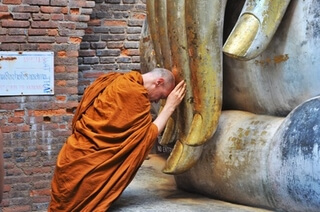
The Blessed One's pyre shall not be lit until the venerable Mahakasapa has saluted the Blessed One's feet with his head.
Then,
Lord,
Let it be as the devas intend.
The venerable Mahakasapa came to the Blessed One's pyre at the Malian's Makuta Bandana shrine at Kusannara.
When he had done so,
He arranged his robe on one shoulder,
Raising his hands,
Palms together.
He circumambulated the pyre three times to the right.
Then the Blessed One's feet were revealed.
He saluted the Blessed One's feet with his head.
The 500 bhikkhus arranged their robes on one shoulder.
And they did as the venerable Mahakasapa had done.
As soon as they had finished,
The pyre caught a light of itself.
And just as when butter or oil burns,
It produces neither cinder nor ash,
So too in the burning of the Blessed One's body,
Neither the outer skin,
Nor the inner skin,
Nor the flesh,
Nor the sinews,
Nor the oil of the joints produced any cinder or ash.
Only the bones remained.
And of the 500 twin wrappings,
Only two were burnt,
The innermost and outermost.
When the Blessed One's body was consumed,
The cascade of water poured down from the sky and extinguished the pyre.
And water welled up from underground and extinguished the pyre.
And the Malyans of Kusinara extinguished the pyre with all kinds of scented waters.
The Malyans kept the Blessed One's body in the assembly hall for seven days.
They made a lattice frame of spears set around with a rampart of bows.
They honored,
Respected,
Revered,
And venerated them with dances,
Songs,
Music,
Garlands,
And scents.
And then something interesting happened.
A little bit scary,
Actually.
King Ajatasa II of Magadha heard.
The Blessed One,
It seems,
Has attained final nirvana at Kusinara.
He sent an envoy to the Malyans of Kusinara with the demand.
The Blessed One was a warrior.
I,
Too,
Am a warrior.
I am worthy of a share of the Blessed One's bones.
I,
Too,
Will build a monument and hold a ceremony.
And the Lichavisavaisali heard likewise.
And they,
Too,
Sent an envoy with the demand.
The Blessed One was a warrior.
We,
Too,
Are warriors.
We,
Too,
Are worthy of a share of the Blessed One's bones.
And the Sakians of Kapaliwatu heard likewise.
They,
Too,
Sent an envoy.
The Blessed One was the greatest of our blood.
We,
Too,
Are worthy of a share of the Blessed One's bones.
We,
Too,
Will build a monument and hold a ceremony.
And the bullions of Ala-Paka heard likewise.
And they,
Too,
Sent an envoy.
The Blessed One was a warrior.
Two are warriors and the Coelians of Ramagama etc.
And the Brahmin of Veta Island heard likewise and he too sent an envoy with a demand the Blessed One was a warrior I am a Brahmin I too am worthy of a share of the Blessed One's bones I too will build a monument and hold a ceremony the Malyans of Parva heard likewise they sent an envoy etc.
When this had been said the Malyans assembled assembled the envoys and answered them thus the Blessed One attained final nibbana in the precincts of our town we will not give up the bones of the Blessed One thank goodness there was a Brahmin by the name of Dhona who was very wise and he addressed the assembled group with these stanzas sirs hear a word from me our awakened one preached patience so it ill becomes us now that we should come to clash over a share in that exalted personages bones sirs let us all unite in harmony and in agreement to make up eight parts that monuments be set up far and wide that many may gain trust in the seer and that's what happened eight different stupas were built in eight different kingdoms we've paid respects at two of those very very old ancient monuments one in Vaisali the other day and today at the site of the cremation was where the mullions built their stupa but isn't it telling and fascinating lord buddha taught for 45 years non-attachment non-clinging letting go not grasping fading of lust and when he dies everyone wants the relics everyone wants to hang on to a bit of the buddha so anyway that's the way unenlightened beings are and they come up with a wise compromise it's also as buddha explained lord buddha explained a wonderful source of accumulating merit when people are able to pay respect offer fragrances practice at those places giving rise to feelings of confidence conducive to auspicious even heavenly rebirth so the brahmana was the one that divided up and distributed the blessed one's bones fairly into eight equal parts and then of course the morians of pipa livana heard the blessed one it seems has attained finally vana at kusinara and they sent an envoy with demand the blessed one was a warrior we two are warriors we two are worthy of a share of the blessed one's bones we too will build a monument and hold a ceremony there is no share of the blessed one's bone left said the brahmana they have all been distributed but you may take the ashes so they took the ashes so then a japa satu king of magadha had a monument built to the blessed one's bones and he held a ceremony and all the others did likewise so there were eight monuments to the blessed one's bones and one to the vessel and one to the ashes and that is how it happened so that was the buddha's maha parinibbana flowers raining down from heaven knee deep devas filling the sky 12 leagues all of the bhikkhus present when the buddha entered maha parinibbana were all established in liberation when maha kasapa came his bhikkhus paid respects the funeral pyre instantaneously a lit and then there were the only remains were the relics which were split into eight parts and it's a water sankara but the way i don't mean no upachitvani root janti taste some upasam also call remembering the buddha's final words all conditions are transient strive on with diligence it's i can tell you something interesting about mr cunningham chinese people know hong sa pilgrim the thai people know pratham sangchan the same chinese pilgrim who wandered from china and it was mr cunningham was using the diary which had been translated into english of that pilgrim who also studied for a period of time at nalanda and then took many teachings back to china it's very important for chinese buddhism then mr cunningham was using his diary and he was able to use that diary to find the four holy sites and several of these stupas but isn't it interesting that there's a colonel in the british army that should be so interested in the four holy sites and who had the resources to have a team of people in those days about 130 years ago it's not easy to travel in these parts and then to find these places also wasn't easy tanajanan told me that he has a strong feeling that mr cunningham was the reincarnation of the chinese pilgrim that makes sense doesn't it because the pilgrimage route was completely closed for like a thousand years and then when it was time to reopen that pilgrimage route you know it would be difficult wouldn't it without mr cunningham's work and i think i suspect it's true actually i've got goosebumps thinking about it i'm feeling rapturous just thinking about this mr cunningham actually replanted the bodhi tree in that site the old bodhi tree had fallen down but there was a sapling coming up and he planted two that one and he also planted another one in case that one died under which we were doing our poojas facing the stupa so those trees i think they're 135 years old they were replanted by this mr cunningham so that's interesting is there any description of the relics i think some of them can be viewed there's uh even in that i think it's the delhi museum some of the original relics and i think also in patna museum there are some relics from there what you see physically might not be that impressive i think if they're buddha relics they're quite clear where arahant relics tend to be a bit milky can be perfectly clear but if you have the divine eye you see something else so a buddha has what they call panarasi seven colors in his aura so an arahant's relics will not have all seven colors but the buddha's relics will so if you practice very diligently and get your divine eye open you'll be able to see the seven colors in the buddha's relics and also the bodhi tree apparently the bodhi tree the tree that's planted in that side has i i gave a gift because i've spent quite a bit of time meditating under that tree and i know some of the monks who live for periods of time in bogaya over the years i've been given you know branches fall down in the wet season and then those monks very quickly grab them and have small buddhas made out of them i actually have a small buddha amulet made out of bodhi tree wood but i've had a few of them over the years and i had the very good fortune to give one to his holiness the dalai lama and i gave another one to his holiness the kamapa and i gave another one to these were not all given to me there's another woman committee member of anandakiri by the name of malin she has been supporting some of the monks who live in bogaya so she had five of these buddhas made of bodhi tree wood which she gave to me to give away and she gave me a small amulet to give away and so one was the dalai lama one was the kamapa one tanajana nun and then one of ajana nun's disciples i better not mention his name but he's famous for his samadhi and i gave him this piece of bodhi tree buddha and he said that's from the bodhi tree in india isn't it i said how do you know and he said i can see the seven colors so it is a special tree and i sometimes tell you an interesting story last time ajahn pavro and i were meditating and i'd set the bow to meditate i think it wasn't last time it was the time before last time set it out to meditate 300 hours uh 10 hours a day nine or 10 hours a day on that occasion for a period of time and i had confidence i'd given away all of these little buddhas and i had confidence that if you give them away you'll get another one says a little bit of greed and i'm meditating nine hours 10 hours nine hours 10 hours nine hours 10 hours for more more than a month and i still hadn't got one of these little buddhas and i was thinking hmm i was gonna give one to the dalai lama and one to the kamapa and anyway so it's the last day at lunch one thai man who'd been staying at the thai temple came he says i've been trying to talk to you but you're always meditating i never get a chance to talk to you but i found out where you're staying so he came to lunch and he said i've got something for you and he gave me a little buddha cup from bodhi tree wood at lunch on the last day and then i tell you something even more interesting when i was at the airport sitting next to another monk he asked what i'd been doing and i asked what he'd been doing and he pulled out of his yam a little packet of buddhas made of bodhi tree wood and so i got two in one day but it was the last day so i had to fulfill i had to work hard i had to fulfill my vow of 300 hours before i got those two little buddhas of which i gave one away and i kept one anyway we use these things to recollect the perfection of the buddha the qualities of the buddha and strive on with diligence