Welcome to the Mindfulness Meditation podcast.
I'm your host,
Dawn Eshelman.
Every Wednesday at the Rubin Museum of Art in Chelsea,
We present a meditation session led by a prominent meditation teacher from the New York area.
This podcast is a recording of our weekly practice.
If you would like to join us in person,
Please visit our website at rubinmuseum.
Org slash meditation.
We are proud to be partnering with Sharon Salzberg and teachers from the Interdependence Project.
The series is supported in part by the Hemera Foundation.
In the description for each episode,
You will find information about the theme for that week's session,
Including an image of a related artwork chosen from the Rubin Museum's permanent collection.
And now,
Please enjoy your practice.
Good afternoon.
Tashi delek.
That's what Tibetans say when we are greeting Tashi delek.
So if you remember that,
Then you can say you remember my name,
Or you can say you speak a Tibetan word because Tashi means auspicious or good luck.
So after today,
If you remember that,
You can say you speak a Tibetan word.
So welcome,
Very warm welcome to all of you here to the mindfulness meditation.
So this week's theme is refuge.
Yeah?
Okay.
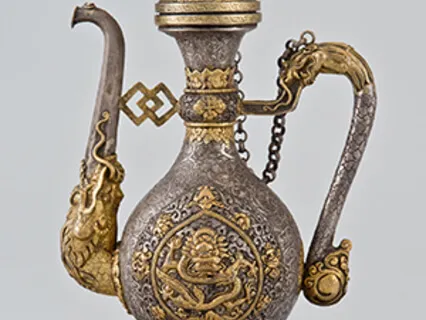
And the art connection we have here is this beautiful ewer,
E-W-E-R.
How do you pronounce that?
Ewer.
Right?
But in Tibetan,
It's called chama boom.
Right?
Chama boom.
Boom is actually a short form of pumba,
Which you would find in the shrine room.
Even pumbas are the vase with a feather on top,
Although you don't see feather here.
So this one is chama boom,
Which is often used in the shrine room ritual object for serving tea,
Not to people,
Not to human,
But on the shrine to the deities.
So what you see here is a 19th century beautiful chama boom with gold and silver inlay.
And so this is used in the shrine room.
You will see that in the shrine room if you have time to explore after the session.
And refuge and ritual,
You know,
Someone asked me earlier,
What is the symbolic of ritual,
You know,
Where there's offerings of flowers and candles and tea?
And sometimes for fierce wrathful deities in the Vajrayana Buddhism,
You also find hard liquors,
You know,
Not like something that's like how we see it as liquor,
But it's part of an offering for the wrathful deities.
And all this ritual is,
As a practitioner,
I would say the benefit of that is like nurturing.
You know,
If you want a good plant,
Like let's say mango tree,
You have to have right elements,
Enough water,
Enough sun,
Soil,
All of that,
Right?
And then you have to put enough water for the plant to grow well.
So the ritual offerings,
Candles and all these offerings,
Offerings of tea on the shrine,
Is all nurturing,
Kind of dedicating,
You know,
And reaching that goal.
And the goal is to reach enlightenment.
Right?
So it's beautiful to have this refuge here that we can all come to on a middle of the week,
Middle of the day.
And so for this week,
Our teacher here is Kate Johnson,
Welcome back to Kate.
And Kate teaches mindful yoga in New York public schools and Buddhist meditation at Interdependence Project,
Holds a BFA in dance from the Alvin Ali School,
Fordham University,
And a master's in performance studies from NYU.
She has trained at Spirit Rock Meditation Center,
The Interdependence Project,
Laughing Lotus Yoga,
And the Presenting Institute.
She's working on a book about waking up to power and oppression as a spiritual practice,
Parallax Press in spring 2018.
So please help me welcome Kate back.
Thank you.
Thank you.
Good afternoon,
Everybody.
Hello.
Yeah,
It's lovely to be here and thank you for taking the time in the middle of your day to come in and practice and as Tashi said,
You know,
To make a refuge together in an auditorium in the middle of Manhattan,
Where we can be with our minds and hearts.
I've seen a little of this,
So I'll try to raise my voice and please feel free to do this again or like this or something if you need me to speak up.
Now,
Especially when things feel tender,
My voice tends to drop.
So today,
Under this theme of finding refuge,
We have this to inspire our practice,
This beautiful sacred ritual vessel that we just heard about.
And it reminded me of,
It's used to hold water and sometimes other objects or liquids from what I hear.
And I,
As I was thinking about what to prepare for today,
Was reminded of meditation on the different elements that is often taught in the meditation tradition that I teach in.
And so the elements that are shared,
The earth element,
Which is represented by things that are solid and stable and hard,
Water element,
Which we'll come back to in a minute,
The fire element,
Which is heat emitting and also kind of energetic and upward rising,
The air element,
Which is often in the body represented by the felt sense of the breath.
And then sometimes people also use space,
You know,
Both inside the body in the big space.
And I was thinking about what kind of practice might be appropriate for supporting our minds and hearts in what could be considered fearful times.
I don't know how each and every one of you are doing,
But certainly a lot of the students that I'm working with now are expressing fear and anxiety for a number of reasons,
Some of them personal,
Many of them social and political.
And sometimes that spike of fear can alert us to something that we need to pay attention to.
But if it overwhelms,
It becomes really hard to respond in a way that actually makes us feel effective.
And so I was thinking about this water element,
Which is really just any kind of liquid quality as a helpful place to place our attention to find a sense of refuge in that which moves.
So when there's fear,
What I notice with students is that they can in terms if you look at the responses in terms of elements,
Many people go to Earth element,
They get kind of stuck and they bear down and they're like gonna stick in the mud response to fear.
Some of you might identify with that.
Some people tend to go airy.
So things get very spacey,
Very kind of heady,
There can be a lot of anxiety,
Right?
This is the two in excess of air element.
Earth element tends to be more like depression and kind of sluggishness.
And then fire element,
When there's too much fire element in response to fear,
It's like an anger that is eating us from the inside,
Right?
And so what I've been thinking about at this time is like,
What would it be like to be like water in moments like these?
Water that is able to adapt to the circumstances can be solid,
Can be liquid,
Can be gas,
Can take the shape of any vessel that it is poured into.
And that has a tremendous power but a gentle power.
We certainly see the power of a raging river or a waterfall.
It's obvious,
Right?
What water like that can do.
Some of the storms that we've been experiencing.
But you can even see how drips of water over a rock over time wear away the rock.
It's a steady,
Continuous drip that doesn't get tired,
Right?
It just kind of keeps moving.
And so I thought that might be helpful for us today.
And so I'll just go over a little bit kind of an outline of what we'll do to practice first and then I'll guide it so you can just get a sense of where we're going and you don't have to like be stressed that we're gonna like do something weird like that,
You know.
So you all know I'm sure but I'll just review the practice of mindfulness that often we do here is to pay attention to a physical sensation as a way to kind of gather and unify the attention.
So often people use the feeling of breath or the feeling of,
You know,
The feet on the ground or the seat in the cushion.
Having a physical sensation that is soothing in some way.
And so,
You know,
That's what we'll do.
I'll ask you to notice either the breath.
Some people,
The breath feels agitating so you can use the feet or the hands.
And just allow the mind to rest on that physical sensation for the first,
You know,
Few minutes of the practice as a way to start to settle the mind.
It's like an invitation,
You know,
For those of us who've been running around all day,
You know,
That our minds over here,
Our hearts over here,
Our bodies here.
And it's just by paying attention for a few minutes you can start to notice,
Oh,
The mind starts to gather here,
Oh,
The heart starts to gather here.
And we start to experience this sense of being all collected in one place at one time.
You know,
That's one of my favorite definitions for mind,
The state of mindfulness,
Right?
Unified.
And then,
You know,
So we'll do that for a while with a familiar object.
And then I'll ask you to shift your awareness to noticing water element.
And I'll guide you through a little bit of a guided experience to notice a water element inside the body and outside the body.
And that part is,
You know,
Both a felt experience and like a little bit conceptual.
And so for some people it can feel like,
I don't know,
Too,
Like,
Busy or something.
So if it starts to feel like that to you,
Feel free to just drop it and come back to feeling the breath or feeling the body sensation.
But if it helps,
You know,
It's supportive for cultivating this sense of noticing what's fluid and the qualities that that noticing helps us to access,
Both in meditation and daily life,
Then,
You know,
Feel free to continue with that.
Does that seem kind of clear?
We can do that?
Okay.
So we'll meditate and then we'll have some time,
As always,
To ask questions or comments after the practice.
So just go ahead and find your comfortable meditation seat if you'd like to adjust,
If you'd like to take a little movement of the neck.
For practice it's fine to either,
You know,
Close your eyes or open them and keep them softly focused in front of you.
Both are good.
And just,
You know,
Picking one that feels supportive now and sticking with that for the rest of the practice.
And feet contacting the floor if they can.
Just either resting on the thighs or clasp in the lap.
Letting the body come into its full length,
Physically but also just energetically so that we really feel that the bottom of the body is connected to the earth and the top of the head is reaching for the sky.
So we have all the dignity of our humanness right here.
Getting also into the full width of the body so that we know that there's a left side and a right side to the body and that there's a lot of space in between and we can actually feel,
We can take up the full width of the body.
And this width connects us to our neighbors here in this room but also the people that we walk and work shoulder to shoulder with in this life.
None of us are alone here.
Feeling into the full depth of the body.
From the front surface of the body to the back of the body and the back to the front.
This body has depth.
Feeling into the full depth of the body.
For some people,
The back of the body is a place we can connect with our ancestors,
The people that came before us and then the front of the body connecting with our descendants,
The people who will inherit this earth from us.
So we feel that we're connected in that way.
And then in the middle of all this,
Just noticing the breath.
And then doing it all along.
If the breath feels difficult or unpleasant to access,
Find to also use the feeling of the feet or the hands.
But for now,
Just picking one and allowing the mind to really notice what it feels like moment to moment to moment.
The changing sensations of this aspect of your physical experience.
The relatives that grow,
Who were family andGENALYS and S Heal,
Must Dist IPv1 network with AMI stream live.
I can constantly use the Has dam to will delivery in this way.
And if ever you notice the mind wandering around,
Kind of wandering around on autopilot,
Just gathering it back to the sensation you chose,
The breath,
The feet,
The hands,
And inviting it to rest.
The resting is actually good for the mind.
Perfect for that.
Gathering and unifying the attention and inviting it to rest.
And the feeling of the breath,
The feet,
And the hands.
Discovering what sensations can be known in this place now.
And the feeling of the breath.
And now having taken some time to just gather and settle,
The mind and heart to some extent,
Will transition into a contemplation of the water element.
And so you don't have to do anything different with your body.
Just bring to mind a few places where we notice water.
So we can think of the water that's running through the pipes in this building.
Below our feet and at our sides,
Pipes that move water to make steam to heat.
The water that comes through the faucet when we go to wash our hands.
The bodies of water on this landmass.
Reservoirs.
Ponds.
Reflecting that at this moment we're on a landmass that's surrounded by water.
And that these rivers flow out into ocean.
That stretch into this vast,
Vast blue covers most of the earth.
So just letting the mind now rest on the element of water that exists outside the body.
In this building,
In this neighborhood,
Around this island,
Around the earth.
Noticing what it feels like to reflect on this vast bodies of water.
And as these images of water come and the felt experience of contemplating and perhaps being by water come,
And just note to yourself,
Earth,
Water element,
Water element.
This is water.
Moving,
Changing,
Shaping.
Water.
Water.
Water.
Water.
And now contemplating that that same water element that exists outside the body exists also inside the body.
And so from the great waterways,
Creeks,
Waterfalls,
Oceans,
Rivers,
Reservoirs.
Inside the body we have the rivers and creeks of our veins and arteries.
The fluid that circulates and bathes all our organs.
The saliva,
Tears.
Water element,
Water element.
So letting the mind rest for a few minutes now on the water element inside the body.
Not different than the water element outside the body.
And seeing if you can connect with a felt sense of that which is fluid in the body now,
That which is moving.
And noticing how it is to gather and unify the mind around the fluidity inside the body.
And so starting to soften now your awareness so you're not so closely focusing on anything,
But just noticing what it feels like to be sitting here in this moment.
Your spot on the earth right now,
Breathing.
And then I'll close the practice with a sound of the bell and when I do you can feel free to make a gesture to honor your practice if you'd like,
Or just stretch and open your eyes.
May it be so.
And if I don't see you before,
Many blessings on your new year.
Thank you.
That concludes this week's practice.
If you'd like to attend in person,
Please check out our website rubinmuseum.
Org slash meditation to learn more sessions are free to Reuben museum members,
Just one of the many benefits of membership.
Thank you for listening.
Have a mindful day.