Welcome to the mindfulness meditation podcast presented by the Rubin Museum of Art.
We are a museum in Chelsea,
New York that connects visitors to the art and ideas of the Himalayas and serves as a space for reflection and transformation.
I'm your host,
Dawn Eshelman.
Every Monday we present a meditation session inspired by a different artwork from the Rubens Collection and led by a prominent meditation teacher from the New York area.
This podcast is a recording of our weekly practice.
In the description for each episode,
You will find information about the theme for that week's session,
Including an image of the related artwork.
Our mindfulness meditation podcast is presented in partnership with Sharon Salzberg and teachers from the New York Insight Meditation Center,
The Interdependence Project,
And Parabola Magazine.
If you'd like to join us in person,
Please visit our website at rubenmuseum.
Org slash meditation.
And now,
Please enjoy your practice.
Welcome everyone.
Welcome to the Rubin Museum of Art.
My name is Dawn Eshelman.
Great to see you all here.
Anybody here for the first time?
Welcome.
Great.
Oh,
Good.
A few of you.
Who comes every week if they can?
Are you raising your hand for your friend?
Okay.
It's okay.
It's all right.
Abstainers,
We love you.
It's okay.
And in between.
In between first timers and every week.
Okay,
Great.
Great to have you all here.
And thanks for joining us for our weekly meditation practice.
We are focusing this month on happiness because,
You know,
It's the middle of January.
It's just can be helpful,
Right?
And as I mentioned last week or two weeks ago and the week before that,
We're also entering this new realm here at the Rubin.
We are having this year-long conversation all about impermanence,
Which is an incredible,
Multifaceted,
Often misunderstood topic.
And happiness is actually kind of right at the center of it.
True happiness,
Real happiness,
Which is the subject of Sharon Salzberg's new edition.
This classic of hers has been republished 10 years after the original.
And so we're delighted to have her back.
If you missed your chance to get a signed copy of her book,
You're in luck because today Sharon is here to kindly sign or personalize some of the books that we have in the shop.
Already some signed,
Just so you know.
And Sharon will be happy to personalize those for you.
And I know some of you brought your old tattered copies as well.
So that's great.
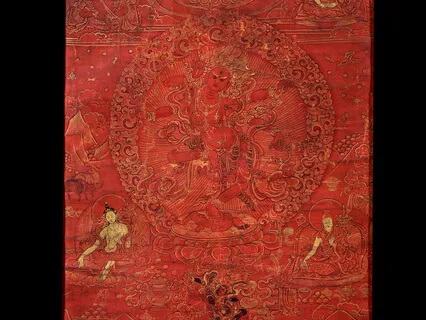
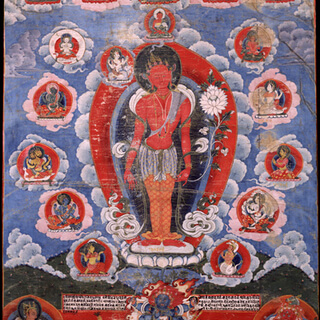
And we're looking at a really interesting figure today.
This is Kurukula,
The goddess of power.
And this is a tanka from central Tibet,
19th century.
And this is a pretty fierce being here.
I hope you got a look at some of the detail.
And this is a really great one to go up to the galleries to visit afterwards.
Tasha will be outside to take you up if you'd like to go.
This is created by painting the entire tanka in a kind of vermilion and then creating the detail with black and gold lines.
And so the figure kind of seems to emerge here.
And we see that this is a wrathful figure with several arms.
And you can see the fierce kind of look in her eye.
And she is,
As many of these wrathfuls like to do,
Dancing on top of a corpse,
Which represents the ego.
So she's dancing on top of that,
Dancing on top of the ego.
And this may be a key to true happiness.
I don't know.
We'll see.
But she also is centered in this ring of fire,
And this red color links her not only to this idea of power,
But also to Amitabha Buddha.
So she is a related emanation of Amitabha Buddha.
And she is actually known,
Despite this fierceness,
For being this creature of great love and even tenderness,
And has a great magnetism,
And is able to create,
Even despite a lot of obstacles that may be in her path here,
Which we can kind of see,
Great,
Deep,
True happiness.
So we'll hear more about this idea of happiness,
Which is maybe not as simple as it sounds,
From our wonderful teacher,
Sharon Salzberg,
Who's back here with us before she flies off to California.
And Sharon is,
Of course,
The co-founder of the Insight Meditation Society in Barre,
Massachusetts,
And the author of so many great books,
Including this one that's just been re-released,
Real Love.
Please welcome her back,
Sharon Salzberg.
I don't know if it's,
I guess it's good afternoon,
Not good morning.
So I have a really bad cold,
But I actually feel a lot better than I sound.
So that is my talk on happiness.
There you go.
So I was struck listening to Don about the word ego,
And somehow vanquishing or undoing or stepping on the ego.
And what could that mean?
Because actually,
Within the Buddhist tradition,
A sense of confidence and even pride is considered a good thing,
Not pride in the sense of being conceited,
But taking delight,
Taking delight in some of the choices we make or having a sense of integrity or self-respect is a really good thing.
And it's not considered onward leading to just be down on ourselves and to feel incapable and held back and torn apart.
Isn't that interesting?
Because we tend to associate that kind of joy or delight in some of our actions with being conceited.
And we think,
Oh,
That's not good.
That's not spiritual.
But I think it's very interesting to explore what's actually the consequence of having that sense of fullness and that sense of self-respect,
Because it's actually considered important.
There are all these practices in the Buddhist tradition that I guess you could call them preliminary practices.
It's odd because these things that are like foundational exercises actually are expressions of a liberated mind or a purified mind.
And so the path isn't so linear.
It's more like going round and round and round and round.
We start from certain actions and living in a certain way.
And they allow us to concentrate more fully,
Which allows us to have insight,
Which allows us to live in a different way.
And then we go round and round and round.
My friend Sylvia Borstein once called the Eightfold Path,
Which is kind of the foundation of moving to a liberated life in the Buddhist tradition.
She called it the Eightfold Dot for exactly that reason.
And oddly enough,
The common theme throughout that dot is happiness.
It's one's own happiness in that sense of fullness and self-respect and confidence and an ability to look at our own integrity and not just fall into a pit of guilt and paranoia and what have I done and what if anyone finds out and so on.
So it's kind of a trick question that's asked sometimes in the tradition when they say,
Well,
What would be a springboard to concentration?
So concentration is the gathering of our attention,
Getting more centered,
Getting more stable,
Not being so scattered,
Distracted,
All over the place,
Flying obsessively into the past or into the future,
But really bringing that attention together.
And so I've been asked that question,
For example,
By teachers.
And I've tried to be like a good girl.
I've said things like effort,
Exertion.
And the answer is actually happiness.
But it's not happiness in the ordinary conventional sense of the word,
Which would be getting exactly what we want or having only pleasant,
Lovely,
Desirable experience.
It means something else.
It means that sense of wholeness,
That lack of guilt,
That ability to explore and even go into some kind of painful or risky terrain but not feel so afraid because we have some sense of inner resource.
It's happiness.
And that's why in so many schools of the Buddhist tradition,
They talk about beginning with practices like generosity.
As the Buddha said,
Everybody has something to give,
Even if it's just like smiling at somebody or thanking somebody or a little bit of material offering,
Whatever it is.
It's not the amount that's the quality of the action.
It's the heart space.
Everybody has something to give.
And in the act of giving,
We can experience this.
It's almost like a return to a place inside ourselves that feels like we have enough.
Because if we feel deficient and we feel our gift is so measly or something like that,
We don't actually make the offering.
So in making the offering,
It returns us to this place of feeling more in touch with that wholeness.
And it's definitely the reason why there can be a lot of emphasis on morality or ethics because it feels better.
We're happier.
It's not a question,
Although it can seem that way,
About being prim and proper and self-righteous.
It's not that at all.
It's like,
Give yourself a break.
It's just so much harder,
Say,
To tell lies at work all week long and sit down on Saturday seeking the truth.
It's just very difficult because it turns out we go back there,
Even though we don't want to.
These thoughts come up.
The anxiety comes up.
The feeling of uncertainty.
What if they find out?
Or maybe I better lie some more.
Oh,
I really hurt that person.
It's just complicating everything.
It's not to say that you have to have lived or be living a perfect life in order to be able to concentrate.
But it's easier not to go into a session where you're really looking deeply within,
Only to confront the fact that you cheated and you're worried about the ramifications.
So it's really like,
Give yourself a break.
Be happier.
That will be a great platform for then making the effort to bring all this disparate energy together to have a sense of wholeness,
Which will be a great platform to be able to look at whatever happens in our experience,
Pleasant or unpleasant or neutral,
In a different way.
So even though it's an unusual meaning of happiness,
We can also think about how we meet all kinds of experience as a source of happiness.
Do we always get what we want?
No.
I don't want to have a cold.
There's no doubt about that.
I'm flying on Wednesday.
This is like a bad moment in time.
But life,
Of course,
Is like that.
I'm intrigued,
And I talk more and more about how we meet different experience,
Even pleasant and wonderful and delightful experience,
And how often we're so distracted we don't even take it in.
Or evolutionary biologists would say we have a negativity bias.
We tend to look toward threat or danger or what can be undermining or what's kind of wrong in a situation,
Much more than we would tend,
Through conditioning,
To look at what's right.
And so it takes some intentionality to say,
OK,
What went well today?
Or can I actually take delight in the fact that I have a choice,
That I can bring my energy?
And I can come here.
I can use my life energy in a certain direction.
Can we actually enjoy that?
Sometimes we are so distracted we don't take it in.
Sometimes whatever is going on just doesn't meet our unreasonable standard of what should be happening.
Sometimes we feel guilty about experiencing joy,
And so we kind of shun it or move it aside in some way.
And certainly we can and usually do have a very,
Very distorted relationship to pain,
To suffering,
Where we add,
If it's our own,
We add a sense of shame or guilt.
I blew it.
Life should only be delightful all the time.
And it must be wrong as a wrongness to having a difficult feeling or even difficult situations.
So I said that I want this on my epitaph,
Which is a joke,
But I also want someone to make a mug out of it,
Which is not so much of a joke.
It's saying some things just hurt.
It's like you're not going to talk yourself out of it,
And it's not because you're relating badly to it,
And it's not because you're resisting.
Some things just hurt.
There are painful things that happen in life internally and externally.
The question is how do we meet them?
And what we don't want is what I would call extra suffering.
Where can we have a certain perspective on things that's genuine?
It's not false,
But it's different.
And where can we remember the possibility of compassion for ourselves and for others?
Where can we have a sense of community instead of a sense of isolation even in a difficult situation?
And so there are many opportunities to relate in such a way that we have almost a kind of happiness even though things are really rough.
And a very intriguing thing to look at is how are we with neutral experience or something that's just kind of ordinary,
Repetitious,
Or routine.
It's not strikingly pleasant or strikingly unpleasant where we tend to numb out,
We go to sleep,
We wait for intensity in order to feel alive.
And it's interesting sometimes just to really pay attention.
I mean,
I've had teachers say to me things like,
Try to be mindful every time your hands are in water.
And it's so interesting because those experiences just pop.
And there's nuance and there's subtlety.
And there's actually a kind of pleasure in the ordinary.
And that is really the definition of mindfulness.
It's relating to what's pleasant,
What's unpleasant,
And what's neutral in a different way.
Because that we can affect.
You can't insist on only pleasure.
Too bad,
You know?
And we can't ward off pain,
All pain,
Because something's just hurt.
But we can really relate differently.
So that is our practice.
So let's sit together.
You can sit comfortably,
Close your eyes or not,
However you feel most at ease.
See if you can find the place where your breath is strongest for you or clearest for you.
Bring your attention there.
The nostrils,
The chest or the abdomen.
And just rest.
See if you can find just one breath.
And then the next.
The next.
If images or sounds or sensations or emotions should arise,
But they're not very strong,
If you can stay connected to the feeling of the breath,
Just let them flow on by.
You're breathing.
It's just one breath.
But if something arises,
Like with a bang,
It really pulls you away.
See if you can spend a few moments just recognizing,
Oh,
This is what's happening right now.
There's joy.
There's sorrow.
There's thinking.
There's this sensation.
Whatever it is,
It's recognizing,
Then seeing if you can let go and bring your attention back to the feeling of the breath.
And for all those,
Perhaps many times,
You are just gone,
Lost in thought,
Spun out in a fantasy,
Or you fall asleep.
It's okay.
Use the moment when you recognize that as the moment of letting go gently and just returning your attention to the feeling of the breath.
Right now,
Are we deep and calm?
Take a little rest.
Okay!
.
.
.
.
.
.
.
.
.
.
.
.
.
.
.
.
.
.
.
.
.
.