Welcome to the Mindfulness Meditation Podcast.
I'm your host,
Dawn Eshelman.
Every Wednesday at the Rubin Museum of Art in Chelsea,
We present a meditation session led by a prominent meditation teacher from the New York area.
This podcast is a recording of our weekly practice.
If you would like to join us in person,
Please visit our website at rubinmuseum.
Org slash meditation.
We are proud to be partnering with Sharon Salzberg,
The teachers from the New York Insight Meditation Center,
The Interdependence Project,
And the Shambhala Center.
In the description for each episode,
You will find information about the theme for that week's session,
Including an image of a related artwork chosen from the Rubin Museum's permanent collection.
And now,
Please enjoy your practice.
Hi,
Everybody.
Happy Thanksgiving.
It's great to see so many of you here today.
So welcome to the Rubin Museum.
My name is Dawn Eshelman,
And thank you so much for joining us for our weekly mindfulness meditation practice.
We have been talking this month about the theme of impermanence,
Which is a really central concept in Tibetan Buddhism.
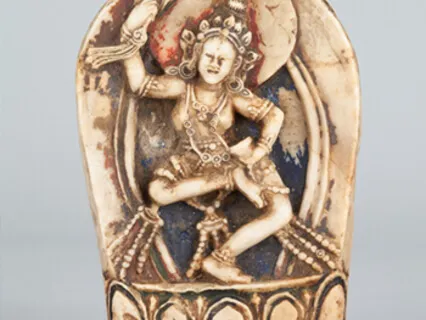
And we're looking today at this gorgeous kind of carving.
This is carved out of stone in the 16th,
17th century.
This is Machik Labdrön.
And you can see that she is one of the kind of most famous figures in Tibetan Buddhist practice.
She's standing here in a rather dynamic pose.
Looks like she's kind of partying it up.
She has in one hand,
In her right hand over her head there,
A damaru,
Which is a two-sided drum.
And it has a couple of balls dangling from it.
And it's played by twisting it around.
And so a very kind of rapid drumbeat with that.
And then in her left hand,
A bell.
And these are both instruments that you can see upstairs on the sixth floor in our exhibition,
The World is Sound,
Which is in itself all about impermanence.
So sound is a metaphor for impermanence.
And it's also these instruments are ritual objects and used in what is called the chöd ceremony,
Which Machik Labdrön is linked to.
The chöd ceremony is pretty intense.
And in it,
Practitioners visualize their bodies being chopped up and offered to gods and demons.
This is an exercise in impermanence,
In letting go.
And there's got to be a joke in here somewhere about carving up a Thanksgiving turkey.
I will leave it to you on Thanksgiving Day.
You can mull that over.
But the practice is really this cutting through of attachments.
And it is a practice.
It is something that is repeated over and over to really ingrain this concept of letting go and impermanence as something that is very important and central to this practice.
So Sharon Salzberg is here today.
Our wonderful teacher is back.
And she'll be here next week as well.
Yeah.
So we'll hear a little bit more from her on this concept of impermanence.
Sharon is the co-founder of the Insight Meditation Society in Barre,
Massachusetts.
She is a renowned teacher and practitioner.
And she's the author of really great books,
Great gifts,
Guys.
The most recent one,
Of course,
Is love and real love.
Please welcome Sharon Salzberg.
Hello.
So I craned my neck to see how many of you were here for the first time.
And I also had a brief conversation with somebody who tells me she's here every week.
How many of you come every week when you come?
Wow.
That's a lot of people.
It's so great.
Especially thinking back to those first conversations,
Like,
You think we should do this?
It's like so cool.
It's great.
So yes,
Happy Thanksgiving and dawn.
Thanks for that image.
Now I'm going to watch someone carve the turkey tomorrow.
That could be your body,
You know.
Not a bad reflection in a lot of ways.
So I'll talk some about impermanence.
I guess I have to talk about gratitude because you have to,
Right?
If you're going to make some meaning out of this holiday.
I was asked by,
I guess it was the Huffington Post,
That I was doing an article on how to find more meaning in Thanksgiving.
And one of my suggestions was,
Look up the history.
It's complicated.
Think of it from various points of view,
Which is always an interesting thing to do.
So Machig Lobdram as a bodhisattva,
As a figure,
An archetype,
Is most highly associated in Tibetan practice with this practice called chod,
C-H-O-D.
And it's feeding the demons.
The underlying meaning of it is,
It's like a practice in cultivating more fearlessness.
Like looking directly at the things we are afraid of that kind of haunt us.
And having a certain sense of hospitality.
It's almost like those of you who were,
Yeah,
It's funny.
Those of you who were here when I talked about a practice that we often do.
If you have a persistent negative voice,
Like an inner critic,
I said give it a name,
Give it a wardrobe.
And I said I named my inner critic Lucy after the character in the Peanuts comic strip.
Sorry any Lucys are in the room.
So one of the things we sort of say almost as an extreme oversimplification of this practice is invite Lucy to dinner.
It's like your awareness is actually stronger than this thing you're afraid of.
You have the capacity as a human being to hang in there with this thing you have avoided forever.
That is the one thing you think I cannot face that,
And actually you can.
So invite Lucy to dinner.
Don't give her the run of the house.
That's not the point,
You know,
Is to have this force,
This pretty negative force take over.
But you also don't have to be so ashamed and so afraid and so freaked out that Lucy has appeared.
So I said in that class that I had said that,
Invite Lucy to dinner,
And somebody in the room objected to it.
And so I said how about a cup of tea?
And they said how about a cup of tea to go?
So that's an extreme distortion of chirp practice.
It's like eh,
Maybe a fingernail,
Like nothing really valuable.
It's a practice of fearlessness.
It's a practice of generosity,
Right?
We're offering.
We're giving.
We're giving over our presence,
Our bodies.
And yet it's not one of self-abnegation or self-denial.
That's what's so weird about it.
When we practice generosity,
We touch upon a space within us that is abundant,
That can afford to give,
That isn't going to be lessened or harmed in some way by the offering.
And that may be very fleeting,
But that is actually there.
That's why generosity itself is like a practice,
Because it reunites us with this place where we're enough.
And so does the idea of chid.
It's seeing,
Oh,
I can hang in there with this really difficult space,
This demon.
And one thing I think most of us would say about our personal or familial conditioning,
And I would assert about the kind of collective conditioning in society,
Is that we're taught to avoid these things that are so troublesome.
That's why they're so frightening.
Even a simple thing,
Not like a massively traumatic thing,
But even a thing like boredom,
Sometimes I think the whole society is designed so that we shouldn't feel bored from the moment we're born to the moment we die.
And if you start to feel bored,
That's the signal.
You've got to do something,
Like buy something,
Consume something immediately.
Or loneliness,
Or so many of the things that we would tend to avoid,
And then very personal things as well,
Whatever they might be.
So here we are saying,
Come in.
Even if it's Thanksgiving leftovers,
Whatever you're offering,
Come in,
Have a meal.
I can be with you.
My awareness,
My capacity to love,
My capacity for compassion is actually stronger than any demon,
Any aspect of our experience that may come up,
Because they're all impermanent.
There's this very beautiful quotation from the Buddha in which he said,
The mind,
My mind,
Your mind,
Is naturally radiant and pure.
The mind is shining.
It's because of visiting forces that we suffer.
Now,
This is a really amazing statement for a couple of things.
One is these forces are just visiting.
Lucy,
The demons,
They're just visiting.
They may visit a lot,
But they're still just visiting.
It's not who actually lives here.
It's not our deepest truth of who we are.
They're visiting.
And he also said,
Take note,
It's because of visiting forces like greed,
Jealousy,
Anger.
It's because of visiting forces we suffer.
He didn't say it's because of visiting forces that were terrible people,
Evil people.
He said it's because of visiting forces we suffer.
So that's an important consideration.
I just love the image.
I love the saying,
Because right away I could imagine myself sitting happily at home,
Minding my own business,
And here,
Knock at the door.
It's kind of like Halloween,
Right?
And you open the door,
And there's some force you really don't want to see.
Greed,
Your own fear,
Your own jealousy.
And it's so tempting to fling open the door and say,
Welcome home,
Forgetting who actually lives here.
It's also tempting to try to shut the door and pretend you never heard the knock,
Which is sort of an interesting tactic,
But unfortunately,
It doesn't work.
We desperately shut the door only to find that very force comes in somewhere.
One of the greatest tools we have is remembering it's a visitor.
This is coming,
This is going,
Because we dive right in usually.
I'm such an angry person,
I will be forever.
This is the only thing I'll ever feel.
This is what I was feeling all along.
Nothing else was real.
So we solidify,
We reify,
We make substantial that which is always,
Always changing.
And then we have a distorted relationship to reality.
Then we're sunk.
And just to remember,
This is a changing state,
Is a tremendous asset in being able to open that door and be there in a different way.
We want presence,
We want balance,
We want peace,
We want calm,
We want love,
We want kindness,
We want compassion,
And we can have all of those because that's the cultivation.
In a way,
They're all facets or aspects of being mindful.
That's what we're actually practicing when you sit and it's usually,
I mean,
It's never really just the breath,
Right?
The famous list of the hindrances,
They're called hindrances because they tend to be seductive states and if we get lost in them,
Then they hinder our concentration,
Our ability to really be present.
But they're not bad states.
It all depends on how we relate to them.
And they're talked about a lot in meditation teaching because they come up so often.
And they come up so often because they come up so often in life.
Unlike people's image of what should happen,
Like you take a few breaths and you zone into this peaceful realm and you're kind of transcendent and it's so nice and not a thought to be had.
And then you sort of emerge half an hour later,
Oh,
Where did the time go?
It was just so blissful.
In contrast,
Commonly it's a few breaths,
Something aches or you get bored or one of the hindrances arises.
But that's not considered bad.
That's like the knock at the door.
And how we respond to that knock is everything.
That's where the real skill comes in.
And it develops.
It grows over time.
So the first hindrance is desire or attachment.
You're sitting there perfectly content and you're seized with this belief that,
God,
What time does this store open until?
I've got to get up there.
Maybe I'll sneak out.
Out of the corner of my eyes,
I was walking in and I saw this bag.
I think I need that bag.
Just saying.
That kind of thing comes up.
Or aversion,
Anger,
Fear.
Out of nowhere,
That person like 18 rows behind me is breathing really loudly.
Or anticipation of tomorrow,
A holiday gathering family,
Blah.
So it's attachment,
Aversion,
Sleepiness,
Sluggishness,
Kind of zoning out.
Even if you don't completely fall asleep,
It's just a sort of muddled,
Dull sort of state.
And then the energetic opposite of that,
Restlessness.
There's a lot of energy,
But it's really ungrounded and unchannelled and you feel agitated and worried.
And then the last of the hindrances is doubt.
Doubt is tricky because certainly within the Buddhist teaching,
Doubt can be a very,
Very positive quality.
It's really urged that we question everything and find that for ourselves.
But this is more almost like cynicism or not being willing to try something out,
To see for yourself if it's true.
It's just like standing aside and saying,
Yeah,
It's not worth it because then you're not going to try it.
You're not going to actually do anything.
It's like,
Or doubting yourself.
Like it's work they say for 2,
600 years,
It's not going to work for me or whatever it might be.
You know,
Like.
So with all these states,
They will come for sure.
It's not a sign that things have gone awry.
They're expected to come.
The question is how do we relate to them?
Can we recognize them for what they are?
Can we remember they're impermanent?
They're coming,
They're going.
Can we just hang in there with them without giving in to them and without pushing them away?
Just being there with them,
That's the training.
And then let go.
Let it go.
Sometimes it's so odd,
You know,
You see one of these things come up and it's actually fading and you watch your mind like grab it and bring it back so you could feel worse about yourself.
You see all kinds of things.
It's quite interesting.
So we're going to sit together.
Should a hindrance arise,
Just in case,
Don't worry about it.
See if you can recognize it for what it is.
Remember that it's changing state.
And then bring your attention back to the feeling of the breath.
OK,
So we're going to start.
You can sit comfortably.
Close your eyes or not,
However you feel most at ease.
Can let your attention settle into your body.
Find the place where the breath is strongest for you or clearest for you.
Maybe the nostrils or the chest or the abdomen.
See if you can feel that breath that's clear or clearest.
You bring your attention to that place where it's strongest for you.
See if you can feel one breath.
You may get an image of the breath or hear the breath,
But let that be in the background.
Your attention is really going to feeling the breath.
Something like a hindrance comes up.
It's OK,
You can recognize it.
Any emotional state for that matter.
Remember that it's a changing state.
It will come and go.
See if you can let go and bring your attention back to the feeling of the breath.
And perhaps those many times when you're just gone,
You're completely sucked in somewhere.
Don't worry about it.
That too is a time of practicing letting go and beginning again.
Just see if you can let go gently.
Bring your attention back to the feeling of the breath.
See if you can feel it.
See if you can feel it.
See if you can feel it.
See if you can feel it.
See if you can feel it.
See if you can feel it.
See if you can feel it.
See if you can feel it.
See if you can feel it.
See if you can feel it.
See if you can feel it.
See if you can feel it.
See if you can feel it.
See if you can feel it.
See if you can feel it.
See if you can feel it.
See if you can feel it.
See if you can feel it.
See if you can feel it.
See if you can feel it.
See if you can feel it.
See if you can feel it.