Welcome to the mindfulness meditation podcast presented by the Rubin Museum of Art.
We are a museum in Chelsea,
New York City that connects visitors to the art and ideas of the Himalayas and serves as a space for reflection and personal transformation.
I'm your host,
Dawn Eshelman.
Every Monday we present a meditation session inspired by a different artwork from the Rubin Museum's collection and led by a prominent meditation teacher from the New York area.
This podcast is a recording of our weekly practice currently held virtually.
In the description for each episode,
You will find information about the theme for that week's session,
Including an image of the related artwork.
Our mindfulness meditation podcast is presented in partnership with Sharon Salzberg and teachers from the New York Insight Meditation Center,
The Interdependence Project,
And Parabola Magazine.
And now,
Please enjoy your practice.
Hello,
Everybody.
Welcome to mindfulness meditation online with the Rubin Museum of Art.
I'm Dawn Eshelman.
So great to be here with all of you today.
I'm so happy to be your host for this session where we combine art and meditation in this weekly practice that we share together online.
So for those of you who are new to the Rubin Museum of Art,
We are a museum of Himalayan art and ideas in New York City.
And so glad to have you all join us for this weekly program inspired by works of art from our collection.
So later today,
In just a moment here,
We'll take a look at a work of art together.
We'll then hear a brief talk from our teacher on the theme for our month.
And our teacher today is the incredible Sharon Salzberg.
And then we'll have a short sit led by Sharon for 15 to 20 minutes guided by her.
So our theme this month is Renewal.
And it's coming to us really,
It's being inspired by the exhibition Healing Practices,
Which we have on view right now all about the different ways that we heal.
And we're looking at that through the lens of our collection,
Himalayan art,
And also through the voices and lives of local Himalayan Americans.
It's a really special exhibition.
I hope you can come and see it and,
And or engage with the many online components of the exhibition.
But this theme,
Renewal,
Really can be present in our practice as we meditate,
Right?
We're constantly kind of revisiting the breath,
Remembering to do so if that's our focus in a meditation,
And just kind of welcoming a sense of Renewal every time that we practice.
And Renewal also reminds us of the theme of impermanence,
The theme that things change and things begin and end and begin again.
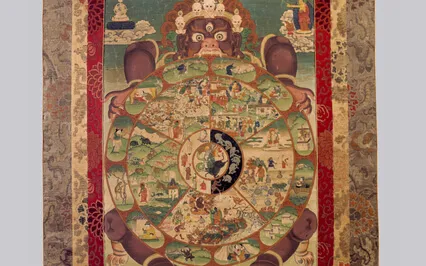
This is the wheel of life.
This artwork is iconic,
Right?
And is,
I would say,
One of the most important in this lexicon and has been just a huge inspiration,
Point of inspiration for so many people as we come to understand this concept of impermanence and also this idea of samsara.
And we'll get into that here in just a second.
So the diagram that we're seeing here,
This is a,
This is a diagram,
Right?
And this is really hearkening back to the Buddha's enlightening vision under the Bodhi tree where he drew the circle and explained the cyclical process of life,
Death,
Rebirth.
And if we look at the outermost element here,
Because it's such a detailed painting and there are so many kind of layers moving from the outside in.
So if we look at this outermost layer,
We'll see the Lord of death,
Yama,
Gripping this wheel driven by these three animals at the very,
Very center of the wheel,
Which really represent these three mental poisons attachment by the rooster anger by the snake and ignorance by the pig.
These are the,
The,
The three kind of main causes of samsara and then the circle right outside of that,
We have the dark and light and people moving upward to the higher states of consciousness and downward to the afflicted states.
And of course it's their actions that really propel them through these different states.
And then we have the six realms of existence.
These are the realms of the gods and the demigods.
This is on the,
The top left.
We'll get to the next slide here and you'll see kind of the pie pieces and there's Yama as well.
Yes.
So we'll see just the previous image where we're seeing the whole pie if we can.
So we'll,
We'll look at the demigods and the top left,
The humans,
The top right,
The animals,
The lower left,
The hungry ghosts on the lower right and at the bottom,
The hell realm.
And of course this is this symbolic chain of causality that binds this closed circle with seemingly no way out.
But of course the Buddha was able to discern this pathway and a different type of renewal,
A different type of existence.
And that is enlightenment.
And there is the Buddha pointing the way out at the very upper right of this painting.
So we'll bring on our teacher today,
The wonderful Sharon Salzberg,
Who will talk to us a little bit more about this idea of renewal and lead us in our meditation practice.
Sharon is the co-founder of the Insight Meditation Society in Barre,
Massachusetts.
She's guided meditation retreats all over the world.
She's an author of wonderful books.
Her latest book is Real Change Mindfulness to Heal Ourselves and the World.
And Sharon is the author of several publications in addition to Real Change.
So Real Happiness,
Many,
Many.
I'll leave it at that.
Real Love.
I can't help but mention Real Love.
That's a really good one.
And she runs her own podcast,
The Meta Hour,
And has been such a huge,
Important presence on stage here at the Rubin in a variety of programs.
And of course here in our weekly practice.
Welcome Sharon.
Thank you so much.
And I would like to actually start just for a few minutes,
Each of us just sitting quietly and holding that word renewal in our minds and our hearts and seeing what comes up.
Because for me,
There were a lot of the same questions that came up around the word resilience,
Because usually we think of renewal as going back to the original place or the most recent recently visited place or situation.
We think of resilience as bouncing back to the situation as it was before.
And it has those elements because that is not easy to do,
As we all know.
But it has other elements as well.
It's like we're not maybe going back to or renewing the precisely same situation.
There's something in that process itself of being generative,
Of being creative,
Of seizing possibility of renewing that doesn't leave us kind of stuck where we were.
But it's almost like the ability to be there and move on.
So what comes up for you just as you sit quietly with the term renewal?
Yeah,
And if you feel like putting something in the chat that's great,
If you like,
Or just sit with the word.
There's something about change,
Or I think partly maybe some evolutionary biologist would say we have a negativity bias.
We think of change.
We think of threat.
We think of loss.
We think of things falling away.
But there's something about change that always points to what is possible.
People are putting in things like springtime,
Like the plants that come back in the spring.
They're like somebody else.
They're the same but never the same.
Reconnection and moving forward.
You can read these things in the chat.
So in defiance of that negativity bias,
There is something about renewal that points to many possibilities,
Many opportunities.
We don't know what they are necessarily.
We can't list them,
But we can feel them.
It's part of the very process.
In some ways the Wheel of Life expresses that.
It's a basic description of Buddhist cosmology.
It can be seen as a description of over lifetimes.
Not everyone believes in that,
Of course,
And you don't have to believe in it,
Which is that almost priceless element of the Buddhist approach.
It's like you don't have to believe anything.
Check it out for yourself.
But as a presentation of a cultural moiré,
This is what it looks like.
There are many realms of existence.
There are many lifetimes.
No one is stuck.
No one is permanently consigned to say experiencing the fruits of their anger from a previous life.
Everything is moving.
Everything is changing.
Or you can see it very much in a kind of moment to moment relationship.
We go through many realms in a minute sometimes,
Don't we?
Lives that are largely defined by our anger or largely defined by our wanting.
Lives that are largely defined by the mixture of pleasure and pain and our ability to hold them both,
Actually.
Lives that are largely defined by joy and upliftment and beauty and subtlety.
Lives that are largely defined by complete absorption into love,
Into peace,
Things like that.
It doesn't take long,
As it turns out,
In the human realm to have just this cascade of thought and feeling and even physicality in a way,
If we can experience that very subtle realm of physicality.
We're always changing.
And things are renewing.
They're moving on and yet not in a discordant,
Disconnected way.
There's a connection to where we put our energy,
What we care about,
What we're devoted to.
At the same time,
There's a strong belief that we are not stuck,
That we're not consigned to forevermore be just living off the consequences of some particular state.
So as Dawn mentioned,
We absolutely experience in terms of a method of meditation.
Anytime we are meditating,
We're always needing to begin again and start over and renew and pay attention anew.
It's absolutely essential to everything that we're doing.
So let's do some meditation together.
You can sit comfortably,
Close your eyes or not,
However you feel most at ease.
Can let your attention settle on something like the feeling of the breath.
Let's say it's the breath,
Wherever you feel the breath most distinctly,
At the nostrils,
At the chest or at the abdomen.
You find that place,
Bring your attention there and just rest.
See if you can feel one breath without concern for it's already gone by,
Without leaning forward for even the very next breath,
Just this one.
And if for whatever reason the breath isn't serving you,
You have physical constraints on the breath or emotional constraints on the breath.
It doesn't matter.
It's fine,
Really.
See if you can find another set of sensations in your body,
Something happening naturally and rest your attention there.
If it's the breath and as you feel the breath,
This holds true for whatever object you've chosen.
There may be other experiences arising,
It seems almost simultaneously,
Thoughts,
Emotions,
Sensations.
You can recognize these,
Just allow them to come and go as you settle your attention,
As you rest your attention on the feeling of the breath.
You don't have to follow after them,
You don't have to reject them.
Keep breathing.
But if something comes up and it's kind of intense,
It pulls you away,
You get lost in thought,
Spun out in a fantasy or you fall asleep,
Truly don't worry about it.
You can recognize that.
See if you can gently let go of whatever and just bring your attention back to the feeling of the breath or to that chosen object if it's something other than that.
We let go and we begin again.
We let go and we renew.
We let go and we start over,
Over and over again.
That is an assign of failure or a problem.
That is actually the practice.
An important word in that is rest.
Sometimes we feel that if we grab hold tight to whatever that object is,
The breath or something else,
Our attention will settle,
Will get calmer.
Because really we just get more uptight.
We want to just rest our attention on that chosen object and remember always losing it,
Falling asleep,
Going far,
Far away is not a sign of personal failure at all.
It's just a part of the way our attention is trained to be more scattered,
To be more distracted.
It's not something to blame ourselves for.
You realize you've been gone,
Recognizing the other side of change,
The possibility side,
The option side.
We let go and then return our attention to that chosen object.
We let go and then return our attention to that chosen object.
We let go and then return our attention to that chosen object.
Thank you.
.
.
.
.
.
.
.
.
.
.
.
.
.
.
.
.
.