Welcome to the mindfulness meditation podcast.
I'm your host,
Dawn Eshelman.
Every Wednesday at the Rubin Museum of Art in Chelsea,
We present a meditation session led by a prominent meditation teacher from the New York area.
This podcast is a recording of our weekly practice.
If you would like to join us in person,
Please visit our website at rubinmuseum.
Org slash meditation.
We are proud to be partnering with Sharon Salzberg and the teachers from the Interdependence Project and the New York Insight Meditation Center.
In the description for each episode,
You will find information about the theme for that week's session,
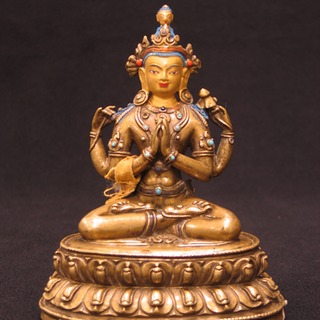
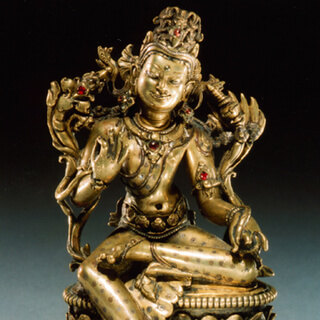
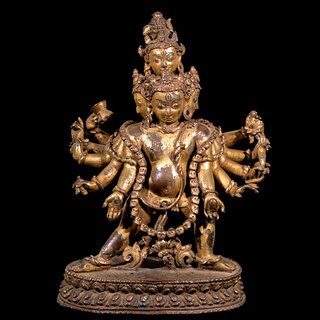
Including an image of a related artwork chosen from the Rubin Museum's permanent collection.
And now,
Please enjoy your practice.
Blessings,
Blessings,
Blessings.
That's what we're talking about today.
We're talking about mantra this month.
And if you joined us last week,
You will remember our exploration into that powerful seed syllable,
That seed mantra of om.
And that sort of gets to the reason of why we get to explore this for an entire month.
Up on the sixth floor,
We have an exhibition called the Om Lab.
And we are,
It's an experiment of sorts.
It's a way of spending a good amount of time and focus on this very powerful seed syllable and really coming to understand what it means.
And it's also a chance for us to collect your om.
We are collecting om's and gathering them into what will be part of our upcoming exhibition on sound and the sacredness of sound.
And we will be exhibiting this collection of om's as part of that exhibition.
So today,
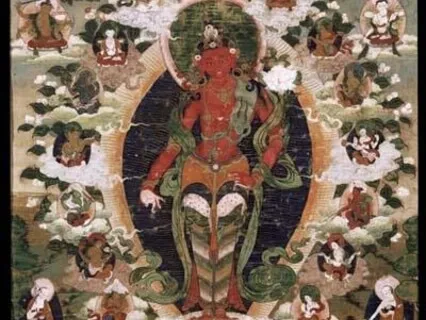
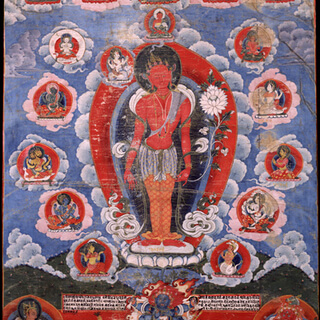
We are looking at this beautiful red Avalokitesvara.
And Avalokitesvara is a Bodhisattva of compassion here in this tanka.
This is from 19th century Tibet or Nepal.
We see the right hand of Avalokitesvara gesturing out in kind of a gift giving gesture.
And in his left hand,
He's cradling this lotus blossom that's blooming over his shoulder there.
And the lotus,
Of course,
Represents this ability to be grounded in muck and be able to blossom pure at the top of the surface of the water.
And Avalokitesvara has a particular mantra that is associated with him.
It is the most popular,
Most spoken mantra in Tibetan Buddhism.
And it is om mani padme ham.
And this mantra,
As with all mantras,
Is a challenge to define in a literal sense.
The power of mantra is usually understood to be experienced in the listening of the mantra,
In the experience of the actual sound of the mantra,
And not necessarily in the literal meaning.
But of course,
We want to know what it means.
And it is said to be defined as the jewel is in the lotus,
Right,
Which kind of goes back to this iconography here of the lotus.
The Dalai Lama describes that as meaning the jewel or altruism and the lotus or wisdom are combined.
And that is where enlightenment can be found.
And it's also understood that om mani padme ham,
That phrase in and of itself contains all of the Buddha's teachings.
But it can also be understood to simply mean blessings,
Blessings,
Blessings.
We're going to hear a little bit more about that with Sharon Salzberg,
Our teacher today.
And Sharon is the co-founder of the Insight Meditation Society in Berry,
Massachusetts.
She has been studying and teaching and writing for many years.
And we're always happy to have her here with us.
She's the author of many great books,
Including her latest,
Which is Real Happiness at Work,
Which is for sale in our shop,
Along with many of her other books.
And she's,
I think,
Just gone to print on a brand new one.
We'll hear about a little bit more later.
Please welcome her back,
Sharon Salzberg.
Hello.
Oh,
Thank you all for coming out on a misty,
Rainy,
Drizzly day.
I've just been in Berry,
Massachusetts,
Where the misty,
Drizzly rain is hard like hell and icy.
And I had a big debate with myself.
It was a very daring moment when I was packing to come back to the city.
Should I leave my snow boots behind?
And I didn't know,
Because he needed them up there.
And I did.
Thank goodness.
That would have been really,
Would have felt really foolish.
Which brings me to the topic of the mantra.
One way of understanding a mantra,
A very kind of down home way,
Is like a kind of default saying we have.
Like what do we go to when we wake up in the middle of the night?
Or we encounter somebody we find really obnoxious?
Or do we have kind of a script?
Or we make a mistake and we feel kind of bad about it?
And sometimes the mantra,
The kind of repetitive saying we have ingrained within us is pretty negative.
Like,
I always knew you couldn't do it.
Or why once again did you,
Whatever.
Sometimes it's pretty positive.
It's like really what we reach for in those situations,
For comfort,
For support.
It's habitual.
So one question sometimes people ask themselves is what is my mantra?
You know,
And in the positive sense.
And that could be something like,
Just breathe.
You know,
Like take a breath.
Or take a moment.
Or you're stronger than you think.
Or my mantra apparently,
The saying that is very much associated with me is,
Begin again.
Right?
Anybody who sat with me or read anything I've written.
One of the things I did when I was up in Barry,
This last week,
Last weekend I taught at a yoga center in West Hartford,
A meditation class.
And I'd been there a year ago.
And somebody who was there and had also sat with me a year ago showed me her tattoo,
Which said,
Begin again.
And it was absolutely beautiful.
I thought,
Huh,
Maybe.
But that's the kind of way we use a mantra.
And if we don't feel like we have one or the repetitive saying we get into is pretty negative or damaging or limiting,
It's an especially interesting practice to see a better substitute.
And in a way,
That's what even these very ancient classical practices were.
It's like the groove becomes om mani padme ham.
Om mani padme ham.
Om mani padme ham.
Right?
So that when you meet a stranger,
The way I,
You know,
In a more contemporary way might look at somebody and think,
May you be happy.
May you be peaceful.
Even if I don't say it out loud.
Even if I don't know them.
Even if I'm not going to pursue a relationship.
It's like,
May be happy.
Even if they're obnoxious and annoying.
May be happy.
And so the equivalent,
Just like Dawn said,
That sense of blessing is om mani padme ham.
Right?
So it's interesting to think about the grooves that we set just through repetition.
And the classical mantras really do serve in that way so that some ludicrous situation erupts.
And you just see like it's a bad person reaching for their mala,
Which is in effect a counter.
That's what it is.
Right?
Om mani padme ham.
Om mani padme ham.
Om mani padme ham.
That's how you use it.
Or maybe even mutter,
You know.
This person goes off in a huff or whatever.
That's our,
It becomes more our default respite.
Right?
That particular saying or phrase or whatever it is.
So clearly the ancient practices invest a lot of meaning in the particular words of the mantra.
The seed syllables are said to evoke different energies.
They have a kind of power.
More contemporary renditions of this are things like even centering prayer begun by Father Keating and Father Pennington who were,
Father Keating was the abbot of a nearby monastery,
A Trappist Abbey to Barry to the Insight Meditation Society.
So he was our neighbor.
And we got very friendly and all kinds of times we were together in some way.
We had the Dalai Lama visit us at the Insight Meditation Society in 1979 through some quirky turn of events and we sort of didn't know what to do with him.
Exactly.
We knew he'd give a talk to our assembled practitioners but it was like a luncheon,
Just like a very small luncheon.
So we thought,
Oh,
Let's invite Father Keating.
So that worked out well actually and they became good friends.
But he sort of took that notion into his Catholicism and what he encourages people to do is actually similar to the practice we're going to do today,
Which is to choose a word.
What kind of lifts you?
What helps you feel connected?
What do you want that groove to be?
So it's usually a single word because he has people first feel it,
First repeat it along with feeling the breath.
Joy.
Peace.
Love.
Let go,
You know,
It's a little longer.
Just be whatever it might be.
And in the beginning you just,
Or something more faith-oriented if that suits you,
And you just repeat the word along with feeling the breath.
And then there are a variety of perspectives and changes.
I'll guide you through as we do the sitting.
But it's a very,
It's one of those practices that's very simple but not easy because of course one word,
Even a phrase,
Not quite enough to keep us focused.
It is a concentration practice,
Which means a practice of repeatedly gathering all of our distracted or scattered energy and awareness coming back to the present moment,
Which is the phrase,
Right?
It's got a more energizing quality than many practices because it is a word,
It's verbal,
It has a kind of a distinction.
If you find yourself saying something other than,
Oh,
Mani padme hum,
You know you're kind of lost in space.
You know,
The effort that we put in needs to be a really balanced effort.
And I'll say,
And using my own mantra,
Your mind will wander.
Like,
Don't think if you were doing it a little better,
Holding on a little tighter,
Enunciating perhaps more clearly,
Your mind won't wander,
Your mind will wander.
So the art of the practice,
The skill of the practice is really in the beginning again,
Right?
So we have a word,
And you'll need to choose your own word.
You can use om if you like,
Or whatever word has you feel kind of lifted up into maybe a better mood than you had when you were getting here,
You know,
When you woke up this morning.
Or remind you of something that you deeply care about but maybe are not so connected to in the trials and tribulations of every day.
And very commonly,
They are words like peace or joy or whatever.
As you repeat the word,
It needs to be kind of just gently resting your attention on the word or the word and the breath,
Whichever mode we're going to be in.
Not grabbing tightly to it,
Thinking your attention won't wander,
But really just gently resting.
And then when your attention wanders,
We'll say when and not if,
It's okay.
The whole point is to be able to gently let go and with some greater and greater kindness toward ourselves,
Bring our attention back.
And utilize the tools as the vehicle for the return,
Right,
For the renewal,
For the coming back to ourselves.
Okay?
So that's it.
See if you can sit comfortably.
You can close your eyes or not,
However you feel most at ease.
First let's say let your attention settle into your body.
If you can find the place where the breath,
And this is just the normal natural breath,
Is the clearest for you,
The strongest for you,
Maybe it's the nostrils or the chest or the abdomen.
You can bring your attention there,
That place,
And just rest.
See if you can feel one breath.
And then in support of the awareness of the breath,
If you have a word,
See if you can just quietly repeat it,
Letting most of your attention be going to feeling your breath,
But just very quietly,
Joy,
Joy,
Or whatever that word might be.
And if you find your attention wandering,
Truly don't worry about it.
You can realize,
It's been quite some time since I was really present,
That's okay.
See if you can let go of whatever's distracted you and simply return your attention to the feeling of the breath with this very quiet word in support of it.
I believe again that it can rightfully PRESIDENT statute is important.
If you go further by just sesame seeds,
These are also the steps.
And if you move to,
You can see what it's like if the breath and the word are kind of equal.
And if they're not perfectly equal,
That's fine.
You may find yourself shifting a little bit back and forth.
That's okay.
All right?
And then see what it's like if the word is more predominant with the breath just quietly in the background supporting you as you pay attention just to the repetition of this word.
The speed may change,
The intensity may change,
And you're just kind of receiving that.
A simple SB or a Brah Bloating or SMB is going to keep your connection even in an And for a few minutes you can see what it's like just to rest your attention in the repetition of the word.
Beach.
So thank you.
That concludes this week's practice.
If you'd like to attend in person,
Please check out our website,
Rubinmuseum.
Org slash meditation,
To learn more.
Sessions are free to Rubin Museum members,
Just one of the many benefits of membership.
Thank you for listening.
Have a mindful day.