Welcome to the Mindfulness Meditation Podcast presented by the Rubin Museum of Art.
We are a museum in Chelsea,
New York City that connects visitors to the art and ideas of the Himalayas and serves as a space for reflection and personal transformation.
I'm your host,
Tashi Chodron.
Every Thursday,
We present a meditation session inspired by a different artwork from the Rubin Museum's collection and led by a prominent meditation teacher from the New York area.
This podcast is a recording of our weekly in-person practice.
In the description for each episode,
You will find information about the theme for that week's session,
Including an image of the related artwork.
Our Mindfulness Meditation Podcast is presented in partnership with Sharon Salzberg and teachers from the New York Insight Meditation Center,
The Interdependence Project and Parabola magazine and supported by the Frederick P.
Lenz Foundation for American Buddhism.
And now,
Please enjoy your practice.
Good afternoon,
Everyone,
And Tashi Delek,
Happy New Year!
I've missed you all.
I missed the end of the year,
I was looking forward to,
But I'm glad I'm here and,
You know,
In the Buddhist studies,
Every day is New Year.
Every morning we wake up,
It is like a new year,
Right?
So welcome,
Welcome to Mindfulness Meditation at the Rubin Museum of Art.
My name is Tashi Chodron,
Himalayan Programs and Communities Ambassador,
And I'm so happy to be here with all of you to host this weekly program.
We are a global hub for Himalayan art,
A home base here in Chelsea,
New York City,
And I'm so glad that all of you could join us for this weekly program.
And I often ask,
How many of you have been attending this on a regular basis?
Wonderful.
And how many of you are a first-timer?
Wow!
Every day should be New Year so that we can have more and more people,
You know,
Enjoying this beautiful session.
And then,
Of course,
Those who didn't raise your hand,
Maybe in between.
So inspired by our collection,
We will first take a look at work of art from our collection.
We will hear a brief talk from our teacher,
Tracy Cochran,
And then we will have a short sit,
15 to 20 minutes,
For the meditation guided by her.
And every month we have a theme.
So for the New Year,
Guess what the theme is?
New Beginning.
So that is the theme for this month,
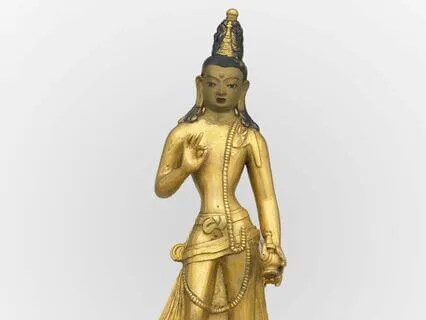
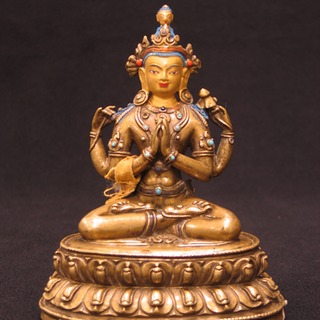
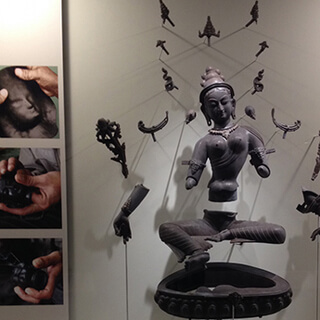
And the art connection for this month and for today's session is this beautiful sculpture of Maitreya,
Which is a Sanskrit word,
Maitreya.
In Tibetan,
He's known as Champa,
Which basically means compassion.
And so Maitreya is the Buddha of future,
The Bodhisattva,
Often that's what he's referred to as.
This is a beautiful sculpture,
Origin Mongolia,
Dated 19th century,
Gilded copper alloy with pigment.
And this is about,
The sculpture is about 10 1⁄2 x 3 x 1 1⁄2 inches.
And so the connection to the theme is Maitreya is both the Buddha of the future and the Bodhisattva of loving kindness.
Maitreya is associated with new beginning in his role as the future of the Buddha.
Now,
How to identify that he is the Bodhisattva is you look at some of the jewelries,
Ornamentations that you see,
And Maitreya can be specifically identified with his beautiful stupa sculpture above his crown right here.
And so this is a beautiful sculpture that is a copy from the Mongolia's very famous artist named Zanabazar,
Who was one of the first Buddhist teacher that was sent by the great fifth Dalai Lama in the,
If I'm not wrong,
In the 16,
Later 16 to 17th century to Mongolia.
And that's how the Buddhism flourished and the art of Zanabazar.
So some of the beautiful symbol and the signature look of Zanabazar is these very elaborate,
Beautiful multi-layered lotus stand and sort of,
They often say like an S-shaped kind of figure and the translucent drapery.
So these are some of the signature look.
And so let's bring on our teacher for today.
Our teacher is Tracy Cochran.
Tracy has taught mindfulness meditation and mindful writing at the Rubin Museum of Art and New York Inside Meditation Center,
As well as in schools,
Corporations,
And other venues worldwide.
Tracy is the author of the forthcoming book,
Presence,
The Art of Being at Home in Yourself,
Which is available for pre-order via Amazon and Shambhala Publications.
Tracy serves as the editorial director of Parabola,
And you can find more information on Tracy and her writings and podcasts on her website at parabola.
Org.
Tracy,
Thank you so much for being here,
And please help me in welcoming Tracy Cochran.
Right before I took the stage,
I talked with someone here who said they were looking forward to everything to come in the new year.
And I said,
That's really brave.
It's very brave of you.
And I remembered,
And it's important to remind all of us,
That Maitreya,
I'm a Western person and didn't grow up with these images,
But this truth that Maitreya brings,
It's something that belongs to all of us.
This idea that there is something coming in the future that will support us,
A force of compassion,
Of loving kindness.
And there's so many stories connected to Maitreya,
And one that I just heard when I was in Nepal on pilgrimage is that the woman who raised the Buddha,
Mahaprajapati,
Wove a beautiful robe,
And there are tales about the painstaking care and love that she put into this beautiful,
Beautiful robe,
And she wanted to present it to her son,
The Buddha.
And he returned to the place of his birth to give a sermon,
And she presented it with great love and great pride,
Only to have it seemingly rejected.
He wouldn't receive it.
And he turned to his senior monk,
Also rejected it,
And down,
Down,
And down.
Can you imagine her heartache and her disappointment,
This gorgeous act of love,
Rejected,
Until it finally came to a newbie,
A humble,
Humble monk,
Ajita,
Who took it?
It's tempting to put yourself in her place as a mother,
As a human being,
To think,
Oh,
This is just a terrible outcome,
The dashing of all my hopes.
But get this,
Ajita,
Through lifetimes of effort,
Became Maitreya,
Became Maitreya.
And so,
In effect,
She had created a robe for the Buddha of the future.
And I'm not offering this as,
Like,
Simple consolation for every single thing that goes wrong,
But a reminder.
One of my favorite poets,
Mary Oliver,
Who used to write for my magazine,
Once wrote,
Someone I loved once gave me a box full of darkness.
It took me years to discover that this,
Too,
Was a gift.
And what that points to in Maitreya,
Too,
Is that when things go sideways,
Or when something happens that causes fear,
Or pain,
Or heartbreak,
Sometimes other qualities appear.
Compassion in friends and loved ones,
In ourselves,
All the loving,
Small,
Good things that remain.
And as we take our seats to meditate,
I invite you to make yourself really welcome.
Notice how it feels right now,
As you sit straight and straighten your back,
To treat yourself with extraordinary kindness and welcome.
And not in some perfected state or some perfect state,
But just like this,
You're welcome.
And notice that no matter what came in here,
Inside your head,
What worry,
What story,
What fear,
Notice that there's something else here,
Presence,
A capacity to be here with others,
With kindness,
Attention.
And let your eyes close,
If you haven't yet done,
And just let that soft awareness be present,
Just open,
Open to what's here,
Just rest,
Quiet attention,
Don't push,
Don't strive,
Don't flee,
And notice that you can begin again,
Just thinking,
Gently come back to presence,
Being present in the body,
Breathing,
Opening to what's here,
With an attitude of kindness,
Compassion,
Just soft,
Be soft,
Be still,
And see that this attention itself softens us,
We begin to remember that we belong to life,
Find yourself thinking,
Just come back,
Be still,
Begin again,
Notice that the simple action of turning the attention to body softens,
Opens,
Notice that you can rest in stillness,
In presence,
That it's kind,
Open,
Compassionate,
Notice how it feels to be seen with kindness,
Openness,
Care,
And notice how it feels to let go of stories,
Of thoughts,
And be present,
Carried by stillness,
Notice that you can begin again anytime,
Just come back to the body,
To the present moment,
And notice that you're welcome with kindness,
Acceptance,
Just the warmth and light of attention inside you,
Notice how it feels to be more open with yourself,
More accepting,
Compassionate,
And present,
Notice how it feels to give yourself to stillness,
To presence.
Thank you so much for that Tracy.
That concludes this week's practice.
To support the Rubin and this meditation series,
We invite you to become a member at rubinmuseum.
Org membership.
And to stay up to date with the Rubin Museum's virtual and in-person offerings,
Sign up for a monthly newsletter at rubinmuseum.
Org slash e-news.
I am Tashi Chodron.
Thank you so much for listening.
Have a mindful day.