Welcome to the mindfulness meditation podcast presented by the Rubin Museum of Art.
We are a museum in Chelsea,
New York City that connects visitors to the art and ideas of the Himalayas and serves as a space for reflection and personal transformation.
I'm your host,
Dawn Eshelman.
Every Monday we present a meditation session inspired by a different artwork from the Rubin Museum's collection and led by a prominent meditation teacher from the New York area.
This podcast is a recording of our weekly practice currently held virtually.
In the description for each episode,
You will find information about the theme for that week's session,
Including an image of the related artwork.
Our mindfulness meditation podcast is presented in partnership with Sharon Salzberg and teachers from the New York Insight Meditation Center,
The Interdependence Project,
And Parabola Magazine.
And now,
Please enjoy your practice.
Hi,
Everyone.
Really wonderful to be here with all of you,
And it's my pleasure to welcome you to mindfulness meditation online with the Rubin Museum of Art.
I'm Dawn Eshelman.
For those of you who might be new to us,
We are a museum of Himalayan art and ideas in New York City,
And so glad to have you all join from all over the place,
It looks like.
And this is our weekly program where we come together and we combine art and meditation online and practice together.
This month,
With the holidays upon us and the season of feasting and coming together in one form or another,
We decided to focus on the theme of interdependence.
So this idea that we're all interconnected and that that's the true nature of our experience through the lens of Buddhism and Tibetan Buddhism in particular.
And so inspired by that,
We will take a look at a work of art from our collection,
Which you were just looking at here.
I'll go into it a little bit with you.
Then we'll hear a brief talk from our teacher.
Today we have the fabulous Tracy Cochran here with us.
And then we'll sit together for about 15 or 20 minutes guided by Tracy.
So here we go.
We'll take a quick look at the artwork that we have chosen with Tracy for today.
There it is.
And again,
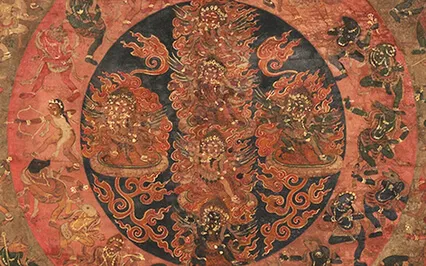
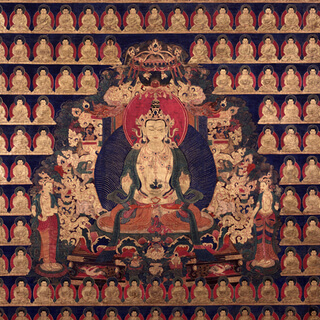
We're talking about this idea of interdependence and we're looking at a tanka with so much going on in it here.
So many figures,
Right?
And these very bold colors of like a deep indigo and reds.
Seeing a lot of groupings of figures.
Even the red is expressing itself in fire behind some of them here.
And then it looks like this is all existing in this plane of deep indigo.
And of course we see circles,
Right,
Especially in the very center and then two concentric circles outside of it.
And circles of figures in each of those.
So the artwork that we're looking at today is called Peaceful and Wrathful Deities of the Bardo.
This is from Tibet,
19th century,
Ground mineral pigments on cotton.
And in fact,
We're looking at a portrayal of 113 apparitional deities arranged in these different categories.
And we'll get into the details of this and the categories with Tashi at the end of our session today.
But I wanted to give you a sense of just a sense of what's going on here.
The title here is so important,
Right?
This is Peaceful and Wrathful Deities of the Bardo.
So at the moment of death,
According to Buddhist belief,
We have this opportunity to attain an enlightened state of mind.
However,
Our own karma brings up various visions,
Including terrifying ones.
So if we don't recognize them as these mere projections of our own mind,
Whose essence is really that of reality itself,
Then we may not escape from the cycle of death and rebirth,
Right?
So these are gatekeepers in a way to enlightenment.
And we have here five Buddhas,
42 peaceful deities,
58 wrathful deities.
And these images illustrate this very structured and vivid experience that practitioners have between death and rebirth.
And the Bardo teaches that those who reach the state to realize the true nature of visions and free oneself from the cycle really do that through this awareness.
So this depicts this host of these wrathful and peaceful deities covered in flames,
Holding these weapons and skull caps of blood in unison,
Working together with the peaceful deities,
Right?
And trampling corpses under their feet.
And those corpses really represent our own egos.
So their wrath is not directed at the practitioner,
But against their negative emotions.
And this creates an opportunity for liberation if one can recognize their true nature.
So we'll pause there.
There's so much more to say.
I feel like there are metaphors in here about large family gatherings and holiday dinners.
And I think it was Ram Dass who said,
If you think you're enlightened,
Go spend a week with your family,
Right?
They have a lot to teach you.
But I will leave the storytelling to our wonderful teacher,
Tracy Cochran,
Who has been a student and a teacher of meditation and spiritual practice for decades.
She's the founder of the Hudson River Sangha,
Which is virtual and open to everyone.
And you can find the link for her weekly meditations and all about her at TracyCochran.
Org.
In addition to teaching at the Rubin,
Tracy's top mindfulness meditation and mindful writing at the New York Insight Meditation Center,
In schools and all over the place.
And she is also a writer and the editorial director of Parabola,
A beautiful,
Very special quarterly magazine that seeks to bring timeless spiritual wisdom to the burning questions of the day.
You can find out all about that and more about her at Parabola.
Org.
Hello,
Tracy.
Welcome.
So wonderful to have you.
Hi.
Hi.
Hi.
I'm very happy to be back.
And I was telling Dawn earlier,
I admire her beautiful backdrop.
But I have my blinds up and precisely because I was hoping you could see that it's a transitional time,
Even if you can't see so clearly.
The trees are bare,
But it's not yet snowing.
And if you can see the ground,
There is an old pumpkin from Halloween and an autumnal decoration that's lying in the woods.
And we're between things.
And where we are here in New York,
It's also a dark time.
And I wanted to share a brief poem from that great Western sage,
Dr.
Seuss.
And it goes,
How did it get so late so soon?
It's night before it's afternoon.
December's here before it's June.
My goodness,
How time has flown.
How did it get so late so soon?
And it can feel this way because it was just Thanksgiving,
You know.
America is concluding and Christmas is heading for us like a train.
Or it can feel that way in our lives.
And Bartow means transitional state.
It doesn't just wait for us at the moment of physical death.
We discover it in times of transition,
In times of not knowing or the darkness of uncertainty.
And what attracted me about this beautiful visionary illustration is that it suggests a state of reality and a possibility that we don't often embrace,
At least in the West.
But we kind of do it innately.
What I'm talking about is that we tend to live in a state of virtual reality all the time.
And that panicky sense that it's late can hit you when your 10th anniversary of your college is coming up or the day is about to close and you haven't gotten work done or you're already 40 or 50 or 60 or 70.
Yikes.
And what happens at those moments is that we innately see that we've been dreaming.
What have I been doing with my time?
Is this how it can feel?
And it immediately becomes apparent to us that we have been filling our heads with other people,
People who aren't there.
We've been arguing or trying to appear a certain way.
I saw a cartoon in the New Yorker that had a small child being tucked in by his mother and she was saying to him,
Don't pay attention to anything anybody says to you except me.
And you picture this little kid right then taking in an impression of this mother.
What would she think?
What would she think?
And the invitation of this practice is that we can begin to soften and open to the presence of benevolent forces of wisdom and compassion.
And in this tradition,
As well as in Western traditions,
Often people visualize and pray to a particular deity.
But I thought of something else last night when I was practicing.
I didn't mean to be practicing,
But I happened to wake up at three in the morning troubled about something and it occurred to me to practice.
And my practice was to just soften and open,
To remember how it felt to be in the presence of somebody without whom I could be completely honest.
And it occurred to me that we spent so much of our time,
I will just take myself as an example,
Knowing that I was coming here to teach.
There's something in a person,
A teacher,
That feels like,
Oh,
I should be calm,
Not troubled.
I should feel the warm,
Not shut down or contracted.
I should feel happy and peaceful,
Not angry,
Not upset.
And there can be a temptation to cover myself,
To put up an act,
To play the role.
But instead of that,
I could offer my truth,
I could be with myself first of all,
And just let myself feel upset,
Troubled,
Uncertain,
A flow of things.
And let that be completely okay,
Completely acceptable,
Just emotions passing through.
And one step further is to know that when we are in the barrow in times of uncertainty,
We tend to contract and act as if we are all alone or possibly facing doom and fearful,
Critical people,
Our bosses,
Our ex-boyfriend,
Whoever it is.
But the practice is an invitation to open to the truth that we're also surrounded by benevolent beings and forces.
And we can be very playful in imagining how it feels to be in their company or who we pick on,
It was just Thanksgiving here five minutes ago,
It seems.
And being in New York,
I watched the Thanksgiving parade,
Macy's parade on TV.
And with suddenly great fanfare,
I was cooking,
So I went back and forth,
Great excitement and fanfare,
Because baby Yoda was flipping through the air,
This great flow,
And what was so charming about the moment is that even the newscasters were shouting,
Baby Yoda,
Baby Yoda,
Beseeching,
Praising this balloon of this very cute little fictional being.
And so I'm not suggesting that we all pray to be Yoda,
But I'm inviting you to see that this practice of bringing a kind,
Accepting attention to the body and to the feelings that get stirred up,
Especially at this time of year,
That that movement opens us to an attention that is beyond our private virtual reality,
Our endless trance of thinking and picturing and anticipating,
And that this awareness can be warmed by a reminder that we can bring of beings or forces,
Can be the force of compassion itself.
The special being or state in which we can be completely truthful,
Completely ourselves,
And let ourselves rest in that attention.
Just that.
Don't solve or fix,
Just rest.
And notice how it feels to be completely accepted and accompanied.
So let's take a comfortable seat and we can practice together.
And just let yourself be as upright as you can comfortably be.
And this is so we can have a more complete experience of the body,
Of the feeling,
Of the movement of energy and thought inside us.
So take a comfortable seat with feet planted firmly on the floor,
Back straight in.
Just let your eyes close or avert them.
Just rest.
See how it feels to bring the attention back,
Back to this experience,
To how you feel right now.
And notice that you can let this attention be completely soft,
Not striving,
Not seeking,
Not being soft.
And you see that when we down strive,
When we down try,
Another kind of presence begins to appear.
The attention that is completely accepting begins to sink through the body like water in sand.
Just let this attention settle and spread.
And notice how it feels to be held.
It feels to be held in attention that doesn't comment,
That doesn't judge,
That sees with kindness and spaciousness.
See that when you get distracted,
You can't see it.
When you get distracted,
When you get taken by thinking,
Picturing,
And movies in the head,
You can gently come back to the body,
To the breath,
To sensation,
And be met by this attention that's spacious,
That's kind.
And notice how it feels to just rest in that attention.
Just be held.
And notice how it feels to have everything that comes up,
Every feeling,
Every thought,
Every intention,
Completely acceptable,
And looked upon with great kindness and compassion,
With great interest in you.
Notice how it feels to let yourself soften and open,
To be seen.
Dressing in the kindness of this attention,
Its spaciousness,
Its quietness,
Its quietness,
Its quietness.
And notice how it feels to be held in the presence of this attention,
Its quietness,
Its quietness,
Its quietness,
Its quietness.
And notice how it feels to know that you're sitting with others,
That you're sitting with others,
That even if you can't see them,
Others are with you,
Sitting,
Softening,
Opening,
Just like you.
And notice how it feels to have this stillness,
This quiet and softness,
Be supportive,
Be nourishing,
Not frightening.
And notice how it feels to be held in the presence of this attention,
This quietness,
This quietness,
And notice how it feels to know that this attention waits for you every time you come back to the body,
To sensation,
Every time you open to presence,
That attention waits,
That is spacious and kind.
And notice how it feels to be held in the presence of this attention,
This quietness,
This quietness,
This quietness,
This quietness.
And remember that you are not alone,
But accompanied by wisdom and compassion,
By an attention that's spacious and kind.
And notice how it feels to be held in the presence of this attention,
This quietness,
This quietness,
This quietness,
This quietness.
Thank you,
Tracy.
Thank you.
Thank you.
Thank you.