Welcome to the mindfulness meditation podcast presented by the Rubin Museum of Art.
We are a museum in Chelsea,
New York City that connects visitors to the art and ideas of the Himalayas and serves as a space for reflection and personal transformation.
I'm your host,
Dawn Eshelman.
Every Monday we present a meditation session inspired by a different artwork from the Rubin Museum's collection and led by a prominent meditation teacher from the New York area.
This podcast is a recording of our weekly practice currently held virtually.
In the description for each episode,
You will find information about the theme for that week's session,
Including an image of the related artwork.
Our mindfulness meditation podcast is presented in partnership with Sharon Salzberg and teachers from the New York Insight Meditation Center,
The Interdependence Project,
And Parabola Magazine.
And now,
Please enjoy your practice.
Hi,
Everyone.
Welcome.
Welcome to the Rubin Museum of Art and to our weekly practice,
Mindfulness meditation.
I'm Dawn Eshelman.
So happy to be here with you today.
And welcome.
To those of you who are new,
We are a museum of Himalayan art and ideas in New York City.
So glad to have you all join us for our weekly program where we combine art and meditation online.
Today,
As we do every week,
As is our practice,
We will take a look at a work of art from our collection,
And then we will hear a brief talk from our teacher.
Today,
That is Tracy Cochran,
And we'll have a short sit,
15 to 20 minutes,
Guided by the fabulous Tracy Cochran.
So we'll take a look at our artwork today.
And as I bring up our screen here,
We are reminded that our theme this month is love.
And happy Valentine's Day or Baja Humbug Valentine's Day,
Whatever,
You know,
Whatever approach you choose.
But here this month,
We're spending a little time with this concept of true,
True love.
And that can come in so many forms,
Right?
So self-care,
Self-love,
Love of the community,
Love of each other.
So many ways in which we can talk about love and appreciate it in our lives.
And so today,
Especially on Valentine's Day,
I think it's so lovely and important to connect that to our practice.
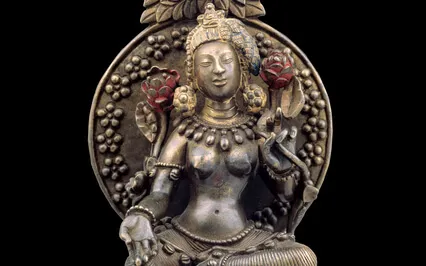
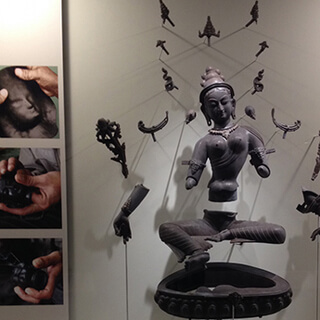
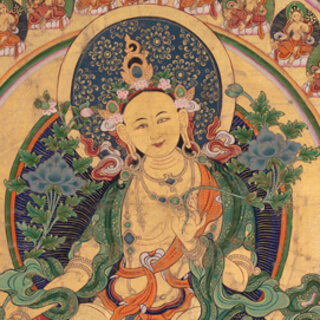
And this beautiful sculpture here that we're looking at is the fantastic green Tara.
This particular sculpture is from Tibet,
17th century,
Brass with pigments.
And this is actually created.
Now oftentimes we don't know the exact artist or we don't have a lot of detail about the exact artist or an artwork was created by many people or a few different people.
And here we actually know that this sculpture is attributed to the hand of Chöyun Dorje who was alive from 1604 to 1674.
This is the 10th Karmapa.
This was the head of the Karmakagyu school of Tibetan Buddhism.
And this was an eccentric figure within the history of Tibetan art.
The 10th Karmapa possessed a very individual style and looked really at a range of traditions for inspiration,
Including ancient metal work from Kashmir.
And these influences can be seen in this sculpture.
This is again,
The beautiful goddess Tara who really embodies this kind of motherly love,
A care,
A protection,
And whom practitioners call upon when they feel afraid or in need of love and support.
And so here we see the expression of the 10th Karmapa's vision of Tara.
And we see this sort of elliptical shape of the Lotus petals that make up her seat.
And there's even like a striated pattern on her tight fitted clothing here.
And it's just beautiful to see not only this figure who's so beloved and embodies this idea of love so much,
But also the Karmapa's personal style and the Karmapa's actual love of craft and even of animals,
Which is often incorporated into the works of the Karmapa.
So here we see a pair of birds that can be found nestled right above Tara's head,
Right at the top there.
So let's bring on our wonderful teacher today,
Tracy Cochran.
She's been a student and a teacher of meditation and spiritual practice for decades.
She's the founder of the Hudson River Sangha,
Which is now virtual and open to all.
And you can find the links to all of her meditations and works at TracyCochran.
Org.
And in addition to teaching here at the Rubin,
Tracy's taught mindfulness meditation and mindful writing at the New York Insight Meditation Center,
As well as schools and corporations in many different settings,
Her writings,
Podcasts and other details can be found on her website and also at parabola.
Org.
So Parabola,
That wonderful magazine that Tracy helms is now exploring the theme of wonder.
So beautiful.
Welcome,
Tracy.
Great to have you.
Thank you.
Thank you,
Dawn and everyone.
I'm delighted to be here today on Valentine's Day.
And I know that it's not everybody's favorite day.
I completely understand.
And as a matter of fact,
I am born the day after Valentine's Day tomorrow.
And I was born in the small hours of the night and I grew up hearing that I was almost a Valentine.
And I'm sure my mother didn't intend to create this feeling,
But it created a feeling that I had just missed the boat.
I just wasn't quite a Valentine.
I was born on the day when all the big hearts full of chocolates were 50% off.
It was over.
And Jayan said,
True love.
And you might feel something like that,
That this is not a day for you.
It's not a theme for you.
There is this feeling that love comes from someone special outside of us.
So I want to invite you,
I want to invite all of us,
Including me,
Right now,
Even before we meditate,
To soften and open to the idea that love is here.
And one of the things I love about Tara,
This image of green Tara,
White Tara,
All of her aspects is that she is a force of an energy of the most generous love.
She comes to you when you call,
According to the tradition.
She is here.
And one of the things I love about Buddhist cosmology is that it presents a world where multiple myriad,
Countless worlds are happening at the same time.
So that this beautiful figure,
This embodiment of compassion,
Isn't something from long ago,
But something that's happening right here.
And the story of Tara in the Tibetan tradition,
Since this is a museum of Tibetan art,
An image from that tradition in that region,
The story was that the great bodhisattva of compassion,
Someone full of compassion,
Was sitting on a mountain top picture,
A huge mountain Tibet,
Gazing down at all the manifestations of suffering that he saw below him in the whole world,
Every kind of suffering,
Lovelessness,
Pain,
Rage,
Grief,
All of it caused in his view by ignorance,
Ignorance of our connection.
All of it caused by the fear and rage and grasping that comes from ignorance,
That comes from loneliness and feeling cut off.
And he cried and cried and it pooled,
These tears made a pool around his feet that grew and expanded until they became a lake and out of the lake came a lotus and the lotus rose and opened and in the heart of it was Tara,
This beautiful feminine embodiment of compassion.
And this might seem to you a faraway tale,
Beautiful but far away,
But I invite you to think of the calm that comes after tears.
Let yourself think of that.
You cry your heart out and at a certain point that quells and calm comes and sometimes with that calm there's a feeling,
I know I've had it,
Of giving up in the sweetest sense.
It's a feeling of here I am,
Here I am.
I give up all attempts to strive for something I don't have or was bitterly denied and all attempts to hide myself.
And sometimes for a moment sometimes we're just peacefully there and this knowing of that feeling of being completely seen right there is where Tara comes in,
Where a love and compassion appears,
That essence is acceptance.
And recently we lost the great teacher Thich Nhat Hanh but we still have his teachings and one of my favorite and a perfect Valentine's Day teaching is a teaching for self-love.
And again I invite you to just bring your attention to yourself and let yourself know that along with everyone here and the thousands of people that will listen to this podcast there are things,
Feelings,
Edges that you don't want other people to see.
A bit of shame,
A bit of hurt,
A bit of anger,
A grudge,
Something that you think doesn't belong here.
And I invite you to let Tara,
To let this energy of love and compassion come to just those parts,
Just those parts.
And Thich Nhat Hanh offers the mantra,
Darling I'm here,
Darling I'm here.
And just let yourself picture and hear and feel into that being said,
Not to the best of you when you feel pulled together and peaceful but to that part,
That lingering sorrow,
That grudge,
That part that you might find troublesome,
Let that mantra come to that part and offer its accepting,
Non-judging,
Loving gaze.
Tara is famous for protecting us against all kinds of forces,
Lions and floods and fire and snakes and I invite you to see that this means difficult feelings and hurts and forces inside ourselves that they too deserve love and compassion.
They too deserve to be welcomed here so that we can become whole,
Wholly ourselves,
Completely loved and Thich Nhat Hanh offers a few other mantras and it's perfectly okay just to say with,
Darling I'm here.
And he adds,
If you wish,
I see that you're here and that makes me so happy,
This energy,
Because true love isn't just an attachment or a romantic attraction but an energy that sees with compassion,
With spaciousness,
With acceptance and this true love can touch everything,
Everything inside us that seeks expression,
That needs to be healed.
I see that you're here and that makes me happy and I see that you suffer and that's why I'm here.
Let yourself feel we have this fictional idea that if we yearn and pray and I don't know what we search online we'll find just the right person to grant this seeing to us but it's here,
It's here right now inside you and around us.
It's an energy of love and compassion that's past.
And the last phrase he sometimes included was,
Darling I suffer and I need your help.
This is an invitation again not to hide what we are but to let it be seen and this can seem like an exquisite act of daring even in private conditions like we're in right now do I dare to let this hurt,
This broken heart be seen,
Be touched by an attention that doesn't comment,
Doesn't judge.
Just that and the last thing I'll say because I came here to sit now just to listen to a talk is that we can really let ourselves do something very special here which is give up.
Not give up in the sense of keeping a grip on what we think we know.
I will never find love.
It may be for others but not for me,
Whatever it is to give up in the sense of just sinking into the body and letting go like the calm after tears.
Let yourself not know.
Let yourself not fix.
Not rush to a conclusion.
Not strive.
But to simply be present in the body in the most simple and basic way and let yourself soften.
You don't even have to do the work of opening completely but just softening a little bit to trust that there's more here than your thinking,
Than your fears,
Than your armoring and contraction.
That maybe,
Just maybe,
There's a light of awareness that's full of love and compassion that's also present.
That just maybe Tara isn't a tale from another time and another culture but right here saying,
Darling,
I'm here for you.
Let's take a comfortable seat and comfortable also means upright.
If you can be upright some people need to lie down but if it's possible for you to sit,
With the straightest back,
You can let yourself have.
And this being an alignment is so that we can have a more complete experience of ourselves.
Body,
Heart and mind.
So let yourself sit straight if you can.
Feet on the floor or if you're sitting on the floor take a firm seat.
Back straight.
It can help to let the abdomen be just a little bit pulled in just a tiny bit to help straighten you.
And just notice how it feels to be here today.
And notice without thinking about it just let yourself take in an impression.
And notice that this attention begins to soften us.
It's a little bit like sitting in warm sunlight.
And let the attention go where it wishes to go.
It might go to a place of tension or to the sensation of feet on the floor or hands in the lap or the feeling of gravity in the whole body or the movement of breath.
And notice that thinking can still happen and memories and sensations and feelings of all kinds.
And at the same time you can bring the attention home to the body in the present moment.
And notice that this attention is warm,
Compassionate,
And that you can let everything be touched by it.
And notice how it feels to be here today.
And notice how the feeling of painful thought or feeling or memory appears.
Just let it be seen.
And notice how that feels to be accepted,
Cared about,
Not in words but in attention.
An attention that's boundless and interested and completely accepting of what is here.
Just rest in this stillness,
Which doesn't mean perfect silence but softness.
Not resisting,
Not striving.
Let yourself sink into sensation.
Giving up all striving,
All efforts to be other than this.
And notice as you let yourself soften and open that you don't feel alone.
There's a presence here,
An awareness that sees that is with you.
And notice the aliveness that is in you.
Making this movement of return,
Of coming home to the experience of the present moment opens us.
And acceptance,
Including everything that arises,
Brings us aliveness,
Warmth,
And ease.
And notice the aliveness that is in you.
And notice the aliveness that is in you.
Notice that you can begin again anytime.
When you notice that you've drifted into thinking or dreaming,
Gently come back again to the body and to presence.
And notice how it feels to be completely accepted,
The going out and the coming back,
All of it accepted,
Natural,
Of interest,
Welcome.
Notice how it feels to have that vast attention.
And notice how it feels to have that vast attention,
Not be remote but close,
Caring.
Saying without words,
Darling,
I'm here for you.
Thank you.
Notice how it feels to be completely seen and accepted by a loving attention.
And notice how it feels to be completely seen and accepted by a loving attention.
Notice how it feels to be beloved,
To be welcome.
All of you,
Every part.
All of you,
Every part.
Notice how it feels to be more here,
To be seen,
To be loved and cared about.
All of you,
Every part.
All of you,
Every part.
Thank you.
Thank you,
Tracy.
Thank you.
Thank you.
Thank you.