You are listening to The Adventures of Saraputa and Mogulana.
I'm your host,
Morris Sullivan.
A lot of people have asked me over the years about sleepiness during meditation.
What do you do about that?
Well,
Probably everyone who meditates has to work with that at some point.
I certainly do.
Even Mogulana himself struggled with it at times.
After they ordained,
Saraputa and Mogulana went off to meditate in solitude.
Saraputa went to stay in a cave,
And Mogulana went to live in a forest.
He meditated diligently,
But he was often plagued by sleepiness.
He'd get so drowsy that he'd have trouble keeping his back straight and his head upright.
The Buddha saw this,
And he appeared to Mogulana in a vision.
Are you nodding off,
Mogulana?
He asked.
Mogulana admitted that he was.
So the Buddha gave him instructions on how to stay awake during meditation.
First,
He said,
If drowsiness arises when you're thinking some specific thought,
Then don't dwell on that thought.
If changing your thoughts doesn't work,
Then reflect on a Dharma teaching,
Examining it closely from different angles.
Your drowsiness might vanish then,
But if not,
Recite the teaching in full detail,
As much as you can remember.
If that doesn't work,
He said,
Use some physical stimulation.
You can pull your earlobes,
Rub your arms and legs.
If you do all of that and are still drowsy,
Get up.
Wash your face with water.
Look around in all directions.
If it's nighttime,
Look up at the stars and constellations.
But if doing all of that drowsiness still persists,
The Buddha said,
Then turn to the perception of daylight.
In other words,
Even if it's nighttime,
You can envision what it's like during the day.
Thus with your mind clear and unclouded,
The Buddha said,
Cultivate a mind filled with brightness.
If that doesn't work,
Switch to walking meditation.
Instead of sitting,
Mindful of the breath or some other object,
Get up,
Walk up and down,
Keeping your attention on the act of walking itself.
And finally,
If none of that works,
Lie down and go to sleep.
Lie down,
Lie unlike,
On your right side,
Resting one foot on top of the other,
The Buddha said.
And then on awakening,
Get up and get back to the work at hand.
Thus Moggallana,
Should you train your mind.
I don't usually do this,
But I want to open by reading you something that I found a few years ago.
And I don't remember how I came across this,
But I kept it for some reason because I liked it a lot.
And I figured one of these days I would use it for something.
So this is from a book called Opening the Hand of Thought by Kosho Uchiyama.
And Uchiyama was a Soto Zen priest.
He died in 1998.
And he's talking about Sangha,
About the Buddhist community.
And here's what he wrote.
He said,
It is important that every one of us cooperate with each other to protect and maintain an atmosphere conducive to practicing together.
There is no one who can claim to always embody bodhi mind,
The mind that aspires to practice and attain enlightenment.
Each of us gathers and contributes his or her own little bodhi mind to the general effort.
Sawaki Roshi,
Who was the Zen master who ordained Uchiyama,
Often said that a monastery is like a charcoal fire in hibachi.
If you put in just one little coal,
It will go out right away.
But if you gather many small coals,
Each glowing just a little bit,
Then the fire will flame up.
In the same way,
Every one of us should contribute a little bodhi mind and thus enable our Sangha to thrive.
I love that.
I've been thinking about Sangha a lot lately,
About what it means and that metaphor of a coal and then a pile of coals creating a fire.
Anyway,
I was thinking a lot about this idea of community and spiritual community and what that means.
And I started thinking about the religious institutions of my youth.
I grew up Baptist and I went to church with my parents until I stopped going to church around age 13 or so.
And we moved around quite a bit when I was a kid and so we would change churches.
And there were a few key considerations that my parents would look for with a new church.
And location was probably the most important one.
They'd kind of start closest to home and work out until they found one they liked.
So number one was where is it?
And the second one was do we like the preacher?
And then I guess,
You know,
The building itself was always kind of an issue.
Was it nice and clean and all of that?
And you know,
We come here and I was sitting outside this morning and it was not terribly hot because of the rain that we've had.
Just such a beautiful place to be.
And that's a nice thing too.
And then the kind of the thing that was always the deciding factor for them was the community itself.
How did they feel there?
Did they feel welcome?
Did they feel like the other people in the church had similar ideas and attitudes toward spiritual practice?
But the churches were never too far away.
And in fact,
I remember walking to Bible school in the summertime sometimes.
So they must have been pretty close.
But I grew up where there were lots and lots of Baptists.
I know I'm a Buddhist and there are not lots and lots of Buddhists where I live.
And so,
You know,
There's people who've come a long way to be together on Sunday morning like this.
I drove almost 50 miles to get here.
And there are people I know that come even farther.
And then we just went through these months and months when people couldn't come together physically.
And the interesting thing about that is that the community didn't fall apart.
You know,
We're still here,
Even though for periods of time we couldn't be here physically.
We're still here spiritually together.
People didn't decide to stop practicing.
Our community,
My community,
Actually got bigger.
I noticed that when people who had moved away started coming back to the virtual meetings that I had,
And they were really happy to be back with our community,
Even if it's just in a little screen you're staring at on your desktop.
And so I started to realize this weekend as I was thinking about this that really community includes people from around the world.
I find out who listens to my podcasts when I'm recording these talks and I'm including them in the podcast.
And including the U.
S.
,
There are people from 22 countries so far that listen to the talks that I give right here.
Imagine what it would be like if they were all in the same room at the same time.
But anyway,
That's this idea of what does it mean to be a saga has been on my mind a lot lately.
And it's an important factor,
I think,
In our spiritual practice.
So a lot of the time when you read about Buddhism,
You know,
The people who write about it talk about it sometimes like it's all about sitting by yourself and meditating somewhere.
But Buddhism is a comprehensive system of practice and some of these practices work a lot better if you do it in a group.
And so I always encourage people to practice with others,
Even if it's just in a Zoom room or something like that.
I'll get emails from somebody saying,
I'm interested in Buddhism and I found you online somewhere on Facebook or whatever.
What do I need to do?
Well,
Find a community that you can practice with,
Even if it's an online community now.
There is something really powerful about practicing together.
So unlike a lot of religions,
Buddhism isn't so much a set of principles that define your beliefs.
It's more like a set of principles that outline a way of doing your spiritual relationship to the world.
So when you decide to become a Buddhist,
You go for refuge.
And that means that you're directing the way we live toward what we call the three jewels.
And so by going for refuge to the Buddha,
We're acknowledging that spiritual awakening is possible,
That his example reflects what we want to achieve spiritually,
And that that's a possibility.
The second jewel is the Dharma.
This refers to the teachings the Buddha left,
The guideposts that he set for us to follow.
And it also refers to the greater wisdom that comes from us realizing for ourselves the wisdom and compassion that develops as we follow that path.
And then the third jewel is the Sangha,
The Buddhist community.
So when the Buddha talked about Sangha,
At first at least,
He meant two main things.
There was the Bhikkhu Sangha,
Which meant the community of monks and nuns,
And there was the Arya Sangha,
The community of arahants,
Those who had realized the teachings for themselves and become enlightened.
And this has broadened a lot,
You know,
Through the couple of millennia of practice since the Buddha lived.
But those two ideas of community are still important.
When the Buddha awakened,
He spent several weeks enjoying just the bliss of spiritual freedom and meditating and things like that.
He made sure that he fully understood what he had realized,
That he hadn't missed anything.
So he spent several days still on his own,
Just meditating.
And then he started wondering,
Should I try to share this or not?
And at first he thought maybe he wouldn't.
He knew that what he realized was very profound and that it wouldn't be easy to understand.
And he wasn't sure that very many people would be able to understand this.
But then he felt compassion for other beings.
And he said,
I surveyed the world with the eye of an awakened one,
And I saw beings with a little dust in their eyes and those with much dust in their eyes,
Those with keen faculties and those with dull,
Those with good attributes and those with bad,
And those who were easy to teach and those who would be hard to teach.
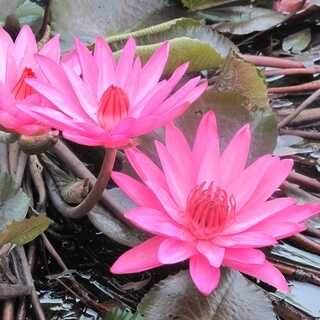
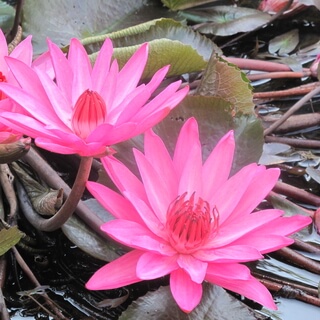
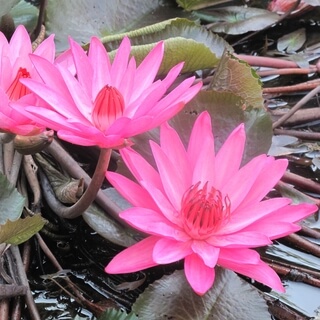
And he realized that people are like lotuses in a pond.
Some stay down in the water,
Completely stuck in the mud,
And some rise up through the water to the surface and others come completely up out of the mud,
Out of the water and bloom,
Unstained by the mud from which they arose.
And seeing this,
He decided that he would teach.
And once he was convinced that his path would help others,
He deliberately and systematically set out to create a means for it to spread through humanity so that it could endure without his direct presence,
Much the way our practice endured even when we couldn't all be here.
So anyway,
The first sangha,
The bhikkhu sangha,
Were those who had heard the teachings,
Decided to devote themselves to practice,
To teaching,
And to maintaining monasteries and temples so that this path would continue to be available to others.
And so without that,
Without this tradition of monks and nuns and lay practitioners and so on,
The Buddhist practice would literally not be here today.
And so when we go for refuge to the sangha,
That act includes this realization that the group effort is what unites us with the Buddha and the Dharma.
So some of the Buddhist students awakened very quickly.
They had been pursuing the spiritual life for a long time and they just needed a little nudge in the right direction.
And then others stuck with the practice and were awakened later.
So those awakened followers,
Those were the Arya sangha.
Arya means noble.
So these were the ones who awakened to the noble eightfold path,
To the noble release from suffering,
The community of arahants who were fully enlightened.
And this Arya sangha is important because we have examples of people who did what the Buddha said to do,
Who have been where you want to go.
And so you know because of their example that the path literally leads to freedom if we practice diligently.
And so these are people who have done what we want to do,
Who have gone where we want to go,
Who have achieved the kind of spiritual awareness and freedom that we'd like to experience.
And it's good to show respect and support people like that because that also helps you recognize their value to your own path.
But to truly show respect to those who've gone before should practice the teachings.
We have a little tendency in our society to kind of shy away from respecting authorities sometimes as people who seem to think that if you have strong opinions you don't really need to know what you're talking about.
But that doesn't really serve us very well.
We're right to be careful about following someone just because they're an authority figure.
But we should be wary of our own opinions and basically test our progress against the possibilities.
And so that's the importance of the Arya sangha.
Where can this go?
Where does this lead?
So when we talk about respect we should try to find someone who really reflects what we want to achieve and follow their example so that we realize the fruits of the practice for ourselves.
And that's how you really show respect for the teacher and the teachings is to realize the teachings for yourself.
So in the contemporary Buddhist world there's a little broader use of the word sangha which I think is also very useful.
And Vietnamese Zen master Thich Nhat Hanh said something about this that I think really expresses it well.
He said a sangha is a community of friends practicing the Dharma together in order to bring about and maintain awareness.
The essence of a sangha is awareness,
Understanding,
Acceptance,
Harmony,
And love.
When sangha is awareness,
When you do not see these in a community it's not a true sangha.
But when you find these elements are present then you know you have the happiness and good fortune of being in a real sangha.
I really like that.
That is a true sangha when you find awareness,
Understanding,
Acceptance,
Harmony,
And love.
That doesn't mean you have to like everybody.
It doesn't mean you have to get along all the time.
It doesn't mean you all have to feel or think exactly the same way.
It means you bring awareness,
Understanding,
Acceptance,
Harmony,
And love to this process of practicing together.
So the broader sangha is a group of people who share values and are willing to support one another in their spiritual goals.
And the Buddha referred to these people as spiritual friends and he knew this was very important.
So important in fact that he considered spiritual friends and the availability of spiritual friends to be a prerequisite for awakening.
As I'm talking about this I'm remembering a conversation I had very recently about things like anxiety and comfort zones and that kind of stuff.
And when we are practicing with others and we realize that others experience the same kind of stuff that we do,
That strengthens our practice.
When we can recognize our suffering and others and when we can see examples of how those same sufferings were transcended and how we're really kind of going through these things together and all of that,
That's a really important component of practicing together.
It's almost like,
I think I used guitar playing analogies last time I was here,
It's almost like a jam session.
You can be a really good musician and sit in your room by yourself and practice,
But when you play with other musicians then things really come alive.
And it's kind of the same way with practicing spirituality.
You know you find sort of problems that need resolution and you resolve those as a group and that's when your practice really comes along.
So this is your Sangha.
These are the people you're jamming with spiritually right here.
It's not a Sangha so much because you have a charter and a building,
Although those things are certainly nice,
Makes it a lot easier to do this.
But they include things like listening to talks and praying together.
Those are methods of learning and expressing shared commitment,
Shared values.
And then as Venerable Thich Nhat Hanh said,
Actively practicing understanding,
Acceptance,
Harmony and love.
That's what makes a place like this real community.
Listening together and supporting one another as we go through difficulties and spiritual crises.
That makes the community a refuge.
If we're part of a spiritual community we don't have to go through stresses and difficulties alone.
We have the strength that we give one another.
We have one another to look to as examples of how to live better.
And that's what the Buddha meant when he talked about spiritual friends.
That's true friendship.
I think Uchiyami's allegory of charcoals burning together is such a good one.
It reminds me of another story that I've told here before,
I think,
But it bears repeating.
There was another Japanese Zen master,
Sohin Nakagawa Roshi.
He became very well known throughout the world and established some prominent Zen centers in the US.
And he was known to be kind of strange in a good way.
He was really kind of iconoclastic.
There's a famous conversation between him and a student who is having difficulty with their practice during retreat and having trouble concentrating during meditation.
Anybody ever have trouble with that?
And the student came to him and said,
Master,
I'm so discouraged.
I'm not sure I can keep going.
What should I do?
And the Roshi thought for a moment and then he said,
Encourage others.
When we do this,
When we encourage others,
We're encouraging ourselves as well.
Yes,
We strengthen our sangha when we support each other's practice.
But also when we encourage someone else to keep going,
To keep practicing,
We hear that instruction too in here.
As long as we pursue our spiritual path as a solitary endeavor,
We can get wrapped up in our own ego and our self-rating and stay trapped in our circles of delusion.
So when we have the opportunity to look beyond ourselves to others,
We find a clearer direction.
So in practicing together and adding our energy to a community,
We not only energize each other,
We energize ourselves even more.
So in a way,
Each of us is like that single coal burning with the energy of bodhi mind.
To sustain that and make it grow,
To really lead to liberation of all beings,
We just combine our bodhi mind with others.
So thank you for being a part of the community.
Thank you for joining me for episode 19 of the Adventures of Saraputa and Moggallana.
I have some interesting talks and interviews coming up over the next several weeks.
I'll be talking about things like compassion and on basics of Buddhist practice and how to apply them to your life.
And I'll be interviewing some interesting people like Dr.
Debbie Jaffe Ellis,
Who's a noted psychologist who has been exploring the intersection of Buddhism and rational emotive behavior therapy.
I'll also talk with Chun-Zing Han,
Who is the author of Be the Refuge,
Raising the voices of Asian American Buddhists.
In the meantime,
I haven't thanked all the people who support this project lately,
Jazz composer and musician Edward Simon for the music,
White Sands Buddhist Center for continuing to hold services and inviting me in to give Dharma talks,
Anchor FM and Insight Timer for hosting my podcast.
And I want to thank you for listening,
For subscribing,
For sharing,
And for helping others find this podcast so they can benefit from the Buddha's teachings too.
Now,
Go save the world.