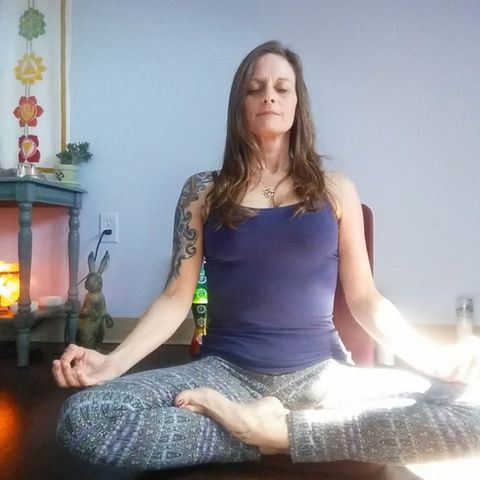
Change is possible.
Hi there.
Today I'm gonna share with you a bit about the brain,
Development things there,
And what it has to do with your personality.
Let's get into it.
Our brain develops from bottom to top.
Bottom is those survival parts of living.
The top is more related to impulse control,
Emotional regulation,
Empathy.
In case you were not aware,
Individuals who have trauma,
Especially early childhood trauma,
Or trauma that's going on in the environment while they're in the womb,
Their brain develops differently.
Say a baby's in the womb and the outside environment is hella chaotic out there.
Well,
Their body is going to primarily be working on developing bottom brain functioning.
In my work with pregnant women,
I often encourage them to try to view their body as a Zen center for the baby in their womb.
This will often help them bring in that moment of visualization to help push the pause,
Try to work on emotion regulation,
And recognize how they're digesting the world around themselves.
Now they come out of the womb into the world and it's still mad chaos going on out there.
Well,
Continued development in bottom brain functioning.
When a child is living in a home that has chronic cycles of chaos,
Abuse,
Or addiction,
This will often contribute to learning disabilities within the classroom.
It's hard enough as adults for us when we're experiencing a traumatic or unsafe environment and situation in our everyday life to then transfer into a sense of learning,
Focus,
And ease if we have to then go to work or something like that in the in-between.
Think now what it's like as a child in that environment and then we have them just go to school and we don't recognize how that's interfering in creating the learning disabilities and then they just get pushed into this category of having a learning disability and not looking at what can be done to help with the mental health situation to create the focus so it can open up that part of the brain for them to be able to learn.
See what I'm saying?
This is like so interconnected in every pocket of life and just varies depending on the age of the person.
And there's so many ways we can address it by addressing the mental health and giving the tools and the support and the understanding to heal.
That can happen as adults too,
Where maybe in adolescence or adulthood,
We face and go through and experience a significant trauma.
Well,
Yeah,
We might've had the top brain development,
But there's a shift there that then can occur where we're just in bottom brain mode.
It's why we might find ourselves in chronic states of hypervigilance or we can't trust anybody or sometimes people even get what's called agoraphobia,
Where they really can't leave the house.
There's a lot of stuff that can happen there.
And part of it is how the brain develops.
We are well aware now that some areas of the brain that are associated with emotion regulation,
Empathy and impulse control are not even fully connected until the age of 25.
That number even gets pushed further if the individual experienced trauma or has a history of substance abuse.
It doesn't mean though that a mental health medication is the answer for that.
Keep in mind,
There's patterns,
There's ways we disconnect or disengage with self that we can learn to do different so we can move through life different.
And this then starts to create some of that change in the structure of the brain as we're learning.
There's that neuroplasticity part where brain structure can change,
Cells can get rejuvenated,
We can take different highways that maybe we're used to taking.
So we wanna be mindful if we are looking for a medication to numb out,
To not experience.
And what does that exactly mean?
We have emotions.
Emotions are important.
I will never teach anyone to not have this,
That or the other emotion.
Someone's seeing me for anxiety,
I'm not gonna teach them not to have anxiety.
Even people who see me for anger,
I'm not going to teach them not to have anger.
It's about regulation,
Understanding and having curious compassion around our emotions and to be able to stay in our body to experience them in order to regulate.
Unprocessed emotions are expressed as repeat patterns.
This also can lead to us experiencing those unprocessed emotions as disease in the body.
It is also not this thing that is placed there for you to be in a chronic judgment cycle towards yourself or feelings of hopeless,
Helplessness that this is just you,
Back to that kind of emotional reasoning,
Right?
This is a part of an experience you are having that maybe you need some support around,
Some tools and some understanding of those deficiency areas and how to build them.
In all of this,
It is important to recognize healing is a personal responsibility.
If we have these things happening,
It doesn't give us an excuse then to harm another through our actions and our words.
It also does not mean that we are supposed to openly accept this kind of behavior from another in this awareness.
Boundaries are important.
This awareness does not mean accepting unacceptable behavior towards you.
That's where boundaries come in,
Even if it means having to not have any contact with the individual.
This though is about awareness so we can be a little bit more aware of the reality of the things that are happening that create this stuff instead of just blindly walking around in the way that we are doing in some capacities.
A very common one,
That's why I said,
I feel like I need to do a whole separate thing on personality stuff so that people can consider not continuing to escalate and just throw out these terms if they don't even know what they're talking about and they place this,
Oh,
You're borderline or,
Oh,
They're a narcissist or,
Oh,
They have antisocial personality disorder when it's not the case.
And I just wanna make something real clear here and I'm gonna use borderline personality disorder as an example.
Even if someone has the characteristics say,
Some of the patterns that an individual might be looped into,
Personality stuff,
When it is on that dialectical kind of track,
When it goes too far,
It might create challenges and how people move and engage in life.
But the symptom stuff here is about unresolved,
Unhealed trauma.
Dialectical behavior therapy was specifically started for helping women who had borderline personality disorder,
Who had chronic states of suicidality.
It continued to expand well beyond that and is helpful for people who are working through all kind of life things because it's very skill-based,
It's very tool-oriented and so it helps to empower the individual in self and recognize their strengths and some things that could be healed there that would assist them to build relationships with self and others in a different way.
So if you think about how people are just like blasting these labels out there,
Well,
Those labels,
If people are meeting some of those symptoms,
It is someone who is struggling with some life stuff,
Someone maybe who has had to go through some pretty significant trauma in their life.
The DSM-5,
Which is the diagnostic manual for therapists,
Psychiatrists,
People in the mental health field,
They even changed with the DSM-5 how to go about diagnosing someone with a personality disorder.
It has a long way to go,
But it's moving,
It's changing and know that even to diagnose somebody with a personality disorder,
You have to be seeing a therapist for an extended period of time so that we can work through what is trauma.
A longitudinal study happened,
For example,
Where they looked at individuals who were diagnosed with borderline personality disorder.
They followed up 10 years later,
Same checklist to see if they were meeting qualifiers for that disorder.
80% of those individuals no longer met the criteria for that diagnosis,
Showing about how change is possible,
Symptom resolution is possible through healing,
Through understanding,
Through gaining tools of emotion regulation,
Self-esteem,
How to compassionately look at another through empathy and how to have intimate relationships with others without fear or lack of trust.
And I'm not just talking about sexual relationships there.
Thanks so much for joining me.
I will talk to you again real soon.
Have a good one.