All right,
Well let's go and get started.
So I got in a storytelling mood earlier today.
Somebody was asking me about what to do with distraction in meditation,
And it got me thinking about Siddhartha's final night of meditation before enlightenment and the story of Mara.
So I thought I'd just sort of riff on that for a couple of minutes and I'd like to do a little reading short piece from the Dhammapada.
So without going into the whole story of the Buddha,
Six years after leaving his life in the palace,
After six years in those torturous rigors of aestheticism,
You remember Siddhartha was near the point of death.
And having collapsed near a river and nursed back to health by Sujatha,
A girl from a nearby village,
Siddhartha made a vow.
He would sit beneath a tree in the forest and not rise until he had attained awakening,
And he sat all night beneath the full moon of May.
Now Siddhartha gained many insights during that night,
And as he approached full understanding,
Mara,
A demon of unwholesome choice and the death of spiritual life,
Mara appeared before him,
Determined to stop Siddhartha's awakening.
Now first Mara tempted Siddhartha's sensual desires.
He sent his three daughters,
Lust,
Thirst,
And discontent,
To seduce Katama with their feminine ways.
They danced and they sang before him,
But Katama told them he was beyond temptation of the body and that they should return to their father.
Then Mara tried to rouse Siddhartha's fear,
Threatening him with a vast army,
And Siddhartha sat unmoved and said mere numbers do not make the strength of an army.
If wisdom is the source of power,
A single hero can defeat countless soldiers.
And the army then advanced,
And monstrous beings with lion heads and wearing human skulls,
And Mara used the army to frighten Siddhartha by shaking the earth,
Uprooting trees,
Devastating the landscape.
But the arrows which rained down to wound Siddhartha became flowers as they fell,
And the army ran in fear.
Next Mara tried to make Katama feel ashamed of his efforts by telling him that he'd failed his family and society by leaving the palace,
Not doing his duty as the prince,
As a father,
As a husband.
But Buddha continued to meditate and ignored Mara,
Knowing that his purpose was pure.
Finally in desperation Mara claimed that the seat of enlightenment rightfully belonged to him and not to Siddhartha.
By what right,
He demanded,
Do you,
A mere mortal man,
Make claim to the approach of enlightenment?
And Mara's monstrous soldiers cried out together,
We are Mara's witnesses.
Mara then challenged Siddhartha,
Who will speak for you?
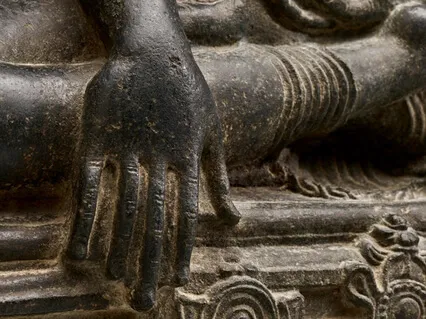
And Siddhartha reached out his right hand to touch the earth,
And the earth itself spoke,
I bear you witness.
And Mara disappeared with a shriek.
And as the morning star rose in the sky,
Siddhartha Katama realized enlightenment and became a Buddha.
The Dhammapada is one of the most ancient of Buddhist texts and there's a translation if you ever get a chance to see this book,
The Dhammapada,
Translation by Gil Fronsdell.
It's quite good.
I want to just read a short section from this called The Mind.
The restless agitated mind,
Hard to protect,
Hard to control,
The sage makes straight as a fletcher the shaft of an arrow.
Like a fish out of water thrown on dry ground,
This mind thrashes about trying to escape Mara's command.
The mind hard to control,
Flighty,
Alighting where it wishes,
One does well to tame.
The disciplined mind brings happiness.
The mind hard to see,
Subtle,
Alighting where it wishes,
The sage protects.
The watched mind brings happiness.
Far ranging,
Solitary,
Incorporeal,
And hidden is the mind.
Those who restrain it will be freed from Mara's bonds.
For those who are unsteady of mind,
Who do not know true dharma,
And whose serenity wavers,
Wisdom does not mature.
For one who is awake,
Whose mind isn't overflowing,
Whose heart is not afflicted,
And who has abandoned both merit and demerit,
Fear does not exist.
Knowing this body to be like a clay pot,
Establishing this mind like a fortress,
One should battle Mara with the sword of insight,
Protecting what has been won,
Clinging to nothing.
All too soon this body will lie on the ground,
Cast aside,
Deprived of consciousness like a useless scrap of wood.
Whatever an enemy may do to an enemy or haters one to another,
Far worse is the harm from one's own wrongly directed mind.
Neither mother nor father,
Nor any other relative,
Can do one as much good as one's own well-directed mind.
We don't talk a lot about that kind of mental instability that is distraction,
But everything that we talk about in Anapanasati meditation addresses it directly,
Looking at the things that arise,
Not attaching,
Not pushing them away,
Everything we've always talked about.
If anything just runs their cycle of a rising being and falling.
And there's a lot of things of a rising being and falling.
And there are plenty of images in different sutras that talk about how to deal with it.
You know,
I really like the one,
An image of a rotten peg in the kind of construction that is wooden peg construction.
A rotten peg where the carpenter will come and take a new peg,
A wholesome peg,
And drive it through the hole,
Knocking out the unwholesome peg and replacing it with the wholesome.
There are,
You know,
As I say,
A variety of metaphors of that sort.
But I'll tell you one of the best things that my teacher,
Sam's teacher as well,
Teshin,
Said to me.
I was doing Dokasan with him recently and I was talking about distraction and,
You know,
The sort of thing.
And,
You know,
I've talked to him about it before because I've been meditating for years and distraction can still be an issue.
It is for everybody.
And he looked at me and says,
You know what,
Sheldon?
I said,
What?
He said,
Just don't put up with that shit.
But interestingly,
That is sort of another piece of advice from sutras.
You can do the wholesome peg driving out the unwholesome peg and all these other metaphors.
But finally what it comes down to,
The sutras say,
Is you just gotta grit your teeth sometimes and say enough.
Enough.
So that's my word for today.
Just don't put up with that shit.
Sam,
Don't tell him I said that.
All right.
Let's go ahead and sit.
Find a comfortable,
Upright position.
Think for a moment about aligning your body.
Ears over your shoulders.
Head erect.
Shoulders relaxed.
Eyes open or gently cast down.
Your hands in your lap in a meditation mudra if you use one or just relaxed on your thighs.
Take a few breaths and just feel yourself root into your position.
So you do so.
Let a sense of mindfulness rise up within you.
Feel it gently begin to stir.
And with each breath grow more strong.
And welcome it as an old friend.
So let your mindfulness settle onto your breath.
Come to know the nature of your breath.
Its length.
It's depth.
I encourage you to let your diaphragm expand as you inhale.
Feel it contract as you exhale.
Feel your lungs.
Mindful of each inhalation and each exhalation.
Our sutra says simply breathing in I know that I'm breathing in.
Breathing out I know that I'm breathing out.
So so and as your mindfulness deepens and grows expanded out to encompass your body.
Your entire body.
Feel at once all points of yourself stable in space.
Feel the energetic flow of your body.
Find a union body and breath.
Remember our body and our breath are impermanent.
Like everything else they do not last.
Her body is like a clay pot the dhammapada said.
Here for a moment serving a purpose and then gone.
One breath starts and finishes before the next.
Each breath changing within itself.
All things subject to change.
And we greet things with non-attachment.
That's so much of our practice.
Open-handed release.
So Let your mindfulness of body and breath begin to move into that peripheral awareness.
Bring your mindfulness to the feelings.
Our reactive patterns.
What we encounter in our days.
People with situations.
They can bring challenges to our practices of loving kindness compassion equanimity.
And we have reactive feelings which can be difficult.
Consider the feelings you've had today.
Consider the feelings you've had in recent days.
Are there patterns you can learn from?
The blessing of course is that feelings like the body like the breath are in their nature impermanent.
Anger sadness disappointment.
They flash up and fade away.
And we let them.
Without clinging.
Without aversion.
We learn to see these things rise.
To exist in their being and then fall.
And if we don't hold them they will.
And understanding of impermanence and acceptance of impermanence.
As the nature of reality.
Shows us the futility of clinging.
And with attention you can see the difference.
When a feeling arises.
The difference between being and swirled in it.
And standing slightly apart observing.
And it's in the observation that freedom lies.
And as we grow skilled in this.
We find we are able to calm our feelings.
Let your feelings calm now.
Let them allow us to live SYSTEM see Just this much calming of body and breath,
Calming of the feelings.
Such a gift we can bring to ourselves and by extension that we bring to others.
That sense of calm,
That sense of contentment.
Yet as our feelings calm,
It opens the doorway to greater work,
Higher in sight.
Because as the feelings calm,
Our mind is revealed.
Let mindfulness of the feelings move into that peripheral awareness and bring your attention to your mind.
Perhaps it's calm,
Perhaps it's roiling with things that have happened in your past,
Fears that you have for the future.
There are deep things here.
Thoughts of joy,
But suffering thoughts as well.
Take a moment to feel your body and your posture.
Find your breath for one or two good mindful breaths.
And then bring yourself to your mind.
Understand that thoughts rise.
And it is so easy to cling to the things that are joyous or happy.
It's so easy to engage in a version of pushing away the things that are painful.
We get so trapped in that.
Instead just let your mind be like a clear surface of water.
And there can be waves on the water.
But each wave really is just comprised of the water itself.
Each thought,
Emotion of mind.
And like the feelings,
Like the breath,
Like the body,
Our thoughts are impermanent.
The sadness we feel today,
The anger,
The joy,
They will disappear.
And we can hasten that by practicing with open hands.
Neither grasping nor pushing away.
Simply allowing thoughts to rise.
To be in their nature and to fall.
And as we do,
Our mind begins to calm.
A practice of non-attachment at first may be quite steady.
One thought after another,
One release after another.
But over time and with practice,
We can find spaces in between.
The rising and falling thoughts.
Spaces of clarity.
Emptiness.
And in this we can gladden our mind.
Gladness for the practice.
Gladness for its result.
And with a calm mind,
Our concentration grows.
We begin to find a sense of liberation.
Over time,
The futility of clinging and aversion becomes so clear.
The benefits and meditative joy of non-attachment so clear.
What it might be to meditate in a state free from attachments.
Where there is no need to cling,
Nor to push something away.
Rather to be and breathe in a sense of equanimity.
The cessation of attachments is the 14th step on upon a sathy's 16 steps.
Datity is challenging.
The practice of all manpower.
.
.
.