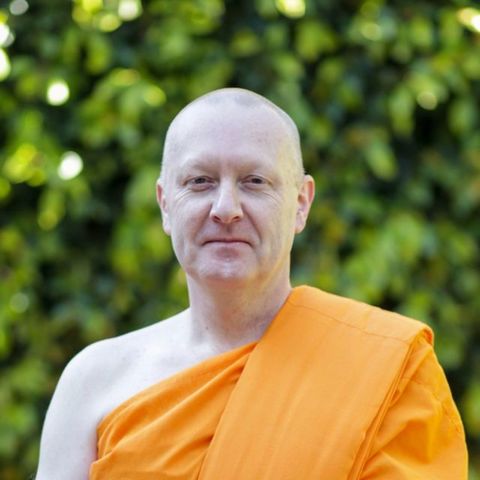
Last time you saw me,
We looked at blessing number 16 on Dhamma practice.
With the Dhamma talk today,
We will continue in the Pillar of Society subsection of our series on Enlightened Living to the next blessing,
Blessing number 17 on looking after one's extended family.
One thing often remarked about the teachings of the Buddha are that they become successfully deeper in the order in which they are taught.
It's never been the Buddha's style to skip over the important details.
The Udāna-Zubō Sutta compares the Buddha's teachings to a coastline which gets progressively deeper as you go further and further out to sea,
Until at its furthest extent it reaches to the deepest point at the bottom of the ocean.
It's not like suddenly falling off the continental shelf into some sort of ocean rift.
If you learn the teachings in order they were intended,
You will appreciate a gradual progression of complexity.
It's not like mundane tasks where you can tick the boxes in order of convenience.
This is why in Dhamma practice we always need to start with ourselves before gradually expanding the circle of influence of our good deeds for the benefit of those around us.
With the 38 blessings,
We start with ourselves,
Learning about how to do good deeds before going on to make ourselves useful to society.
Once we've taken care of ourselves,
Only then can we turn our attention to looking after others in our family.
We start by looking after our parents,
Offspring and spouse.
Once our close family is harmonious and well-provided for,
We can enlarge the influence of our good deeds further to look after our extended family.
From our extended family we potentially can spread the goodwill further until it extends to everyone in the world.
Caring for extended family looks superficially easy,
But in practice it can be soul-destroying.
On one hand,
There are families where everyone chips in to help each other set themselves up properly in life.
Particularly,
There are many examples where the internal politics are so complicated that no one would want to get caught in the crossfire.
This is why care of extended family isn't tacked on as a continuation of Blessings 11,
12 and 13.
You'll notice that the intervening blessings between harmonious close family and extended family are teachings on non-procrastination in the workplace,
Effective generosity and doing what is just.
Some people might think this just to be a coincidence,
But there is a reason why looking after our extended family comes much later than looking after our close family.
First,
It is not so urgent as looking after the members of our close family.
Secondly,
It is a major investment of time,
Energy and money.
And lastly,
If done in a clumsy way,
It may be misunderstood as favouritism or nepotism.
This is why we need to know how to earn our living in the proper way first so we'll be financially secure enough to help others.
Also,
We have to be free of prejudice.
Otherwise,
Favouritism will creep in as our motivation for helping those around us.
Instead of making the world a more peaceful place,
Our clumsy attempts at largesse will make the world worse rather than better.
So to know the right way to care for family,
It is useful to divide up those we know into two categories.
Our close family,
Which would include our parents,
Husband,
Wife,
Parents,
In-law,
Sons and daughters.
And then our extended family,
Which would include everyone else in our family I haven't mentioned yet,
Whether it be aunts,
Uncles,
Cousins,
Grandparents,
And strangely enough,
Also our brothers and sisters.
I understand the reason they put siblings in the extended category is the common problem of infighting over things like contested inheritances.
Apart from our blood relations,
Extended family also includes those who we trust and care about,
Close friends,
Spiritual teachers and fellow spiritual practitioners.
For the group of our close family,
Because of our debt of gratitude to our parents or because of husband,
Wife or children involves some degree of voluntary commitment on our part,
The way we would fulfil our emotional bank account towards them needs to be more unconditional.
As for extended family,
Since the degree of expected commitment is less,
You don't see them every day or have to live with them,
So similarly the expectations for how much support you would give them is less.
In other words,
The way we might fulfil our emotional bank account to extended family would be more conditional or on a one-off basis.
Sometimes we're not sure of the size of our extended family,
Both our blood relations and our trusted friends,
But we will surely find out when we are in times of need.
The Vice-Abbot of our main temple in Thailand,
The Venerable Dattachewo,
Likes to tell a story from the pioneering days of the main temple in Thailand about a young man who volunteered his time and skills when the temple was being built.
Once the scaffolding had been taken down,
There was a lot of surplus lumber.
The young volunteer had not yet set himself up in life and had no house of his own,
So the Vice-Abbot donated him the lumber to build himself his first house.
The young man was very appreciative of the gift,
But he confessed that if he had to work on the house himself,
Since he could not afford to hire a carpenter,
It would take him many months to complete.
The Vice-Abbot asked him how many people he had in his family.
He said that he was related to practically everyone on the waterfront.
The Vice-Abbot said that within a few days of starting to build the house,
He would know how many members he had in his extended family.
The Vice-Abbot suggested he go around to everyone he thought might be a member of his extended family and explain that he was short of the wages he needed to employ a carpenter.
The man followed the suggestion,
Going around to everyone whom he thought he had a connection to.
And it turned out that all along the waterfront,
No one agreed to help him except for two people.
His stepbrother,
Who lent him what he could,
And a farmer from another province,
Who had stayed in the family house of the boy when he had first arrived in town and was looking for a place to stay.
That's why from thinking he had relatives all along the waterfront,
It turned out that in actual fact he had only two people who were his true extended family.
One was a blood relative,
Another was a neighbor who remembered a favor.
When we are young and healthy,
We assume that we could live independent of others' help for as long as we tend to think that everyone else ought to be independent too,
And consequently turn a deaf ear to others' pleas for help.
A longer-term view of life,
However,
Shows that with or without a welfare state,
It's only for a fairly limited part of our lives that we can expect to be independent from others.
Whether we are too young or too old to look after ourselves,
Sick or injured,
We will need to reach out to others for help.
In times of natural disaster or falling foul of the law,
Our life may lie completely in the hands of others.
Even during life's rites of passage,
Starting out in life,
Getting married,
Or expecting a first child,
Those who are closest to us can help to smooth the journey.
Without help from others,
We will be like a lone pine,
Exposed and protected to the wind that will soon be uprooted,
Unless given the support and shelter of the other trees in the forest.
So although we have seen the reciprocal relations between members of close family,
We also need to have realistic expectations about give and take for our extended family as well.
The important thing to understand about helping our extended family is that it promotes the unity and solidarity of our family and society at large.
It allows the family or the society we live in to maintain a certain level of shared or collective merit.
However,
In a family or society where there are few troublemakers who do nothing to care for our extended family,
They can undermine the reputation of the family or society at large.
For example,
Up until around 1996,
All Thai people were given a visa waiver to enter New Zealand.
But later,
A handful of Thai drug dealers gave the nationality a bad name,
And after that,
The visa rules got changed.
There are many international organizations campaigning for human rights and world peace.
However,
The Buddhist approach to creating peace was slightly different.
We propose that we should try to reach out to everybody in the world as if they were our extended family.
Lompot Atachiwo often used to give the blessing,
May you be a parent to the whole world,
Which doesn't mean begetting a huge number of offspring,
But rather to have a capacity to treat everyone in the world compassionately as if they were your family.
For as long as there is a them versus us mentality,
There'll never be enough peace organizations to bring an end to gang warfare on the streets,
Let alone peace to the world.
The thing which really can help the situation is the sincere belief in human potential that other people of the world can be their true extended family.
However,
The Buddha didn't claim that if everybody in the world is an extended family member,
It will give rise to happiness.
He merely said that help your extended family and it will bring results.
And by results,
He meant harmony or unity in society.
You cannot start by making the world over there peaceful,
But you have to start small and local with the building blocks of society closest to you.
And that means our relations with our extended family.
Looking out for extended family uses the same set of virtues called the four bases of sympathy or Sangha Hawato that we met up with in the subsection on family harmony.
However,
The ways the four bases of sympathy are applied to the extended family,
As we shall see,
Are much more conditional than for our close family.
For example,
In the Buddhist style of doing things,
You might give a person three chances when helping them.
Three strikes and you're out.
In other words,
The first way to help might be to help with the resources,
Otherwise known by the technical name of Dhana.
This means giving or lending whatever we can spare,
Which are useful to our extended family.
Although I will come back to the problematic issues of cash handouts later on,
At this point,
It's important to realize that if we have not fulfilled blessings 14 and 15,
By working diligently and being used to generosity,
We'll have a hard time when it comes to looking after extended family.
Instead of assuming that an income enough to cover our own basic needs ought to be enough,
We ought to have a plan for the eventuality that our extended family may at some time need to fall back on us and put aside some savings accordingly.
If anyone comes to us in need,
At least we will not lose their friendship.
If we can't afford to lend them money,
We can at least give them advice.
When we can't give them advice,
Then maybe we can give them the bus fare to reach the house of someone else's friends who might be able to help more.
Second principle is that of endearing speech or Piyawaja.
This means speaking in a way that is not at all upsetting to our extended family and not looking down on them either,
Especially if we have to turn them away without giving them all they've asked of us.
Don't be afraid to sit down and listen to a family member who is asking for help.
While money may seem to be the easiest way to make a problem go away,
If you listen carefully enough to find a long-term solution that guarantees that the family member won't need future handouts,
This would be doing them a greater service.
Endearing speech may also mean having the tact and forethought to explain that you can only bail them out one more time and ask them to choose whether this is that time and then stick to it.
Sometimes hearing the polite word no can be a catalyst for a person to be more creative and look for other more sustainable ways to become financially independent.
Just make sure that you are saying no for their long-term benefit and not out of cowardice or selfishness.
Third principle is that of lending a helping hand or Atacharya.
This means helping out our extended family when they have work to be done.
Even if you don't have money to lend,
You are still strengthening the bonds of friendship with your extended family by giving them a helping hand.
The final principle is that of being consistent to one's duty or Samanatata.
This means behaving towards our extended family in a way that will not create suspicion.
Even if they are poorly educated and inadvertently put us in an awkward situation like turning up unannounced at our place of work,
We should still have the magnanimity to treat them acceptingly while only mentioning any possible faux pas when the situation is more relaxed on both sides.
Harmony with our extended family is important because often the case that dangers that affect our extended family may eventually come home to roost and affect us too.
In this connection there is one of the early birth stories of the Buddha called the Vatacajataka where the Bodhisattva is born as a quail.
At that time there was a fowler who baited the flock of quails by imitating their cry.
Whenever the flock settled down in one place,
He would throw a net over the flock and capture them.
The Bodhisattva suggested that whenever the fowler caught them under the net,
If they were synchronized in the way they flew up into the air all at once,
They could escape from the fowler by carrying away the net.
The quails followed the Bodhisattva's plan and the fowler had to return empty-handed for many days to face his disappointed wife.
One day however,
Two of the quails started quarreling and though the Bodhisattva had warned them in advance of the consequences,
They continued their wrangling.
The Bodhisattva realized his plan for synchronized flying would not work anymore,
So he picked an opportunity to move away from the flock with the most loyal of his followers.
When the fowler returned and threw his new net,
Then two quails were still quarreling and this time he was able to capture the whole of the remaining flock.
We have already mentioned that help for the extended family ought to be conditional and part of this means that we need to pick times which are particularly important to offer help and in this respect there are certain times when people have particular need of the support of the extended family around them.
Such appropriate times for one-off gestures come under the broader headings of physical need,
Crisis or rites of passage.
Physical need means when members of our extended family are incapacitated by age or illness.
Crisis might mean when our extended family falls on hard times or are victim to a natural disaster.
We might take in an orphaned child from our extended family.
In terms of rites of passage,
An appropriate time to invest in our extended family might be when they're getting married or setting themselves up in their working life and they need an extra opportunity at a higher education or a travel bursary.
If a member of our extended family is unjustly had up in court,
We might agree to testify in their defense.
A time for the story and this time it is the example of how the Buddha taught by example that monks need to care for others in their community.
Once the Buddha happened to see the sorrowful state of a certain monk called Tissa who I think was affected by dysentery.
The monk had been meditating diligently until becoming afflicted with that disease and he had stinking open sores covering his whole body.
Because of the smell he had been abandoned by his fellow monks.
The Buddha knew that Tissa would soon pass away but he had the potential for enlightenment.
So he proceeded to the fire shed close to the place where the monk was staying.
There he personally boiled some water,
Went to the place where the monk was lying down and took hold of the edge of the couch.
It was only then that the monks also gathered around him and following the Buddha's instructions they carried the whole couch to where the monk could be made more comfortable.
While he was being bathed his robes were washed and dried.
Subsequently the sick monk was soothed and could recover one-pointedness of mind.
Standing at the head of the couch the Buddha instructed him that the body when devoid of life would be as useless as a log and would be laid on the earth.
As the conclusion of the sermon Tissa died and attained final release into Nirvana.
The Buddha then directed some bhikkhus to cremate his body and enshrine his relics in a stupa.
Subsequently the Buddha taught the remaining monks having taken ordination you have no relatives to whom you can turn.
If you fail to tend to each other who will there be to tend to you?
From now on regard the merit of attending a sick fellow monk as equal to the merit of attending me.
This is probably our only opportunity in the 38 blessings to discuss the principles of giving welfare.
So the extended family is like a placeholder for any welfare work we may get involved in as a pillar of society.
The book Robert D.
Lupton published in 2011 called Toxic Charity gives us startling statistics that in spite of one trillion dollars in benevolent aid to Africa over the last 50 years country by country Africans are far worse off today than they were half a century ago.
Rather than discouraging charity however he recommends that when giving charity we should never do for the poor what they have or could have the capacity to do for themselves.
Limit one-way giving to emergency situations,
Strive to empower the poor through employment,
Lending and investing,
Using grants sparingly to reinforce achievements,
Subordinate self-interest to the needs of those being served,
Listen closely to those you seek to help especially to what is not being said,
Unspoken feelings may contain essential clues to effective service and above all do no harm.
As most of us do not get to be the commissioner responsible for national foreign aid probably the closest we will get to major welfare projects might be the sort of situations where we are asked to intervene with personal funding on behalf of members of our extended family who claim to be in need.
However many of Robert Lupton's principles still apply even from the point of view of Buddhists who are generally assumed to be quite a soft touch with regard to helping people.
As with many of the Buddhist values in the 38 blessings I have had to think long and hard about adapting the advice about extended families given in this 17th blessing for the benefit of audiences in the West because unfortunately individualistic societies tend to underestimate the value of family life.
Often Westerners have very sophisticated ways to justify staying selfish.
Meanwhile in many other places around the world including countries where Buddhism is the dominant religion family take care of each other and this means family that doesn't just include spouse and kids.
The attitude in such families is that of course it's better to make a fuss when someone doesn't attempt to work and just leeches off others but for many others who are just having a rough time for once in their lives there's nothing wrong with some monetary support.
There is an expectation that families will work together and support each other to make sure every member of the family stays on a successful financial level.
When a child is supported through school and graduates and lands that great paying job there's an expectation that they will give back to the family and teach the same to their children so that no one ever suffers.
The assumption is that even if you get a good job as a result of your education and earn your money it's not really your money to keep.
It's like your family or extended family have a claim on that money too.
In such societies people are often generous to a fault.
If you are the guest in the house of an Asian,
Indian or Latin family you will often get to sleep on the family bed while the owners of the house choose to make themselves comfortable on the floor instead of offering guests the couch.
But even some Asians who have lived in the West for many years have problems when they go back to visit their family in the East if they are unable to remain level-headed.
When they go back to their home country to visit they are often confronted with a long line of extended family members asking for money to buy land,
A new car,
A taxi permit,
To pay off damages or hospital bills,
All big sums of money.
And even though those relatives haven't been in contact with them for years some Asian expats are so frustrated when they go back to their home country that they go on holiday in secret without letting anyone but their own parents find out.
Otherwise they'll be subject to emotional blackmail.
Especially in Asian society family can be a very emotional issue and even seasoned Buddhists can forget that there is a fine line that needs to be drawn between helping people in need and being taken advantage of which if you do not draw it will force you to put a price on your friendship.
So in finding balance between full-on Asian family values and the individualistic West what I proposed in this blessing is a compromise which neither Asians nor Westerners would find fully satisfactory perhaps but in my opinion it seems to align with the teachings we have received from Buddhism whereby you remain as generous as you can with your extended family while putting yourself,
Your spouse and your kids first.
As you'll see when it comes to helping those beyond our close family the most important principle for welfare is where possible to solve any problem at its root.
When a family member asks for money most of us feel compelled to help because we wouldn't want to be considered the sort of person who turns their back on their family.
According to a blog by Thursday Bram of Portland Oregon as tempting as it is to offer a handout it may not always be the best solution to the problems experienced by our extended family.
If we are left financially burdened by family members painful conflicts may arise and ultimately it may not actually lead to our extended family member recovering stable financial standing.
This is why it's worth considering alternatives before simply pulling out your wallet.
Five things you can do to help members of your extended family that don't involve cash handouts include firstly teaching them financial common sense.
If your relative is in a position where a little more information could help more than money then provide this advice instead because some financial hardships grow out of the lack of knowledge more than a lack of cash.
Simply knowing that you can request changes to your credit card can be a big leap for some people.
If they're having a hard time getting a job you might help them write their resume.
Without patronizing them you might teach them how to budget,
How to learn employable skills,
Ideas for starting a small business,
How to save for a rainy day or how to live within their means.
The gift of self-reliance can bring people more peace confidence and contentment than any amount of money.
Second alternative is to offer a connection instead of cash.
Of course there may still be a short-term need for cash but the longer term need should be for something more ambitious like a job or a career.
You might ask around your network to see if someone you know can help with that long-term fix.
Introductions are often a gift more valuable than money can buy especially if through you they can meet someone who provides work business opportunities or a way to earn a little extra temporary cash to tide them over.
If you don't have connections who can help your relative a third alternative might be to provide an opportunity yourself for them to earn that money since otherwise many family problems can come out of short-term loans that don't get paid back or gifts with strings attached.
If you can give them a way to earn that money from you offer that instead.
It might be a home repair project or something a little more professional that your family member can work on.
You might buy something from that person that is access to their needs for example a push bike.
The fact that the money is earned rather than given can be surprisingly important and will keep your relationship with them on solid ground.
A fourth alternative might be to invest in your family member.
The cost of taking a class or starting a side hustle might be beyond what your relative is asking for but will likely have a much bigger impact on their own abilities to handle money troubles in the future.
By investing in that relative's potential you can be doing them a much bigger favor while ensuring that you don't get asked for money a second time.
Lastly there is always the possibility to say no.
You may face a request for money where the best thing you can do is to say no.
Telling that person that you can't help at this time at least financially can be a wake-up call to them.
If you are a little bit more soft-hearted you might decide not to help the offending parents but maybe you can show you are sorry for their kids by helping them out once a year with stuff they need for school.
Just be sure that a wake-up call is the best thing you can offer first.
Valid reasons you might have to say no might be that helping them is going to cripple you emotionally and financially.
For example you might be recently married and expecting your first child and you need to focus on building up a savings cushion for your child.
In other words prioritizing yourself and your immediate family who may be dependent on you.
If you prefer to avoid confrontation don't tell them anything else other than that you love them.
In theory they can't bother you unless you allow it or as a worst case scenario you might need to tell them that you will be away for a few weeks or months and you will get hold of them when you come back.
I don't think anyone has a problem with lending a hand to people who are just in a rough time at the moment.
Another way to think about conditionality is whether the extended family member is a worthy prospect for your help because some people are more likely to benefit from you and your help than others.
For those others,
And I'm not trying to be cynical here,
The help you give may make their problems worse or even come back to bite you.
So at this stage in the 38 blessings in order to become a pillar of society when helping others you cannot avoid having to be a judge of character for those in your extended family.
As a rough guideline my advice would be to give priority to families who make an earnest effort to help themselves first.
It would mean those who despite difficult circumstances are trying hard to overcome these and are willing to work in any capacity even if it is jobs they don't like whether it's babysitting or home decoration or selling off excess stuff in their home.
This would also mean that you can see they are working but they still need something or the things that they are working at in terms of money.
Secondly a deserving family should ideally be those who are of good conduct,
Well grateful,
Considerate and courteous.
Those to whom you should give less priority or those for whom you might need to say no might include those who have a problem with gambling or intoxicants especially if they use their money to play the lottery,
Smoke and gamble instead of paying bills.
The second category to say no to are those who never try to help themselves,
Who are too proud to apply for government help or would rather go homeless than choose a home within their means.
I guess you could call this category those who just take help for granted.
They don't come asking just the once but routinely ask for money and they seem to put more effort into getting money from you than they put into looking for a job.
Thirdly since managing money is a skill that in theory anyone can learn whether it be budgeting or spending within their means,
The person having financial common sense pointed out to them still doesn't take the initiative to fix the underlying issues and expects cash handouts instead,
No would be the appropriate response.
The fourth sort of person to refuse would be those with passive-aggressive blaming personalities who constantly complain that every one of their problems is due to someone else.
Lacking consideration for others they may be happy be helped the first time but when turned down on subsequent occasions they launch a character assassination on those who previously helped them with the attitude of don't let the truth get in the way of good story.
They will stalk you to your workplace and try to get to you through suggestible relatives with demands or a sense of entitlement to your handouts without any sense of conscience or reciprocity.
In short if you let a certain sort of person treat you like a cash register then you can't blame them for treating you like one.
This point I'd like to take a detour to a story about when hearing the word no can be a wake-up call that may alter the course of a person's destiny for the better.
In a real life story there was a guy called Marco who was between jobs and needed a mere 500 dollars to tide him over.
All three of his brothers turned their backs on him out of selfishness and judged him because they were working and he was not.
Even though they knew Marco had potential and was applying for jobs and actually had a possible job lined up to start in a month's time.
So when he got refusal from his family Marco kept himself to himself while continuing college until he could gain a bachelor's and qualified as a scientist.
One month after his graduation Marco started his own research company earning nearly 500 000 dollars in his first year.
It turned out that since he had his newfound wealth every family member and friend was now interested in him again and they came to him asking for handouts.
Marco could have avoided his family by hiding out in his lab but his grandparents had taught him that two wrongs don't make a right.
One of Marco's brothers had recently accrued a three thousand dollar child support arrears fine because he got laid off from a swanky trucking job that he used to brag about.
The brother had a warrant on him,
Got arrested and was sitting in prison with nobody offering to help.
Marco went to the child support offices,
Paid his brother's bill,
The court fees and had him released.
Marco's brother was shocked that it was Marco who helped him because he had lived far away in another state.
The only words Marco said to his brother were,
Mind how you treat me because you may need me again someday.
The moral of the story is never to turn your back on family.
Always investigate the root cause or circumstances before you choose to say no.
Sometimes there's a problem that needs to be solved that's creating the need for financial assistance.
If you fix that problem the request to borrow or grant a person money will stop.
Nevertheless we forget too easily that we are all dependent on someone.
So rather than judging people who may be going through hard times consider that one day you too may need to call on someone to help you.
Treat your family well because they are likely to be the first one to call who will hopefully be there for you when you need them most.
Without our family we end up lost,
Confused,
Ungrateful and unhappy individuals who want nothing but satisfaction from me.
One person without anyone to fall back on has very little strength.
So in search of a moral to this story I would leave you with the famous unattributed wisdom of the 60s bumper sticker,
Love many,
Trust few and always paddle your own canoe.
Apart from helping people with material things we also need to help our extended family with dhamma teachings.
To give dhamma to people is often even more important than physical things we give to them.
It can be especially important when we come to help members of our extended family who are already materially self-sufficient but who still feel that their life is meaningless or hollow.
You might give an aunt who complains about immobility a lift to the temple.
When she complains she says she is too poor to be able to contribute anything at the temple.
You can say that you've already prepared all the food and all she needs to do is to offer it.
Later as she gets more familiar with the customs of the temple she'll want to go to the temple without anyone prodding her and before long she will recover the habits of generosity,
Self-discipline and mindfulness without needing to lean on other people.
If you have a relative with a good job despite being childish and irresponsible you might persuade them to take a year out to live as a monk to get more level-headed perspective on life.
These are examples of looking after your extended family in a spiritual way.
To finish off with today I will leave you with a story of the Buddha who apart from working hard at his own enlightenment and spiritually looking after his close family also cared for his wider extended family.
There were several times in the Buddha's life when he helped out his extended family by stepping into overt war between conflicting factions in his family.
One example of this was when he prohibited the prince of Vidutapa from massacring Sakyens who had treated him with conceit and that's the story I'll return to in blessing number 33 and another time when he dissuaded prince Ajāsatru from declaring war on the Vajiyans.
However the story I want to tell you today is about a war on the banks of the river Rohini.
At that time the Sakyan and Kolian kingdoms were separated by the Rohini river.
The farmers of both kingdoms irrigated their fields from the river.
One day due to severe drought their paddy fields were running dry and the farmers in both kingdoms wanted to divert the water from the Rohini river to their own fields.
Since there was not enough water to go around there was a will and hatred between the farmers of the two kingdoms.
The quarrel that started between the farmers soon spread to the rulers and their armies.
Fearing to find a compromise both sides prepared to go to war.
The Buddha was related to the Sakyan kingdom through his father and the Kolian kingdom through his mother.
When he learned that his relatives on both sides of the river were preparing for battle to prevent unnecessary suffering he decided to intervene.
All alone he went and appeared in the middle of the river.
On seeing him the Buddha's relatives laid aside all their weapons and paid homage to him.
Then the Buddha admonished them asking what do you think is more precious irrigation water or your royal blood.
They replied our royal blood is more precious.
So he said for the sake of some water which is of little value you should not destroy your lives which are of so much more value.
Why have you taken this unwholesome course of action?
If I had not been here today your blood would have been flowing like this river by now.
You are living with hatred but I live free from hatred.
You are burdened by moral defilements but I am free from moral defilements.
You are striving to develop selfishness and enmity but I have released myself from selfishness.
Hearing his words both sides became ashamed of their foolishness and thus the bloodshed was averted.
So this session I have introduced to you blessing 17 on looking after one's extended family.
For my next session I'll move on to blessing 18 about blameless work which explains the benefits of right livelihood.
Hopefully as the result of today's session you will be inspired to look after your extended family and to extend your family to the whole of the world.
So for today this is me Praniculous,
Thanisro signing off for now.
So long folks and stay safe.