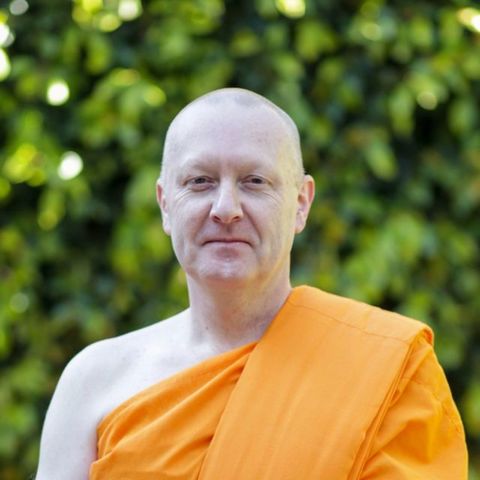
Last time you saw me we looked at blessing number 18 on blameless work.
With the dharma talk today we continue in our series on enlightened living to the next blessing,
Number 19 on putting temptations behind you.
I am going to frame today's session in terms of avoiding temptation while also delving deeper beyond overt habits of speech and action to look at the unwholesomeness that lies at various levels of subtlety in the mind.
The first 18 blessings can be considered to be the first half of the Mangala Sutta.
They are all concerned with improving overt habits in our lives.
Certainly upon the foundation of good character achieved in the first half of the blessings of life,
One can go on effectively in the second half of the Sutta to cultivate purity of mind by following blessings 19 through 38.
With blessing number 19 we come to the start of the sixth grouping which concerns itself with the preparation of the mind.
The sixth grouping includes blessing 19 on abstaining from unwholesomeness which you could characterize as temptations without physical dependency,
Blessing 20 on restraint from drinking intoxicants which you could characterize as temptations that also include physical dependency and blessing 21 on non-recklessness in the dharma.
The mind is fickle and easily influenced.
A person who is virtuous today can easily relapse into bad behavior tomorrow if their mind has not been cultivated to the point of steadfastness.
When you realize this weakness of the mind it implies that we have to upgrade the mind constantly towards something better.
If you really want to be sure that you will never do unwholesome things again then at the very least you need to attain enlightenment at the level of stream entry or Sotapanna.
For people who still fall short of this initial degree of enlightenment,
Although you can always praise and encourage their good intentions,
You can never entirely trust the working of the remaining defilements in the mind that they won't cause some sort of relapse.
Cultivating virtue can be compared to climbing a tree.
Trees have no branches at their lowest level.
The lowest branches are always several meters above the ground.
Therefore if you want to start climbing a tree you have to shinny all the way up the trunk before you can sit to rest on the lowest branch.
If you don't make it to the first branch,
Whenever you get tired you'll slide back down to the bottom of the tree again.
Only if you make it to the first branch you can be sure you will not backslide and you'll have a chance of tasting the fruit from the tree.
In the same way,
In the pursuit of virtue,
No matter how many years you've been cultivating good deeds,
If you still have not managed to attain the body of enlightenment or the Dhammakaya inside yourself,
You cannot be assured that one day if you let your guard down you will not slip back into your old unwholesome ways.
For most people in the world,
Unfortunately the default setting is to do the easy thing rather than to do the noble thing.
Slipping into unwholesome deeds may seem like our choice,
But beneath the surface of our minds,
According to the Buddhist wisdom,
It turns out that we are just behaving like puppets.
Being manipulated on the strings of darker forces or Mara in our minds has seemed to have a vested interest in us succumbing to bad karma.
In the beginning it may seem like taking the easy way out,
But in the end it leads to a long-term entanglement with suffering and regret.
You will of course remember my earlier lecture A.
0.
13 about the five different sorts of dark forces or gremlins that act as the puppet masters in our mind,
Namely defilements in the mind,
Physical health weaknesses,
Damaged reputation,
Gremlins personified and the fear of death.
Consequently,
Doing any good deeds is like swimming against the tide.
It needs much more patience and effort to go against default settings of temptation and defilements in one's mind.
However,
Although it may seem more difficult in the beginning,
In the long term it is something that brings happiness and meaning into our lives.
This is why to gain the steadfastness of mind and resist the temptation of slipping into the short-term convenience of unwholesome ways,
We have to study Blessing 19 concerning the avoidance of all unwholesomeness.
It's the first step in adjusting our quality of mind,
Adjustments that will continue in a way that becomes increasingly refined all the way up to Blessing 38.
You could say that the objective of today's blessing in the sequence is to draw a line under any overt bad habits that we may have had in the past.
Where the precepts may have been regarded as a work in progress,
In previous blessings we ought to be able to rely on them being intact at this stage and our integrity being impeccable.
By this point in the blessings,
Our demons should no longer be serious vices,
Not cheating on our spouse or shoplifting,
But to be called unwholesomeness,
They still need to be fairly serious,
Maybe married flirting,
Being a shopaholic,
Skipping off work early or succumbing to cheesecake while you are supposed to be on a diet.
I'm not going to deal with the alcohol as a temptation here because we'll come back to it specifically in the next blessing.
I'm also not going to mention the Christian approach to dealing with temptation where it tends to be thought of as singular or demonic.
But to give Christians credit,
They do have a lot of expertise that can be learned from.
Nonetheless,
I will stick to insights from Western psychology and counselling,
For which in the initial section of our topic on gross unwholesomeness,
There's a lot of useful life hacks offered.
Later we can return to the Buddhist approaches,
Especially to medium and subtle levels of unwholesomeness where Buddhism is more specialized.
So to return to our life hacks on the level of gross temptations,
Examples of the sort of situations I'm talking about where people feel the pull of temptation might be a scenario like a guy sitting in a singles bar,
Being careful not to look about too much in case he catches the eye of a woman,
Which would spell trouble for him.
Instead,
He finishes a Diet Coke with a final gulp and heads home to his loving fiancee.
Or imagine a lady going strong at three weeks into her diet and five pounds down,
No delicious decadent desserts or calorie ridden snacks.
But tonight her cravings threaten to breach her diet.
She's at her favourite restaurant celebrating a friend's promotion,
But all she can think about is the restaurant's famous chocolate lava cake.
In this case,
She gives in and indulges in a mouthwatering dessert.
For you,
Your weak spot for temptations might be different,
But you will know how hard you need to work simply to say no to powerful,
Persistent temptations.
It is a lot easier to resist if you have some idea about what to expect.
Most of the ten ways to deal with temptation I'll talk about today are things you can do to circumvent trouble.
So in advance of expected temptations,
You can recognise potential triggers,
Stay away from risky situations,
Visualise yourself resisting your pet temptation,
Avoid giving yourself a choice,
Make concrete plans,
Enlist a buddy,
Use technology,
Build skills through practice and only occasionally indulge yourself.
So let's start with ways to circumvent temptations in advance.
The first piece of advice to avoid temptation is to try to recognise potential triggers.
Temptation is all about self-control and tempting situations are often about the conflict between immediate gratification and long-term goals.
For example,
If you're on a diet,
You may be tempted to eat a delicious piece of cheesecake that's beckoning you from the deli case.
Immediate gratification would result from giving in to temptation and eating the cheesecake.
However,
Giving in would also interfere with your long-term goal of becoming more healthy by avoiding high sugar foods.
As another example,
If you're already in a relationship,
Become aware that other people might tempt you to cheat.
These people may be old flames that have come back into your life,
Your co-workers or people that you interact with in private settings.
However,
Temptation isn't always this obvious.
For example,
Say you're a business professional and you're tempted to knock off early on a Friday afternoon a few days a month.
A couple of early departures might not seem like a big deal,
But little by little this will signal to your employer that you can't be trusted with responsibility,
Which could jeopardise long-term goals such as promotion and advancement.
A second piece of advice to avoid temptation is to stay away from risky situations in accordance with the saying out of sight out of mind.
When temptations are at their worst,
It's best to avoid putting yourself in a potentially tempting situation.
For example,
If you're starting out on a new diet,
Throw away everything you're cutting out.
That way you won't be tempted to grab a handful of chips when you pass by the pantry or dip your spoon into a pint of ice cream sitting in your freezer.
Similarly,
If you're tempted to cheat on a significant other when you have private conversations,
Then get a family email instead or have a profile picture with your partner and child on your Facebook page.
If you can't completely remove yourself from a situation or a person,
Try to manage the situation so it is more difficult to act on your temptation.
For example,
If you're tempted to cheat with a friend,
Avoid one-on-one situations.
Always meet in a public place if you have to see that person.
A third piece of advice is to visualise yourself resisting your temptation.
A lot of the time we view a temptation as something we just can't beat.
We accept it along with our other flaws.
But that's simply not the case.
If you believe you can beat it,
You will have a chance.
If you're one of those people who doesn't have a lot of faith in your abilities,
It generally helps first to visualise yourself resisting the temptation.
This will give you the boost that you need to resist and beat your weakness.
Using this approach,
You picture yourself noticing or touching the tempting thing before putting it back and walking away.
Imagine this experience in as much detail as you can.
For example,
If you're trying to avoid candies,
Imagine holding a chocolate bar.
Picture smelling it and touching it before putting it down.
Once you've practised enough,
You might even purposely try to resist the temptation by going to the store and confronting your temptation.
However,
This approach is not recommended for intoxicants for obvious reasons.
A fourth piece of advice would be to avoid giving yourself a choice.
If you're tempted by something,
Remove any element of choice you have about avoiding it.
If you remove choice from the equation,
You'll have to refuse whatever's tempting you.
For example,
If you're feeling tempted to cheat on your partner,
Don't even act like you're interested in anyone else.
In the Thai language,
This is known as not letting down the drawbridge of your castle.
If you're struggling to stick to your low-calorie diet,
You could turn down invitations to holiday parties,
Likely to be full of sweets and rich foods.
However,
This option also limits your ability to socialise and interact with others.
So consider whether this is really the route that you want to take.
A fifth piece of advice is to make concrete plans.
Make an intentional plan or a resolution to yourself,
Such as,
I will replace cheesecake with an apple at every opportunity.
Or having a clear manifesto for yourself helps you focus on your longer-term goals rather than immediate gratification.
Framing your plans in terms of if-then may also be helpful.
For example,
You might come up with a scenario such as,
If I'm offered a piece of cake at the party,
I will say,
No thanks,
I'm watching my sugar and go start a conversation with someone else nearby.
A sixth piece of advice would be to enlist the help of a buddy.
You might find someone not subject to your temptation to act as a sponsor to keep you to your commitment.
Obviously,
For this to work,
You need to be honest.
If you're denying your temptation,
It won't work.
If you can be honest about why you're refusing something to a third person,
It will strengthen your resolve in the future and may even reduce the temptation.
If you find it hard to say no to something,
Like another piece of pie,
Ask your partner or a buddy to remind you.
It's often helpful to simply tell someone that you're tempted.
If you can find one where you feel comfortable,
Support groups can also be a great way to get help when you're trying to overcome an addictive behavior.
If you tell a person upfront that you're already in a relationship,
They will usually be less likely to flirt with you in the future.
You might even try competing with a buddy with a simpler temptation.
For example,
If you want to exercise more,
But are having trouble,
Challenge your friend to see who can lose more weight or log more time at the gym.
A friendly competition might be all you need to ensure accountability to yourself and each other.
So be sure to agree on the terms of the challenge before you both begin.
The seventh piece of advice would be to make use of the available technology.
Hold yourself accountable by using apps or computer programs that allow you to track your habits.
If you're trying to avoid spending money,
Use budgeting software to monitor your spending.
Or if you're watching your weight,
Use an application on your phone to keep tabs on what you're eating or scales for your weight or an app with a graph.
Using technology can also let you know when you are more likely to give in to temptation.
For example,
You might notice that you're more likely to overindulge on the weekends.
An eighth piece of advice would be to build up your skills through practice.
Many research studies have shown that you can develop self-control through rehearsal.
Rehearsing also increases your self-control and lowers your impulsivity.
Just like your physical muscles,
Your self-control muscles will get stronger with routine exercise.
One way to practice is to rehearse changing or breaking an unconnected habit,
Even a trivial one.
So if you notice,
For example,
That you always brush your teeth starting on the right side of your mouth,
You might make a conscious effort to start on the left side instead.
Setting a daily routine is another way to practice.
For example,
You might make a plan to get up at 7.
30 a.
M.
Every day,
Including the weekends,
And eat a cooked breakfast instead of grabbing a donut.
As you practice this routine,
You develop your self-control skills.
You can also try to practice self-control in more meaningful ways,
Such as making the decision to bike to school twice a week instead of driving.
Getting yourself in the habit of setting goals and following through will help you to build your self-control muscles.
A final piece of advice would be to indulge yourself occasionally.
Again,
This would obviously not be good advice for intoxicants.
We typically crave what we can't have,
So the more unavailable or forbidden an act,
The more we obsess about it.
Therefore,
The trick to dealing with certain temptations is occasionally treating yourself to them in a moderation.
Allow yourself a cheat meal every now and then.
This way you're still in control and your temptation won't weigh too heavy on you or take over.
However,
This tactic might not be effective for certain individuals or in specific situations.
For example,
Stealing jewelry every now and then is not a solution to dealing with your shoplifting temptation.
Also,
You should not treat yourself two days in a row.
In terms of what to do if,
Despite all your best efforts,
You still find yourself confronted by your pet temptation,
Your final line of defense would be to distract yourself or simply walk away.
When you feel a temptation coming over you,
Do your best to distract yourself or sometimes just delay acting on an urge until the urge subsides,
Which,
According to the Buddhist law of impermanence,
It inevitably will.
Either place your attention somewhere else or do something else.
You might use this as an excuse to sit in front of your laptop and watch Netflix all day or get out of the house and go for a jog.
The key is to direct your attention elsewhere and keep yourself busy.
That way,
Hopefully,
You'll forget about the temptation you originally had.
Having a specific distraction plan is sometimes a good idea.
For example,
Tell yourself that if you notice the urge for that cheesecake,
You will get up and go for a short run.
This will add to the distraction and improve your health too.
If your temptation involves a fault of omission,
Like skipping a workout or flunking off work,
The trick is to act immediately.
Get up and lace up your running shoes before you have a chance to think about it.
In conclusion,
Temptation is about desiring something that's often not right or not good for you.
Often temptation urges you to fulfill your desires in the short term without giving thought to what may happen later.
Unfortunately,
Temptations can also turn into obsessions.
Giving in to temptation can leave you feeling dissatisfied,
Guilty or upset.
This is why if it's possible to learn how to resist temptations in your life and strengthen your self-control,
It will pave the way to the acquisition of more subtle qualities in your mind further down the pathway of the blessings.
So to turn now to the more specifically Buddhist approaches to avoiding temptations or unwholesomeness,
We will see that temptations also exist beneath the surface of the mind.
The translation in Buddhism for what we glibly refer to as unwholesomeness comes from the Pali word bhāt-bhāt,
Which in fact has a much broader scope of meaning than just temptation.
Of course it can mean unfashionable terms like sin,
Evil or wickedness,
But these are often unhelpful to us because they only cause judgment rather than indicating a way to fix the problem.
Luckily the etymology of the word bhāt-bhāt also implies the idea of malfunction,
As in malfunction of the mind.
When the mind malfunctions,
It takes on the unpleasant qualities of cruelty,
Impurity and diminished quality.
Anything that detracts from the quality of the mind is unwholesome for the purposes of our understanding of the word bhāt-bhāt.
In fact,
Many of the dynamics of unwholesomeness are the same as for merit but in the opposite sense.
Since it is the residue of unwholesome karma which can be done with body,
Speech or mind,
It can give us retribution on the level of the mind,
Personality,
Lifestyle or society.
On the level of the mind,
Unwholesomeness will cause clouding of the mind,
Mental unease,
Instability,
Inflexibility,
Diminished radiance,
Reduced potential,
Faulty decision-making and lack of thoroughness.
On the level of personality,
Unwholesomeness will cause clumptiness,
Gross tastes and values,
Character flaws,
Insensitive speech,
Impatience,
Lack of self-control and anxiety.
On the level of lifestyle,
Unwholesomeness attracts failure,
Condemnation,
Misfortune and disappointment.
On the level of society,
Unwholesomeness attracts sorrow,
Disharmony,
Injustice,
Conflict,
Social stagnation and hardship on a collective level.
In this blessing along with the word unwholesomeness,
The title uses two words to describe the way in which unwholesomeness can be eradicated from the mind.
The first of these is the term Aratthi,
Which means giving up any unwholesome habits which we picked up in the past.
The second term is Viratthi,
Which means not picking up any further types of unwholesomeness in the future.
Where the Buddhist approach to abstain from unwholesomeness and temptations is different from overcoming temptation more generally is that Buddhism talks about unwholesomeness on three levels of subtlety,
Gross,
Medium and subtle.
The sort of unwholesomeness we have been talking about up to this point would all be classified in Buddhism as gross unwholesomeness.
The reason medium and subtle levels of unwholesomeness are not mentioned by clinicians and counsellors is that antidotes require a more refined set of skills which mostly relate to meditation.
So for now let's stick with the Buddhist approach to avoiding gross forms of unwholesomeness.
In the category of gross unwholesomeness,
Buddhism would include overt acts that break the precepts such as killing,
Stealing,
Cheating on one's spouse and telling lies.
It would also include the roads to ruin like gambling,
Laziness,
Associating with the wrong sort of people and intoxicants.
If you remember back to Blessing Nine you'll remember that there were three ways to avoid gross unwholesomeness,
Each illustrated by a story.
We had situational avoidance or Sampattha-Viratthi where without an advanced plan you use your conscience to decide on the spur of the moment to avoid an act of unwholesomeness,
Similar to the story of Jachinna who backed down from killing a rabbit at the last moment.
Secondly we had planned avoidance or Sammattha-Viratthi where a person like in the story of the farmer who got caught in the cause of a python avoided succumbing to unwholesomeness because he had just taken the precepts from a monk.
Lastly for those who have already attained some degree of enlightenment in their meditation there is avoidance of unwholesomeness by the fact that unwholesome intentions no longer arise in the mind.
This is known as transcendental avoidance or Sammotttheta-Viratthi and was illustrated by the story I gave of the hunter Pukuttamitta's wife.
Although Buddhism recommends all three ways of abstaining from unwholesomeness,
In practice keeping the five precepts is the most reliable.
So now we will relate a different example of transcendental avoidance of unwholesomeness.
Even though some people in the time of the Buddha had no worldly knowledge,
They were completely illiterate and belonged to the lowest of professions,
But they had the good fortune to be born at the same time and place as the Buddha.
Because of being contemporaries of the Buddha they were able to attain enlightenment,
The level of stream entry or Sotapanna.
Such a person was a fisherman called Ariyat whose name literally meant noble one who lived during the time of the Buddha.
As a fisherman he made his living out of breaking the first precept every day.
One day in meditation the Buddha saw Ariyat's potential to attain the fruit of stream entry or Sotapattipala and went with several other monks to where Ariyat was fishing.
Seeing the Buddha approaching Ariyat became ashamed of his action and hid his fishing line.
When the Buddha arrived,
While standing in front of the man he made a show of asking Sariputta his name.
Sariputta replied Sariputta.
The Buddha then proceeded to ask the name of each of the other monks and overhearing the fisherman wondered whether after asking all the monks names the Buddha would ask his name.
The Buddha knew what he was thinking and asked the man his name.
Ariyat replied the man.
In fact the Buddha didn't need to be told the man's name because the Buddha gave Ariyat a teaching that anyone who still harms another living being cannot be considered to live up to the name noble on account of their actions.
He said that one's nobility comes from not harming other living beings.
Hearing the Buddha's teaching Ariyat attained stream entry and from that day onwards never killed a living being again,
Having transcended the very intention to kill.
We continue by looking at strategies for abstaining from unwholesomeness because these may vary depending on the level of unwholesomeness we are dealing with.
Just as medicine needs to be categorized according to the sort of illness it's suitable for,
Giving us internal medicine,
External medicine,
Vitamins and so on,
In the same way we need to categorize the different sources strategies to overcome unwholesomeness depending on the level we're dealing with.
If you remember back to my session A24 on rust in the mind,
We described a chart of all the possible categories of impurities that you can find in your mind,
Giving us this picture of a colored plant.
At that time we noted that all the different colored leaves originate from the root of ignorance.
But for today we are less interested in the categories of greed,
Hatred and delusion represented by those different colors.
Actually we're more interested in the size of the leaves.
The larger leaves indicate the gross level of unwholesomeness such as being greedy or vengeful or having erroneous worldview.
The medium sized leaves or medium level of unwholesomeness are things like being attached to meditation results or little niggling emotions like unexpressed irritation,
Spite,
Doubt or envy.
The small leaves equivalent to the subtle levels of unwholesomeness would include deviousness,
Lust or austerity.
So we turn now to look at strategies for dealing with the medium level of unwholesomeness which means anything that causes the mind to wander away from the center of the body.
The further the mind wanders from the center of the body,
The more damaging will be the things which the mind will think about and the amount of unwholesomeness will increase in proportion.
This is the reason why you must practice mindfulness as a way to bring the mind back from all those negative thoughts to the center of the body.
Supposing you're walking along and stub your toe on a step.
When you are angry,
Your mind will go to the step.
If you can bring the mind back to the center of the body again,
Then the anger disappears.
Even if you're not able to bring the mind back immediately,
The sooner you can bring the mind back,
The sooner you will recover from the anger.
If you are slow in bringing the mind back,
The more long your thoughts will escalate into blame and vengefulness.
Same principle can apply to greed.
Whenever you see something attractive,
It will cause your mind to be pulled away from the center of the body towards that beautiful thing.
The longer your mind is away from the center of the body,
The more the thoughts will escalate to possessiveness.
Instead,
If you realize you're obsessing about something,
To maintain your quality of mind,
You should quickly bring your mind back to the center of the body.
Repeat the mantra Sammaraham to yourself and quickly be on your way.
Unwholesomeness on the medium level,
Therefore,
Means distancing the mind from the center of the body and the associated negative thoughts.
These negative ways of thinking can be categorized as five sorts of mental hindrance or Nibbārāṇā.
Most people overlook their harm.
In fact,
They seriously undermine your opportunity to do good deeds,
Whether it be sense,
Desire,
Will,
Sloth and torpor,
Absentmindedness or doubt.
Hindrances can be overcome by the practice of meditation until one point of mind can be achieved.
Some days we meditate well,
Other days we have to compete with many obstacles.
All of this struggle is part of the fight against hindrances in the mind.
In fact,
Those bad days in our meditation are the days when we are doing battle with the medium level of unwholesomeness in the mind,
And if we don't give up beforehand,
One day we will manage to overcome them.
Moving on from the medium level of unwholesomeness,
Unwholesomeness of the subtle level is yet harder to observe.
It is sometimes described as the equivalent of the fine dust that you find coating a mirror that you wouldn't even know was there if you didn't polish the mirror occasionally.
The subtle level of unwholesomeness is usually enumerated in terms of seven so-called fetters or anusāya in the mind,
And they are like habits that hold us back from attaining Nirvāṇa.
They comprise sensual grasping or gāmarākā,
Irritability or patika,
Wrong view or ditthi,
Doubt or vichigicchā,
Looking down on others or māna,
Grasping for existence or bhāvarākā,
And ignorance or avicchā.
You have to overcome such defilements by attaining the Dhammakaya and using the Dhammakaya for insight meditation to uproot them.
As most of us are still struggling with the hindrances in our meditation,
At this point in the blessings we are mostly concerned with the gross and medium level of unwholesomeness in the mind,
But later on in the blessings,
Particularly at blessing number 37,
We will return to the uprooting of the subtle unwholesomeness as part of the subsection on having practiced until reaching an end of defilements.
The practicality of overcoming temptation and unwholesomeness at this stage in the blessings mostly revolves around bolstering the strength of our conscience to allow ourselves to resist.
In this respect,
There are three life hacks to help us give our conscience the vitamins it needs to function accurately when it needs to.
First suggestion is to predict and prioritize the outcomes of our actions,
Which basically means to think of the long-term consequences.
For example,
In the short term you might enjoy your cheesecake while you're eating it,
But later you may hate confronting the guilt and the setback to your weight loss regime after you've licked the plate clean.
So predict the outcomes of giving in to your temptation and ask yourself whether it's worth it.
If you focus more on the long-term outcomes,
You're more likely to resist your temptation.
We all get irrational when it comes to what researchers call epsilon-cost temptations,
Which is technical speak for negligible ones.
Scientists project that the probability of identifying self-control conflicts decreases as the cost of indulging decreases.
In slightly more understandable vocabulary,
It refers to the seemingly little things that don't seem consequential on their own,
But add up to significant consequences.
In other words,
The final cheesecake that breaks the camel's back.
People often have a harder time refusing this sort of negligible temptations because they seem so minor.
For example,
That tiny sliver of cheesecake does not seem likely to have immediate long-term extensive negative consequences.
In other words,
It won't kill you,
But if you're trying to avoid sugar to become healthier,
Eating it will hold you back from that long-term goal.
The extra calories will also add up over time if you keep on giving in.
Thinking about the danger in small things instead of seeing them as an unconnected incidence can help improve self-control.
In Buddhism,
They try to encourage us to change our perspective to truly long-term consequences of unwholesomeness by having us reflect on four things.
The later regret our action will cause,
The criticism it will attract,
Karmic retribution that we will not be able to avoid,
And possible rebirth in unfortunate realms.
The second suggestion is to try to understand why you're tempted.
When you're thinking about what it is that you want to avoid,
It can help you to try to identify the underlying thoughts or feelings that lead to that behaviour.
These may be different for everyone,
But impulsive behaviours often happen when you're trying to cover up some uncomfortable thoughts or feelings.
For example,
You might be more likely to binge eat after you have a conversation with a difficult family member.
If you can figure out this pattern,
It might help you discover the root cause of any self-destructive behaviour.
A final suggestion to bolster conscience is to practice gratitude.
Gratitude enables you to remember what you have to be thankful for in your life.
Focusing on these things can help you feel content without having to binge on other destructive habits.
In practice,
You can cultivate gratitude by trying to write down several things that you're thankful for every day,
So that these are topmost in your mind.
You should keep the list at hand and read through it whenever you feel tempted.
According to Buddhists,
There is a ready-made list of things to be grateful for that can help to boost our conscience,
Which include gratitude for having been born human rather than a savage,
Gratitude to your family and its reputation,
Which you would be letting down by giving in to your temptation,
Gratitude for your level of age and experience,
Thinking that at your age you ought to know better,
Gratitude for the good things that you have done in the past and how this small slip-up will ruin your track record,
Gratitude for your level of education and how with all your knowledge you ought to know better,
And lastly,
Gratitude to your spiritual teachers,
Who you would be letting down by not putting into practice what they have taught and exemplified.
A final piece of advice for avoiding temptation is that all the level-headed thinking and adherence to conscience relies on us having our wits about us.
Often we slip up with temptations when they catch us off guard.
Therefore a good strategy for putting temptation behind us involves making sure that we're never caught with our guard down.
Personally,
I know I find myself vulnerable to questionable decision-making whenever I am recovering from jet lag,
But for you it might be at different times.
Some general suggestions to avoid allowing your self-control to become depleted are firstly to keep an eye on your self-control energy levels.
Just like physical energy,
Self-control can be used up.
When you exercise,
You reach a point where your muscles are tired out and it becomes difficult for you to continue lifting those weights or running.
Similarly,
When you exercise your decision-making skills,
The same thing can happen to your brain.
The constant pressure to resist temptation can wear you down.
So for example,
If you're going to a holiday party with lots of snacks that you need to resist,
Make sure you don't plan to eat lunch in the break room near to the open box of donuts.
Secondly,
There's a theory that you won't be able to think clearly if you're hungry.
Therefore,
To avoid being caught off guard,
Make sure you eat well.
Healthy eating habits can help maintain stable blood sugar levels and thereby help you avoid depleting your self-control resources.
Eating foods high in fiber such as beans,
Oats,
Potatoes,
And vegetables will help your glucose levels stay steady rather than dipping or spiking.
They also take longer to digest,
Which will help you feel fuller longer and can help fight food-related temptation.
Lastly,
You should try to avoid stress.
Stress can burn up your self-control resources really quickly.
Usual recommendations to minimize stress are daily practices such as yoga or tai chi.
Meditation,
As you already know,
Helps many people relax or failing that,
Deep breathing exercises which you can do anywhere or anytime.
Avoiding stress is also enabled by getting enough rest.
If you know you are having self-control problems,
You should try to sleep 7-9 hours a night and keep a regular sleep routine even on weekends.
So for today,
I'd like to finish up with a traditional Buddhist story about the importance of having a fully functioning conscience when it comes to self-control issues.
There was once a man who lived with his wife near the mountains.
One day the husband decided to renounce his home life and went off to live in a cave in the mountains to keep the five precepts.
After a while,
His wife began to miss him and went to visit him in his cave,
Threatening to kill herself if he continued with his five precepts nonsense.
The man was worried about his wife and that she might follow through on her threat,
So he offered to break one of his precepts in order to save his wife's life.
The wife prepared a cow,
A call girl,
And a bottle of liquor and told her husband to take his pick of which precept to break.
The man thought that to kill the cow would be a terrible act of bad karma and to cheat with the call girl would be politically incorrect.
So he set her for drinking the liquor because it didn't seem to bring harm to anyone else.
After one sip of the liquor,
However,
He found he couldn't stop and drank the whole bottle.
Now fully inebriated and unable to use his conscience any longer,
He killed the cow,
And messed around with the call girl.
The moral of the story is that being able to think clearly and use our conscience to the full is the last line of defense we have against temptation.
Although alcohol may seem innocuous in moderation because of the dependency that builds up in our body,
It can undermine our previous self-control in ways that go far beyond the act of pouring certain liquids down our throat,
A topic that we will return to in more detail in the next blessing.
So for this session I have introduced to you Blessing 19 on turning our back on temptation.
For my next session we'll continue in the sixth group of blessings with Blessing 20 on abstaining from intoxicants.
Hopefully as a result of today's session you'll be equipped with all the strategies you need to overcome unwholesomeness in your life,
At least on the gross and medium levels.
So for today this is me,
Prior Nicholas,
Tanisro,
Signing off for now.
So long folks and stay safe.