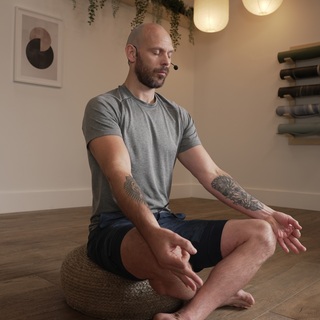
So now that we've touched on what meditation is and what meditation isn't,
Let's look at some of the benefits that are scientifically backed for meditation.
Now there are a host of benefits that come with it,
Far more than I can cover in just a simple lecture.
So instead I've chosen the ones that I found most interesting and most compelling for me.
By all means though,
If you need more convincing or you're just interested,
Check out as much as you can.
Get on the World Wide Web and check out the benefits of meditation.
It's enough to say though that all of the evidence so far points in a very distinct direction and that is that it's good for you.
So if in a doubt,
Just remember that key point,
Meditation,
Is good for you and that's the direction that all of the studies so far have pointed towards.
Now I will touch on some of the more interesting ones now and if you want to read up more about these,
I've got links to videos,
Lectures and research papers after this lecture.
So by all means,
Check those out.
So the first one that I found compelling was Sara Lazar from Harvard University and what she found was that the brain literally changes when we learn a new activity.
So we spoke before about neuroplasticity and that is literally the physical changing of the brain.
When I made the analogy about meditation,
Love being a magic pill and the fact that when we work out,
The body doesn't change straight away and I use the example that the brain doesn't change straight away either.
Well,
It seems that both change in a physical way.
Just like your muscles grow,
Parts of your brain can grow and what she found when studying people that were juggling is after a few weeks of learning to juggle,
After putting them through an fMRI scanner,
She was able to show that parts of the brain were bigger than other parts.
They had literally grown over that time compared to a sample or control group.
Now what happened when she did the same experiment with meditation is very interesting.
The first part was the cortex,
The common sense of the brain grew in size.
Now that's interesting because as we get older,
The brain generally reduces in size.
So the gray matter of this prefrontal cortex got bigger,
Which protects it from aging diseases like Alzheimer's as well as dementia.
As she studied a little bit further,
She also found that the hippocampus,
The area responsible for memory and emotional regulation also grew in size.
Now this is great news for someone who is looking to improve memory or their relationship with others.
But if you're also worried about your empathy with others,
Well good news,
Another part of the brain called the temporoporectal junction is responsible for our emotional connection with others through empathy and compassion.
And this area again was shown to grow in size.
Now there was one area that was shown to reduce in size and you may think,
Well,
That's not good,
Which I'll tell you what area that is.
It's known as the amygdala and this is the part of the brain that's responsible for flight or fight.
It is our stress response.
It's the part of the brain that makes us want to get away from something or fight something to the death.
As you can imagine,
This is a pretty high stress environment and as a result,
We release stress hormones like cortisol to keep us in that state to help us get out of that situation.
This area is one that we probably spend too much time in.
Again,
It's not that this situation is a bad one to be in.
If you're trying to get away from something that's trying to kill you,
It's probably great that you're heart beating very fast,
That you're breathing heavily,
That your gaze is focused and that you are filled with adrenaline.
That's a good situation.
However,
If you're answering an email at 1130 at night before you're trying to go to bed,
That's not the right response.
However,
Our brain has a hard time differentiate what type of threat is.
All it knows is either you're in threat or you're not in threat.
So the amygdala fires up often in areas we don't need it to fire.
Like I said,
If there's a work conference,
If there's a hard conversation you need to have or any other conversation that you're not particularly keen to have,
Then your amygdala is going to fire up.
We don't want this on all the time.
In fact,
We want to be quite sparing about when we hit the amygdala up.
For that reason,
This part of the brain reducing in size and activity is a good thing.
As we meditate,
We can get us off into a calmer state.
So if you're someone who finds himself in stressful situations and wants to be able to better control that situation or at least your response to that situation,
Meditation is a good idea to reduce the amygdala and its effect on your body.
Now if you're not too sure about that,
Then this next benefit of meditation is probably one that's quite compelling.
It has anti-aging properties.
That's right,
Anti-aging properties.
I'll explain why.
As we spoke about the amygdala and the flight of fight response,
You can imagine that that flight of fight response is an important one to get us out of trouble and life-threatening situations.
However,
Releasing those hormones has a big tax on the body.
In fact,
It ages us prematurely.
Therefore,
The more that we are stressed out,
The older we become before years and the more we can reduce that anxiety and stress,
The younger we will stay.
Furthermore,
There's a cellular level that changes in the body and that's because to stay young,
We need our chromosomes to split and replicate.
As we're young,
This happens a lot and it happens all the time and that's why when we're younger,
Aging is not a problem.
There's no real signs of aging per se or at least damaged aging.
As we get older though,
The same can't be said.
What we have at the end of our chromosomes are these little bumpers called telomeres.
These telomeres as we get older get smaller and smaller and when they get so small that we cannot longer split our chromosome,
Then we start to show the effects of aging.
The good news is through meditation,
You can actually grow the lengths of these telomeres,
Not only stop them getting smaller,
But actually grow them in size,
Protecting the chromosomes and protecting you from unnecessary cell damage.
Thus,
The anti-aging properties occur.
It's also worth pointing out as we said before,
The gray matter of the brain is protected as we meditate,
As it grows bigger as Sara Lazar found out and this also keeps us young in terms of not getting early onset dementia or Alzheimer's or any diseases of the brain known to be associated with aging.
For those reasons,
It's a good idea.
You may ask for more benefits.
Here we go.
When it comes to depression and anxiety,
The treatment of these two things was found to be adversely affected by meditation.
When we meditate,
We already have disgust,
We reduce stress and anxiety,
But when it comes to depression,
Just like Sara Lazar found parts of the hippocampus that people with PTSD found were getting smaller,
Meditation can grow that very same area and undo some of the effects of PTSD.
Furthermore,
When they found the effects of meditation on depressive patients,
The Journal of American Medical Association found that meditation was as effective as antidepressants.
Now that's amazing.
I'll go through that again.
They found that meditation is as effective as antidepressants.
So think about that.
You can either meditate or you can take pills that have all sorts of side effects.
Now that's not to say if you prescribe them,
You shouldn't use them.
It's just to say that meditation has been shown to be as powerful,
Which is great news.
Now when it comes to focus,
Dan Coleman,
Who has an amazing book out about meditation and its effect on focus,
Points out that the world we live in is just nonstop stimulation,
Whether it's for your eyes or for your ears.
We just are bombarded by all sorts of things all the time.
Our phones are particularly good at calling our attention away all the time.
Apps are designed to keep us in this mode where we're constantly searching and checking out new things.
He says,
This is no good.
This idea that multitasking is a good thing is absolute rubbish.
Instead we should be looking at a world where we can focus our attention.
How much we can get done in a day pretty much comes down to how well you can sit down and focus your attention on one thing.
As we'll pick up in another study later.