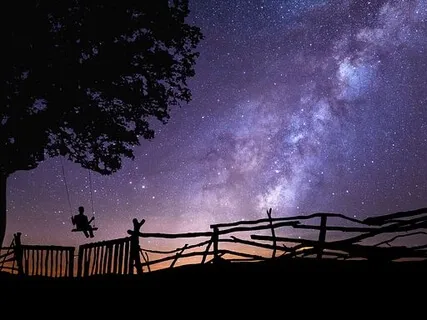
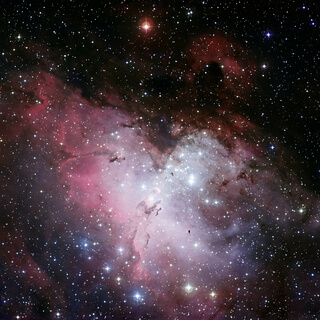
When I behold the canopy of stars and contemplate immensity of space,
Man's unmanned landers dig and probe on Mars for evidence of life to find a trace.
It matters not to me if they should find that we are all alone,
Though that I doubt.
The search is all that matters to my mind.
The eagerness to probe,
Explore,
Find out.
Some claim this wondrous world a turn of chance,
While others say it is a work of God.
Some ponder not,
Make merry,
Sing and dance,
And wonder not.
I find that sadly odd.
So feeble are the greatest minds of men.
In vastness none can hope to comprehend.
Dear friends,
I'd like you to imagine it's night-time.
We're sitting in a deck chair,
Outdoors in an open space.
You might be lucky enough to be in a deck chair,
Outdoors,
In an open space,
On a warm night.
But remember that even if you are in the heart of a busy,
Brightly lit city,
You have the wonderful gift of imagination.
You can use that imagination to close your eyes and allow yourself to be transported to wherever you want.
So I invite you to close your eyes now and allow yourself to be brought on a mini tour of the night sky in the Northern Hemisphere.
People listening to this in the Southern Hemisphere will have to make even greater use of their imagination.
So sit back,
Relax and enjoy the journey.
See the beauty of the night sky,
Brought to you by the magic of starlight.
Looking up,
You can see the sky from the sky.
Looking up,
You can see the sky filled with stars.
I'm told that even on the clearest of dark nights,
We can only see with the naked eye at most about 2000 stars.
Yet science tells us that even in our home galaxy,
The Milky Way,
There are at least 100 billion stars,
100,
000 million stars.
And orbiting telescopes such as Hubble reveal that vast as our galaxy is,
It's only one of an estimated 100 billion galaxies.
The mind boggles at the thought of it.
On the basis of these discoveries,
It has been estimated that there are more stars in the known universe than there are grains of sand on all the beaches and in all the deserts of the earth.
We can only look out in amazement and awe at the wonderful universe into which we've been born.
Let's take a little while to sit back and in our minds eye,
Enjoy the view and admire the wonder of it all.
When we come to look out at the night sky,
We need of course to allow our eyes to become accustomed to the dark.
Coming up,
You might like to search for the constellation Ursa Major,
Which we in Ireland call the Plough,
Because of its distinctive shape.
In the US this grouping of stars is called the Big Dipper.
To find it,
You look for a group of stars almost forming a square,
A square shape,
A square pot if you like,
With three others forming something that might be imagined to be a handle.
Now we'll do a little exploring.
Imagine a line connecting the two stars at the end of the pot,
The end opposite the handle.
If you continue this line off to the upper right,
The first bright star you will come to is Polaris,
The North Star.
Not very bright,
But because of its relationship to the Big Dipper,
Always easy to find,
And we see how in history Polaris was an indispensable aid to navigation.
As you know,
The Earth spins on an axis,
Which is an imaginary line running through the Earth.
If you were floating high above the planet,
Looking straight down along the axis,
You would notice that as the Earth rotates,
All the pines on Earth would appear to move in circles around the axis.
If you followed this axis out into space,
From the Northern Hemisphere on Earth,
It would point towards the star to which we give the name Polaris.
Now if you look up at the sky at different times,
You will notice that the pattern of stars,
Including the Big Dipper,
Moves around in a circle as the Earth rotates on its orbit.
You may have seen this in time-lapse photographs of the night sky,
Showing the stars leaving lines in a circular pattern.
Let's take another break as we imagine this day in,
Day out,
Turning of the Earth,
And fitted the pattern of stars circling about Polaris.
OK,
At this point,
It seems to be almost normal.
You You Continuing our tour you might notice an interesting constellation Cassiopeia a group of five stars in the shape of a W Another favorite is the unmistakable constellation Orion group of seven stars Remarkable for its distinctive belt of three stars at the center of the other four On the top left of the group of seven you cannot but notice a reddish star with the easily remembered name Which children love?
Betelgeuse Betelgeuse is a red supergiant,
And it really is huge If you could imagine Betelgeuse at the center of our solar system Taking the place of our Sun its surface will take in the orbits of Mercury Venus the Earth Mars and extend out past the asteroid belt possibly even to the orbit of Jupiter Betelgeuse only appears small because it's so very very far away more than 400 light years On a clear night you will see an unmistakable glowing band of light arching across the night sky You're looking at the wonderful Milky Way galaxy which we call our home We are left in awe and wonder at the thought that our Milky Way is home to at least 100 billion stars and Is only one of countless billions of galaxies in the vastness of our so far known universe And when we look out into space We have to remember that the distances involved mean that we are really looking back in time Many stars are so far away that by the time a star's light reaches us The star itself could long since have burned out Yet here we are mere dots in that vastness But yet having the amazing capacity to explore to look up to look out to ask why Welcome to the magic and the wonder of the night sky Namaste You You You You You You