Hello,
And welcome to the session.
I invite you to take a seat,
Or lie down,
And get yourself comfortable.
You can close down the eyes if you wish,
And take a long,
Slow breath in through the nose and out through the mouth.
Today we're going to be contemplating a quote from the book The Timekeeper by Mitch Albom.
This book tells the story of three interconnected beings on a journey of discovery.
The first invents the concept of time,
The second wants more time,
Infinite time,
And the third wants their time to end.
Through an interweaving narrative,
This story acts as a finger pointing to the moon,
Relating to the concept that time is finite,
But also that time itself is a construct.
One that,
If we turn the lens of our attention towards,
Tremendous wisdom will flow.
This is the quote.
Try to imagine a life without timekeeping.
You probably can't.
You know the month,
The year,
The day of the week.
There is a clock on your wall,
Or the dashboard of your car.
You have a schedule,
A calendar,
A time for dinner or a movie,
Yet all around you,
Timekeeping is ignored.
Birds are not late,
A dog does not check its watch,
Deer do not fret over passing birthdays.
Man alone measures time,
Man alone chimes the hour,
And because of this,
Man alone suffers a paralyzing fear that no other creature endures,
A fear of time running out.
Try to imagine a life without timekeeping.
You probably can't.
You know the month,
The year,
The day of the week.
There is a clock on your wall,
Or the dashboard of your car.
You have a schedule,
A calendar,
A time for dinner or a movie,
Yet all around you,
Timekeeping is ignored.
Birds are not late,
A dog does not check its watch,
Deer do not fret over passing birthdays.
Man alone measures time,
Man alone chimes the hour,
And because of this,
Man alone suffers a paralyzing fear that no other creature endures,
A fear of time running out.
So this quote epitomizes the message of this book,
And it suggests quite a few lines of thought,
The main one being that final line,
A fear of time running out.
Now you could take that quote down quite a few different paths,
And perhaps we will,
But the one I want to start off with is potentially counterintuitive to the message of this book and the quote.
The fear of time running out might actually be weirdly beneficial.
Let's consider this for a moment.
If we had infinite time,
If time continued,
If we never passed away,
What impetus would there be to make any choices?
Why would we care to do anything?
We could always delay action,
Growth,
Attainment,
Everything,
For some future time.
If time wasn't finite,
We would have infinite time,
But then we would also have infinite reasons not to pursue our goals,
Not to do anything,
Because we could delay it and delay it and delay it.
The fact that all of this ends allows us to be laser focused.
If we allow ourselves this focus,
This is if we can address this fear,
If we can process it,
Allows us to be laser focused on our goals.
This fear,
Or the fact that time runs out,
Shows us that we are finite.
We have finite time,
But we also have finite possibilities.
There's something that I think we need to consider is decision fatigue.
Sometimes it's hard to make decisions.
We feel that we're trapping ourselves,
We feel overwhelmed,
We just can't choose.
And perhaps we can't choose because when you choose something,
When you choose to take action,
That choice blocks off a potential infinite number of other possibilities.
If I choose to do something with this day,
For example,
Recording this lesson,
I could be doing anything else,
But my choice in this moment dictates that nothing else will happen in this day other than what I'm doing here,
Other than what I'm doing now.
Every other infinite possibility of what I could do today will never exist.
This is the only possibility.
That in a way is terrifying.
A choice turns the infinite to the finite,
But it's important to remember that if we avoid all of this,
If we act like time won't end,
If we don't make a choice to do something in our day,
That itself is a choice,
And it's often a less optimal choice.
Sometimes it's better to not make a decision.
Sometimes it's better to wait,
But more often than not,
It's better to choose to act,
To do something.
So this quote to me,
This fear of time running out,
It evokes two feelings in me.
One of a real urgency to pursue my dreams,
To follow my goals,
To take actions that I think need to be taken,
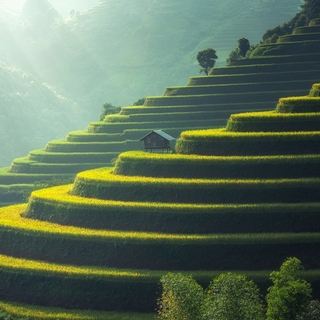
To find that distant mountaintop in the distance that I value and walk towards it,
To let go of the distractions and the confusions and the noise and head down a path,
To choose,
To decide,
To live every moment fully.
That's one aspect that this quote takes me down,
But of course the other aspect is more in line with the,
I guess the messaging and the meaning behind this quote and the book in general,
This idea that time itself is a construct.
The book goes into this idea of time being invented.
One of the characters,
I guess,
Comes from pre-time,
And they're a little bit more curious than those around them,
And they start measuring time and tracking time via a variety of different and innovative methods.
And this character is basically forced,
Doomed,
Cursed,
I guess you could say,
To see time play out for all of eternity.
And it's interesting to see,
Because humans,
And particularly some cultures of humans,
Are very apt at being extremely time-based.
We schedule things.
We manage things.
Things have to be done in a certain order,
In a certain time.
And this is only a fairly recent construct.
They think it's an outshoot of productivity,
This goal,
This idea that we need to maximise our time,
Maximise our life,
With this sort of idea that at the end of our life there will be this scorecard or something,
It's like,
You maximised most time,
Congratulations.
You accomplished 20 times more tasks than your relative peers.
This is fairly new.
Maybe it's an offshoot of capitalism or production line productivity,
All of these sort of things.
I'm not sure,
But what I do know is that we're obsessed with time.
So what if we did imagine a life without timekeeping?
What would happen?
What would that mean?
Now immediately you see societal breakdown and collapse.
You know,
Work wouldn't get done,
Things wouldn't arrive on time,
Quote-unquote.
And maybe it's not viable as a sort of flip of the switch,
Imagining.
You would sort of have to re-imagine,
Or re-evaluate,
Or reconsider what life really is.
Because this quote highlights that man alone measures time,
Dogs don't check or watch,
Deer don't fret over the passing of birthdays.
Whilst that might be true,
Animals do use the seasons to regulate and change behaviours.
They do use times of the day,
You know,
Morning,
Midday,
Late day,
Night time,
Etc.
As a way to alter what they're doing.
They rest,
They sleep,
They hunt,
They do things at different times of the day.
So it's not like time doesn't exist for them,
But rather,
I guess rather than responding to it,
They are a part of it.
Maybe by the act,
And this is sort of what the book suggests,
The act of measuring time sort of takes us away from reality,
Takes us away from nature,
Sort of puts a little bit of an internal mental barrier or block between us and the real world.
If you sit and meditate,
You're attempting to connect with reality as it is for what it is right now.
But I would hazard a guess that it would be exceedingly difficult,
Or potentially at least anxiety-inducing to sit without a timer on,
Just sit and meditate,
For how long?
As long as needed.
As long as needed to sit and check in and calm down and replenish and recover.
What if that's 10 minutes,
Or 10 hours,
Or a day?
What if you're able to just spend that time recovering?
Even just contemplating that,
I can see that life would come into play.
It's like,
I've got to do this,
I've got to do that.
These things are booked in,
Yada yada.
It would be very hard to let go and live a life without timekeeping.
The point of these quotes and these contemplations in this course isn't to suggest a hyper-realistic,
Logical response.
You know,
A life without timekeeping would be vastly,
Dramatically different.
But that's part of the appeal,
That's part of the contemplation.
And if we can sit with it,
If we can imagine a life without timekeeping,
What would that actually mean?
So try to imagine a life without timekeeping.
You probably can't.
You know the month,
The year,
The day of the week.
There is a clock on your wall or the dashboard of your car.
You have a schedule,
A calendar,
A time for dinner or a movie.
Yet all around you,
Timekeeping is ignored.
Birds are not late.
A dog does not check its watch.
Deer do not fret over the passing of birthdays.
Man alone measures time.
Man alone chimes the hour.
And because of this,
Man alone suffers a paralyzing fear that no other creature endures.
A fear of time running out.
So,
How did you go?
I'd love to hear your response to this quote and any questions you may have in the classroom.
Remember to start your response with time,
So we all know which session you're referring to.
And while you're there,
I encourage you to check out my responses and the responses of other students,
Because together,
Collectively,
We can form a kind of synergy that will enable us to help each other and ourselves in turn to grow,
Expand and discover deeper forms of wisdom.
I look forward to seeing you there.
This track was taken from the course Finding Enlightenment Through Fiction.
It's out now via my profile on Insightama.
And I invite you to check it out.