The Tripitaka is separated into three categories of texts,
The Vinaya,
The Suttanta,
Which are the various suttas,
And the Abhidhamma Pitakas.
These three categories are the teachings of the Buddha.
The word Pitaka means vessel or basket,
Which is how we call the three categories or divisions in the present day.
So the Sankhiti,
The first Buddhist council or rehearsal of the Dhamma and Vinaya,
The teachings of the Buddha,
Was held three months after the Buddha's final Nibbana.
The Buddha had foretold that Venerable Ananda would be fully enlightened,
Becoming an Arahant.
So the Sangha with Venerable Mahakassapa at the head was 499 monks who were all Arahants with patisambhida,
Or the analytical knowledges.
That is,
They had a supreme level of wisdom and a supreme level of samadhi concentration.
They were waiting for Venerable Ananda as the last monk to join to become enlightened.
Because the Buddha had already said that it would happen,
So it would definitely come true.
There was nothing that he foretold that did not come to pass.
So they were all sitting,
Waiting,
And it was the last day,
On the 90th day,
And Venerable Ananda attained enlightenment,
Becoming an Arahant.
He attained this not in the sitting,
Walking,
Standing,
Or lying down postures,
But as he was about to lie down.
And he joined together with the Sangha to conduct the council gathering.
And in regards to psychic ability,
Venerable Ananda could travel through the earth to enter,
And this showed he had attained enlightenment.
This was according to the suttas.
The conducting of the council gathering involved meeting,
Judging,
Organizing all the Tripitaka to be in categories and divisions,
And rehearsing by chanting together the one version.
And there was the Venerable Elder Upali,
Who was the foremost in regards to the Vinaya,
The monastic rules.
He could remember all of the Vinaya excellently.
And there was Venerable Ananda who remembered all of the suttas.
Wherever the Buddha taught,
Venerable Ananda had asked for permission that whenever the Buddha would go teach elsewhere,
That the Buddha would teach and tell it to Venerable Ananda again.
Otherwise there would be people who would say,
You are close to the Buddha,
So how come you didn't know where and what the Buddha taught?
Venerable Ananda was very intelligent.
He had a lot of wisdom.
He had to memorize all of the Buddha's teachings.
He had supreme memory for the purpose of conducting the council.
So he had to attain enlightenment after the Buddha's final Nibbana.
Because if he attained enlightenment before the Buddha's passing,
Then he would let go and may not remember to that level.
The conducting of this council made the Buddhasasana,
The dispensation,
Last for a long time.
And later there were the second and third Buddhist councils.
But in the first council it was King Ajastru,
Who was the patron.
The council gathering was held at the Satapani cave in Rajagir city of the Magadha Kingdom.
As there was a sangha of 500 monks and there had to be a food offering every day.
And the meeting took a long time.
It was seven months before the conducting of the council of organizing the Buddha's teachings into categories was complete.
So here we look into our own minds.
We need to have a mind that organizes and categorizes as well.
There is an external organizing.
We do our work of organizing and having discipline and rules.
At home we organize the house.
We make where we stay orderly and tidy.
When it's organized,
Tidy and clean,
Then when ants come in,
We can see it.
If we don't organize anything and it's all messy,
Then if termites come in,
We won't see it.
By the time we notice them,
They have eaten all the wooden posts of the building.
Because we didn't see them.
But if we make our living place to be all organized and tidy,
Then we can see it clearer.
We can protect our living place.
It is clean and pleasant to live in.
Our workplace is usable and we like to work there too.
And what about our minds?
We need to adjust and improve it too.
The time when we were born in this life,
The mind did not receive much sensory inputs.
The child sees with eyes that are pure.
But the defilements are hidden.
When one is newly born,
They haven't received much of the sensory inputs of the world.
Their eyes are innocent.
It's pure and honest.
But later,
The mental defilements direct the mind more and more.
We have more of a sense of self and it starts to change the eyes.
Whether it changes a little or a lot,
It's up to the mental defilements that direct the mind.
For the mind that doesn't have strength,
It follows the defilements.
At times,
The eye is volatile.
At times,
The eye is cunning.
At times,
The eye is cruel.
It comes out in many ways.
It shows from the eyes.
It comes from the mind that has defilements which has come out from the eyes.
This is the defilements having arisen already.
It's not cleared up.
Because they are just things that are bound up with a sense of self.
We don't know what's what.
This is my father.
This is my mother.
This is me.
These are my friends.
And so we follow the moods and thoughts.
We follow the defilements all the time.
Until we see the noble truth of dukkha,
Of suffering.
Why is it like this?
Why do we suffer?
So we look for a way out.
We come to learn of the path out of suffering that is correct.
So we need to practice the foundations of the teachings of the Sama Sambuddha,
The perfectly self-awakened one.
We need to come to read and learn about the Tripitaka,
Or from those great teachers who have practiced following the Tripitaka and which has been condensed in their hearts.
Because all the Tripitaka of the 84,
000 Dhamma items,
If we go and learn them all,
It takes a very long time.
But they say that the teachings are gathered together in the teaching that rupa and nama,
Material and mental phenomena,
Are impermanent,
Being anicca,
Dukkha,
Anatta,
Not-self.
We practice dhana,
Generosity,
And we have the benefits coming from generosity,
Precepts and meditation,
Which is having sagha,
Heaven,
Arise.
When it is heaven,
It is happiness and fullness in the heart.
The Buddha also taught to see the drawbacks of heaven,
That it is impermanent.
The mind states of happiness in the heart are not permanent.
So we have to do the practice and make the mind peaceful and still.
The Buddha called this nekkhamma,
Renunciation.
Keeping the eight moral precepts is renunciation.
There is an external renunciation,
But the mind is still all over the place.
The inner renunciation is training your mind to be peaceful.
When the mind is still,
We can say this is being a Brahma God.
There is rapture,
Bliss and one-pointedness.
The mind has the factors of initial application,
Sustained application of mind,
Rapture,
Bliss and one-pointedness.
This is the mind that has been stilled.
It is being a Brahma.
In the beginning,
It is being a Brahma on the mundane level.
This means that they will still be reborn again.
They can still become a deva,
Deity or a human.
If it is a Brahma of the transcendental level,
Then this is of the level of anagami.
There is no falling back.
No more coming back to be born,
Of being a deva and a human.
Why?
Because they know clearly that the human realm is suffering.
It is difficult and troubled.
They don't come to be born again as a human.
Then there is a sakadagami that is born one more time as a human.
Then from that life they go up to being a deva and not coming to be born again.
They will attain nibbana in the future.
Then there is the sotapanna,
Stream-enterer of the type of strong baromi,
Spiritual accumulations,
Where they are born one more life.
They may be born as a deva and may attain enlightenment as a deva or attain in the life that they are a human.
This is because the defilements have been weakened.
To those who are born again as a human,
They may be born as a deva one more life and continue building more baromi,
Like Amarin Deva,
King Saka in this era,
Who is the head of the devas.
From being King Saka he will advance to the higher realms till being a brahma on the level of anagami and then the brahma will enter nibbana there.
So this is all relating to the states of mind.
So training the mind to keep the brahmacharya,
The celibate life,
It is to make our minds to be still.
It clears up the mind that is chaotic.
The mind will proliferate in subjects that bring up liking or sensuality,
Which we call kama-vitaka.
There is proliferation towards ill-will,
Which we call vyapada-vitaka.
There is scatteredness of mind,
Irritation,
Anxiety.
There is proliferation to doubts.
So all the proliferation in various subjects,
We don't want it.
We stay solely with the breath,
With one meditation object.
There is initial and sustained application of the mind on the breath.
It stays with a meditation object.
We can contemplate that the body has to die or that it is composed of elements.
We have an initial and sustained application of the mind about a meditation object.
This is the way to get peace.
Until we can have pithi,
Rapture,
Arising.
We can see that life is continually flowing towards aging,
Sickness and death.
The people from 100 years ago have all died.
In 100 years,
All the people sitting here will all be gone.
So we come to counsel our minds.
Our minds are more still,
More empty,
And we understand more into dhamma.
When we understand more into dhamma,
Then our suffering reduces by levels.
So we have faith in the Buddha sasana,
Which is the religion of the one who knows,
Who is awakened,
Who is joyous.
So we have a lot of merit.
And we have faith.
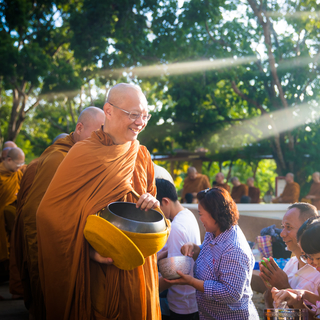
Some give alms every day.
Even if it's raining,
They come to give alms.
This is the merit that we do consistently.
The good karma that we make is a habitual karma.
When we recollect this merit,
We can remember it very clearly.
We see the monks walk arms round in a line,
And it gives us a deep impression in the heart.
We give alms,
And we are happy and joyous.
We think of it again,
And again,
We are happy and joyous.
This is also initial and sustained application of mind on merit.
This is the counselling and organising of our minds.
If we have greed,
This is like giving something heavy to our mind.
When we get angry,
Or we have delusion,
They are all heavy things.
The five khandhas,
The aggregates of body and mind,
Are heavy.
And we go attached to the five aggregates as me and mine.
Then it's very heavy.
And if we die with this heaviness,
Then where will we go?
We go to a place that is heavy.
The chest is heavy and uneasy.
But if we practice so that the mind and heart are light,
Then when the body dies,
It is light,
Being already like that in the present moment.
It is not that one dies from being a human and goes to being a deva when the body dies.
But the body is a human,
And the mind has already changed from a human to being a deva.
It has already changed its realm of existence.
Because we have counselled and categorised it already.
It is categorising which knows a human is like this.
And oh,
We want to be a deva.
So they taught us that we have to do goodness.
We have to practice generosity,
Precepts and meditation.
Then we will advance up our level of the mind to be at a higher realm.
This is something important.
Like this we know that this is categorising.
We are cleaning the house and we reform various things to be better.
So in this life,
Okay,
We have passed a lot of experiences already.
And so we re-establish ourselves today.
And we will think of the goodness we have done before and the good karma that we have built.
And in the present we are determined to do it too.
And we look to the future.
We know that whatever happens,
We live in this world temporarily.
Like one venerable elder said,
This world,
There is no one who is the chief.
It is chief of itself.
That is,
Aging,
Sickness and death is the chief.
Whether we have a lot of things in this world,
But we will need to leave this world.
So they are the chief.
We can't fight against it.
When we can't fight it,
It is better we accept and give in to it.
See it as normal.
We don't go against it.
It is something normal.
The Buddha taught for us to see that it is normal.
The 84,
000 Dhamma items are for us to see the normalness of all material and mental phenomena.
Here the heart that has defilements in charge of it is not normal.
When it likes something,
It attaches to that.
It is the cause for suffering to arise.
So it's not normal.
And so we need to train ourselves.
Okay,
It is something normal.
Happiness arising is something normal.
Suffering arising is something normal.
So know it.
We know it in time as a mood,
A feeling of the mind.
Here when the mind has liking,
We are aware of it.
When the mind has disliking,
We are aware of it.
When we understand it,
Then the mind is in the middle.
It has rapture.
It understands the Dhamma.
It has happiness and fullness of heart.
This is the path to see the Dhamma.
So can we see that it doesn't need much?
But may you make the mind peaceful.
Because if the mind is not peaceful,
We have doubts.
Where is it?
We want to see the Dhamma.
But where is the Dhamma?
How do we do it so we practice correctly?
But when the mind is peaceful,
The mind and body is light.
And we can see it.
When the thoughts start proliferating from the mind,
Then we are aware of it.
A sense of self has arisen.
So we teach the mind that this is not sure.
It is impermanent.
We don't go attaching to it.
The mind thinks of a past experience,
And we say,
It's not sure,
Not permanent.
It thinks of the future.
We say,
It's not sure,
Not permanent.
Whatever mind state or mood arises,
We contemplate it.
Then the mind is peaceful and still.
It is in the present moment.
This is counselling and organising the mind.
It is not liking or disliking.
Before,
We would have liking and make a self of it.
We go proliferate about it.
We want to get that thing we like again.
If we dislike something,
And we proliferate about it again,
We don't want it.
So we all have faith in the Buddha,
Dhamma,
Sangha,
Meaning we have merit in this life already.
So try to practice to change,
Adjust and improve your minds.
And ultimately,
You will have knowing and views that are correct.
We change the wrong view that sees it as me,
As mine,
To seeing that in reality,
Me and mine does not exist.
The heart has that knowledge arise.
But we are supported by this body,
By the aggregates,
In order to continue building goodness.
We know that it is not a self,
But we use it to build goodness.
Before,
It was me.
And the defilements took us to do some good and some bad.
The mind was in chaos.
The whole world is in chaos because of ignorance.
So may you all set your hearts on this.
May you all grow in Dhamma.
May you grow in blessings.